Detecting households is not the same as detecting communities!
In applied graph analytics, the first cluster is often not the real unit you care about.
TL;DR: In applied graph analytics, the first cluster is often not the real unit you care about. Graph membership alone is not enough — combine it with behavioral signals to find the real structure.
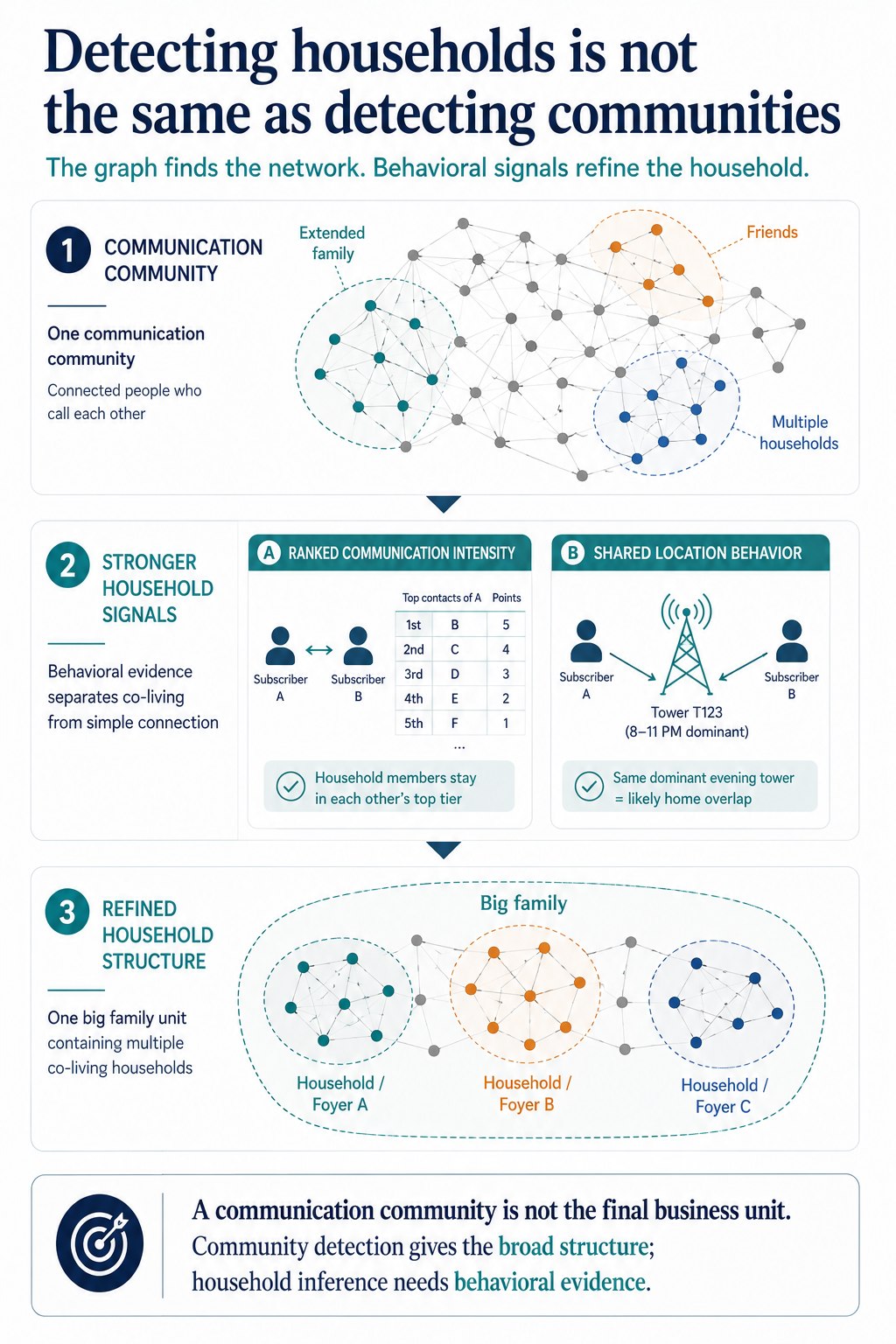
The Problem
In a family-detection project, I started from precomputed communication communities (SAS CLA results). The algorithm found groups of people who call each other.
A communication community is not necessarily a household. A single community can contain extended family spread across the city, multiple separate households, and close friends who call frequently.
I needed to separate two distinct levels of social structure:
The big family
The broader connected social unit (20-30 people)
The household / foyer
The smaller co-living unit (4-6 people)
Two Signals
Signal 1: Communication intensity (with ranking)
Not just 'how many calls?' but who ranks highest. Top 5 outgoing + top 5 incoming contacts, weighted by position (1st = 5 points, 2nd = 4, etc.). Household members consistently appear in each other's top tier.
Signal 2: Shared location behavior (cell tower dominance)
Which cell tower shows up most in your evening CDR? The dominant evening tower = home location. People spend ~8 hours a night in the same place. Two people in the same household share a dominant evening tower with very high probability.
The Rule
Same community + top-ranked contact + shared evening tower = household tie.
The algorithm found the network. The refinement found the household.
Key Takeaway
Design insight: In applied graph analytics, the first cluster is often not the real unit you care about. Graph membership alone is not enough — combine it with behavioral signals to find the real structure.
Comments
FAQ
What is the key takeaway from "Detecting households is not the same as detecting communities!"?
In applied graph analytics, the first cluster is often not the real unit you care about. Graph membership alone is not enough — combine it with behavioral signals to find the real structure.
Who wrote this and what is it about?
This was written by Mahmoud Trigui, Senior Data Scientist. In telecom family detection, communication communities are not households. Combining ranked contact intensity with shared cell-tower dominance separates household ties from social ties.