Not every analytics question is about what drives the outcome
Some variables are not drivers — they are constraints. Choosing the right method starts with choosing the right question.
TL;DR: 'Invest in X to boost performance' is not the same as 'guarantee X above threshold before anything else matters.' Some variables are not drivers — they are constraints.
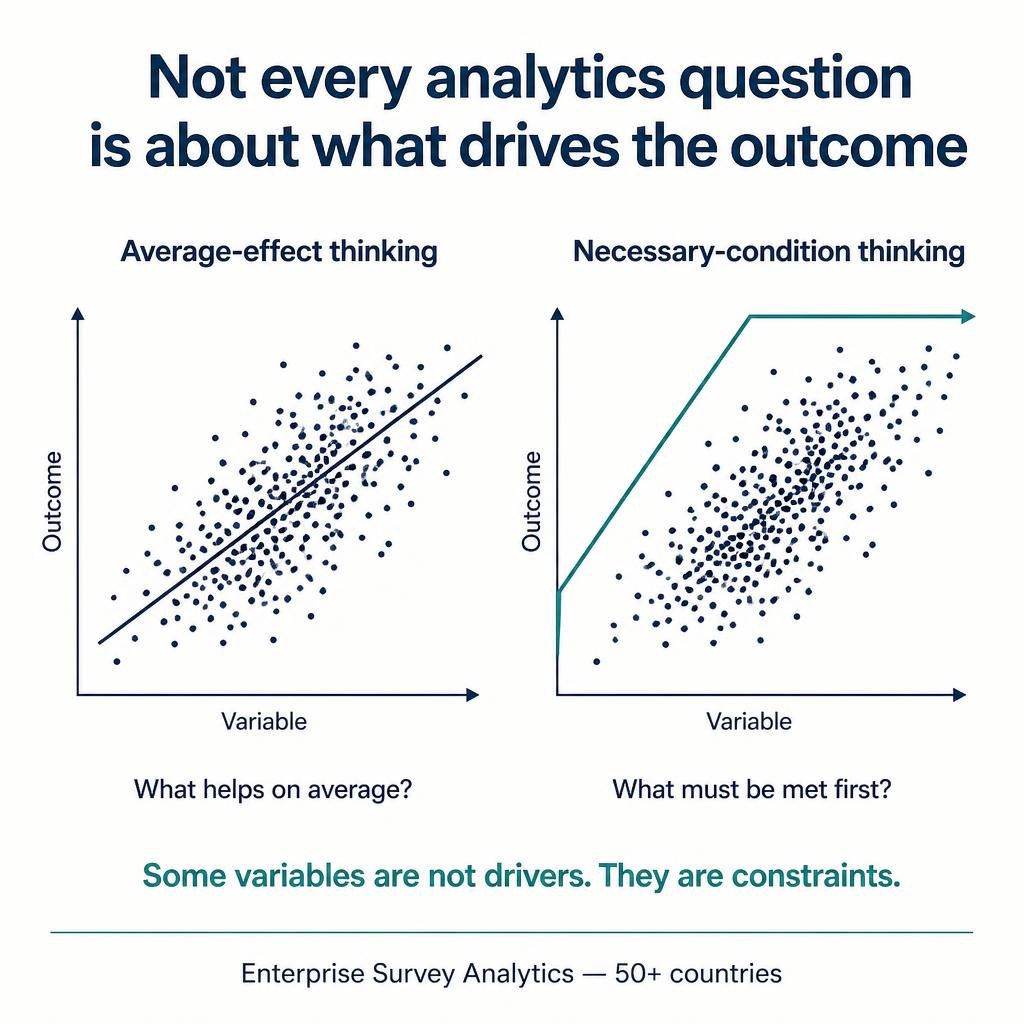
The Problem
Most data science work asks: "what increases Y?" That leads to correlation, regression, feature importance, SHAP.
But some questions are different: what must already be true for high Y to even be possible? That is a different analytical problem entirely.
The Method
In one enterprise survey project, I used Necessary Condition Analysis (NCA) to identify variables that acted less like average drivers and more like minimum requirements.
A regression coefficient tells you a variable is associated with better outcomes on average. An NCA result tells you something else: below a certain threshold, the desired outcome simply does not appear — regardless of everything else.
Regression
Innovation has a coefficient of 0.3 on growth = innovation helps on average
NCA
No company with innovation below 2.4 achieved growth above 7 = innovation is a necessary floor, not just a booster
Key Takeaway
Design insight: 'Invest in X to boost performance' is not the same as 'guarantee X above threshold before anything else matters.' Some variables are not drivers — they are constraints.
Related
The Most Dangerous Label in ML →Adversarial Validation →Categorical Encoding Cheat Sheet →SHAP Waterfall Local Explanation →Zero-Shot Forecasting Changes the Baseline →Foundation Models Raise the Baseline →A Reranker Cannot Rank What It Never Receives →A Strong AutoML Baseline Can Beat Hand-Tuned Models →
Comments
FAQ
What is the key takeaway from "Not every analytics question is about what drives the outcome"?
'Invest in X to boost performance' is not the same as 'guarantee X above threshold before anything else matters.' Some variables are not drivers — they are constraints.
Who wrote this and what is it about?
This was written by Mahmoud Trigui, Senior Data Scientist. Necessary Condition Analysis (NCA) identifies variables that act as minimum requirements rather than average drivers. Below a threshold, the outcome simply does not appear.