Foundation Models Raise the Baseline
Time-series foundation models make a credible forecasting baseline much easier to establish — but promotions, pricing, holidays, and operations still live outside the target history.
TL;DR: Time-series foundation models raise the forecasting baseline — they make it easier to establish a credible benchmark with less custom setup. But promotions, holidays, operations, and domain constraints live outside the target history. An engineered pipeline earns its complexity when those external signals add measurable value, and rolling-origin backtesting with accuracy by horizon and segment, latency, cost, and interpretability makes that value visible. Foundation models raise the baseline; domain knowledge still creates the edge.
Visual Summary
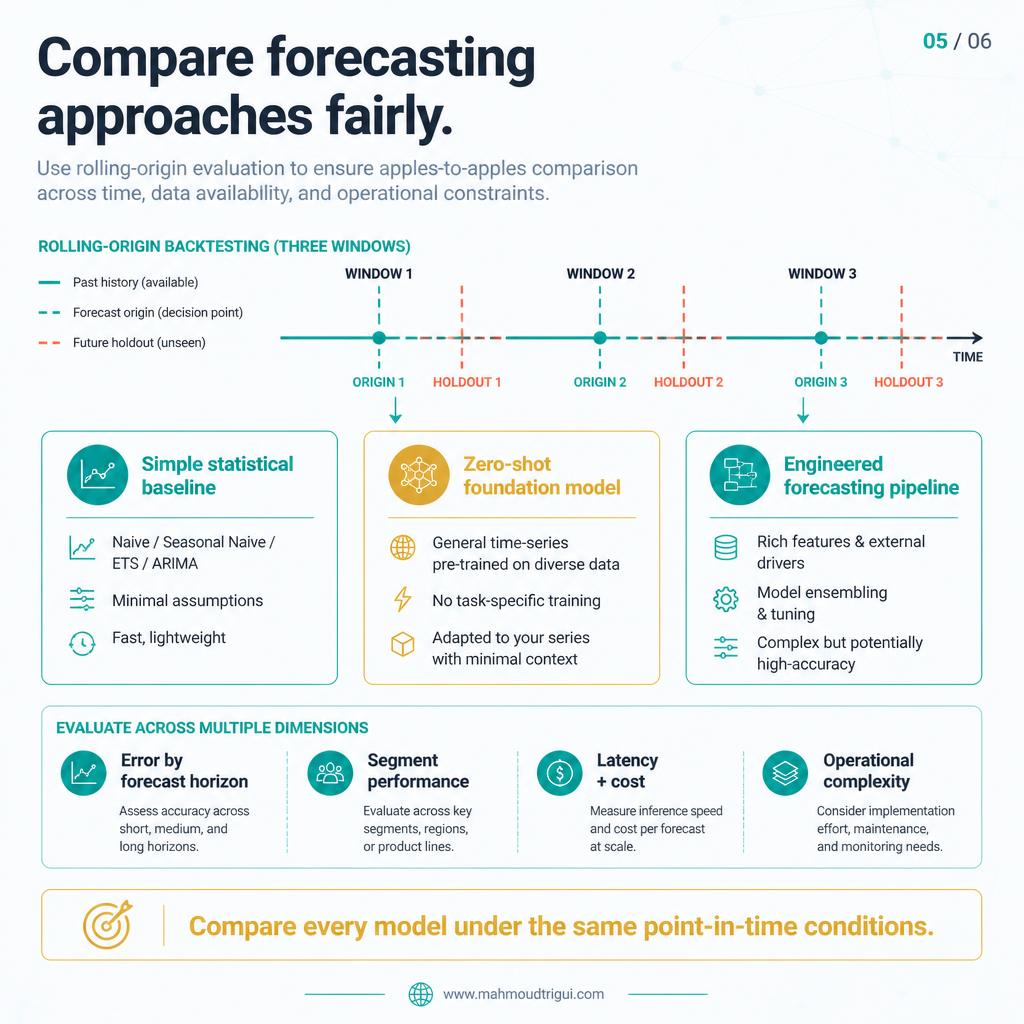
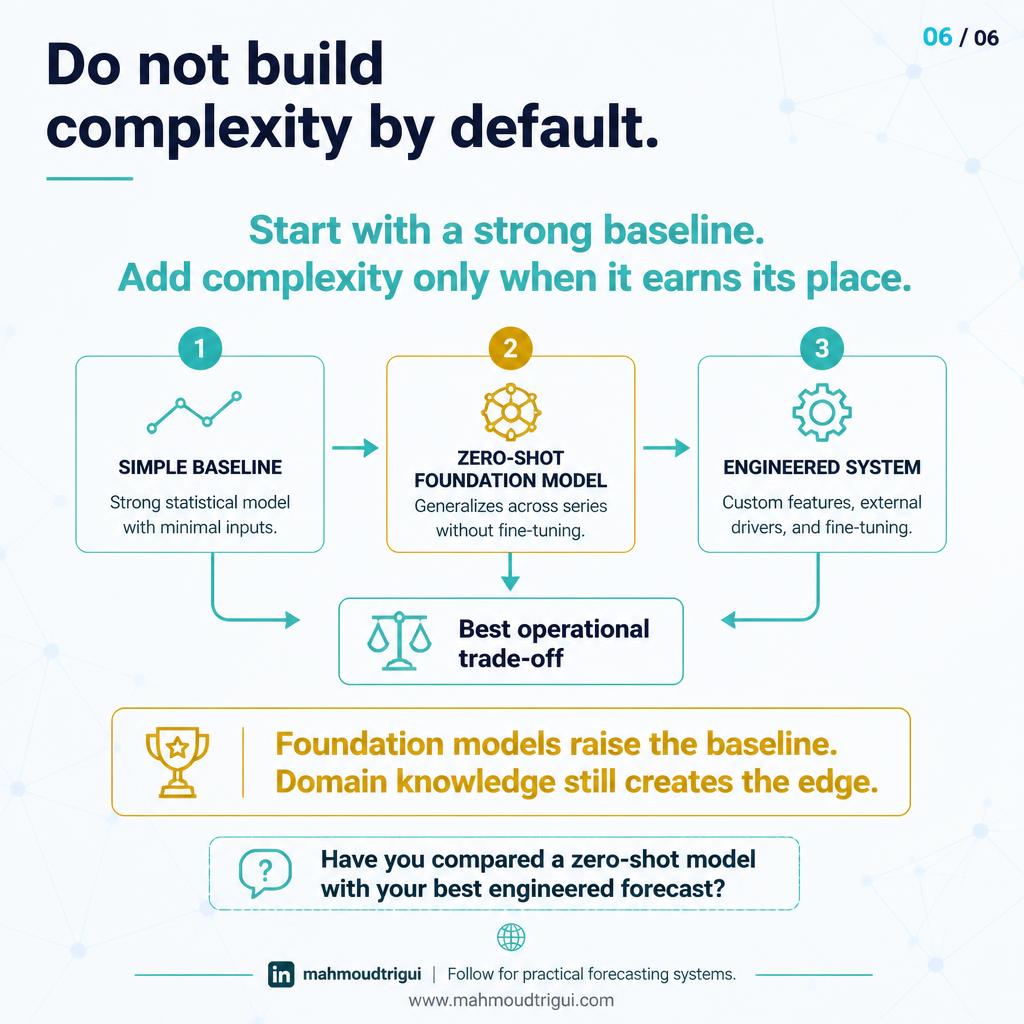
The Problem
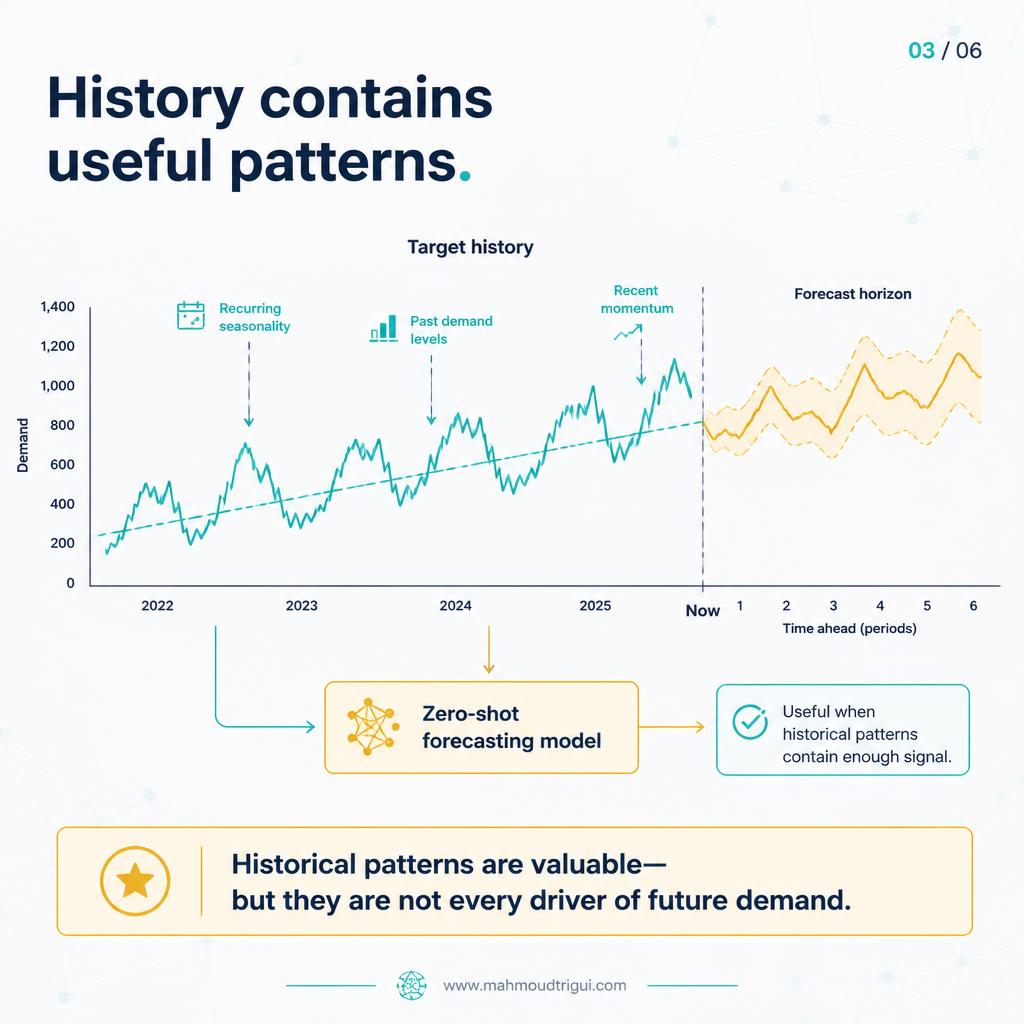
Time-series foundation models can take historical data and produce a forecast with minimal custom setup. No manually engineered lags, no tuning search, no training loop. That changes what a strong baseline can look like — and it raises the bar for any pipeline that adds complexity on top.
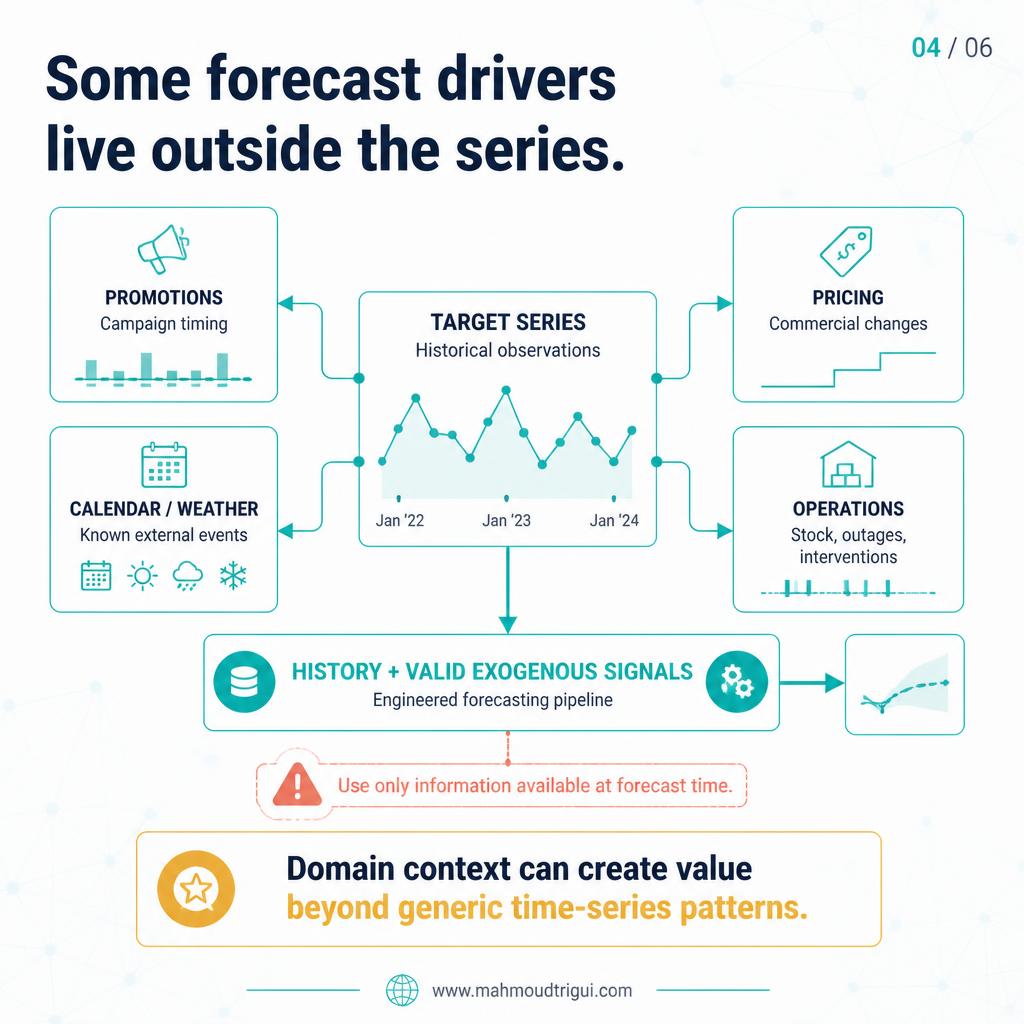
But a generic foundation model is not a universal production answer. Forecasting performance often depends on information outside the target history: promotions and pricing changes, holidays and weather, operational events, stock availability, policy interventions, and domain-specific constraints. A generic model captures broad time-series patterns; a task-specific pipeline can add the context that is only available in your business environment.
The Approach
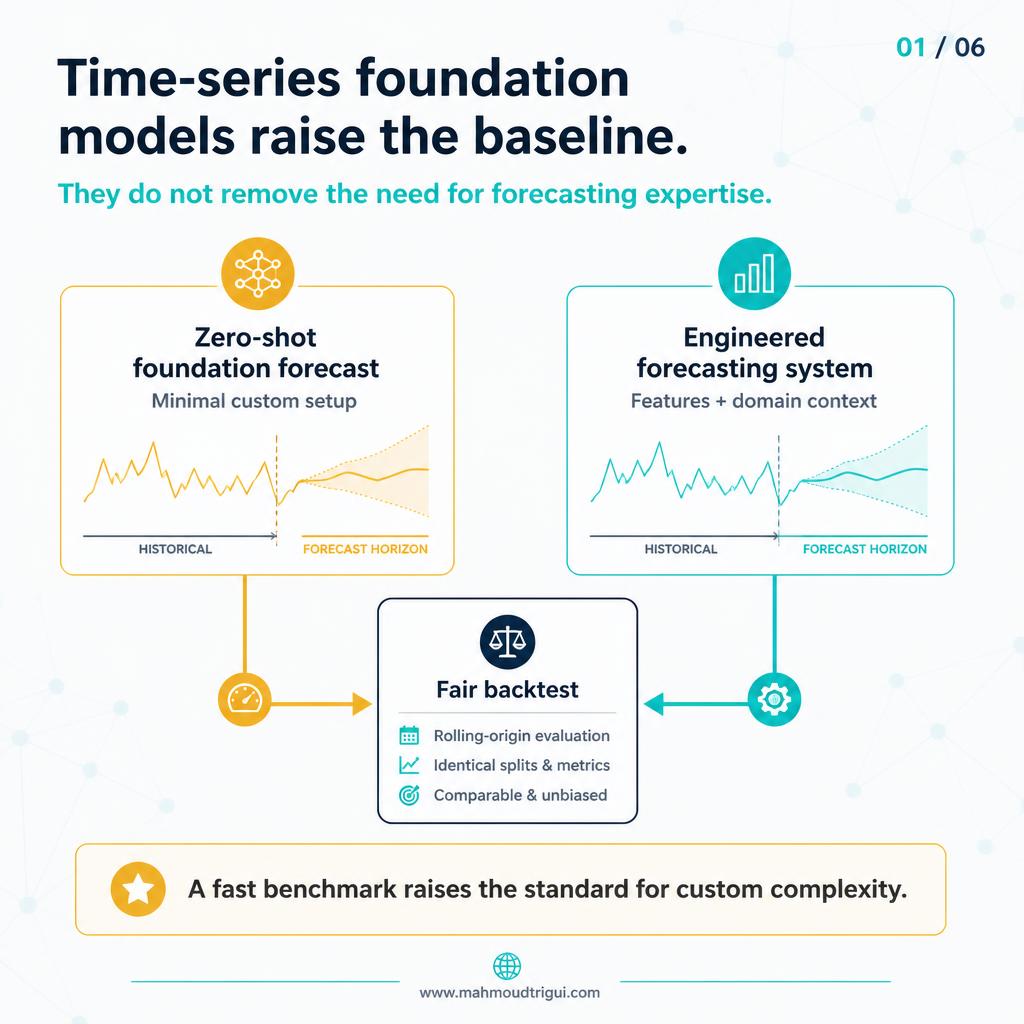
The mature workflow is not "foundation model versus classical forecasting." It is a comparison: a simple statistical benchmark, a zero-shot foundation-model benchmark, and an engineered model with valid external signals — evaluated under the same rules.
Start with a simple statistical benchmark
A seasonal naïve or equivalent reference establishes a minimum bar before any feature engineering begins.
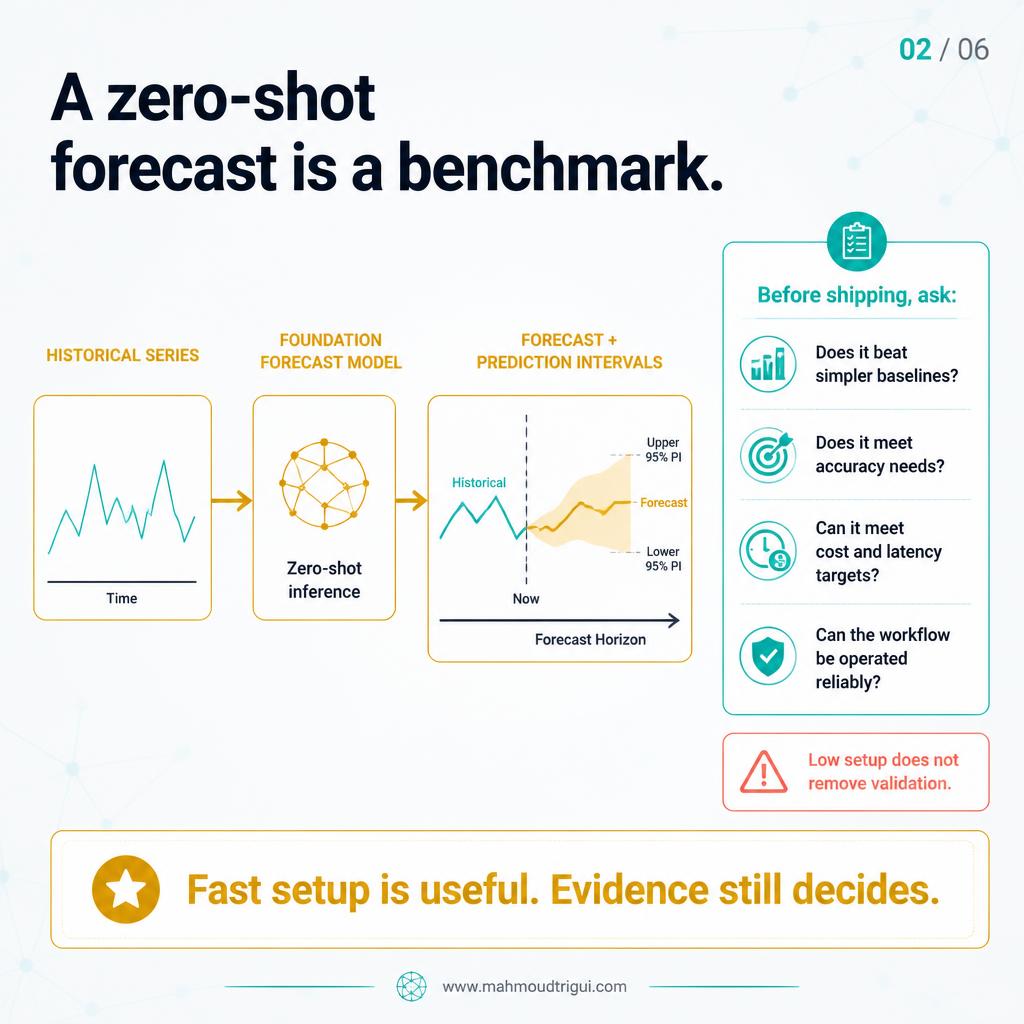
Add a zero-shot foundation-model benchmark
Historical timestamps and target values become a forecast with prediction intervals — a credible comparison point with almost no custom setup.
Build an engineered model with valid external signals
Promotions, pricing, holidays, weather, and operational events come in as features, but only information available at forecast time. Point-in-time validity matters more than feature count.
Compare every model at the same time boundary
Rolling-origin backtesting scores each candidate at the same forecast origins — no model sees future data, whatever its complexity.
The comparison should include forecast accuracy by horizon and segment, point-in-time feature availability, latency and cost, interpretability, and reliability and operational complexity — not just the lowest average error.
A foundation model that performs well with little setup is not a threat to forecasting expertise. It is a higher standard for custom work: if an engineered pipeline adds complexity, it should add measurable value too.
Outcome
The strongest forecasting systems combine a credible baseline with context only the business knows. A foundation model captures general time-series behaviour; the engineered pipeline brings promotions, pricing, holidays, weather, and operational events that the target history alone cannot reveal.
When both are compared under the same point-in-time conditions, the winner is decided by the operational trade-off — accuracy by horizon and segment, latency, cost, interpretability, reliability — not by which approach is newer.
Key Takeaway
Design insight: Time-series foundation models raise the forecasting baseline — they make it easier to establish a credible benchmark with less custom setup. But promotions, holidays, operations, and domain constraints live outside the target history. An engineered pipeline earns its complexity when those external signals add measurable value, and rolling-origin backtesting with accuracy by horizon and segment, latency, cost, and interpretability makes that value visible. Foundation models raise the baseline; domain knowledge still creates the edge.
Related
Zero-Shot Forecasting Changes the Baseline →MLforecast Forecasting Pipeline →Turning Decomposition Into a Forecasting Strategy →Conformal Prediction: When the Model Is Uncertain →TabPFN: a Pre-Trained Prior for Tabular ML →A predictive model is not a decision system →Not Every Analytics Question Is About What Drives Outcome →The Hardest Forecasting Decision Is Which Model to Use →A Strong AutoML Baseline Can Beat Hand-Tuned Models →
FAQ
What is the key takeaway from "Foundation Models Raise the Baseline"?
Time-series foundation models raise the forecasting baseline — they make it easier to establish a credible benchmark with less custom setup. But promotions, holidays, operations, and domain constraints live outside the target history. An engineered pipeline earns its complexity when those external signals add measurable value, and rolling-origin backtesting with accuracy by horizon and segment, latency, cost, and interpretability makes that value visible. Foundation models raise the baseline; domain knowledge still creates the edge.
Who wrote this and what is it about?
This was written by Mahmoud Trigui, Senior Data Scientist. Foundation models raise the forecasting baseline, but domain context still creates the edge. Compare all approaches fairly using rolling-origin backtesting.