Turning Decomposition into a Forecasting Strategy
The best decomposition is the one that creates the most predictable sub-signals. Decomposition is not preprocessing — it is a modeling decision layer.
TL;DR: Decomposition is no longer just a preprocessing step. It becomes a modeling decision layer: the best decomposition is the one that creates the most predictable sub-signals.
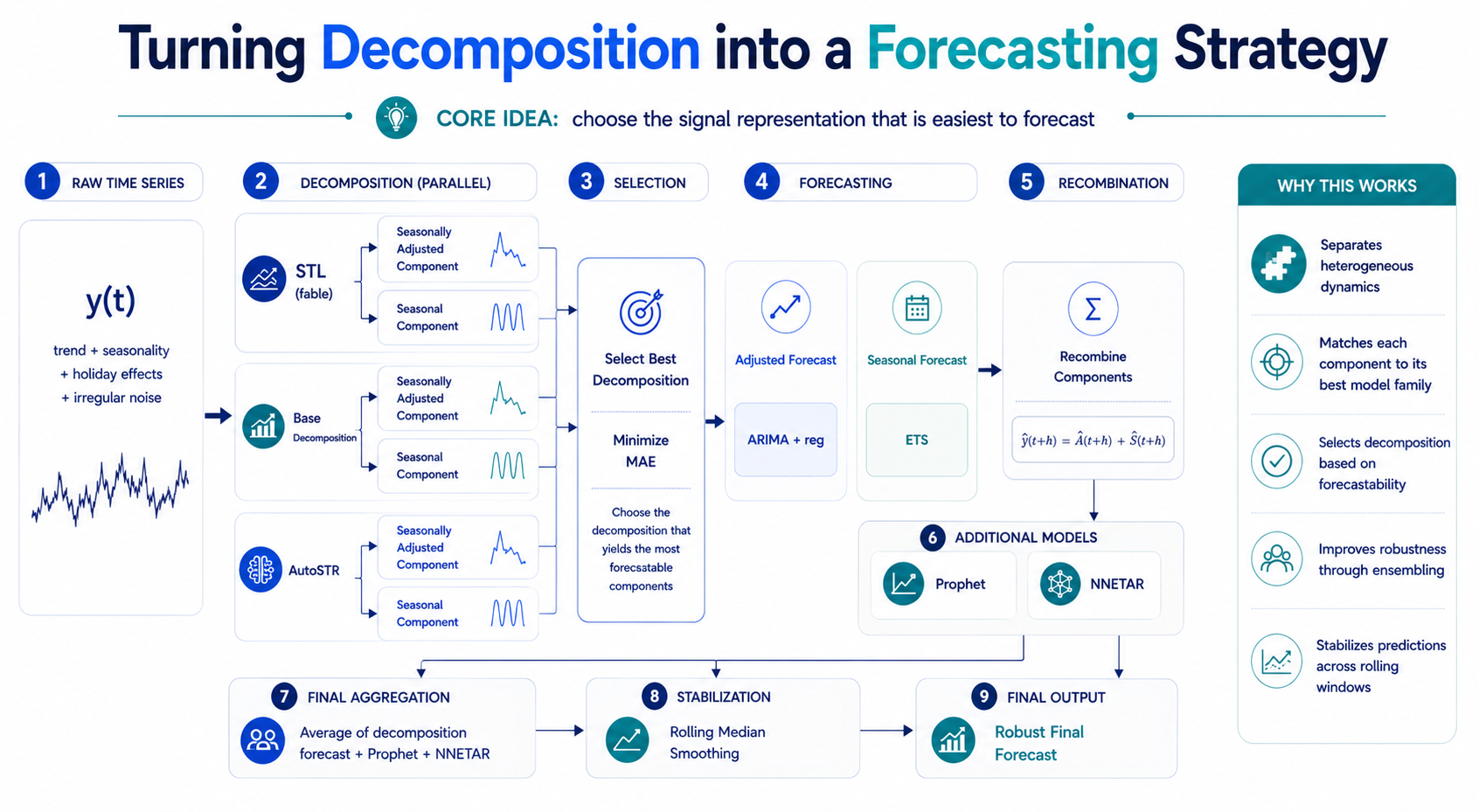
The Problem
A raw weekly time series often mixes several dynamics at once: trend, seasonality, holiday effects, calendar distortions, and irregular noise.
Fitting one single model directly on the raw signal can work, but it forces the model to explain very different behaviors at the same time.
The Approach
- Generate multiple decompositions of the series
- Split each decomposition into a seasonally adjusted component and a seasonal component
- Select the decomposition with the lowest combined residual error
- Forecast each component with the model family best suited to its behavior
- Recombine everything into the final forecast
Implementation
Adjusted component
Modeled with ARIMA + calendar/holiday regressors
Seasonal component
Modeled separately with ETS-based specifications
Combination
Decomposition forecast combined with Prophet and NNETAR
Stabilization
Final output stabilized with rolling median smoothing across iterations
Key Takeaway
Design insight: Decomposition is no longer just a preprocessing step. It becomes a modeling decision layer: the best decomposition is the one that creates the most predictable sub-signals.
Comments
FAQ
What is the key takeaway from "Turning Decomposition into a Forecasting Strategy"?
Decomposition is no longer just a preprocessing step. It becomes a modeling decision layer: the best decomposition is the one that creates the most predictable sub-signals.
Who wrote this and what is it about?
This was written by Mahmoud Trigui, Senior Data Scientist. A forecasting architecture that uses decomposition as a modeling decision layer. Multiple decompositions, component-specific models, and ensemble recombination.