isnull() is a feature. Sometimes the best one.
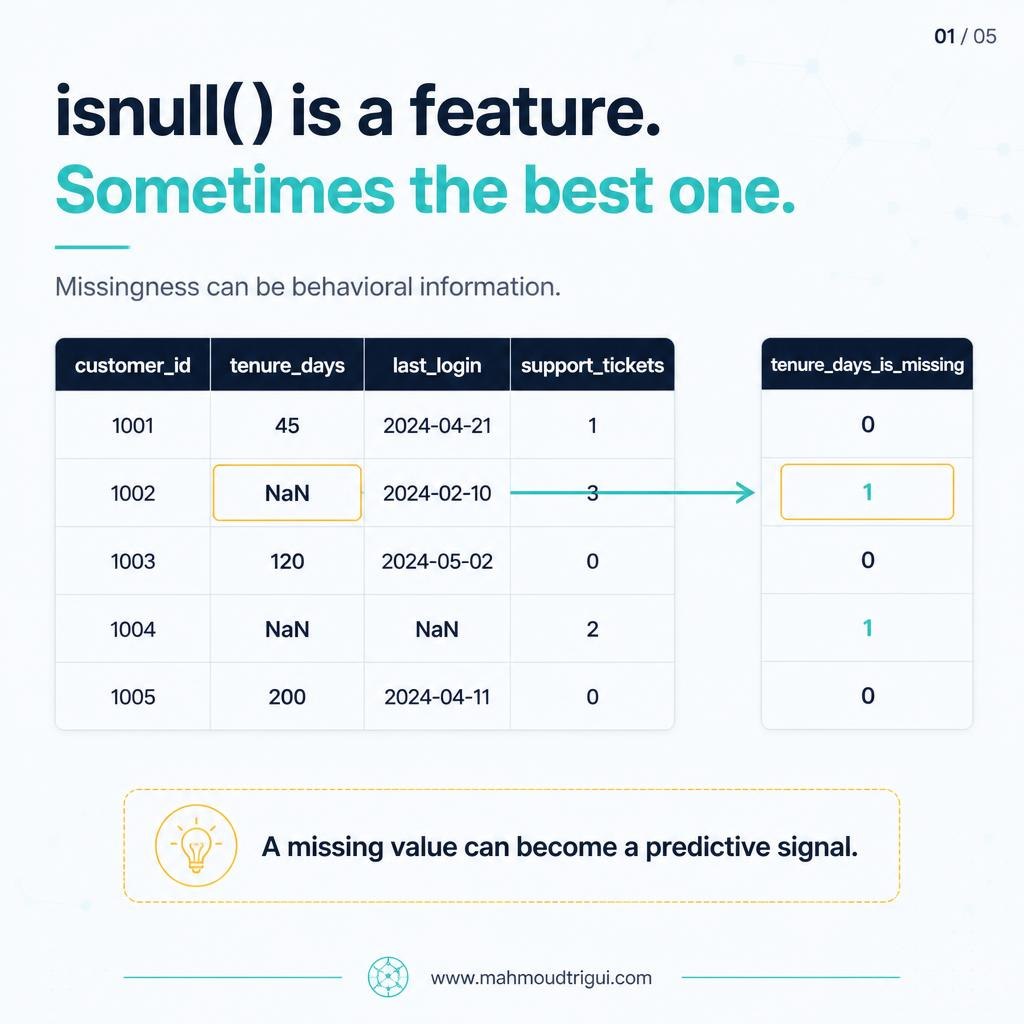
Missingness is often not a data quality problem — it is a behavioral signal. In 3 of my last 5 projects, the null flag ranked above the imputed variable in feature importance.
TL;DR: In tabular ML, the absence of data is itself data. Before filling NaNs, ask: does this absence mean something operationally? If yes, encode it explicitly. The model cannot learn a signal you erased before it saw it.
Visual Summary
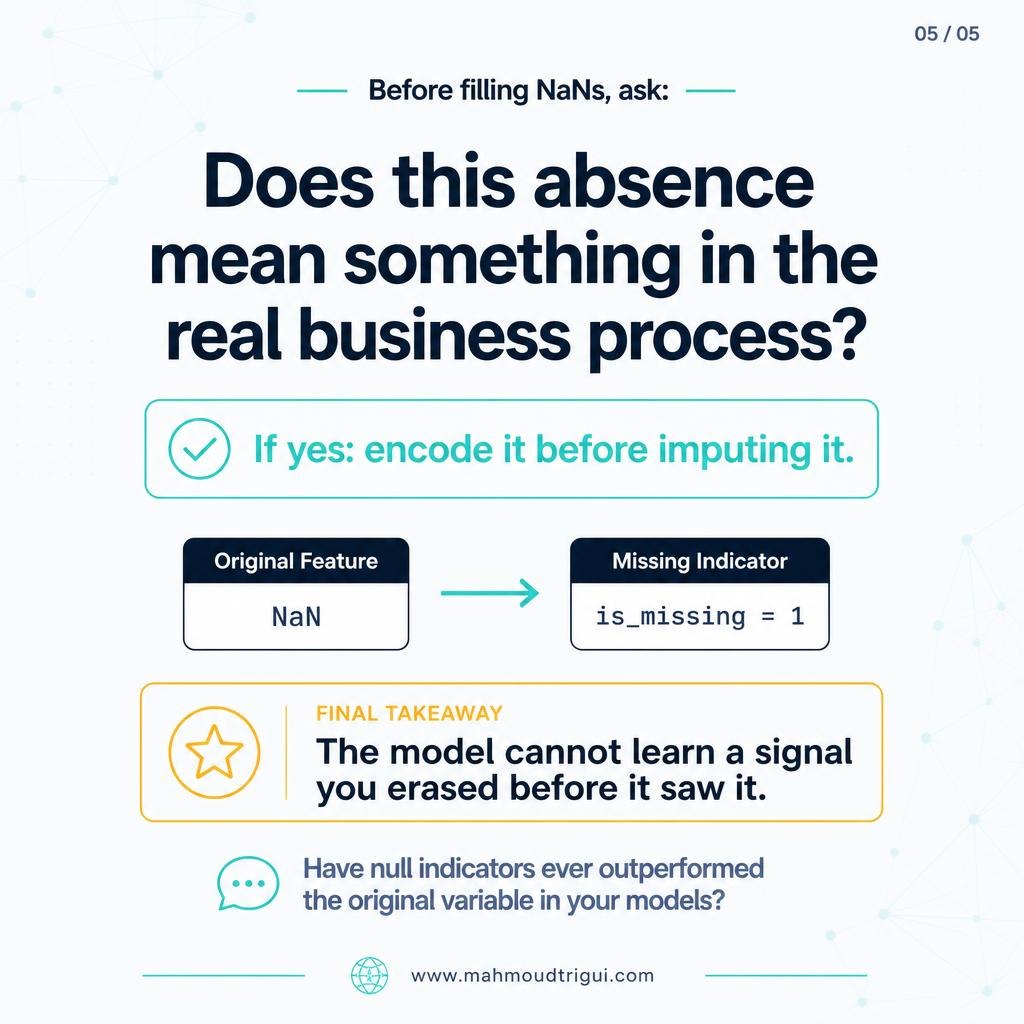
The Core Idea
I treat null indicators as first-class features. Not cleanup — feature engineering.
df['feature_X_is_null'] = df['feature_X'].isnull().astype(int)
This one-liner has been more predictive than the imputed value itself in 3 of my last 5 projects.
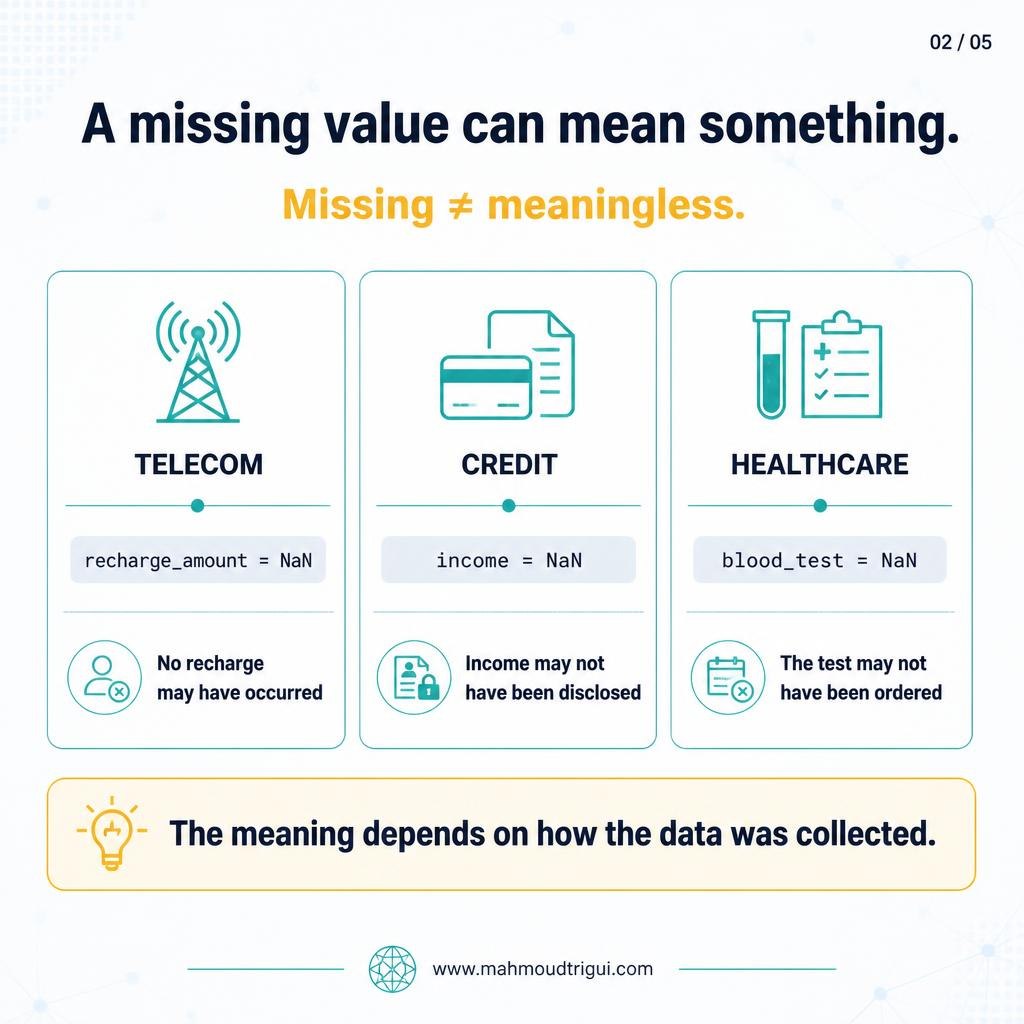
Why Missing Values ARE Information
Telecom churn model
recharge_amount = NaN doesn't mean "unknown" — it means "this customer DIDN'T
recharge." That's a churn signal.
Credit scoring model
income = NaN doesn't mean "data entry error" — it might mean "applicant refused
to declare." That's a risk signal.
Medical dataset
blood_test_X = NaN doesn't mean "missing" — it means "doctor didn't order this
test." The absence IS clinical information.
The Correct Pattern
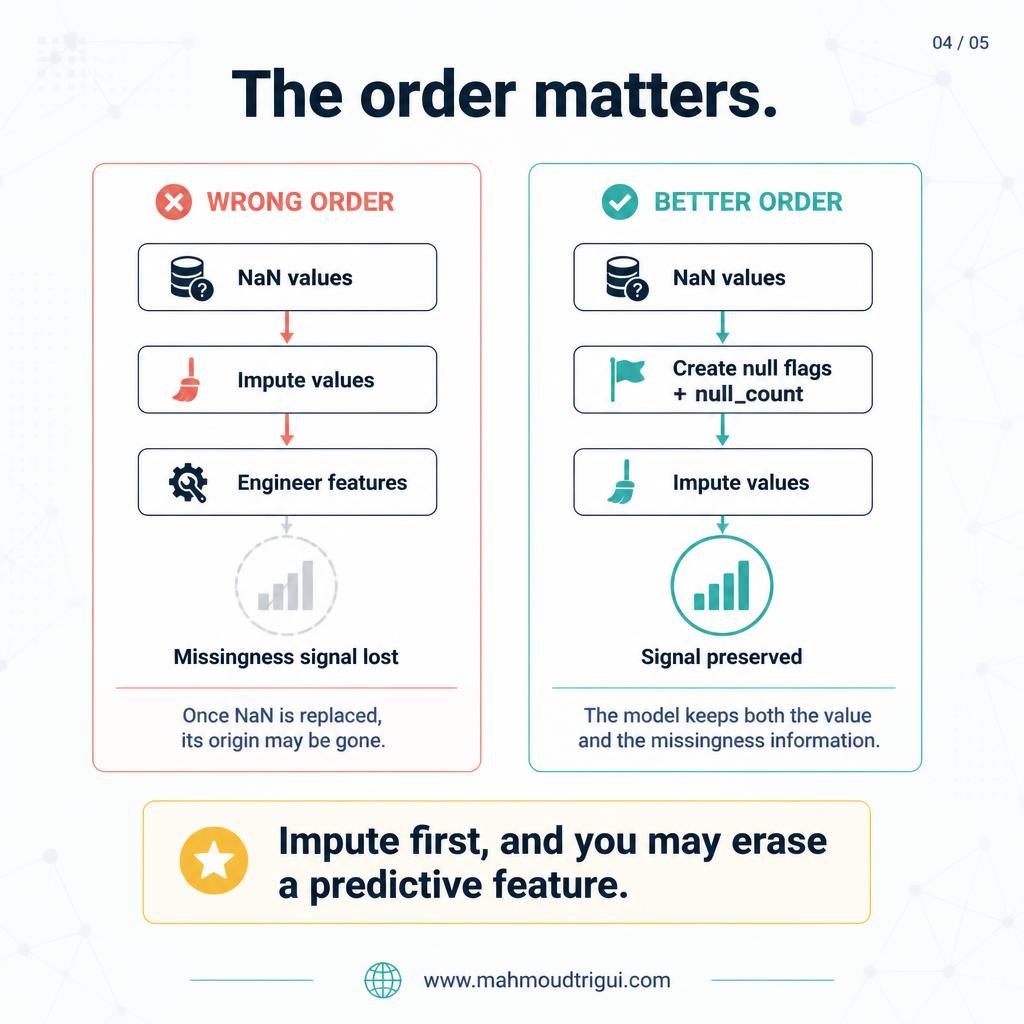
The order of operations matters:
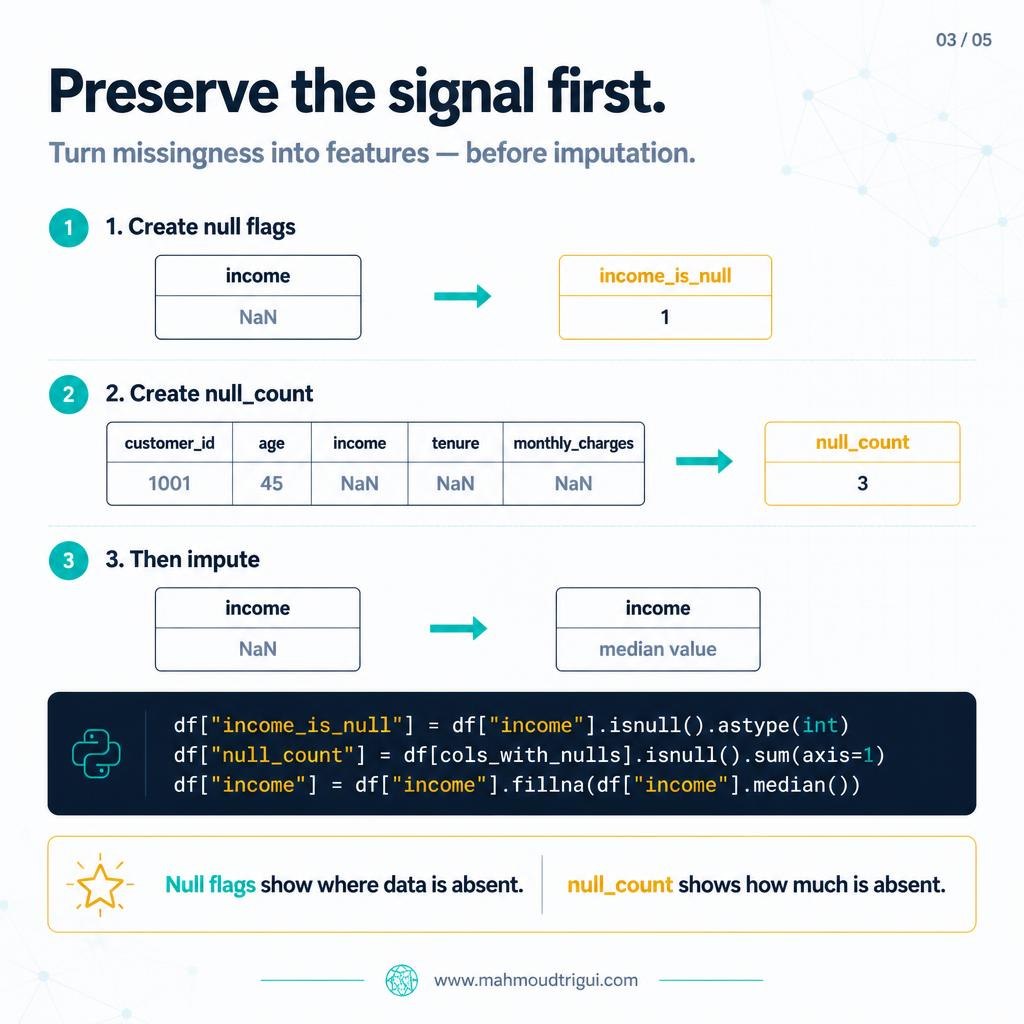
- Step 1: Create missingness indicators
- Step 2: Create row-level null_count meta-feature
- Step 3: Create interactions around missingness (if needed)
- Step 4: THEN impute values
# Preserve the missingness signal first
df["income_is_null"] = df["income"].isnull().astype(int)

# Capture the overall missingness pattern
df["null_count"] = df[cols_with_nulls].isnull().sum(axis=1)

# Then impute
df["income"] = df["income"].fillna(df["income"].median())
Common mistake: Impute first, then engineer features later. That destroys the missingness signal permanently.
Real Project Evidence
- The null flag ranked above the imputed variable in feature importance
- The absence of the action mattered more than its amount
- The missingness pattern itself segmented behavior
Key Takeaway
Design insight: In tabular ML, the absence of data is itself data. Before filling NaNs, ask: does this absence mean something operationally? If yes, encode it explicitly. The model cannot learn a signal you erased before it saw it.
Related
Polars Lazy Execution: More Than a Faster pandas → Cyclical Encoding: Stop One-Hot Encoding Months →Don't Ask Your Model to Learn What a Formula Already Knows →Categorical to Behavioral Signal →Encoding Is a Modeling Decision →Categorical Encoding Cheat Sheet →SHAP Waterfall Local Explanation →Focal Loss for Imbalanced Classification →Multimodal Late Fusion →AI Can Review Feature Code. It Cannot Approve It →
FAQ
What is the key takeaway from "isnull() Is a Feature"?
In tabular ML, the absence of data is itself data. Before filling NaNs, ask: does this absence mean something operationally? If yes, encode it explicitly. The model cannot learn a signal you erased before it saw it.
Who wrote this and what is it about?
This was written by Mahmoud Trigui, Senior Data Scientist. Missing values are not always data quality issues. In tabular ML, missingness can carry the strongest predictive signal. Learn how to preserve and encode null indicators before imputation for better feature engineering.