Focal Loss for Imbalanced Classification: Focus Learning on Hard Cases
How focal loss rebalances a classifier's learning effort so rare, hard-to-predict examples actually drive model improvement.
TL;DR: Focal loss changes what the model spends its learning attention on — it does not change what the model sees or what it is optimised for. The right imbalance strategy is the one that improves your actual validation metric, not the one that sounds most sophisticated. Test techniques separately, compare them on the same validation design, and pick the one that moves the real number.
Visual Summary
The Problem
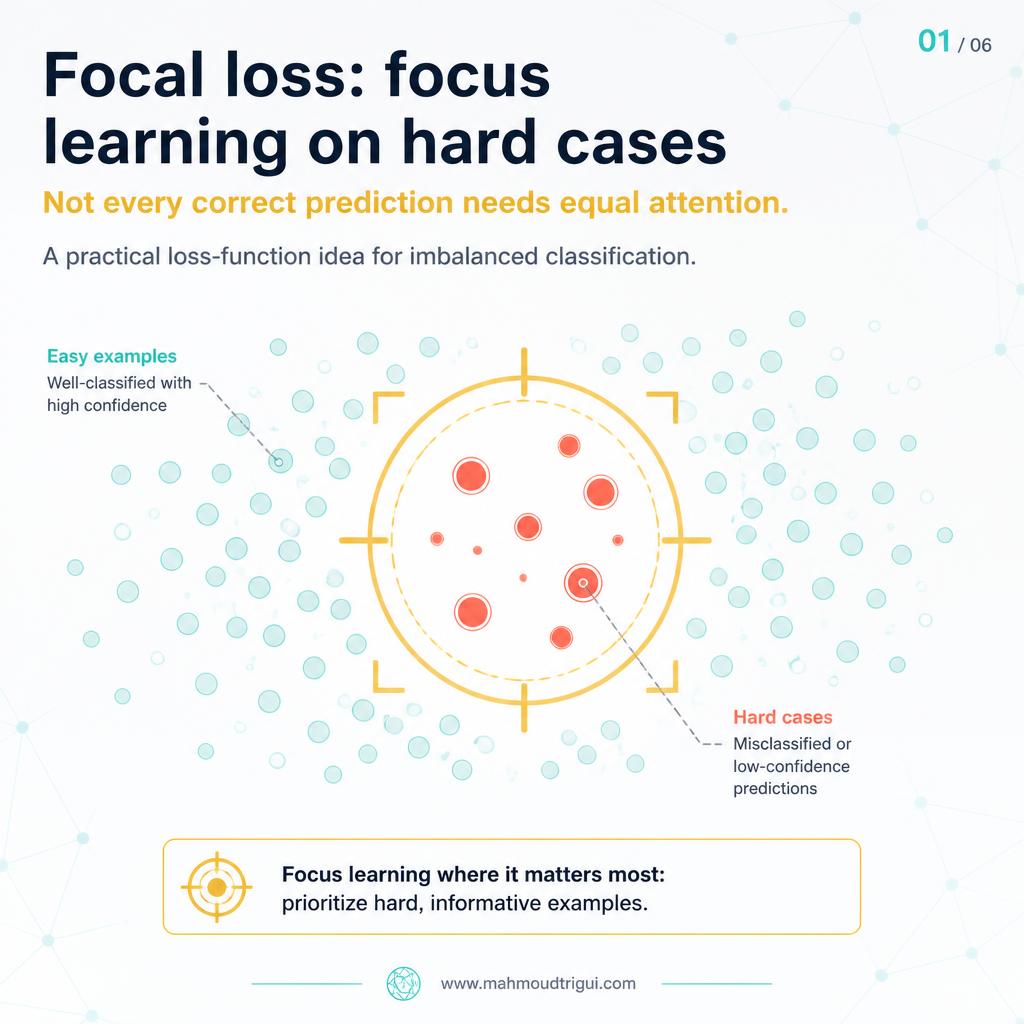
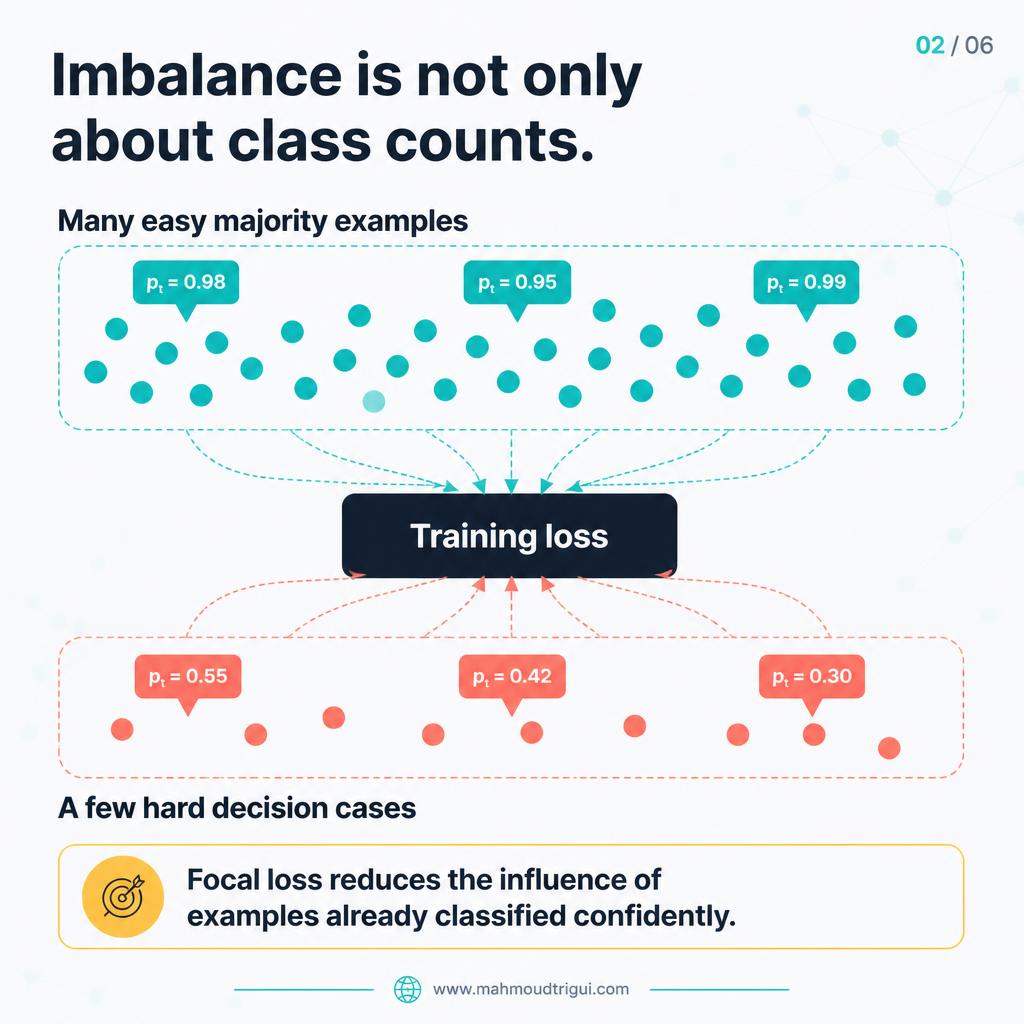
When I work on fraud, churn, fault-detection, or any rare-event classification task, the dataset almost always has the same shape: thousands of easy negatives that the model predicts correctly with high confidence, and a smaller number of difficult positives that are far more important to get right. Standard binary cross-entropy penalises mistakes more than correct predictions, but it still treats every example as equally worth learning from. That means the model spends a huge share of its training budget on examples it already gets right — the easy majority — while the rare cases that actually matter barely move the needle.
The Approach
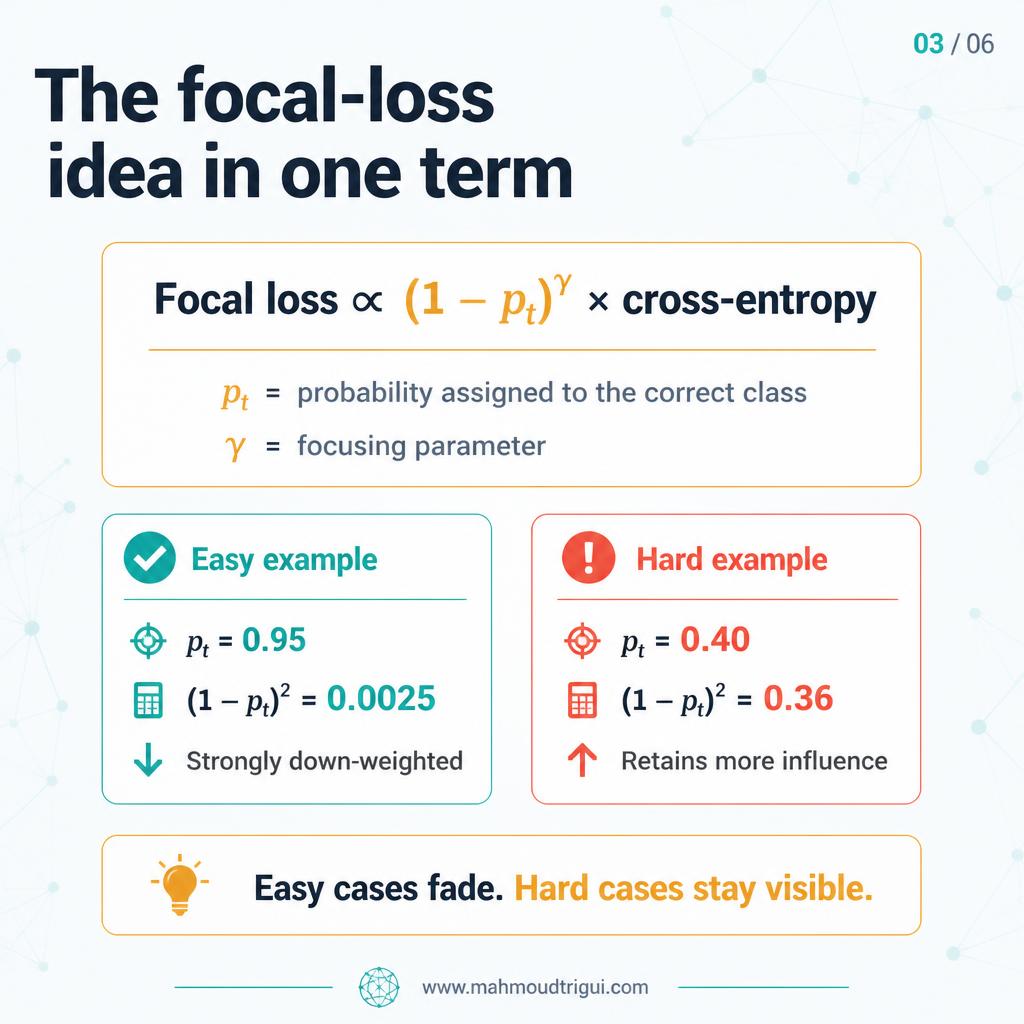
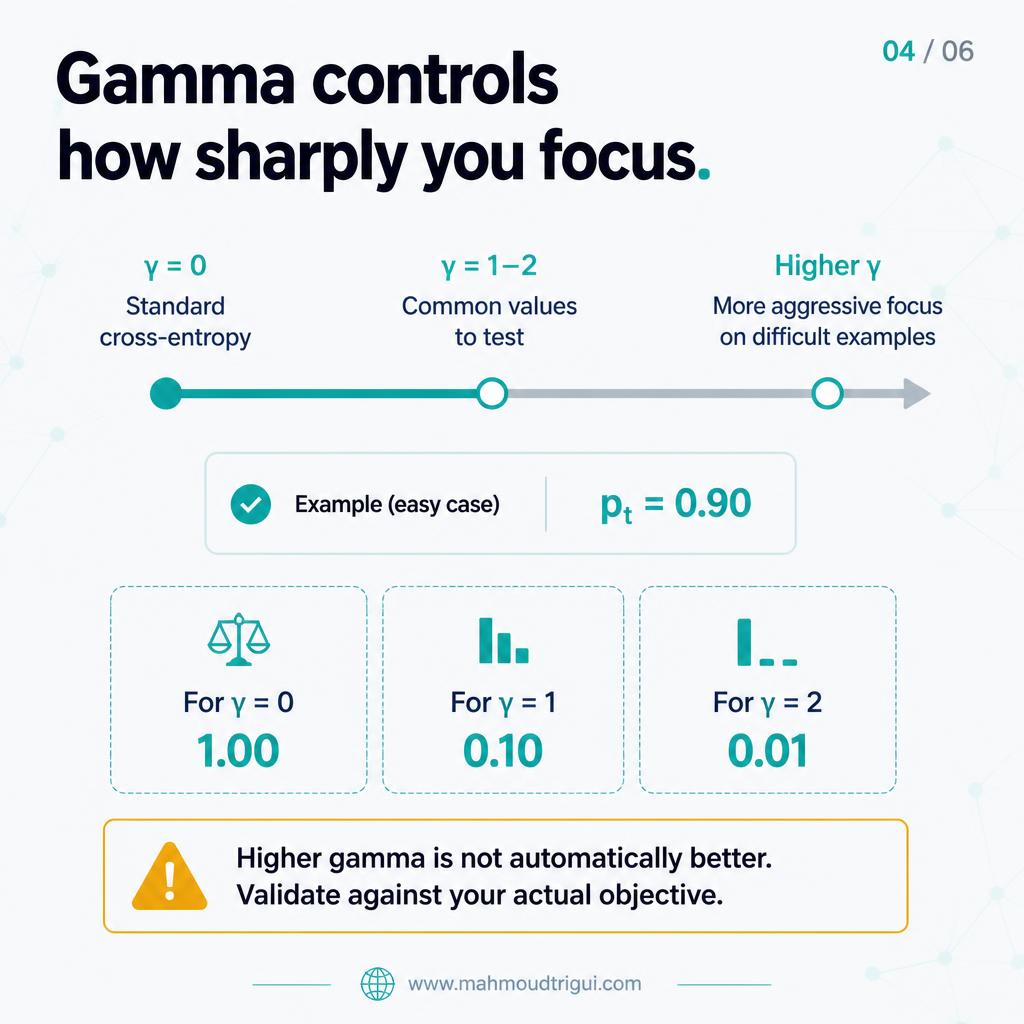
Focal loss is a modification of cross-entropy that explicitly reduces the contribution of examples that are already classified confidently. Its core term is (1 − pt)γ, where pt is the probability assigned to the correct class and γ is a focusing parameter. If an example is easy, pt is high, so its loss is strongly down-weighted. If an example is hard, pt is low, so its loss retains its influence. When γ = 0, focal loss collapses back to standard cross-entropy. The higher γ, the more aggressively the loss focuses on difficult examples.
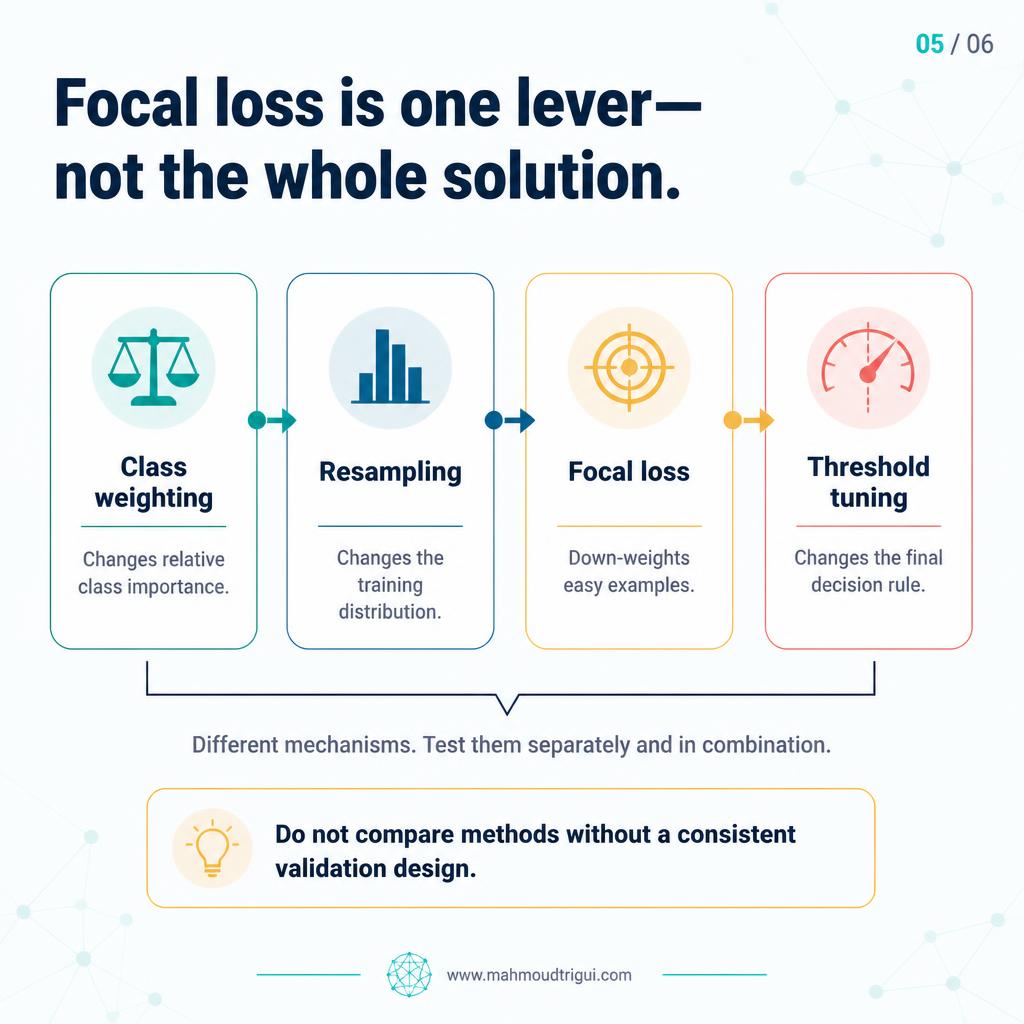
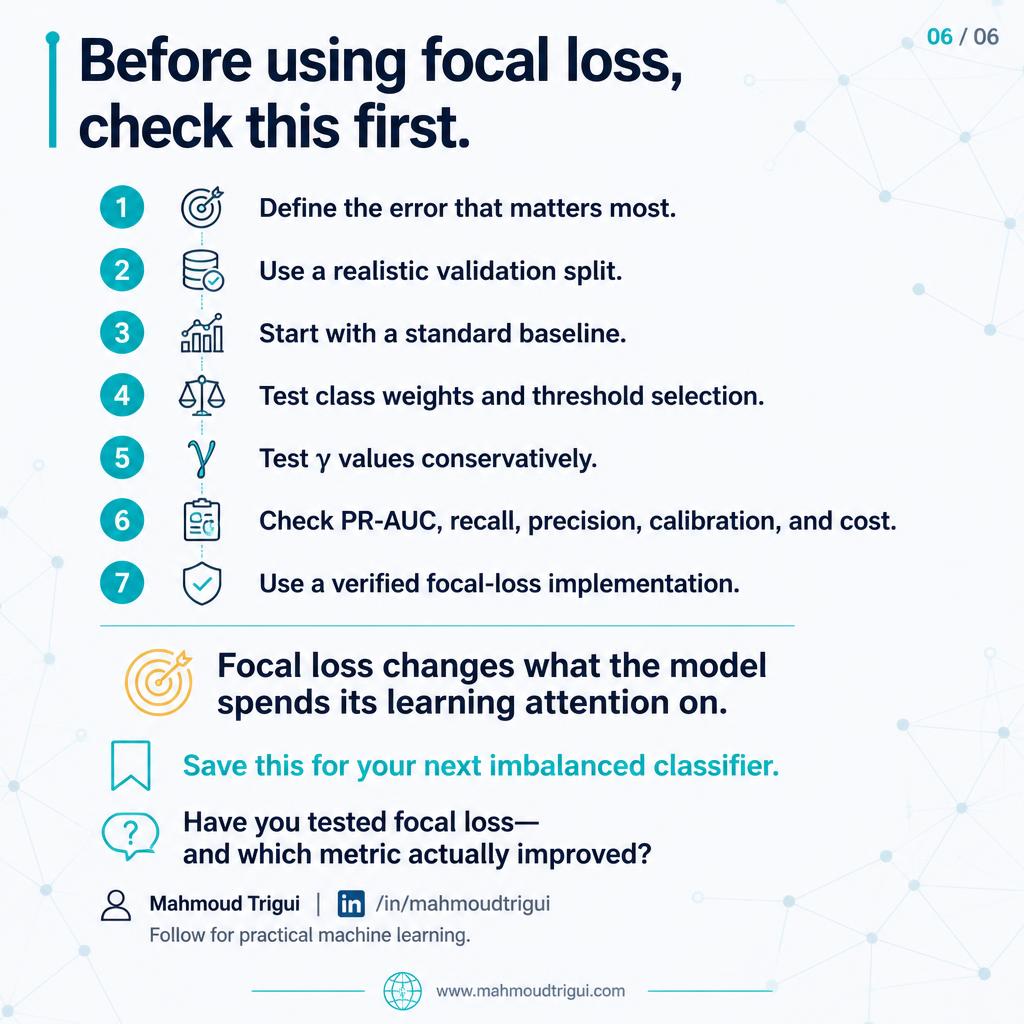
A common starting point is γ = 1 or γ = 2, then validating carefully against the real objective. But focal loss is not the first thing I reach for on an imbalanced tabular problem. My usual sequence is: establish a clean baseline, choose the right metric (PR-AUC, recall, precision, cost, or calibration), test class weights, tune the operating threshold, test resampling where appropriate, and only then test focal loss with a proper implementation. These are not interchangeable techniques — class weighting changes class importance, resampling changes the observed training distribution, focal loss changes how much attention the model gives easy versus hard examples, and threshold tuning changes the final decision rule.
Outcome
Focal loss works best when the problem is genuinely about asymmetric difficulty — when many examples are easy and a few are hard — rather than just about class counts. In practice, it can push a classifier to allocate more learning capacity to the rare class without changing the data itself. But it is one lever, not the whole solution. The right answer is the one that improves your real validation objective, without breaking calibration or operational cost. Higher gamma is not automatically better; it must be validated against the actual metric that matters for the business problem.
Key Takeaway
Design insight: Focal loss changes what the model spends its learning attention on — it does not change what the model sees or what it is optimised for. The right imbalance strategy is the one that improves your actual validation metric, not the one that sounds most sophisticated. Test techniques separately, compare them on the same validation design, and pick the one that moves the real number.
Related
SMOTE Is Not the Default Answer to Class Imbalance →Automate Maintenance, Keep Judgment Human → Encoding Is a Modeling Decision → Adversarial Validation → isnull() Is a Feature → Categorical Encoding Cheat Sheet → SHAP Waterfall Local Explanation → The Most Dangerous Label in ML → Categorical to Behavioral Signal → Don't Ask Your Model to Learn What a Formula Already Knows → A Reranker Cannot Rank What It Never Receives →