SMOTE is not the default answer to class imbalance
It is one option, and in many tabular ML problems it should not be the first one you try. Before creating synthetic minority examples, start with a stronger evaluation plan.
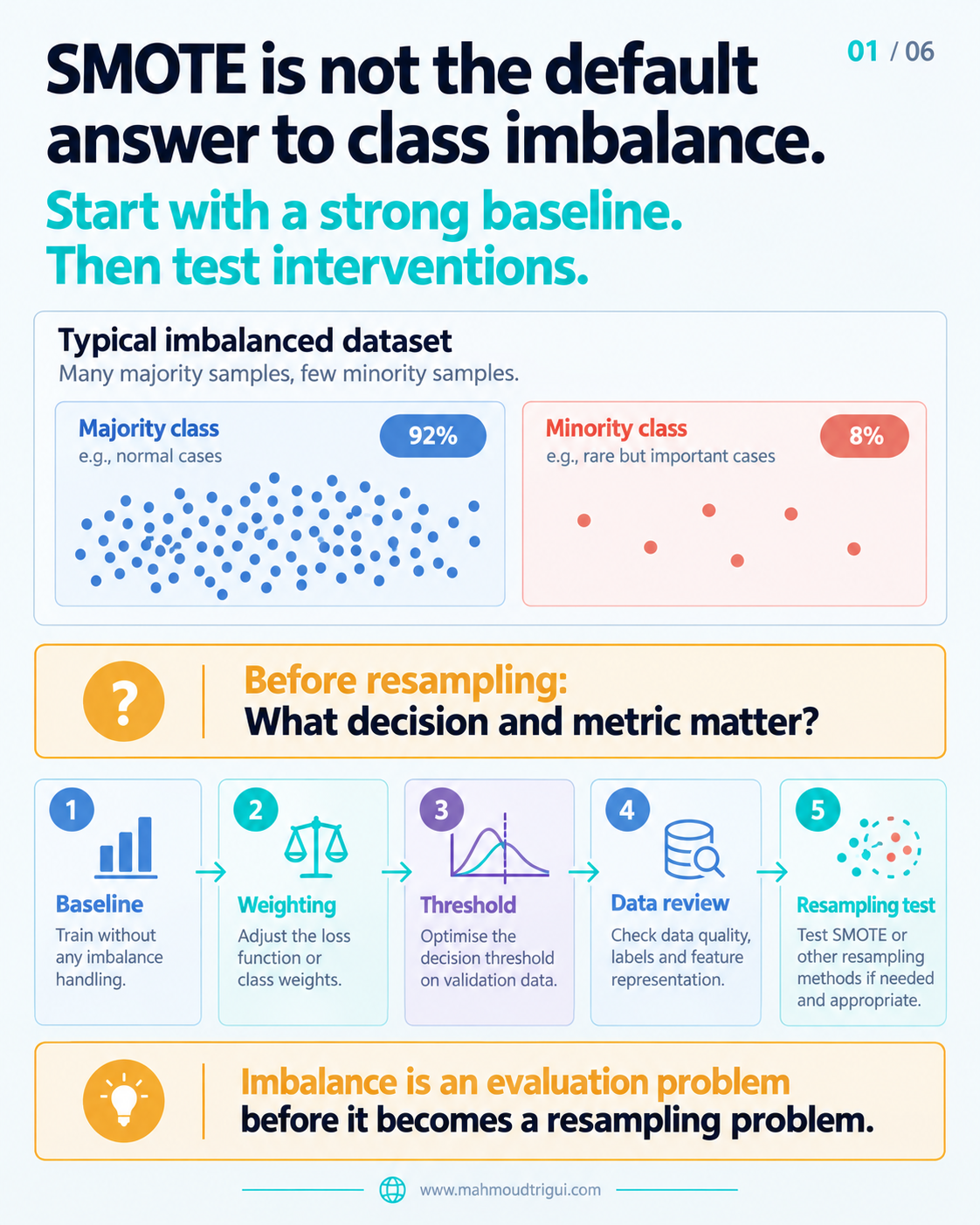
TL;DR: SMOTE is a tool, not the default. Imbalance is an evaluation problem before it is a resampling problem: establish a baseline on the original distribution, try class weighting, tune the decision threshold against real costs and review capacity, and check whether the issue is labels or framing before generating synthetic data. Resample training folds only — never validation or test — and test SMOTE only when minority examples are sparse and local interpolation is plausible. A strong baseline and realistic evaluation come first.
Visual Summary
The Problem
Class imbalance is common in tabular machine learning: fraud, churn, defaults, rare events, escalations. The reflex answer in many tutorials is SMOTE — generate synthetic minority-class examples until the classes look balanced, then train.
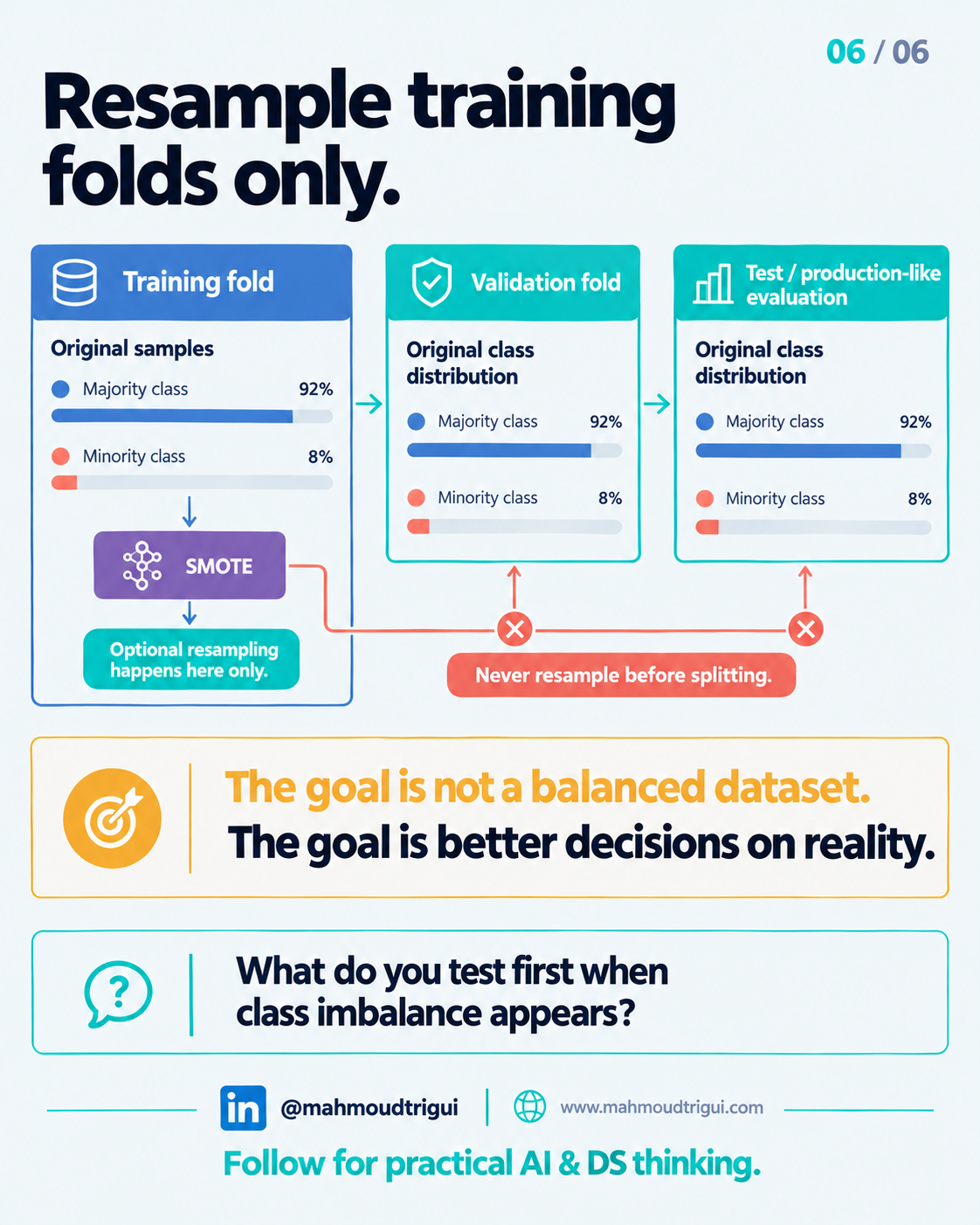
But a balanced training set is not the goal. The goal is better decisions on real-world data, and a model trained on an artificially balanced distribution can score well offline while behaving worse in production. Resampling is easy to reach for and easy to mis-evaluate, because the synthetic examples and the resampled validation folds can quietly contaminate the signal you are measuring.
The real question is an evaluation question before it is a resampling question: what decision are you making, and what does better performance actually mean for that decision?
The Approach
When imbalance appears, I work through a sequence of cheaper, more honest moves before I consider creating synthetic data:
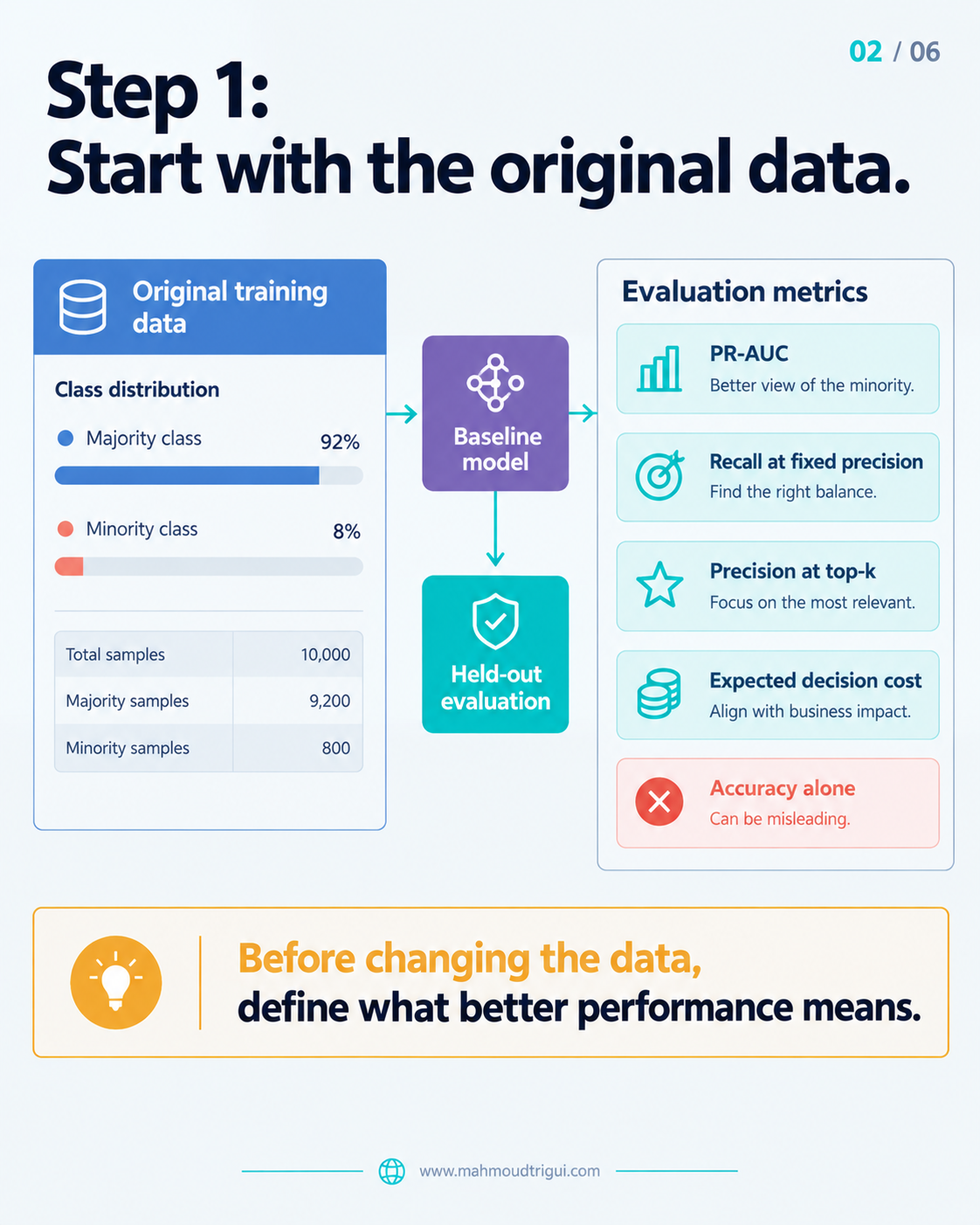
1. Establish a baseline
Train a sensible baseline on the original training distribution. Use metrics that reflect the real problem — precision-recall AUC, recall at a fixed precision, precision at top-k, expected cost, or review workload capacity. Accuracy is often not enough.
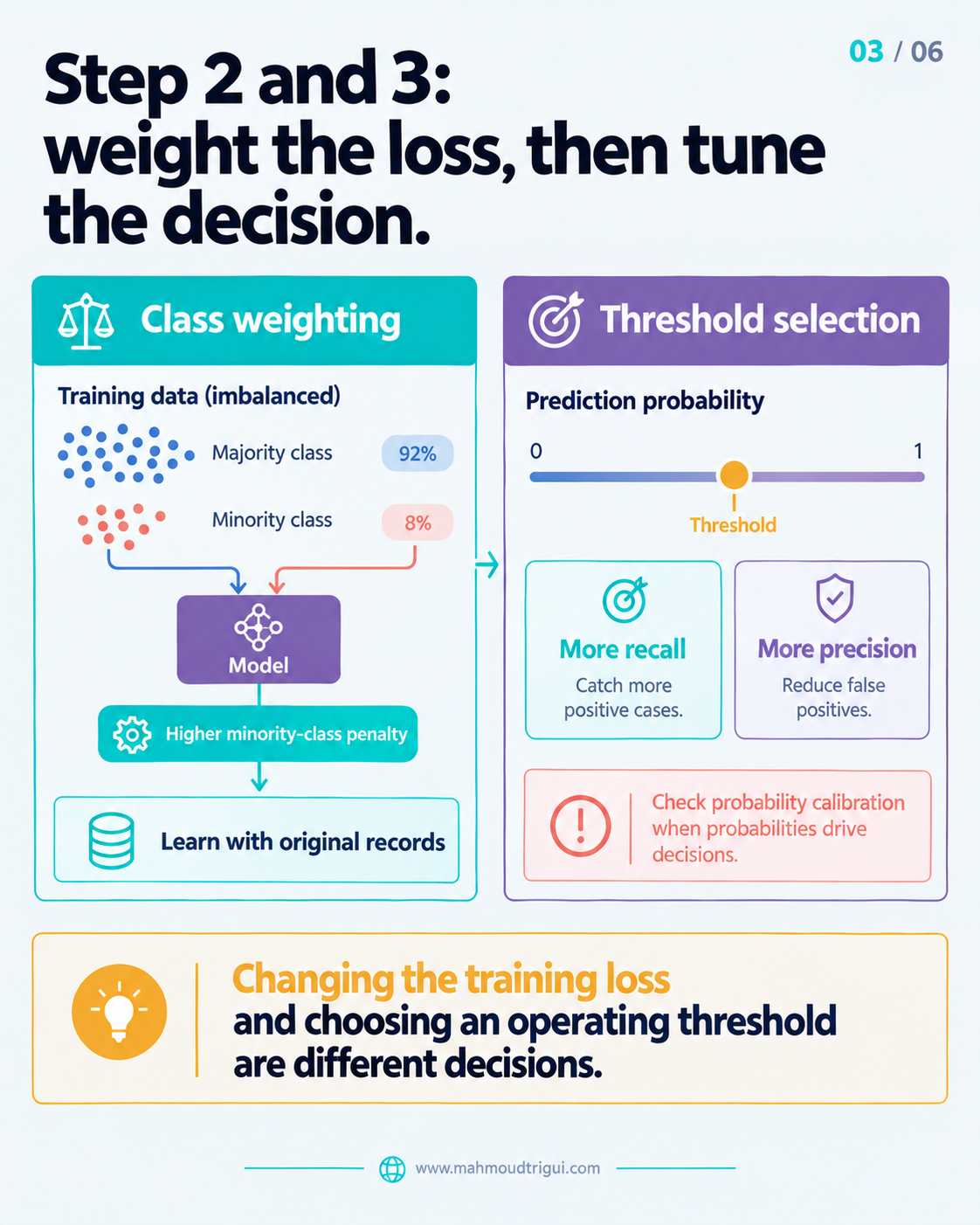
2. Try class weighting
Many model families support class weights or positive-class weighting. It is simple, avoids synthetic samples, and may be enough. Evaluate probability calibration separately if downstream decisions depend on predicted probabilities.
3. Tune the decision threshold
A threshold of 0.5 is not a business rule. Choose it on held-out data using the actual cost of false positives and false negatives and the available review capacity.
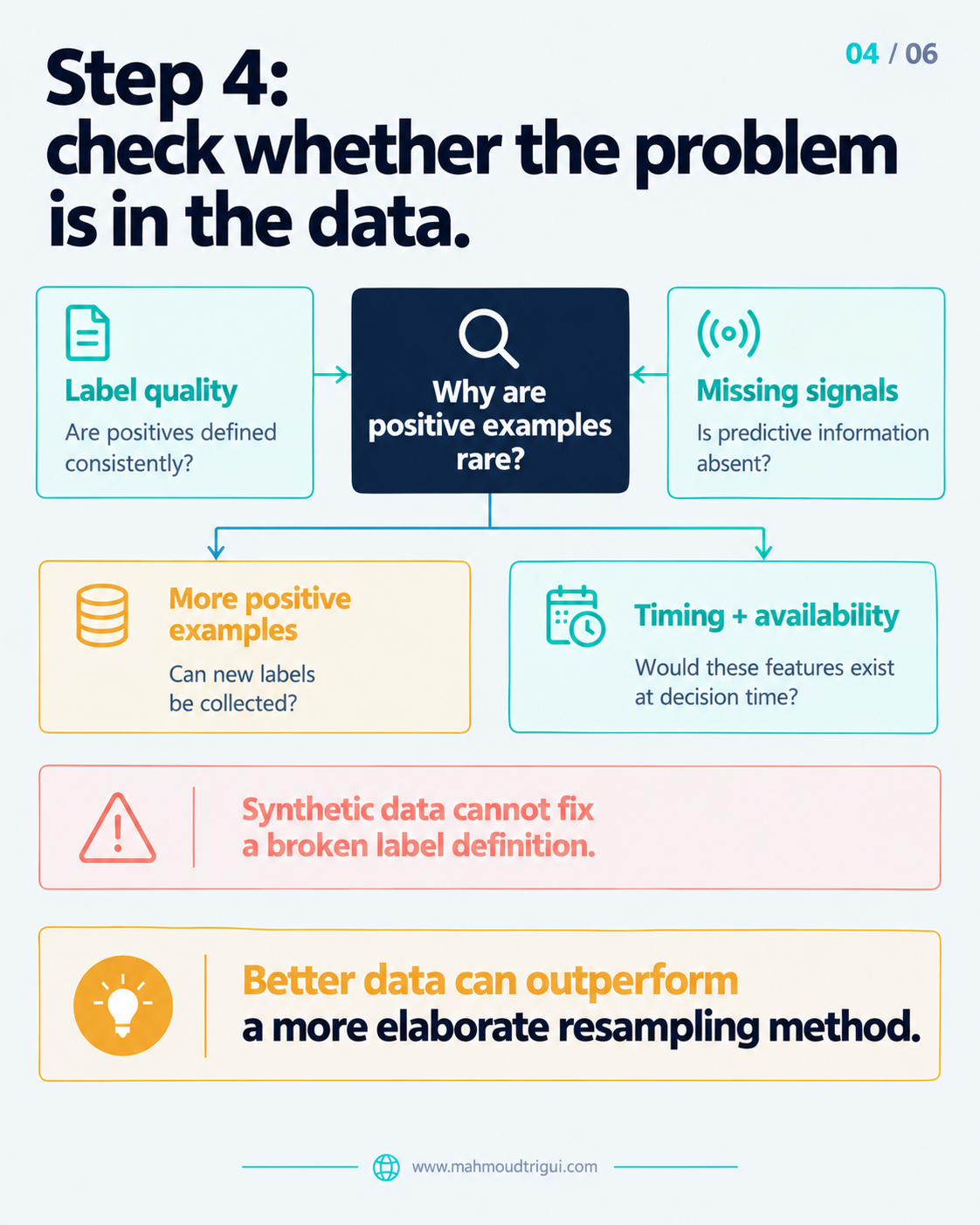
4. Improve the data and the framing
Check label quality, missing signals, temporal validity, and whether more positive examples can be collected. This often creates more value than another resampling method.
5. Test resampling only when justified
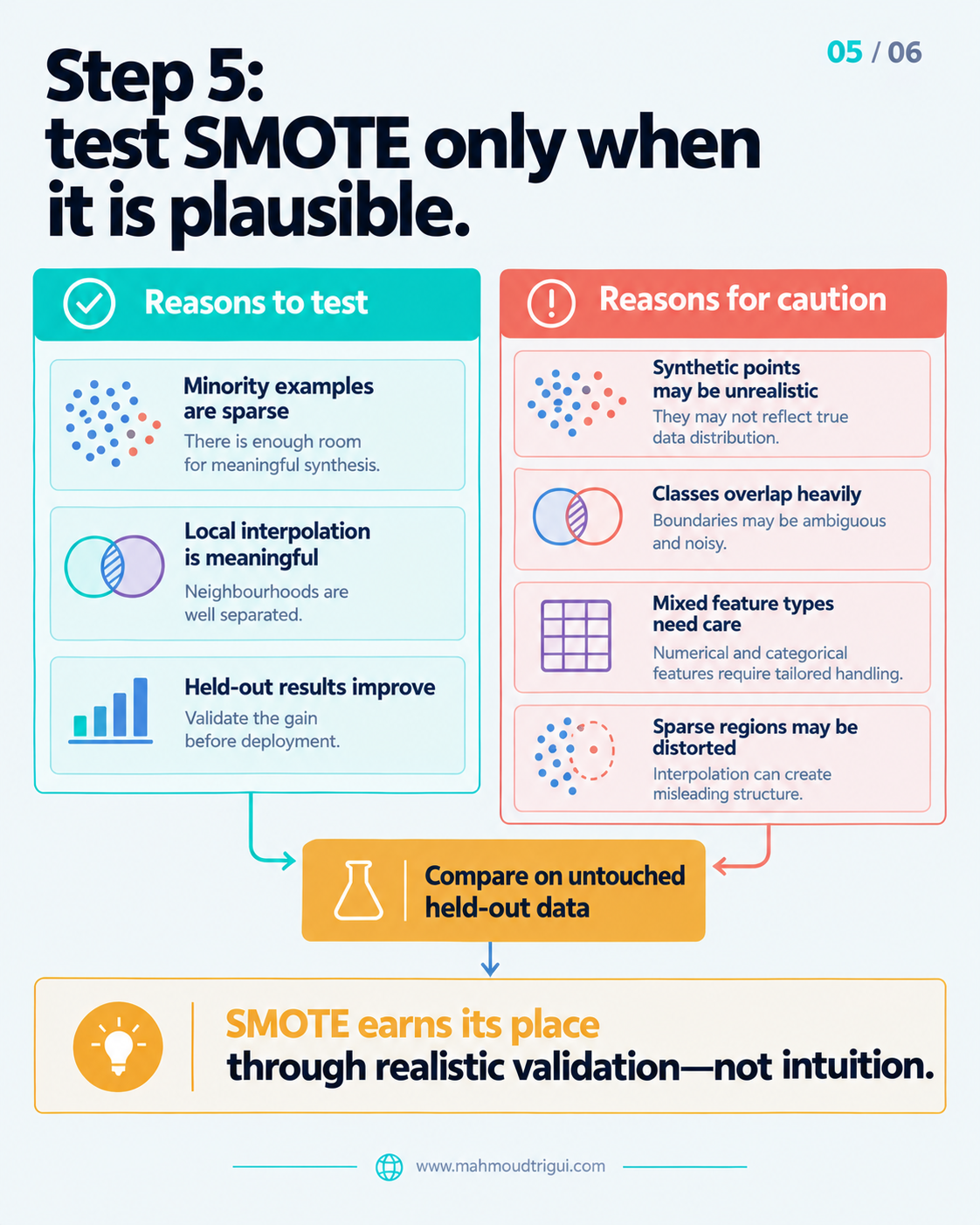
SMOTE can help when minority examples are sparse and local interpolation is plausible. It can hurt when synthetic points are unrealistic, feature types are mixed, classes overlap heavily, or validation gets contaminated.
One rule is non-negotiable: resample training folds only, and keep validation and test data in their original distribution.
Outcome
The result is a stronger baseline and an honest evaluation before any synthetic data is created. Often class weighting plus a carefully chosen threshold is enough, and no resampling is needed at all. When SMOTE is tested, it earns its place on untouched held-out data instead of intuition.
The goal is not a balanced training dataset. The goal is better decisions on real-world data.
Key Takeaway
Design insight: SMOTE is a tool, not the default. Imbalance is an evaluation problem before it is a resampling problem: establish a baseline on the original distribution, try class weighting, tune the decision threshold against real costs and review capacity, and check whether the issue is labels or framing before generating synthetic data. Resample training folds only — never validation or test — and test SMOTE only when minority examples are sparse and local interpolation is plausible. A strong baseline and realistic evaluation come first.
Related
Focal Loss for Imbalanced Classification →Adversarial Validation: Detecting Train-Test Mismatch →Purged Cross-Validation Is Not for Every Time Series →Seed Sensitivity Is Part of Model Selection →Label Validity Is Time-Based →LightGBM vs XGBoost in 2026 →A Predictive Model Is Not a Decision System →Candidate Generation Sets the Ceiling →Not Every Analytics Question Is About What Drives Outcome →
FAQ
What is the key takeaway from "SMOTE Is Not the Default Answer to Class Imbalance"?
SMOTE is a tool, not the default. Imbalance is an evaluation problem before it is a resampling problem: establish a baseline on the original distribution, try class weighting, tune the decision threshold against real costs and review capacity, and check whether the issue is labels or framing before generating synthetic data. Resample training folds only — never validation or test — and test SMOTE only when minority examples are sparse and local interpolation is plausible. A strong baseline and realistic evaluation come first.
Who wrote this and what is it about?
This was written by Mahmoud Trigui, Senior Data Scientist. SMOTE is one option for class imbalance, not the default. Start with a strong baseline, class weighting, a tuned threshold, and better data before you resample.