Purged Cross-Validation Is Not for Every Time Series
A time-aware split removes the obvious leak: future rows inside training. It does nothing about a training row whose label reaches into the validation window. Purging and embargo close that gap — and are unnecessary almost everywhere else.
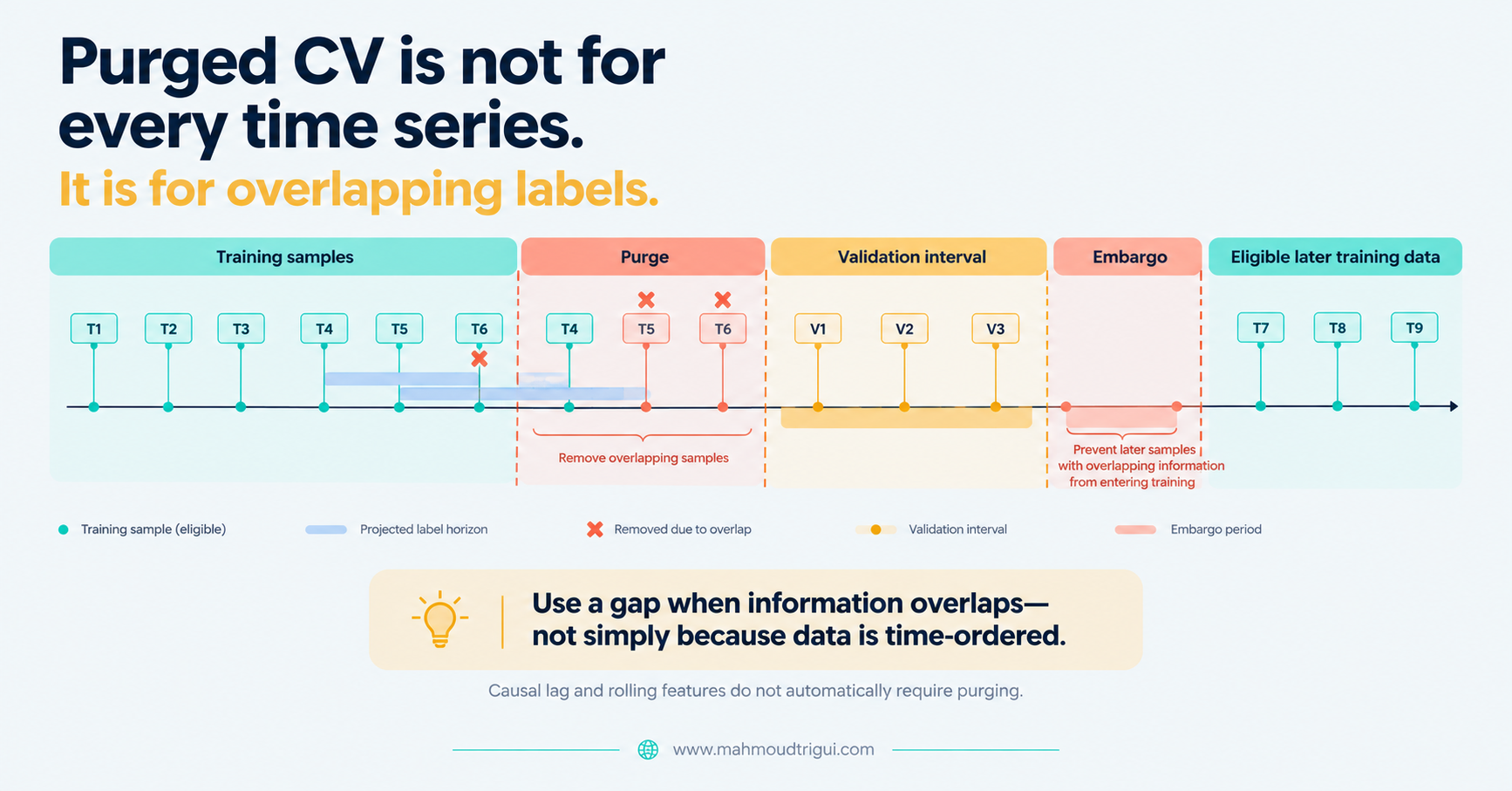
TL;DR: Purged cross-validation is not a default upgrade for time series. It is a specific repair for datasets whose labels or event horizons overlap the validation window. Use a plain time-aware split when features are causal and labels are point-in-time; purge and embargo when a training row's realised outcome reaches into the period you are evaluating on. An arbitrary gap removes the risk, but it also throws away data the model needed.
The Problem
The default instinct is to treat any time series like a normal machine learning dataset: shuffle it, split it, and fit a model. That is wrong, and most people already know it. So the fix is a time-aware split — train strictly before you validate.
That handles the visible leak. It does not handle a subtler one. Consider a label defined as the return over the next 10 trading days. A training row dated just before the validation boundary has an outcome that is only realised over those 10 days, which overlap the validation period. The row starts in training time, but its answer reaches into the future the model is being judged on.
Nothing about the split looks wrong. The metrics simply come out optimistic, and the optimism grows with the label horizon. Ten days of overlap is a detail. Six months of overlap is the whole evaluation.
The Approach
I stopped treating this as a default upgrade and started treating it as a diagnostic. The question is never “should every time-series split have a gap?” It is: can any training sample share future information, labels, or event horizons with validation? So the check has to walk the label definition, not the split code.
Start with a time-aware split
Training rows strictly before the validation window. This removes the obvious leak: future observations inside the training set.
Check whether the label has a horizon
A label realised over the next 10 trading days is not point-in-time. If the outcome spans a window, ask when that window closes.
Purge training samples that overlap
Drop the training rows whose label horizon or event window reaches into the validation interval. Their outcome was partly produced by the period you are testing on.
Add an embargo after validation
Samples immediately after validation can still carry information that overlaps the validation event, so keep a short restricted zone before they re-enter training.
Verify your features are causal, not just lagged
Lagged and rolling features do not leak automatically. A feature like a rolling mean shifted by one period already uses only prior observations.
Outcome
On the datasets where the label spanned a window — forward returns, churn inside the next 30 days, default within 12 months — purging the overlapping training rows and adding a short embargo after validation removed the optimism. The performance drop that followed was the honest number.
On the datasets with point-in-time labels and causally built features, the plain time-aware split was already correct. Adding an arbitrary gap there only discarded training rows the model actually needed, and made the forecasts worse for no gain in honesty.
The same label logic applies well beyond time series: can this customer's outcome land inside the evaluation window? Can this event be resolved only after the period I am scoring on?
Key Takeaway
Design insight: Purged cross-validation is not a default upgrade for time series. It is a specific repair for datasets whose labels or event horizons overlap the validation window. Use a plain time-aware split when features are causal and labels are point-in-time; purge and embargo when a training row's realised outcome reaches into the period you are evaluating on. An arbitrary gap removes the risk, but it also throws away data the model needed.
Related
Adversarial Validation: Detect Data Shift Before It Hurts →The Most Dangerous Label in ML Is the One That Looks Correct →AI Can Review Feature Code. It Cannot Approve It →AI-Generated Validation Can Pass While Data Is Still Wrong →Conformal Prediction: When the Model Is Uncertain, the Interval Is the Product →Seed Sensitivity Is Part of Model Selection →The Hardest Forecasting Decision Is Not Which Model to Use →Make a Simple Forecasting Baseline Fail First →AI Pre-Flight Review Before You Write Model Code →MLforecast Made Me Rewrite My Forecasting Pipeline →Pydantic Is More Than Input Validation →
FAQ
What is the key takeaway from "Purged Cross-Validation Is Not for Every Time Series"?
Purged cross-validation is not a default upgrade for time series. It is a specific repair for datasets whose labels or event horizons overlap the validation window. Use a plain time-aware split when features are causal and labels are point-in-time; purge and embargo when a training row's realised outcome reaches into the period you are evaluating on. An arbitrary gap removes the risk, but it also throws away data the model needed.
Who wrote this and what is it about?
This was written by Mahmoud Trigui, Senior Data Scientist. Purged cross-validation is not for every time series. Use it when labels or event horizons overlap validation, and skip the gap when a time split already holds.
When do I actually need purged cross-validation?
You need it when a training row's label is realised over a window that overlaps the validation period, such as a forward 10-day return, a customer who churns within the next 30 days, or a loan that defaults within 12 months. If the label is point-in-time (the outcome is already known at the row's timestamp) and every feature is causal, a plain time-aware split that trains strictly before validation is already correct.
What is the difference between purging and an embargo?
Purging removes the training samples whose label horizon or event window reaches into the validation interval. An embargo is an additional restricted zone after validation, because a market or event-driven observation immediately following validation can still carry information that originated inside the validation period. Purging handles overlap with validation; the embargo handles information carried forward from validation into the next fold.