Pydantic Is More Than Input Validation
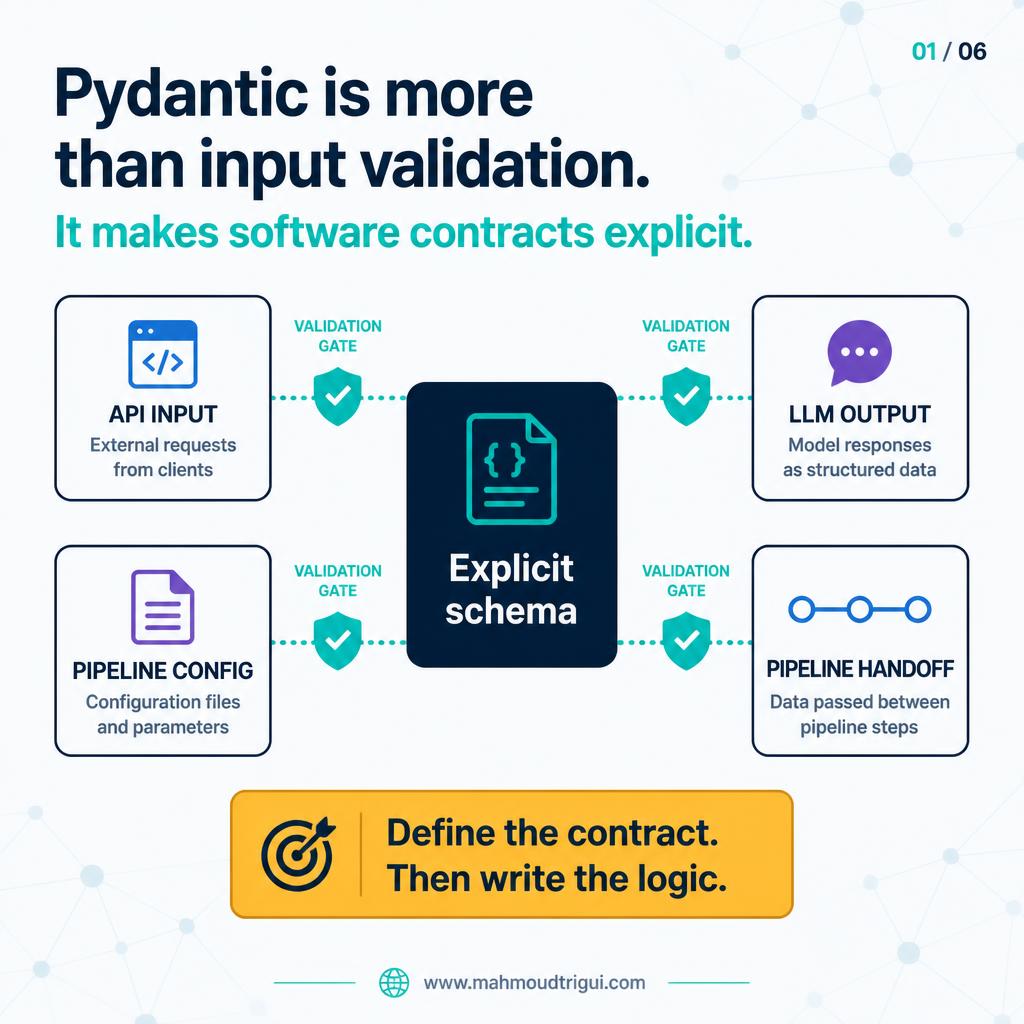
Most production failures in ML and LLM systems are not model failures. They are boundary failures: an API accepts an impossible value, a config typo changes behaviour, an LLM returns malformed structured output, one stage sends data the next stage cannot interpret. A schema is how those assumptions become explicit.
TL;DR: Pydantic is a contract tool, not just a validator. It matters at boundaries — API inputs, LLM output, pipeline configuration, and data handed between stages — where an unstated assumption becomes a production failure. Define the contract, validate at the boundary, then write the logic. Schemas do not guarantee correctness and never replace tests, monitoring, or business checks; they make invalid inputs and outputs harder to ignore, and they make assumptions reviewable before they fail.
Visual Summary
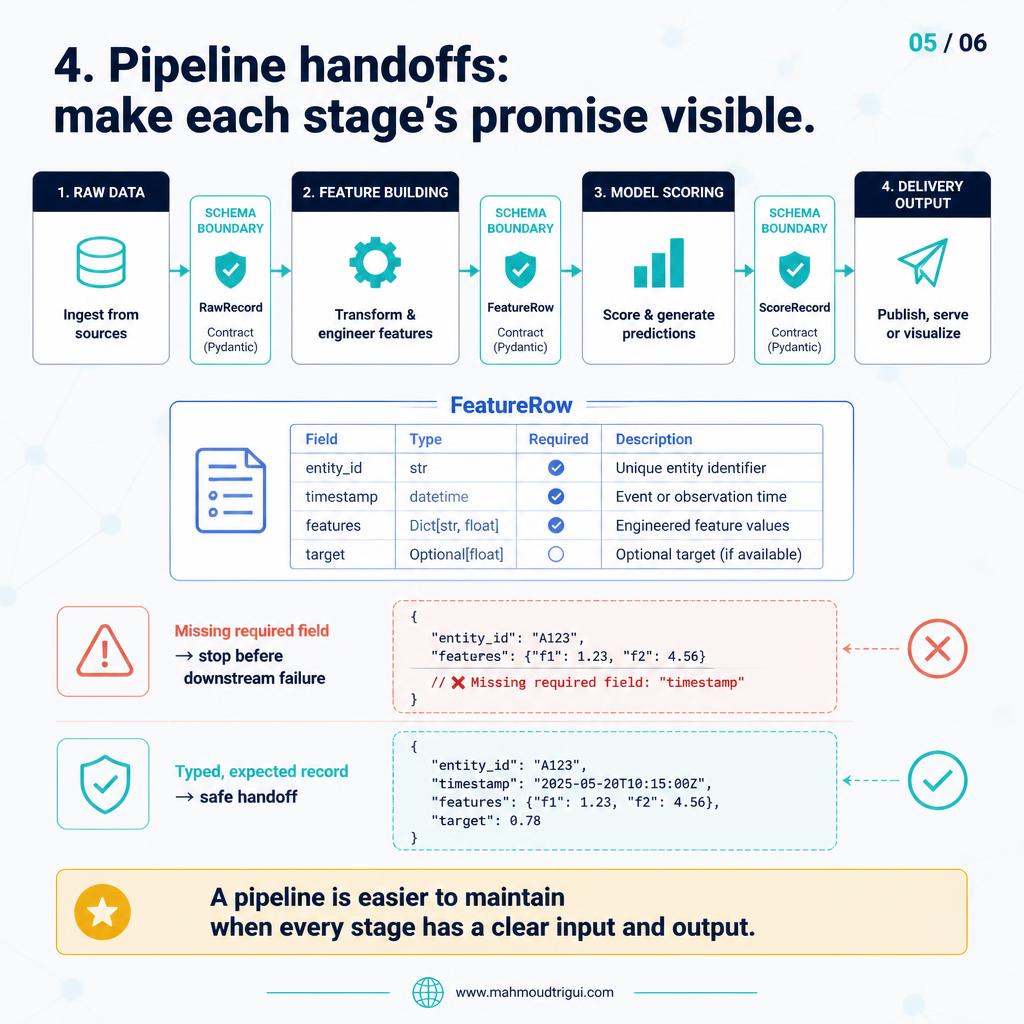
The Problem
When an ML or LLM system fails in production, the instinct is to blame the model: tune it harder, change the algorithm, retrain. But a large share of failures never reach the model at all. They happen at the edges, where data crosses an API, a configuration layer, a file, or another pipeline stage.
An API receives an impossible value. A configuration typo silently changes pipeline behaviour. An LLM returns structured output that is missing a field the application reads without checking. One stage sends data the next stage cannot interpret safely. In each case the logic is fine and the assumption was never written down anywhere.
The result is a class of failure that is expensive to diagnose precisely because it is invisible: nothing crashes loudly at the point where the contract was actually broken.
The Approach
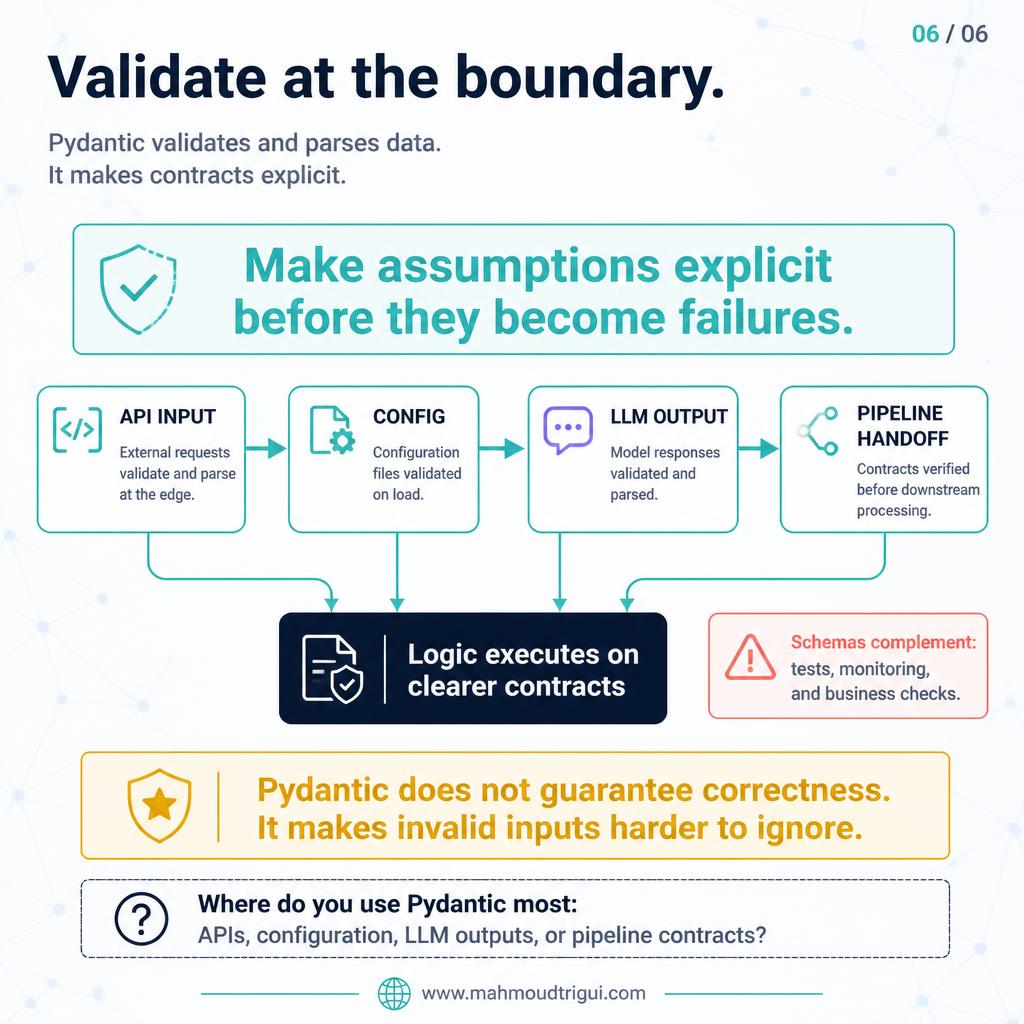
I use Pydantic at the boundaries that matter, which are fewer than people expect. Not everywhere — at the four places where an assumption crosses from one component into another. The pattern is the same each time: define the contract, validate at the boundary, then execute the logic.
API inputs
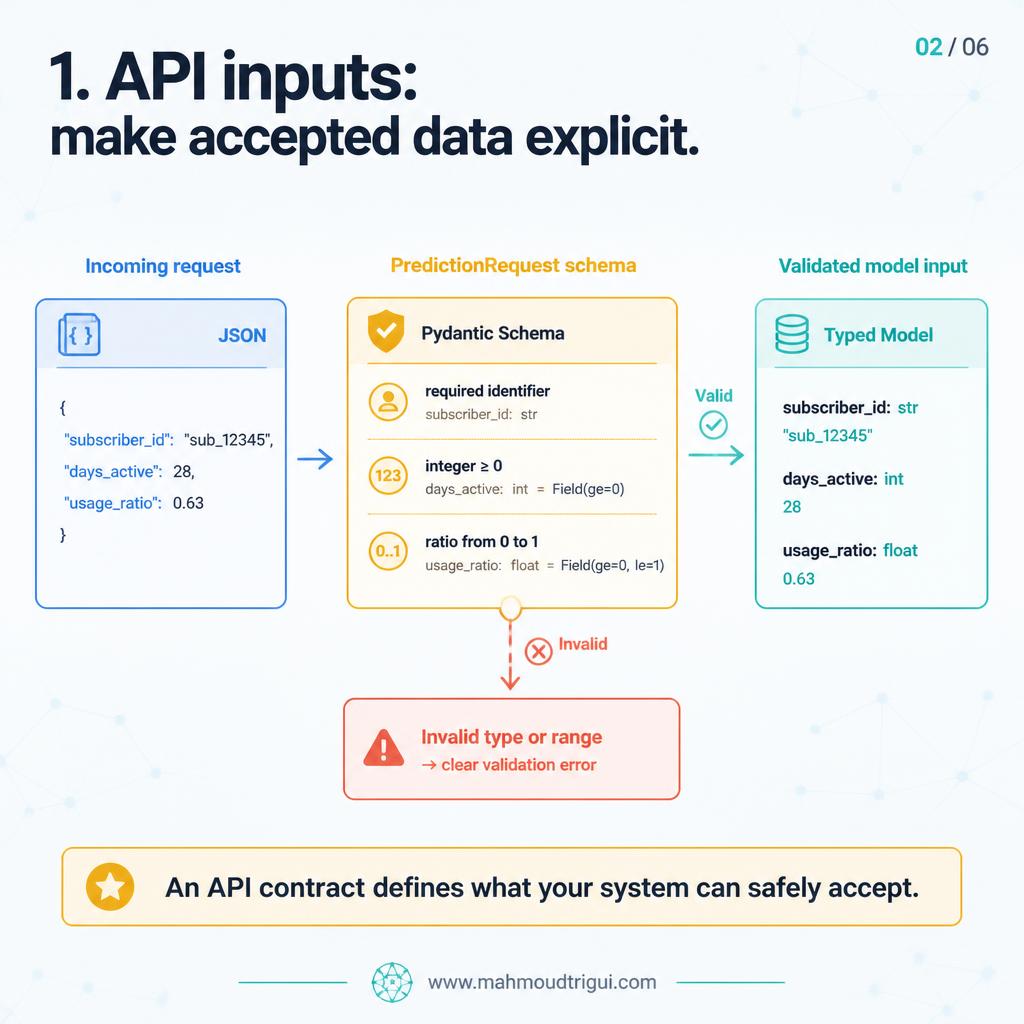
Define what an endpoint accepts: expected fields, types, ranges, optional values, and the validation errors a caller can receive. The contract decides what the system can safely accept.
LLM outputs
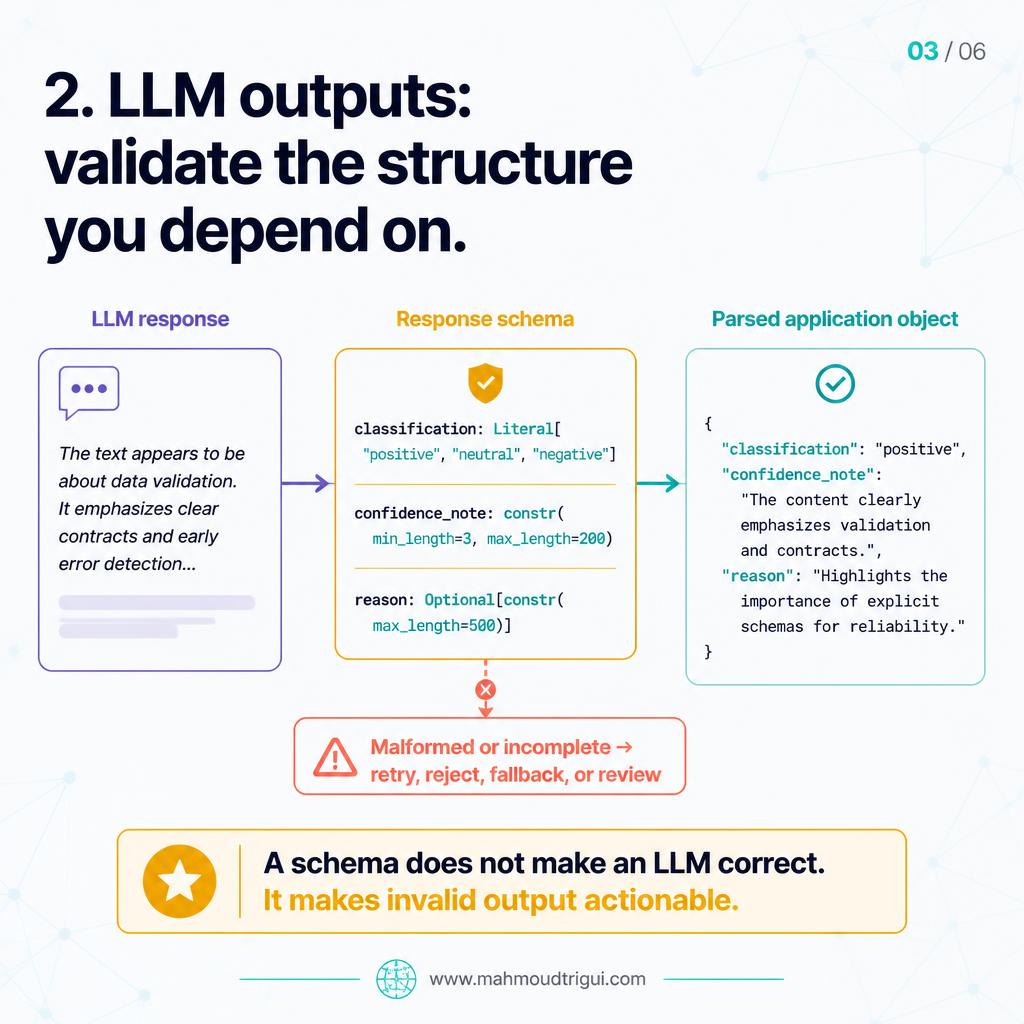
Define the structure the application depends on: required fields, allowed values, length limits, and nested objects. The schema does not make the model correct — it makes invalid output actionable, so the app can validate, parse, retry, reject, or route for review.
Pipeline configuration
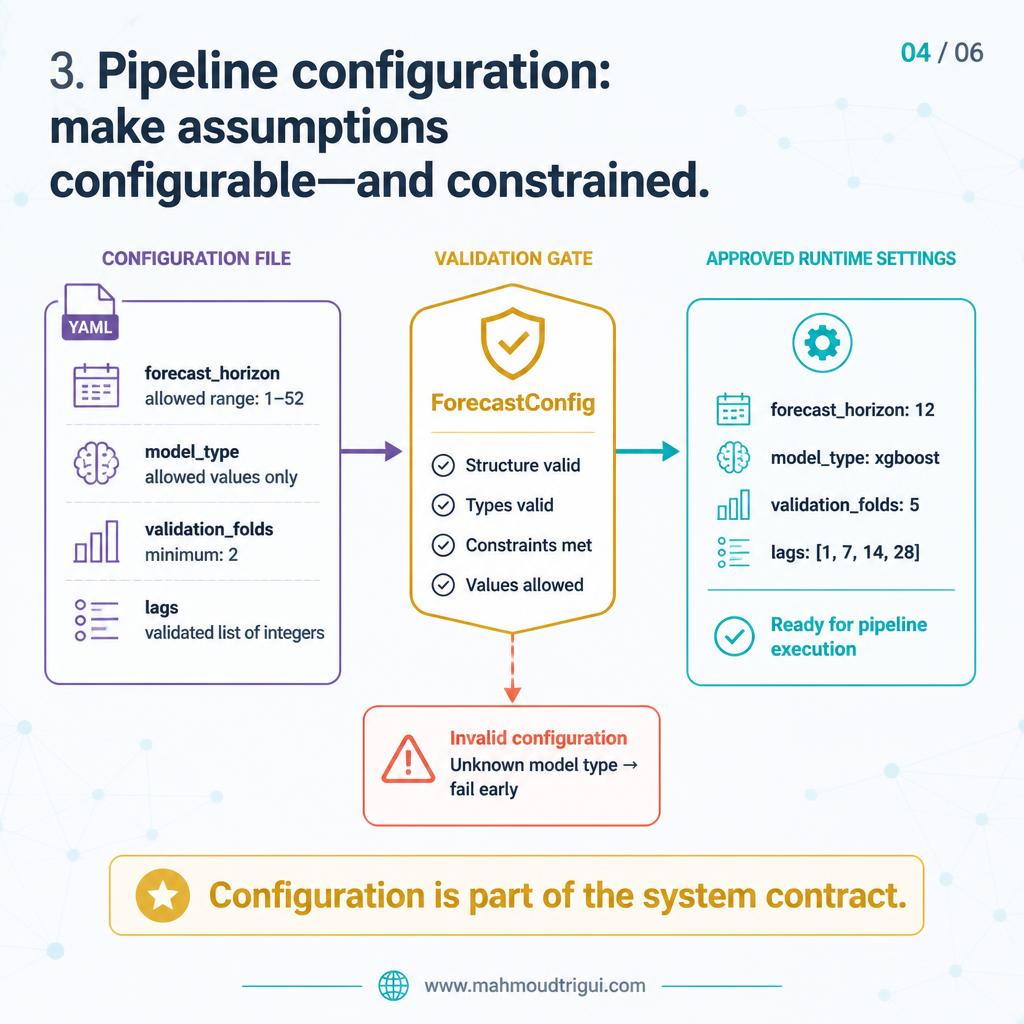
Make horizons, model settings, thresholds, and environment-dependent parameters explicit and constrained, so a typo or an unknown model type fails early instead of quietly changing pipeline behaviour.
Data exchanged between stages
Define the records one stage promises to produce and the next stage expects to consume, so a missing required field stops at the boundary instead of surfacing as a downstream failure.
The discipline is knowing where a schema belongs. Wrapping every internal function in a model adds ceremony without adding safety; the value is at the edges, where untrusted or implicit input enters and where a promise has to be kept between components.
Outcome
The practical effect is that failures move earlier and closer to their cause.
A configuration value outside its allowed range fails at load time instead of
producing a quietly different forecast three stages later. An LLM response
missing a required field becomes a retry, a fallback, or a review item rather
than a KeyError in unrelated business logic.
It is equally important what a schema does not do. It does not replace tests, monitoring, data-quality checks, or business validation, and it does not make an LLM correct. What it does is make assumptions visible, so they can be reviewed like any other part of the system.
That holds anywhere data crosses an API, a model, a file, a configuration layer, or an external service — which, in most production systems, is most of it.
Key Takeaway
Design insight: Pydantic is a contract tool, not just a validator. It matters at boundaries — API inputs, LLM output, pipeline configuration, and data handed between stages — where an unstated assumption becomes a production failure. Define the contract, validate at the boundary, then write the logic. Schemas do not guarantee correctness and never replace tests, monitoring, or business checks; they make invalid inputs and outputs harder to ignore, and they make assumptions reviewable before they fail.
Related
Structured Outputs for Reliable LLM Pipelines →Postman API Testing for LLM Workflow Contracts →A Valid LLM Response Is Not Necessarily a Safe Decision →Enterprise LLM Wrapper: The API Call Is the Smallest Part →Document AI Is a Pipeline, Not One LLM Call →Prompt Versioning: How LLMOps Makes Prompts Reversible →AI-Generated Validation Can Pass While Data Is Still Wrong →AI Pre-Flight Review Before You Write Model Code →Purged Cross-Validation Is Not for Every Time Series →The Prompt That Classifies 500 Images Without Training a Model →
FAQ
Is Pydantic only about validating API input?
No. Pydantic is most useful wherever an assumption crosses from one component into another: API requests, LLM responses, pipeline configuration, and data handed between pipeline stages. The schema states what is accepted or expected, and validation runs once at that boundary, so the logic behind it can assume a known shape.
Does a Pydantic schema guarantee that an LLM output is correct?
No. It guarantees structure, not correctness. A schema can confirm the model returned the fields, types, and allowed values your code actually depends on, which means malformed output becomes something you can retry, reject, route to a fallback, or send for review. Semantic accuracy still needs evaluation, and business rules still need their own checks.
Should I wrap every function in a Pydantic model?
Usually not. Wrapping every internal function adds ceremony without adding safety. The value is concentrated at the edges, where untrusted or implicit input enters a component and where one component makes a promise to another. Inside a single module, plain type hints and tests usually carry the weight.
What does Pydantic replace in a production ML pipeline?
Nothing outright. Schemas complement tests, monitoring, data-quality checks, and business validation. What they add is an explicit, reviewable statement of the contract, and failures that surface at the boundary where they were introduced instead of deep inside downstream logic.