Enterprise LLM Wrapper
"Just call the API" is the prototype version of AI engineering. The API call is the smallest part of the design.
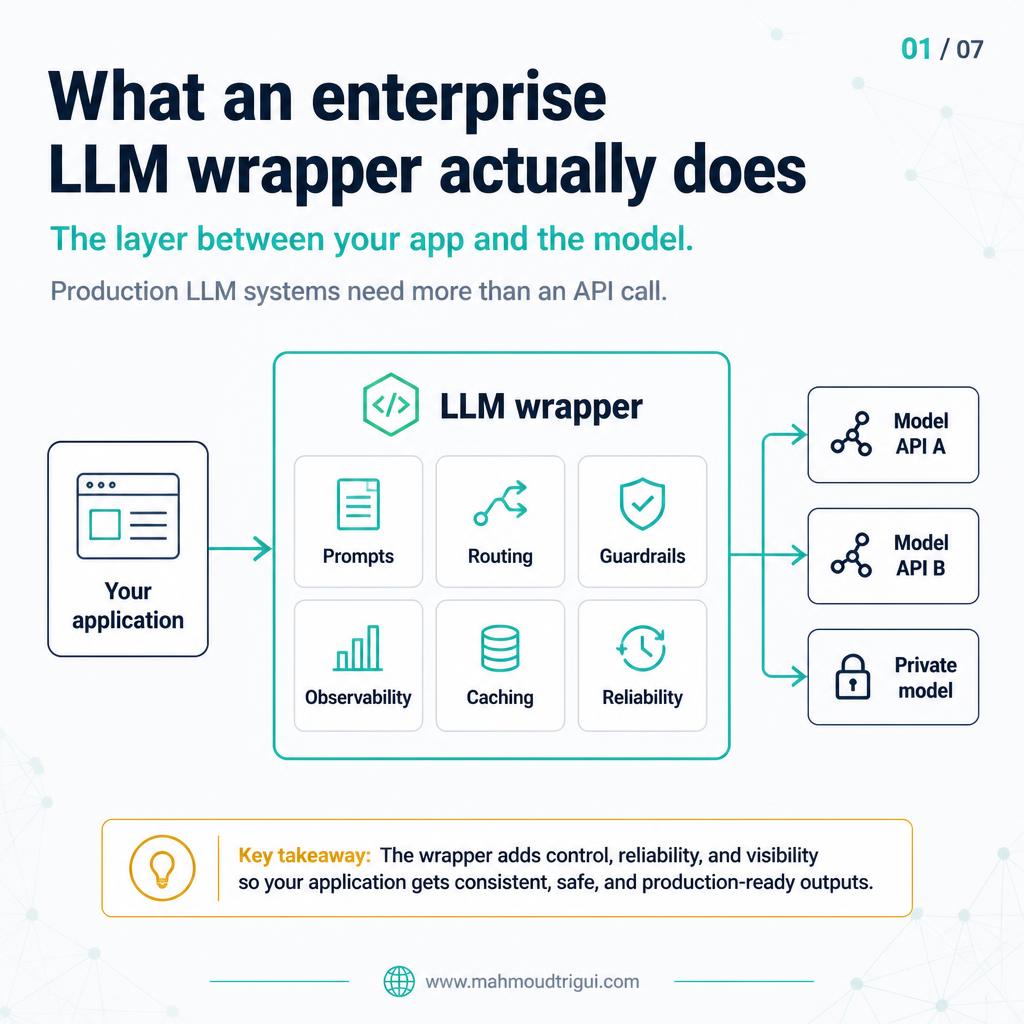
TL;DR: The API call is the commodity. The wrapper is the product. Production LLM engineering is the discipline of making inference reliable, observable, and controllable — not just calling the endpoint.
The Problem
"Just call the API" is the prototype version of AI engineering. The API call matters, but in a production LLM system, it is usually the smallest part of the design. Between your application and the model, you need an operating layer — often called an LLM wrapper, gateway, or orchestration layer. Its job is not to make the model smarter. Its job is to make the system reliable, observable, controlled, and affordable.
The Approach
A practical wrapper commonly handles six layers:
Prompt management
Versioned templates, variables, evaluation sets, and controlled prompt changes. Prompts should not be business logic hidden across application files.
Model routing
Send simple tasks to a faster or cheaper model. Route higher-risk tasks to a stronger model. Define fallbacks when a provider, region, or model is unavailable.
Guardrails and output contracts
Inspect inputs for policy or sensitive-data risks. Validate outputs against a schema before downstream systems use them. A fluent answer is not necessarily valid application data.
Observability and cost control
Track latency, failures, token use, model choice, estimated cost, and quality signals. If you cannot trace a bad answer, you cannot improve the system.
Caching
Reuse safe, repeatable answers when it makes sense. Exact-match caching is simple. Semantic caching needs careful thresholds because "similar" questions can still require different answers.
Reliability controls
Rate limits, queues, timeouts, retries with backoff, circuit breakers, and graceful fallback behavior.
Outcome
The key shift is this: an LLM API gives you inference. The wrapper gives you operational discipline around inference. Before calling an LLM feature "production-ready," ask one question: what happens when the output is invalid, the request spikes, the provider fails, or costs double? If the answer is unclear, the architecture is not finished.
Key Takeaway
Design insight: The API call is the commodity. The wrapper is the product. Production LLM engineering is the discipline of making inference reliable, observable, and controllable — not just calling the endpoint.
Related
Delegate Optuna Boilerplate to an AI Coding Assistant →TabPFN: a Pre-Trained Prior for Tabular ML →AI Production Readiness: 5 Red Flags →Structured Outputs for Reliable LLM Pipelines →AI-Assisted Coding: Specification →Open-Source AI Coding Agents →Rule vs Model vs LLM →LLM Image Classification →AI Replaced the Training Backlog →NLP Classification in 2018 vs LLMs Today →A Predictive Model Is Not a Decision System →Adversarial Validation →Multimodal Late Fusion →Stable vs Changing LLM Context →A Valid LLM Response Is Not Necessarily a Safe Decision →
FAQ
What is the key takeaway from "Enterprise LLM Wrapper"?
The API call is the commodity. The wrapper is the product. Production LLM engineering is the discipline of making inference reliable, observable, and controllable — not just calling the endpoint.
Who wrote this and what is it about?
This was written by Mahmoud Trigui, Senior Data Scientist. The API call is the smallest part of a production LLM system. What matters is the wrapper layer: prompt management, model routing, guardrails, observability, caching, and reliability controls.