NLP Classification in 2018 vs LLMs Today: The Interface Changed, the Engineering Didn't
In 2018 I ranked 1st in an IBM Watson AI Lab competition building an NLP classification workflow. Today a first prototype is much faster — but the engineering discipline behind quality is exactly the same.
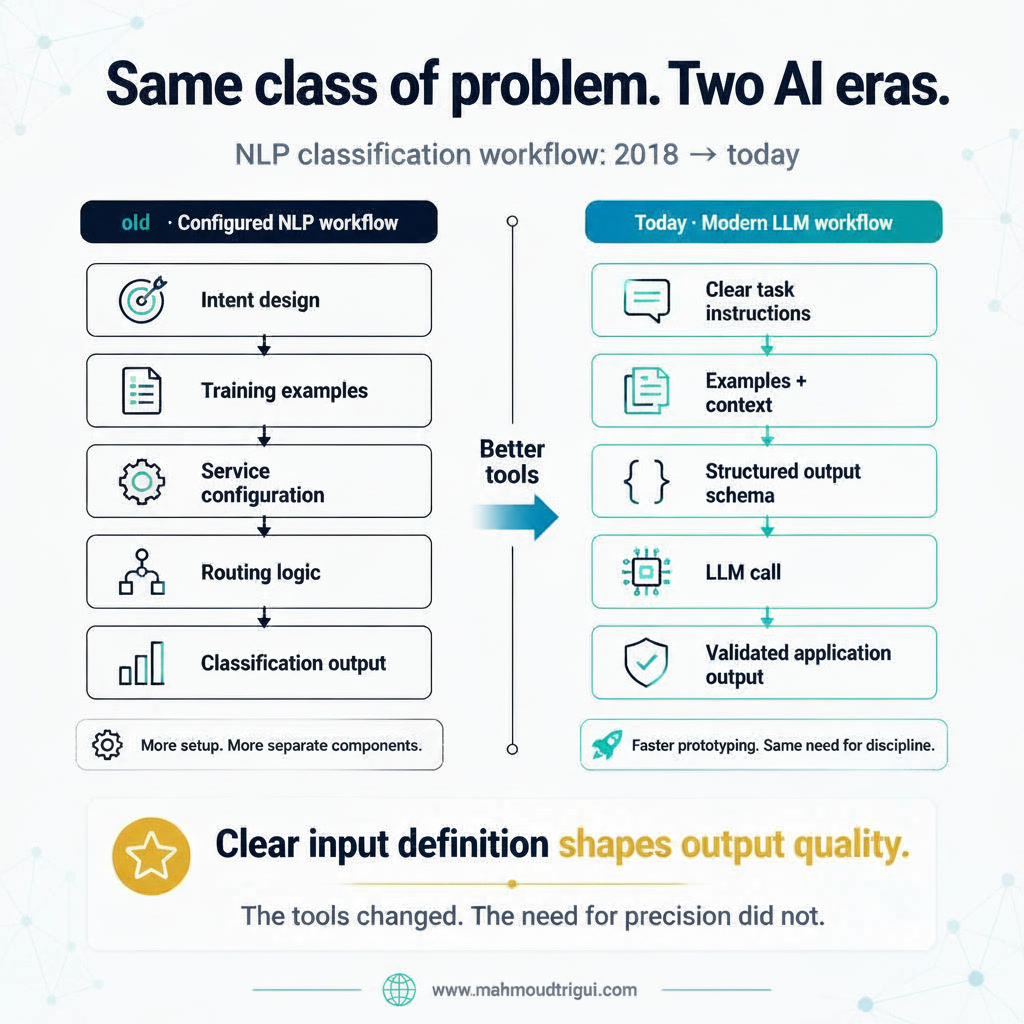
TL;DR: I do not think of this as "old AI versus new AI." It is the same engineering principles expressed through better tools. If your LLM output is unreliable, fix the instructions, the examples, and the contract — not the model.
The Problem
In 2018, I ranked 1st in an IBM Watson AI Lab competition. The task was to build an NLP classification workflow — and at the time, the path looked like this:
- Define intent boundaries
- Prepare and label training examples
- Configure the Watson services
- Build routing logic
- Test edge cases
- Iterate across multiple components
A working prototype took time because the system had many moving parts.
The Approach: Today
For a similar classification problem today, a first prototype can often start much faster:
- Define the task clearly in a system prompt
- Specify a structured output schema
- Call a modern LLM
- Validate the response in the application
The speed difference is real. But the more interesting lesson is what did not change.
What Did Not Change
In 2018, quality depended on
Clear intent boundaries · useful examples · explicit routing logic · reliable contracts between components
Today, quality still depends on
Clear instructions · useful context and examples · output schemas · well-defined workflow boundaries
The interface changed. The engineering discipline did not. A vague task definition still creates unreliable outputs. A poorly specified contract still breaks downstream systems. And a demo that works once is still not the same as a system you can operate.
Key Takeaway
Design insight: I do not think of this as "old AI versus new AI." It is the same engineering principles expressed through better tools. If your LLM output is unreliable, fix the instructions, the examples, and the contract — not the model.
Related
Document AI Starts Before Extraction: Route First →Preprocessing Is Vocabulary Design for Noisy NLP Text →Structured Outputs for Reliable LLM Pipelines →Automate Maintenance, Keep Judgment Human →Open-Source AI Coding Agents →LLM Image Classification →Enterprise LLM Wrapper →Rule vs Model vs LLM →Multimodal Late Fusion →A Valid LLM Response Is Not Necessarily a Safe Decision → Postman API Testing for LLM Workflow Contracts →
Comments
FAQ
What is the key takeaway from "NLP Classification in 2018 vs LLMs Today: The Interface Changed, the Engineering Didn't"?
I do not think of this as "old AI versus new AI." It is the same engineering principles expressed through better tools. If your LLM output is unreliable, fix the instructions, the examples, and the contract — not the model.
Who wrote this and what is it about?
This was written by Mahmoud Trigui, Senior Data Scientist. In 2018 I ranked 1st in an IBM Watson AI Lab NLP classification competition. The tools have changed, but the engineering discipline that made it work hasn't — clear instructions, useful examples, and well-defined contracts still decide quality.