LightGBM vs XGBoost in 2026: the differences that actually matter
There is no universal winner. After years of using both in competitions and production, the gap between them is often smaller than the gap created by better features.
TL;DR: The algorithm debate is interesting. But the data representation usually decides the project. Spend your time on features, labels, and leakage checks — not on choosing between two excellent libraries.
Visual Summary
The Problem
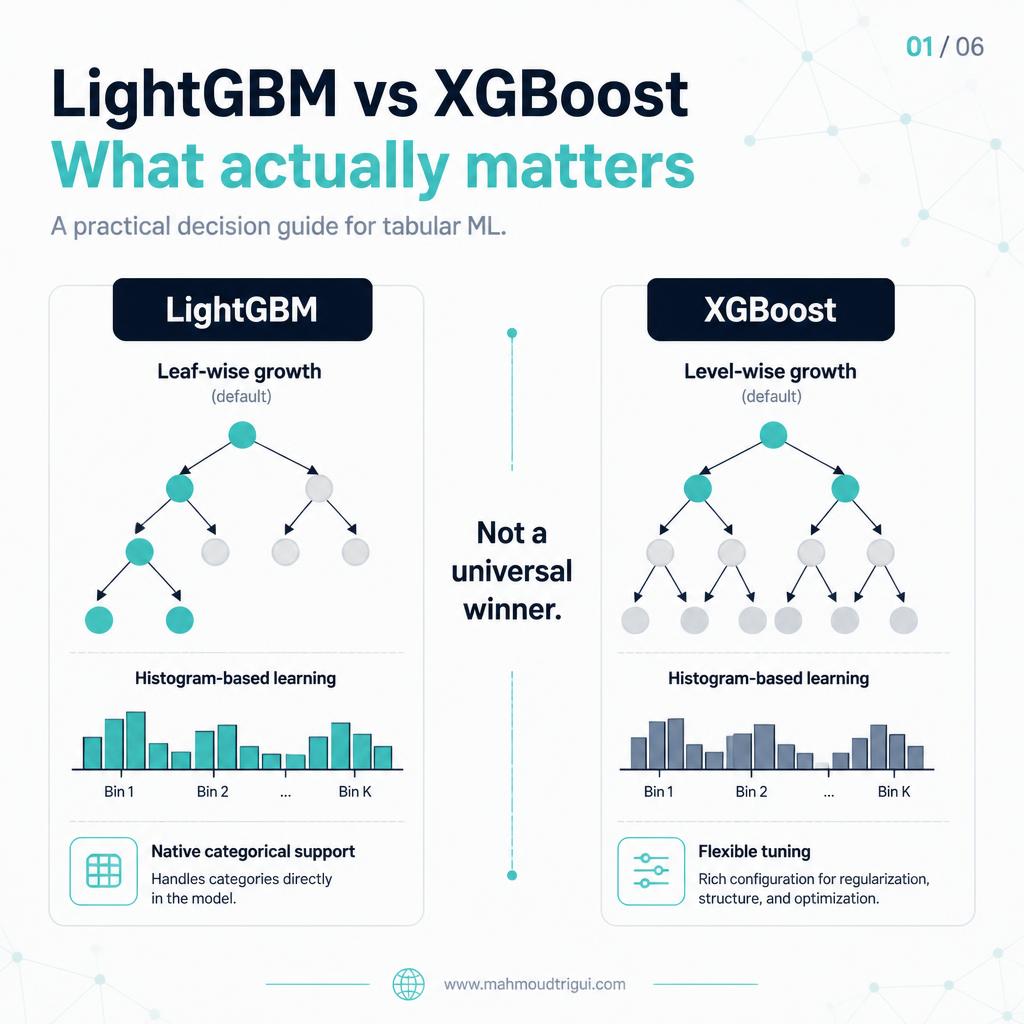
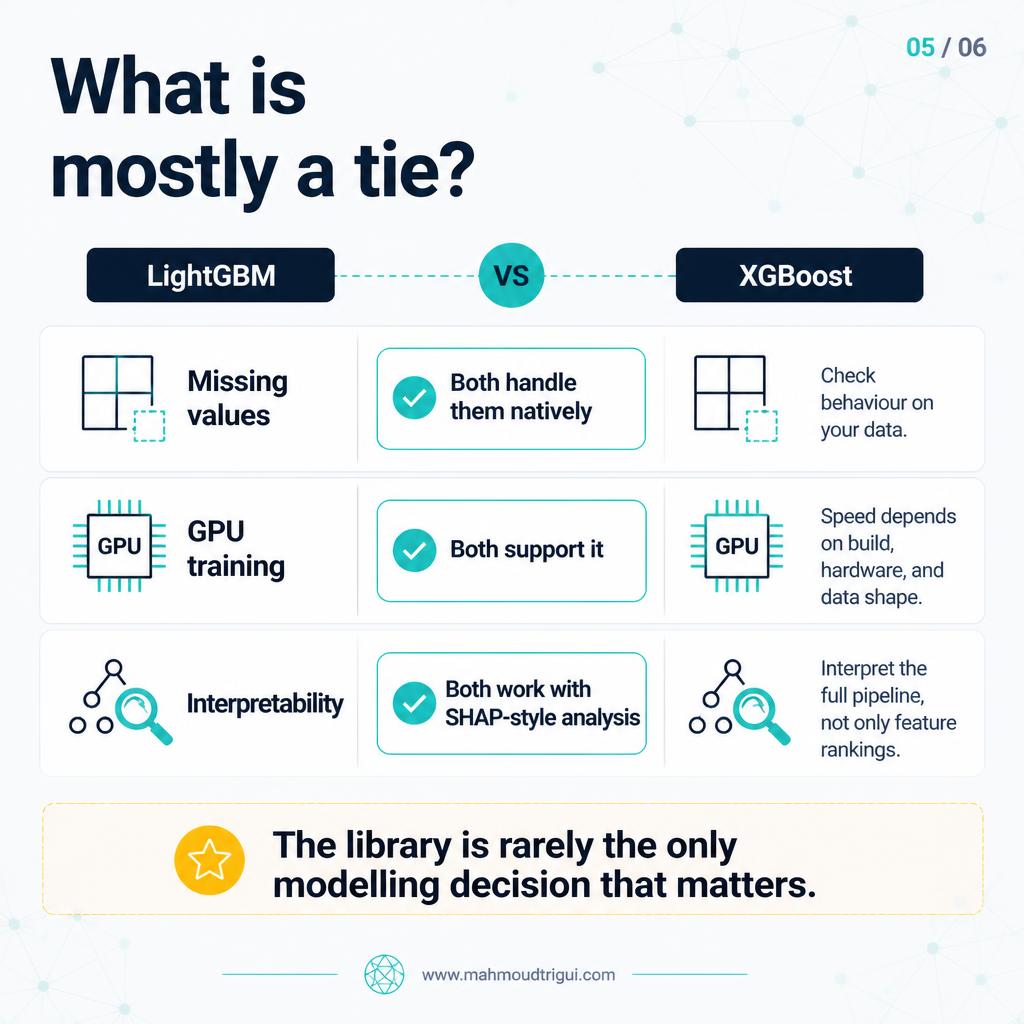
Every tabular ML project eventually arrives at the same question: LightGBM or XGBoost? Both are excellent gradient boosted tree libraries. On a well-prepared dataset, the gap between them is often smaller than the gap created by better features, a better validation split, or removing leakage.
The debate is interesting, but the data representation usually decides the project.
The Approach
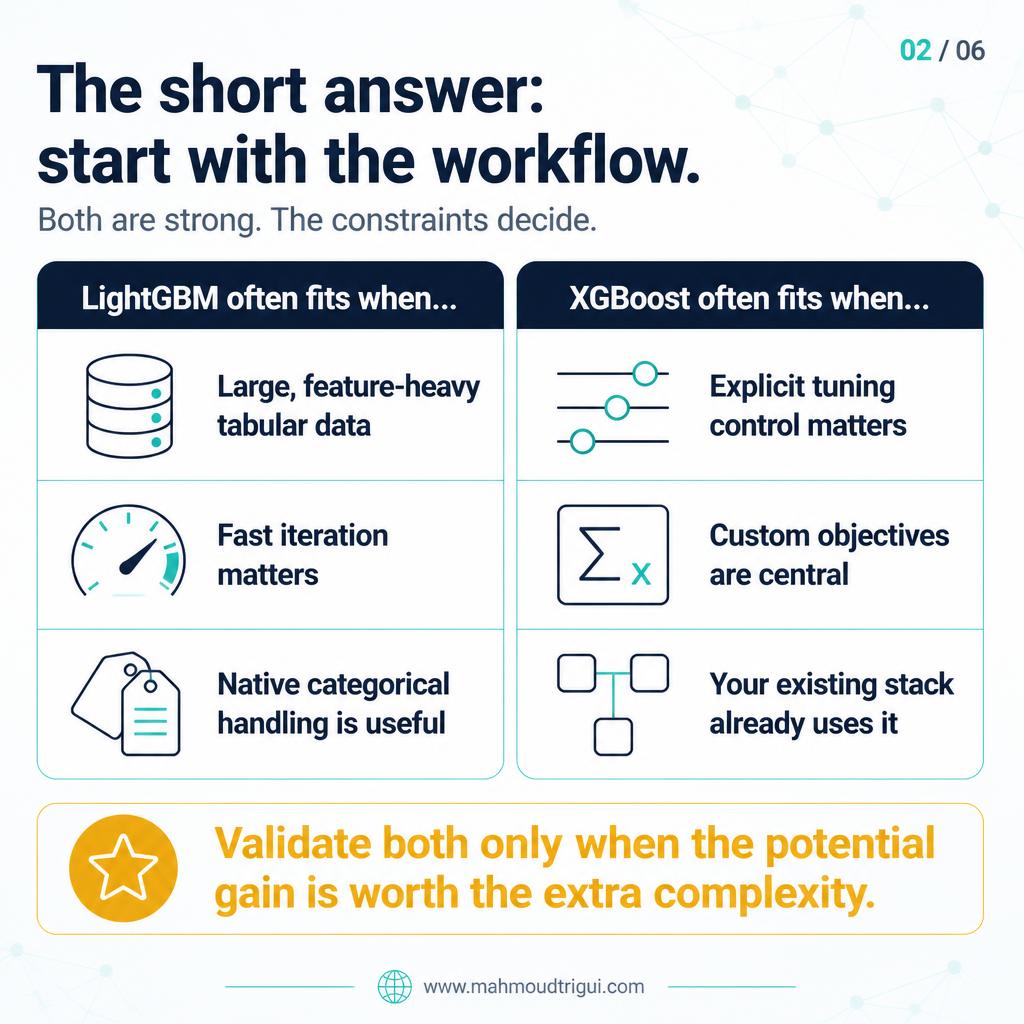
I do not start with "which library is best?" I start with "what is expensive, risky, or awkward in this pipeline?" That question leads to a practical rule of thumb:
Large, feature-heavy tabular datasets
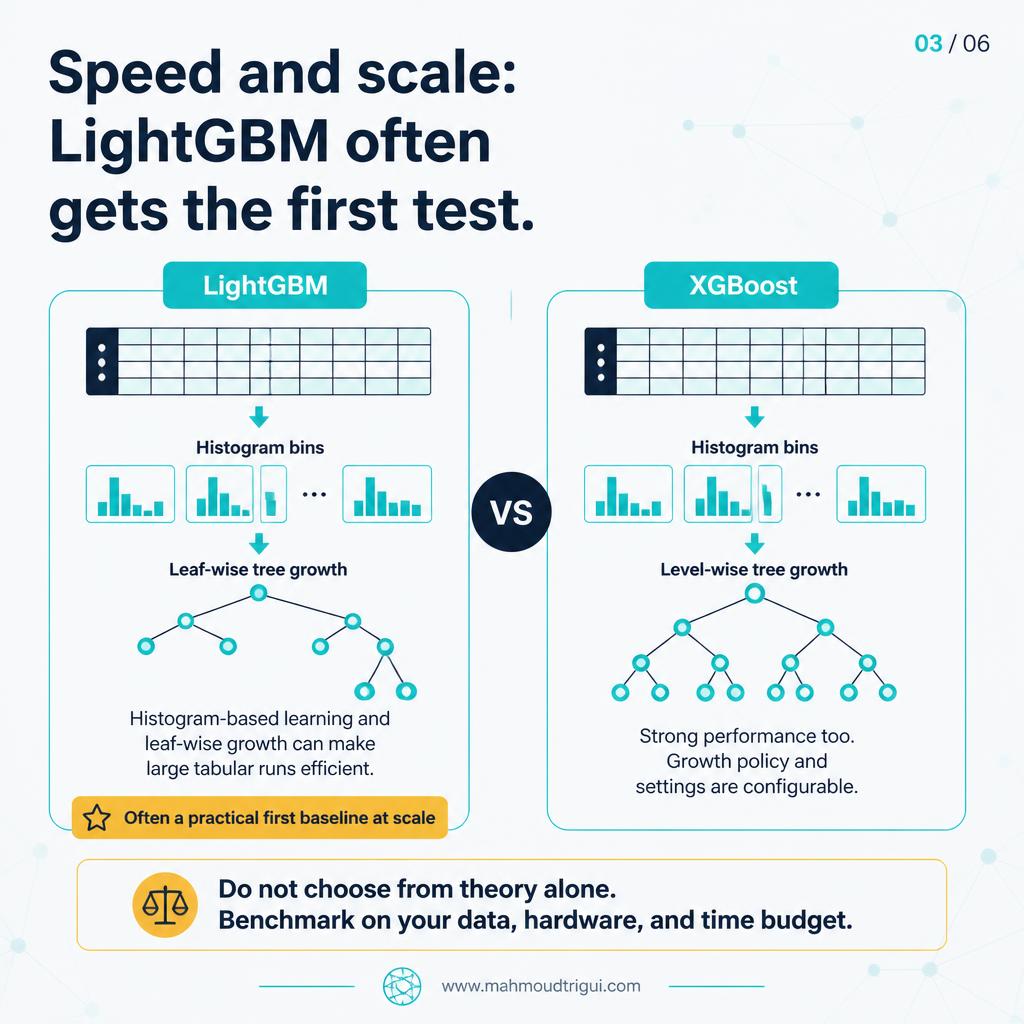
I often start with LightGBM. Its histogram-based training and leaf-wise growth can be very efficient when row count, feature count, or iteration count grows.
Highly explicit regularization or custom objectives
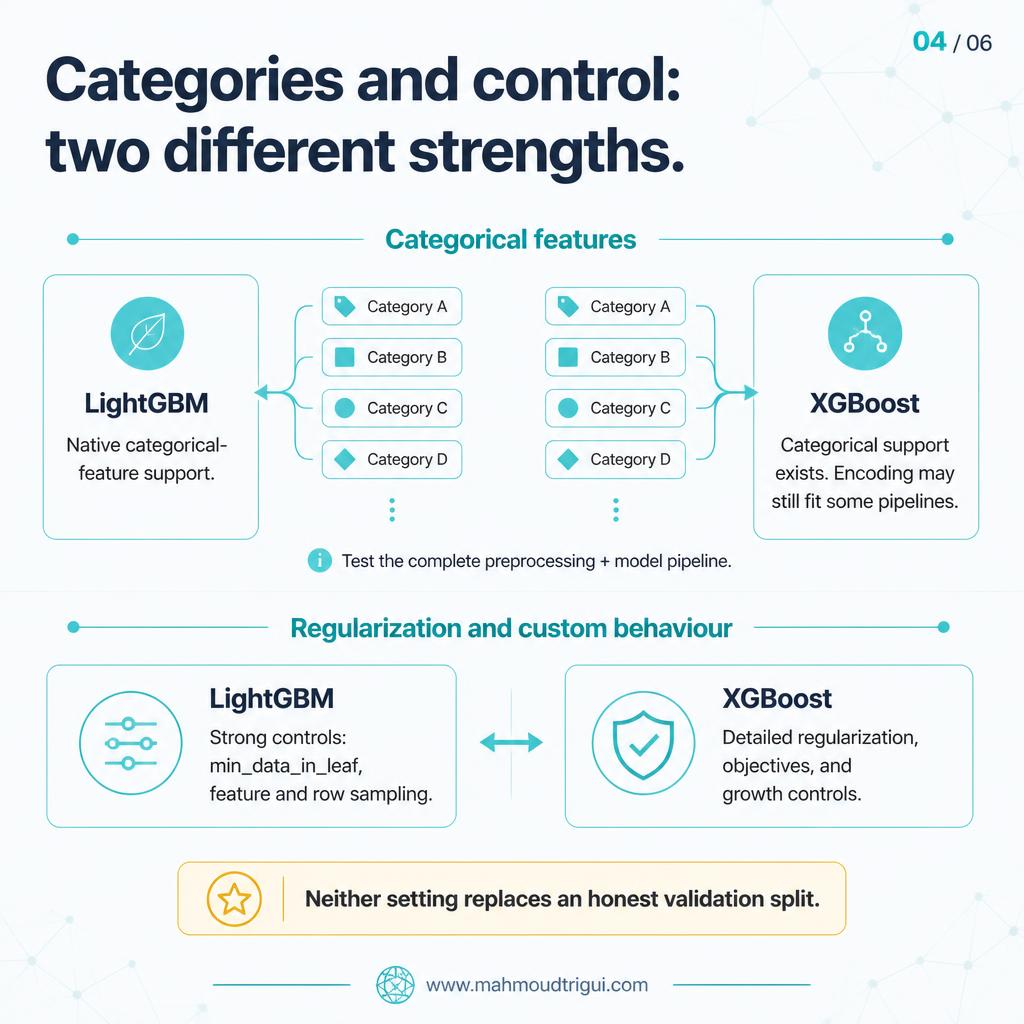
I am happy to start with XGBoost. It gives strong control over regularization, sampling, objectives, and tree growth settings.
Categorical features
LightGBM has native categorical handling. XGBoost also supports categorical features, although encoding may still be the more practical choice in some pipelines. Either way: validate the full pipeline, not just the model.
Missing values and GPU training
Both support them. Neither is an automatic winner. Your hardware, build, data shape, and deployment constraints matter.
The Default Workflow
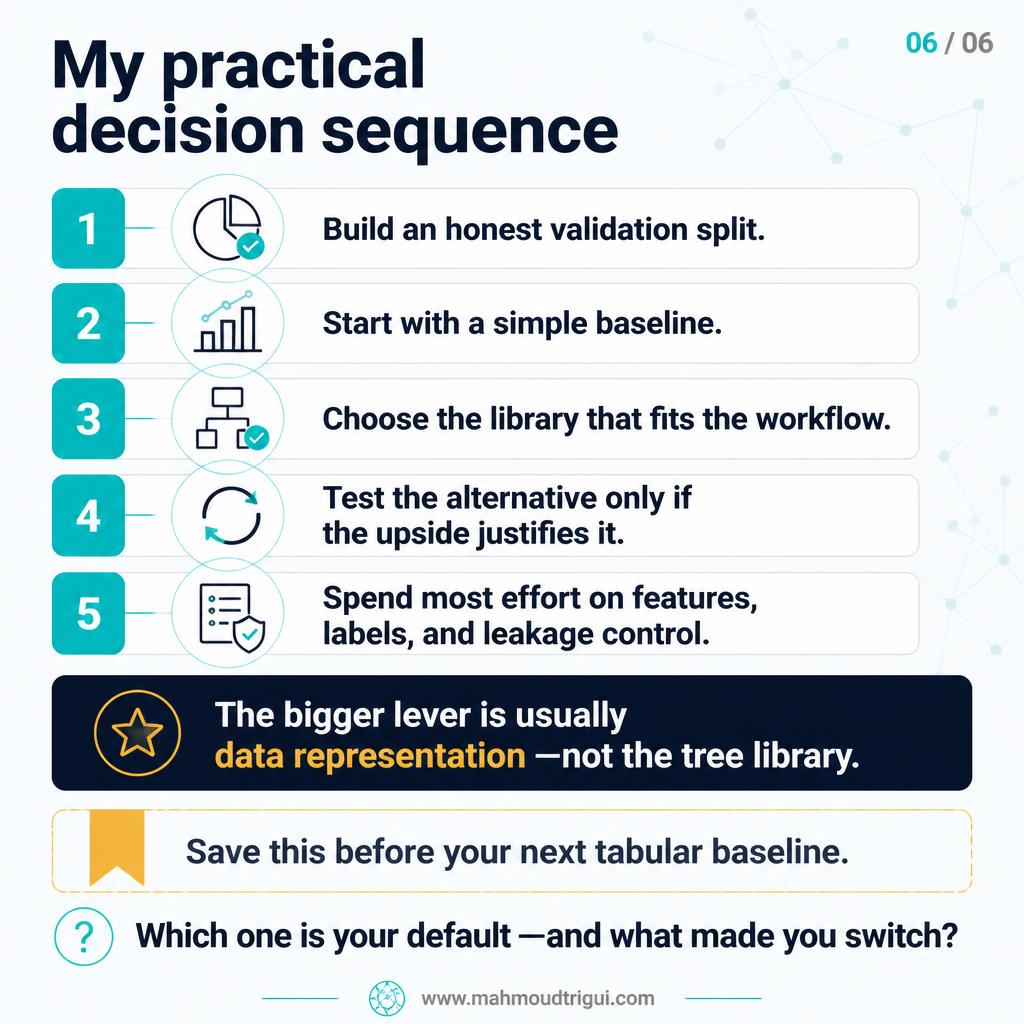
- Step 1: Build an honest split.
- Step 2: Establish a baseline.
- Step 3: Try the library that fits the workflow.
- Step 4: Test the other one only when the potential gain justifies the cost.
- Step 5: Spend most of the time on features, labels, and leakage checks.
Key Takeaway
Design insight: The algorithm debate is interesting. But the data representation usually decides the project. Spend your time on features, labels, and leakage checks — not on choosing between two excellent libraries.
Related
SMOTE Is Not the Default Answer to Class Imbalance → Polars Lazy Execution: More Than a Faster pandas → Delegate Optuna Boilerplate to an AI Coding Assistant →TabPFN: a Pre-Trained Prior for Tabular ML →Cyclical Encoding: Stop One-Hot Encoding Months →Seed Sensitivity Is Part of Model Selection →Automate Maintenance, Keep Judgment Human →isnull() Is a Feature →Encoding Is a Modeling Decision →SHAP Waterfall Local Explanation →Enterprise LLM Wrapper →MLforecast Forecasting Pipeline →Zero-Shot Forecasting Changes the Baseline →A Strong AutoML Baseline Can Beat Hand-Tuned Models →
CatBoost Ordered Target Encoding: Controlling the Leak →FAQ
What is the key takeaway from "LightGBM vs XGBoost in 2026"?
The algorithm debate is interesting. But the data representation usually decides the project. Spend your time on features, labels, and leakage checks — not on choosing between two excellent libraries.
Who wrote this and what is it about?
This was written by Mahmoud Trigui, Senior Data Scientist. After years of using both LightGBM and XGBoost in competitions and production, here is the practical rule of thumb for when to choose each gradient boosted tree library.