CatBoost Ordered Target Encoding: Controlling the Leak
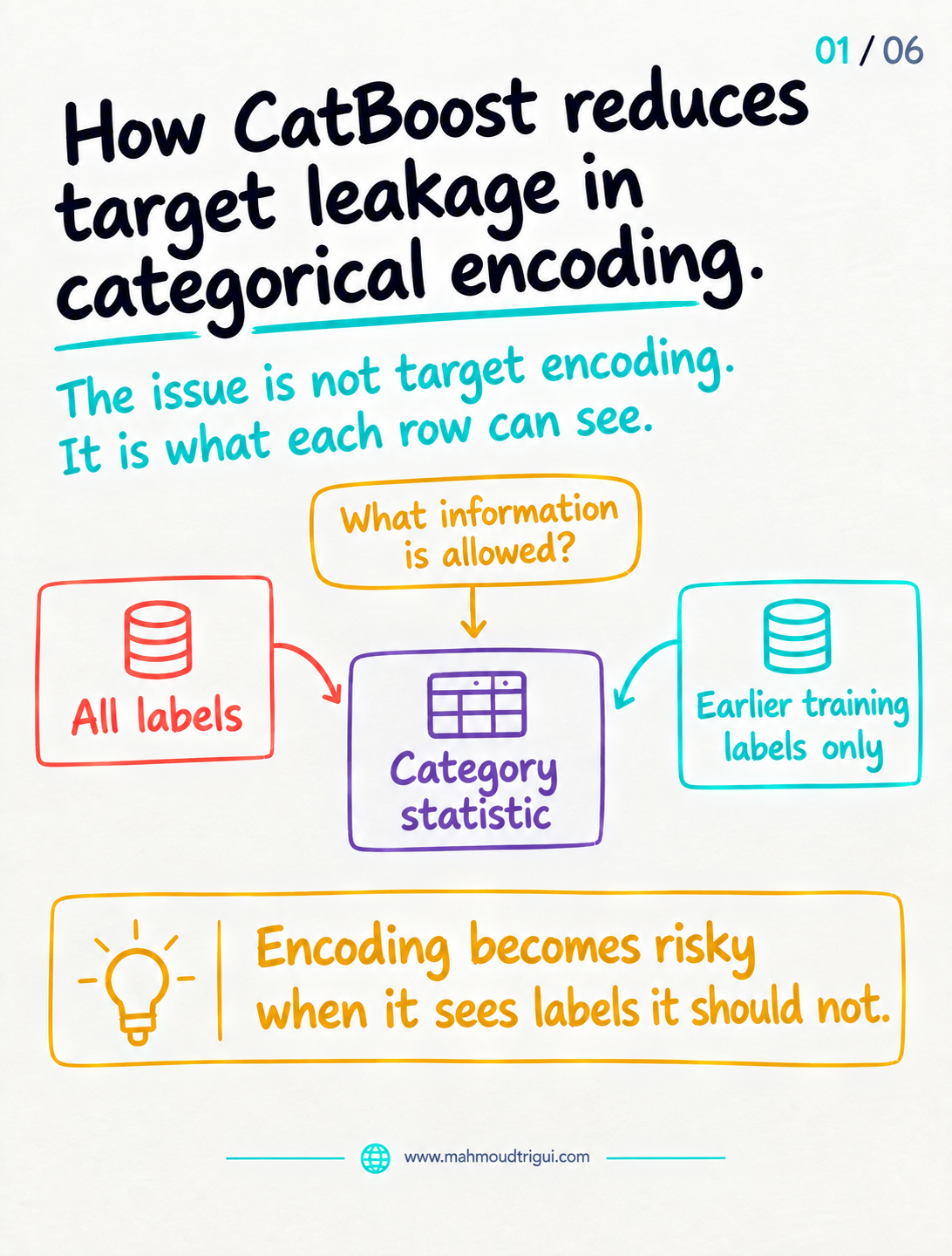
Target encoding is powerful, and it is easy to evaluate incorrectly. CatBoost's ordered target statistics control one specific leakage risk — but what each row is allowed to see is still my decision, not the library's.
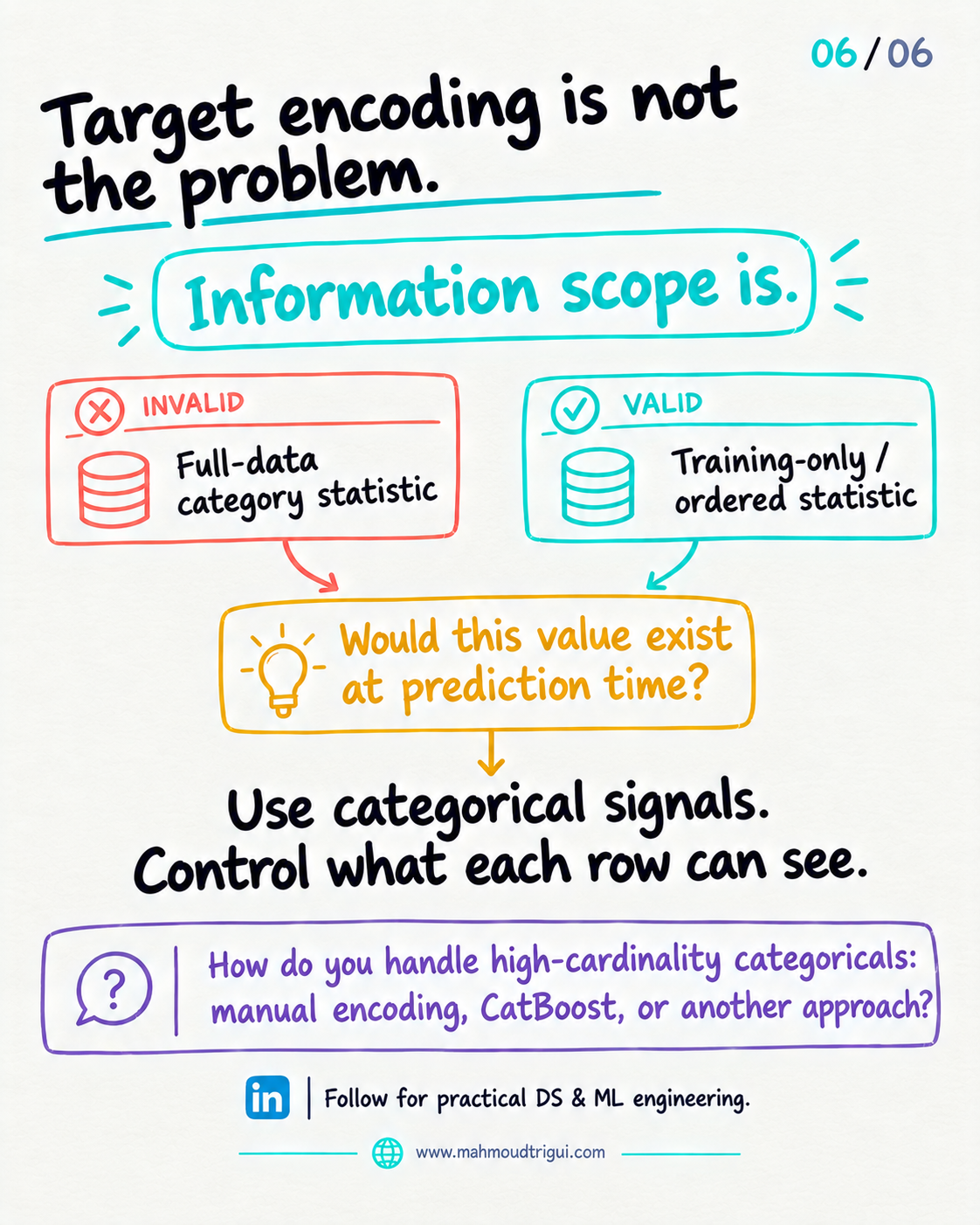
TL;DR: Target encoding is not the problem — information scope is. Leakage appears the moment a category statistic is computed from labels the model would not have at prediction time. CatBoost's ordered target statistics remove one specific version of that risk, since a row never encodes itself. The split, the feature availability, and the external aggregations still decide whether the number is real. The gate I ask for every time: would this value exist at prediction time?
Visual Summary
The Problem
Target encoding is one of the most effective ways to keep a high-cardinality categorical signal inside a tabular model. Replace a category with the average target observed for that category, and a column with thousands of levels turns into a numeric feature a gradient boosted tree can split on directly. It works, and it is one of the first things I reach for on telecom and churn data.
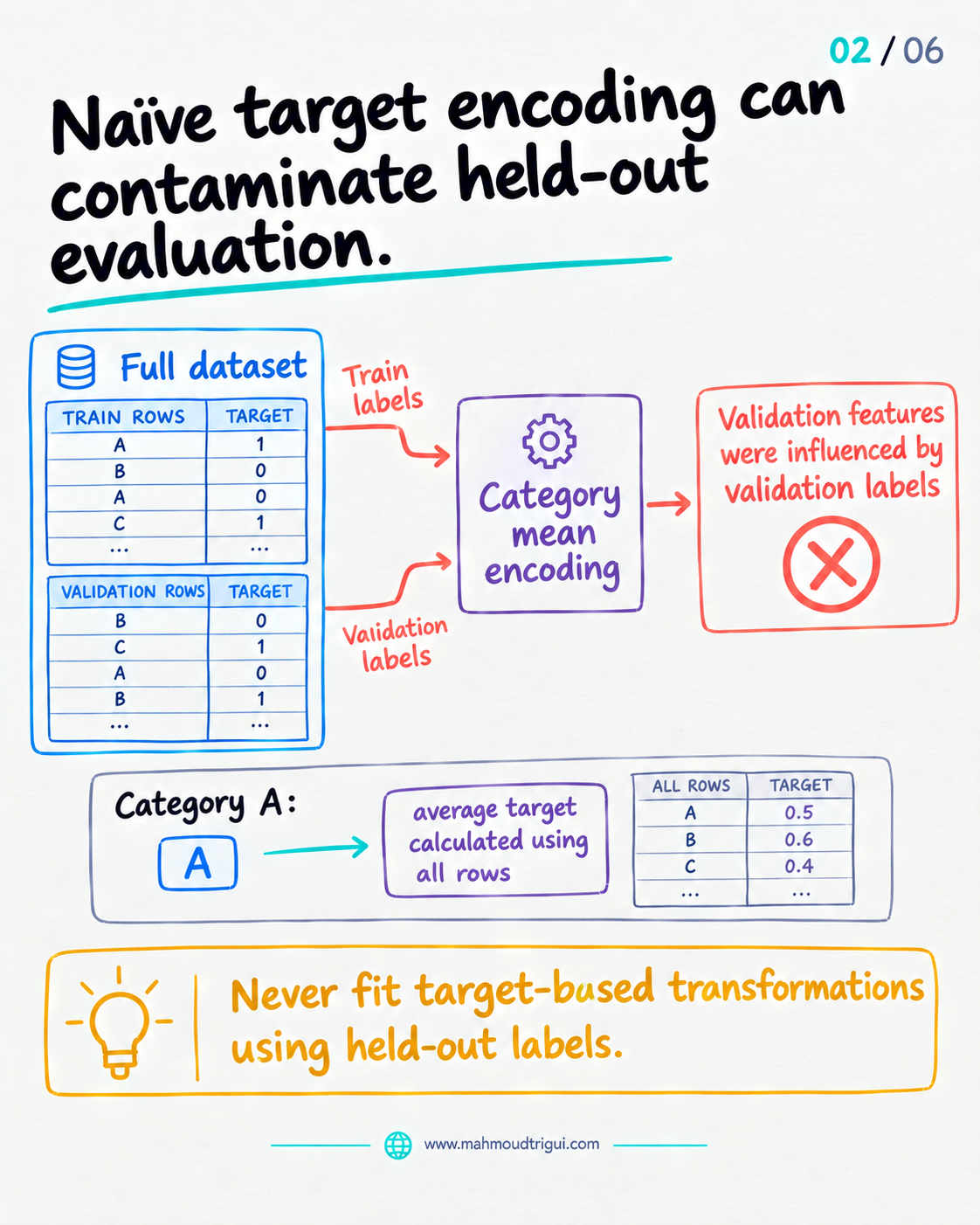
The failure mode is not the technique. It is the evaluation. If the category statistic is calculated on the full dataset, then a validation row's encoded value has already been influenced by labels that will not exist at scoring time — its own label, and the labels of its held-out neighbours. Offline evaluation then looks better than it has any right to, and the model inherits a signal it will never receive in production.
The subtlety is that nothing crashes. The metric moves in the right direction, the feature importance looks reasonable, and the drop in accuracy after deployment is gradual enough to be blamed on drift rather than on the encoder.
The Approach
The fix is not to abandon the encoding. It is to decide, explicitly, which information each row is allowed to use, and then hold that line everywhere. Concretely, that means four controls.
Fit the encoding on training rows only
Held-out labels must never enter a transformation. Fit the category mapping on the training fold, then apply that same frozen mapping to the validation rows. This is the single control that removes most of the contamination, and it is the one most often skipped in a quick notebook run.
Compute category statistics in an ordered permutation
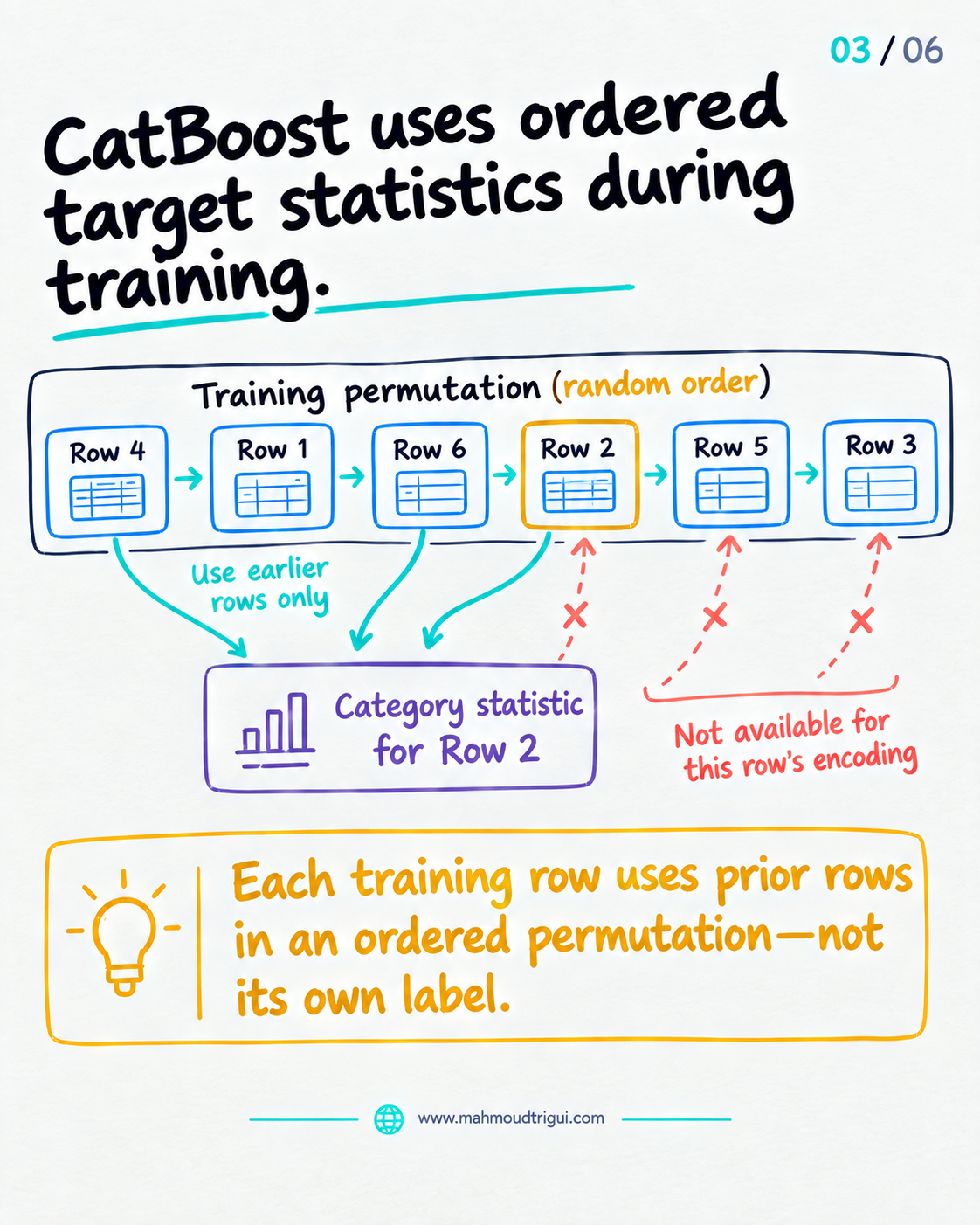
CatBoost handles this natively with ordered target statistics. Instead of encoding each training row using all training labels, it shuffles the rows and builds a row's category statistic only from rows that appeared earlier in that ordering. The row never uses its own target to create its own categorical representation.
Shrink toward a global prior
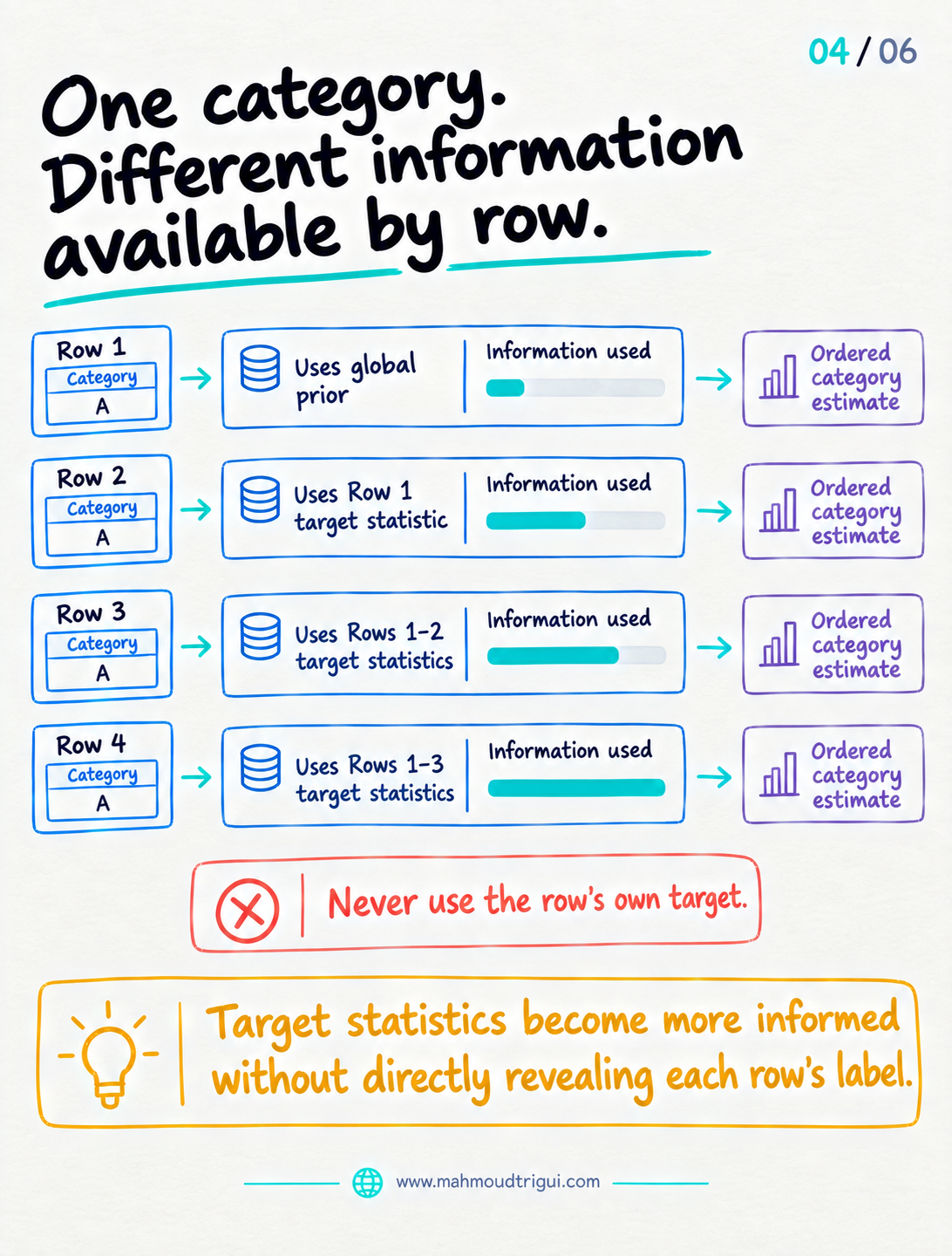
Early rows in the ordering have almost no evidence, so the estimate is blended toward the global target mean. Without that smoothing, the first rows of a rare category get an extreme value from a single observation, and the encoded column ends up noisier than the raw category it replaced.
Keep external aggregations versioned and out of the fold
Aggregations built outside the pipeline — a customer-level table computed once and joined back in — are the most common silent leak, because they were fitted on labels the validation rows will never be allowed to use. Build them inside the training fold, from the same rows, with the same code path.
Outcome
What ordered target statistics actually buy is consistency between evaluation and prediction. At scoring time the encoding is built from the training mapping only, so if training encoded a row from the full label set and validation did the same, the two are simply not comparable. Once each row sees only prior rows in a permutation, the validation number means the same thing the production number will mean.
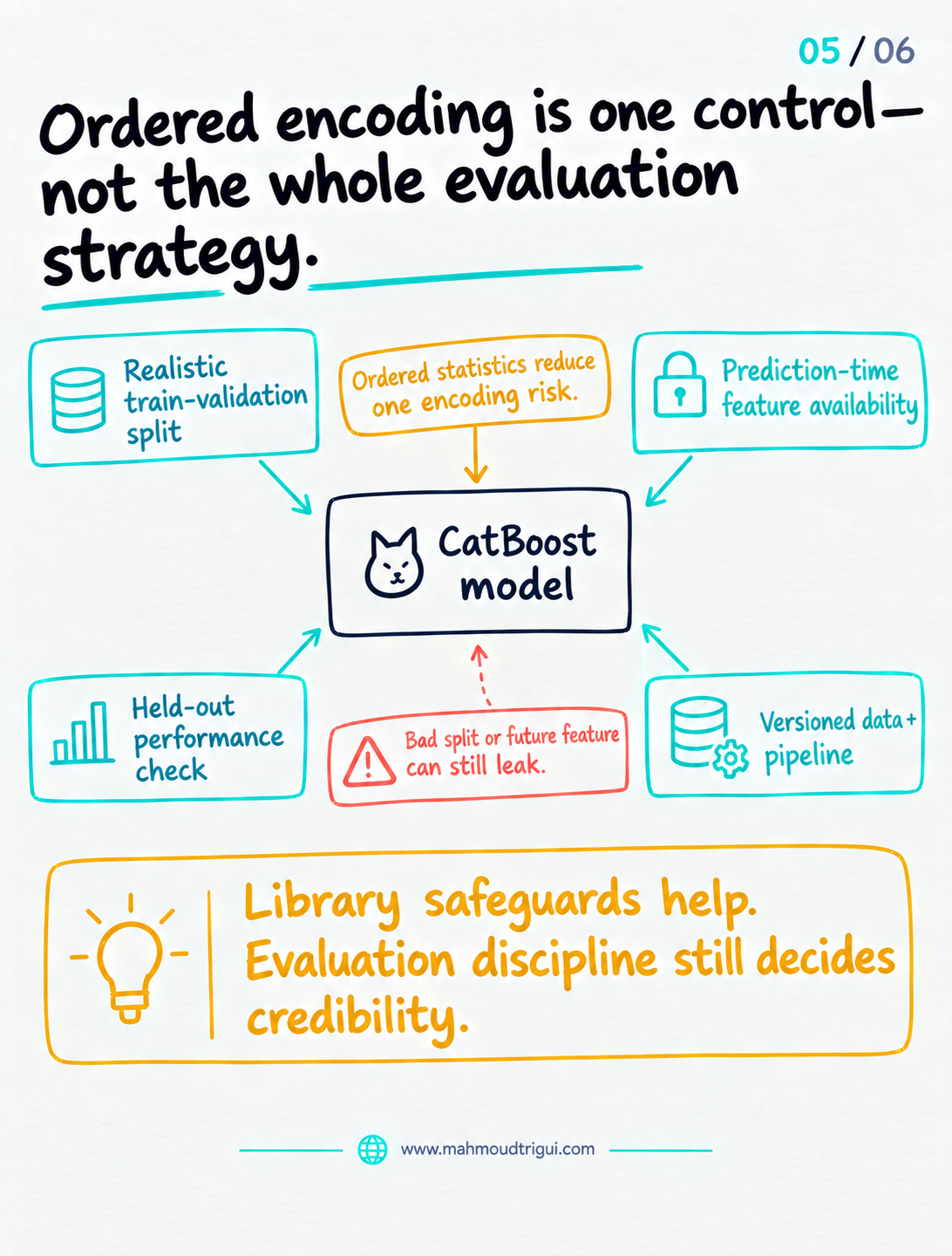
But it is one control, not a guarantee. CatBoost does not make a pipeline automatically leak-proof, and I still need realistic train-validation splits, time-aware evaluation whenever time matters, features that genuinely exist at prediction time, careful handling of external aggregations, and a genuine held-out performance check at the end.
That is also why CatBoost is often the practical choice for tabular problems with important, high-cardinality categorical variables: the safeguard lives inside the library rather than in a preprocessing step a future pipeline will forget to reproduce.
Key Takeaway
Design insight: Target encoding is not the problem — information scope is. Leakage appears the moment a category statistic is computed from labels the model would not have at prediction time. CatBoost's ordered target statistics remove one specific version of that risk, since a row never encodes itself. The split, the feature availability, and the external aggregations still decide whether the number is real. The gate I ask for every time: would this value exist at prediction time?
Related
Encoding Is a Modeling Decision, Not a Checkbox →Categorical Encoding Cheat Sheet →One Row Is a Modelling Decision: Customer or State? →AI Can Review Feature Code. It Cannot Approve It →Purged Cross-Validation Is Not for Every Time Series →The Most Dangerous Label in ML Looks Correct But Isn't →LightGBM vs XGBoost in 2026: the differences that actually matter →Unpack a Categorical Variable Into Behavioural Mechanisms →isnull() Is a Feature →TabPFN: a Pre-Trained Prior for Tabular ML →
FAQ
Does CatBoost prevent target encoding leakage?
No. CatBoost controls one specific risk during training: a row never encodes itself, because its category statistic is built only from rows earlier in a random training permutation. A realistic train-validation split, prediction-time feature availability, careful handling of external aggregations, and a held-out performance check are still your responsibility. A bad split or a future-dated feature still leaks.
What is naive target encoding and why does it contaminate validation?
Naive target encoding (category mean encoding) replaces a category with the average target of that category, computed on the full dataset. Because the average is built from train and validation rows together, validation features end up carrying information from validation labels. The model scores better offline for a reason that will not exist at prediction time.
How do CatBoost ordered target statistics work?
CatBoost randomly permutes the training rows. For a given row, the category statistic is computed only from rows that appeared earlier in that permutation, never from the row's own label and never from rows later in the order. Conceptually: row 1 uses the global prior, row 2 uses information from row 1, row 3 uses rows 1 and 2, and so on. Estimates get more informed without directly revealing any row's label.
Is target encoding safe to use at all?
Yes. Target encoding is not inherently wrong. Leakage appears when a category statistic is computed using information the model would not have at prediction time. The gate I apply to every encoded feature: would this value exist at prediction time? If the answer is no, the encoding is invalid regardless of how well it scores.