One Row Is a Modelling Decision: Customer or State?
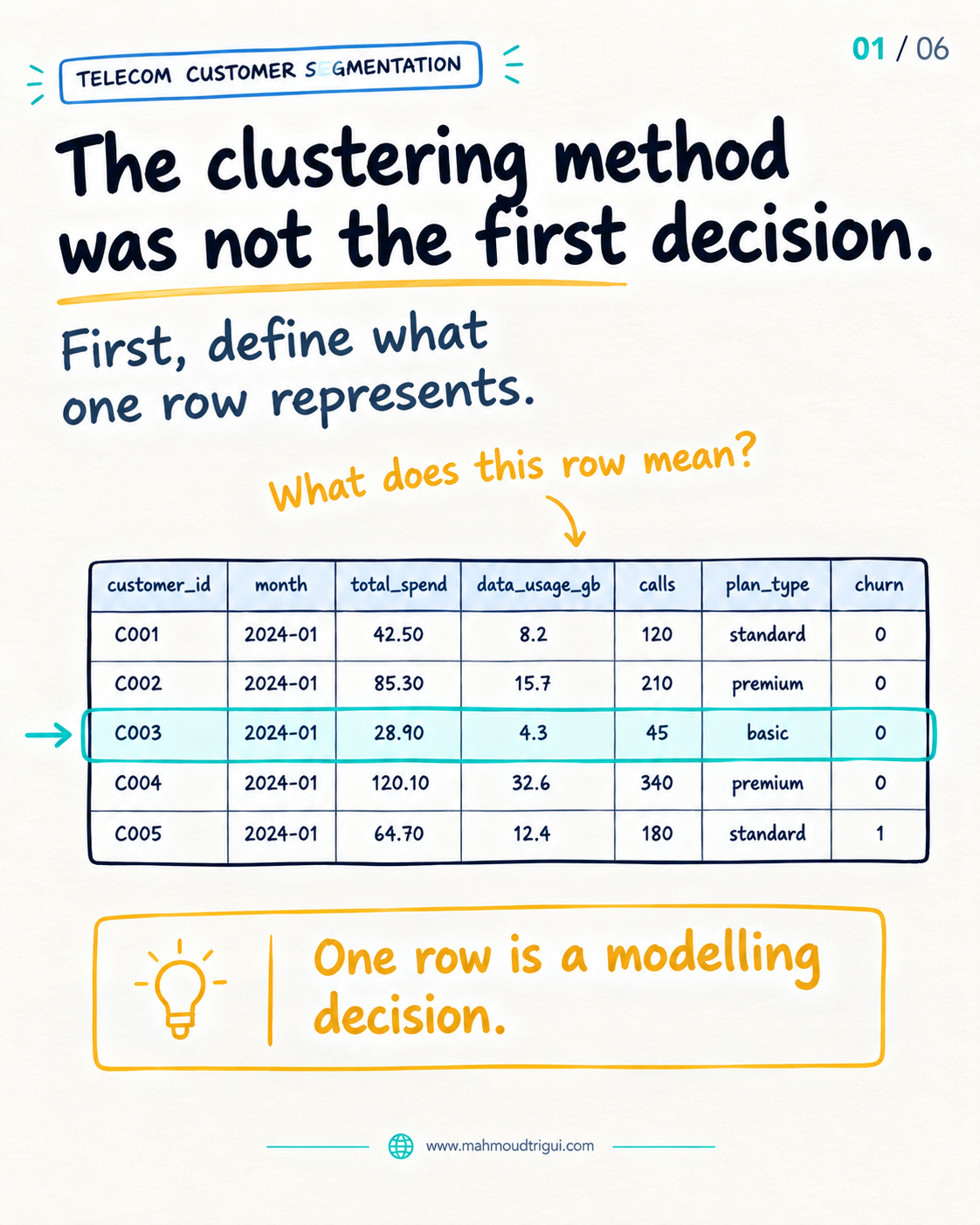
The hardest segmentation decision was not the clustering method. It was deciding what one observation means.
TL;DR: Customer segmentation starts with the observation unit: choose between one stable profile per customer or one behavioural snapshot per subscriber-month, and let the business decision drive the representation. One row is a modelling decision about what the segment represents — it defines what the clustering can learn, before any distance metric, normalisation, or method is chosen.
Visual Summary
The Problem
In a telecom customer-segmentation project, we had several months of behavioural history for each subscriber. Before selecting variables, normalising features, or choosing a clustering approach, we had to answer a more fundamental question: what does one observation mean?
There were two valid options — and they lead to different business uses.
The Approach
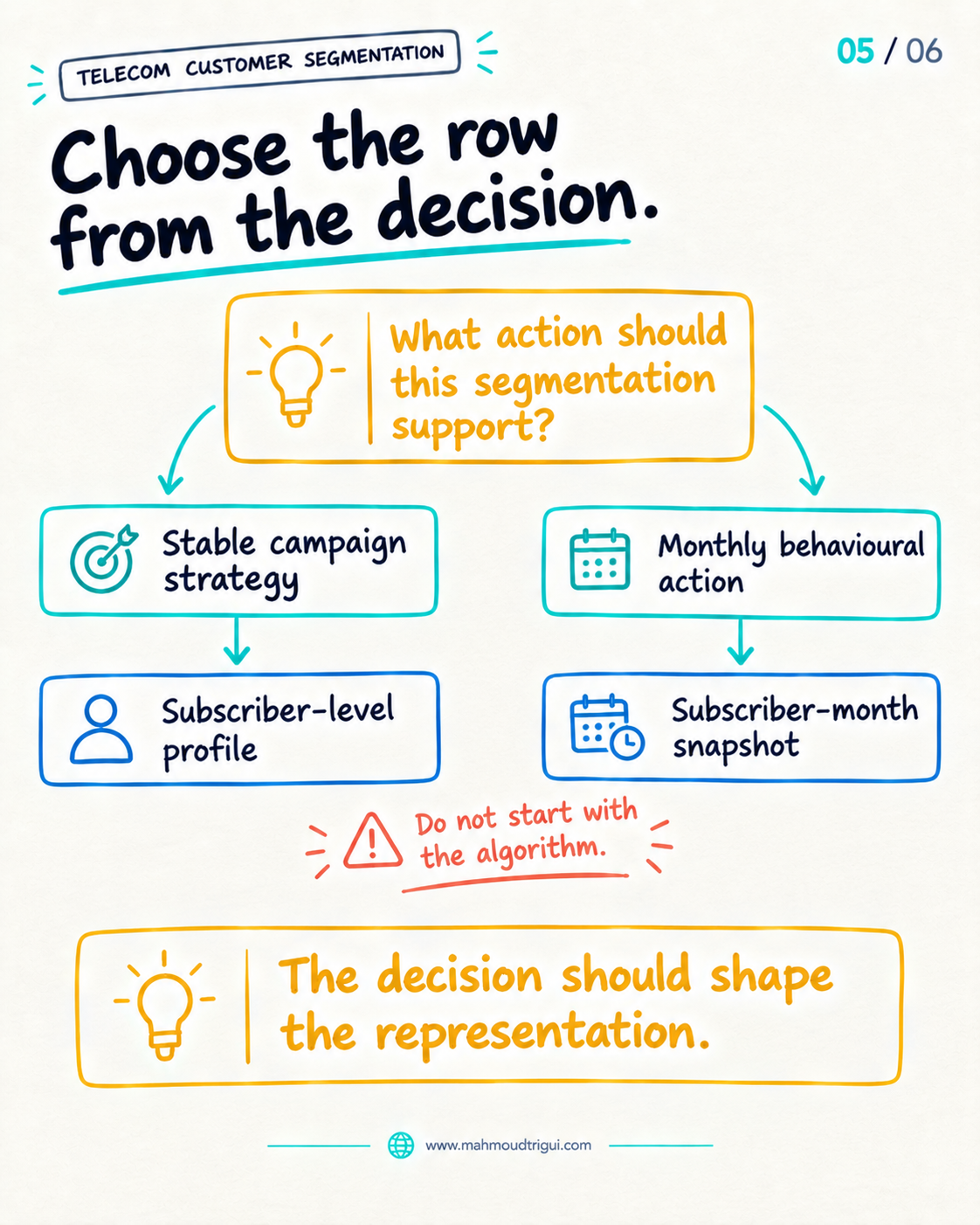
Two representation choices were on the table. Neither is universally better; the choice depends on the decision the segmentation is meant to support.
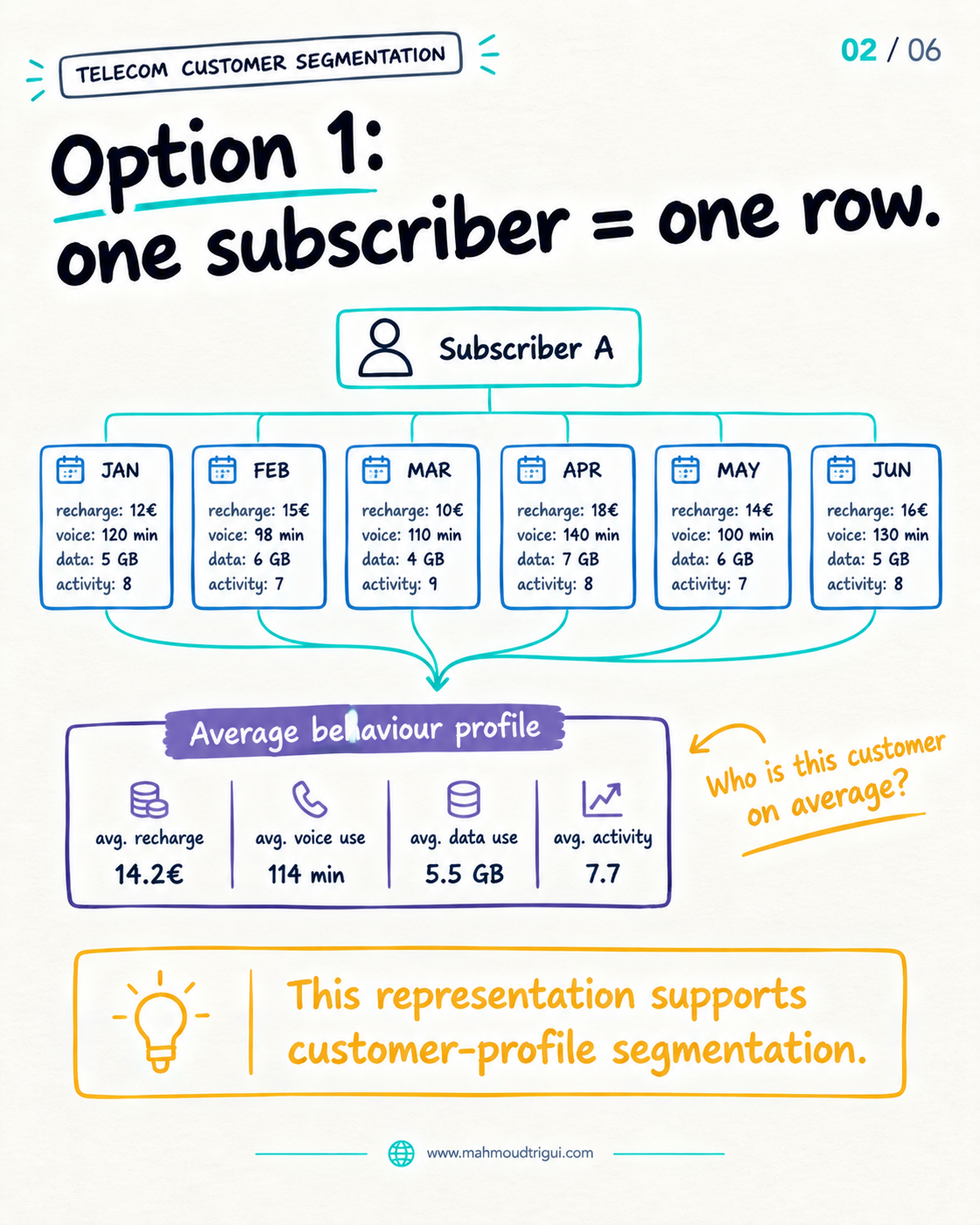
One subscriber = one row
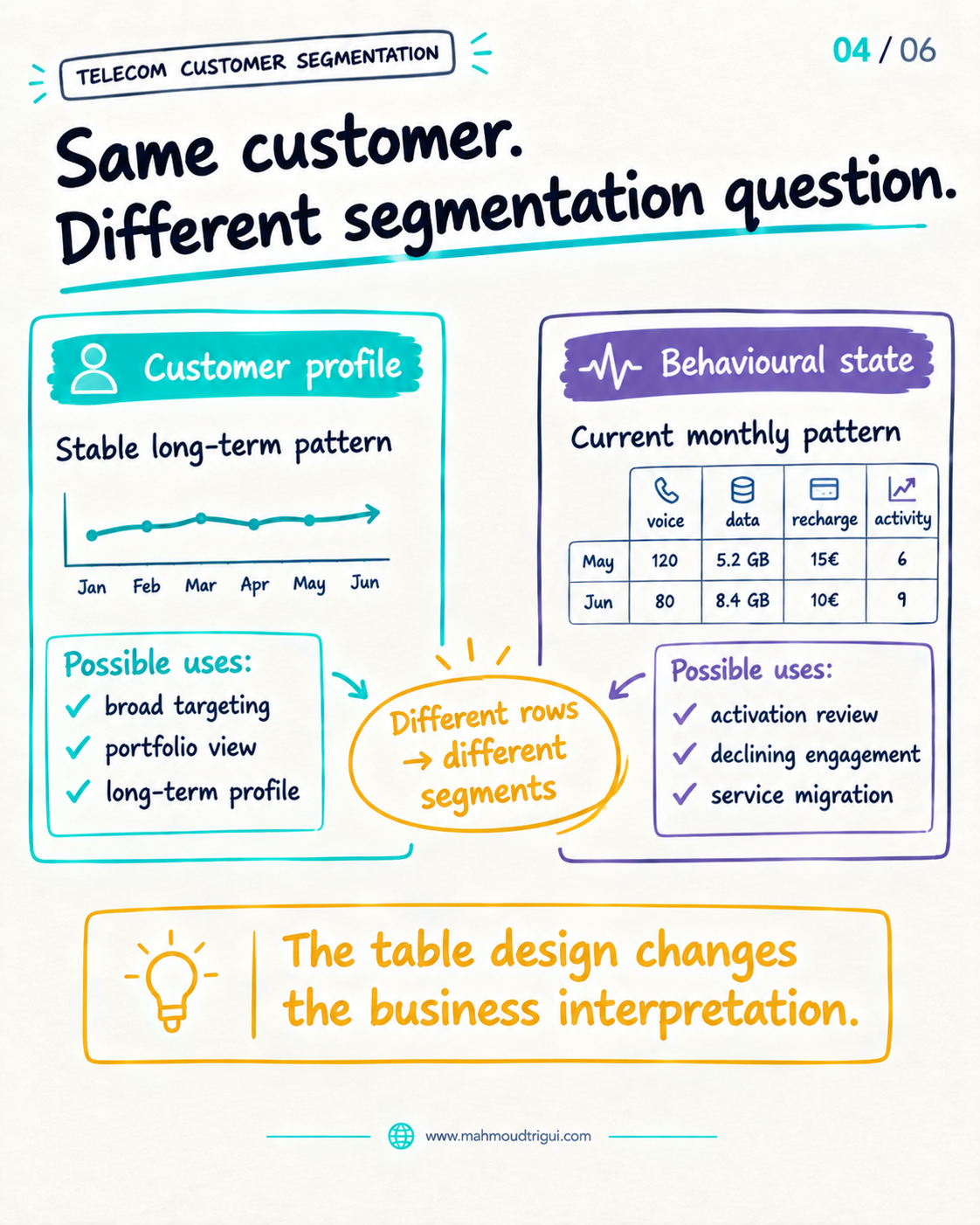
Aggregate several months into one behavioural profile: average recharge, ARPU, voice usage, data usage, opportunity activity level. This segments relatively stable customer profiles and answers "What type of customer is this, on average?"
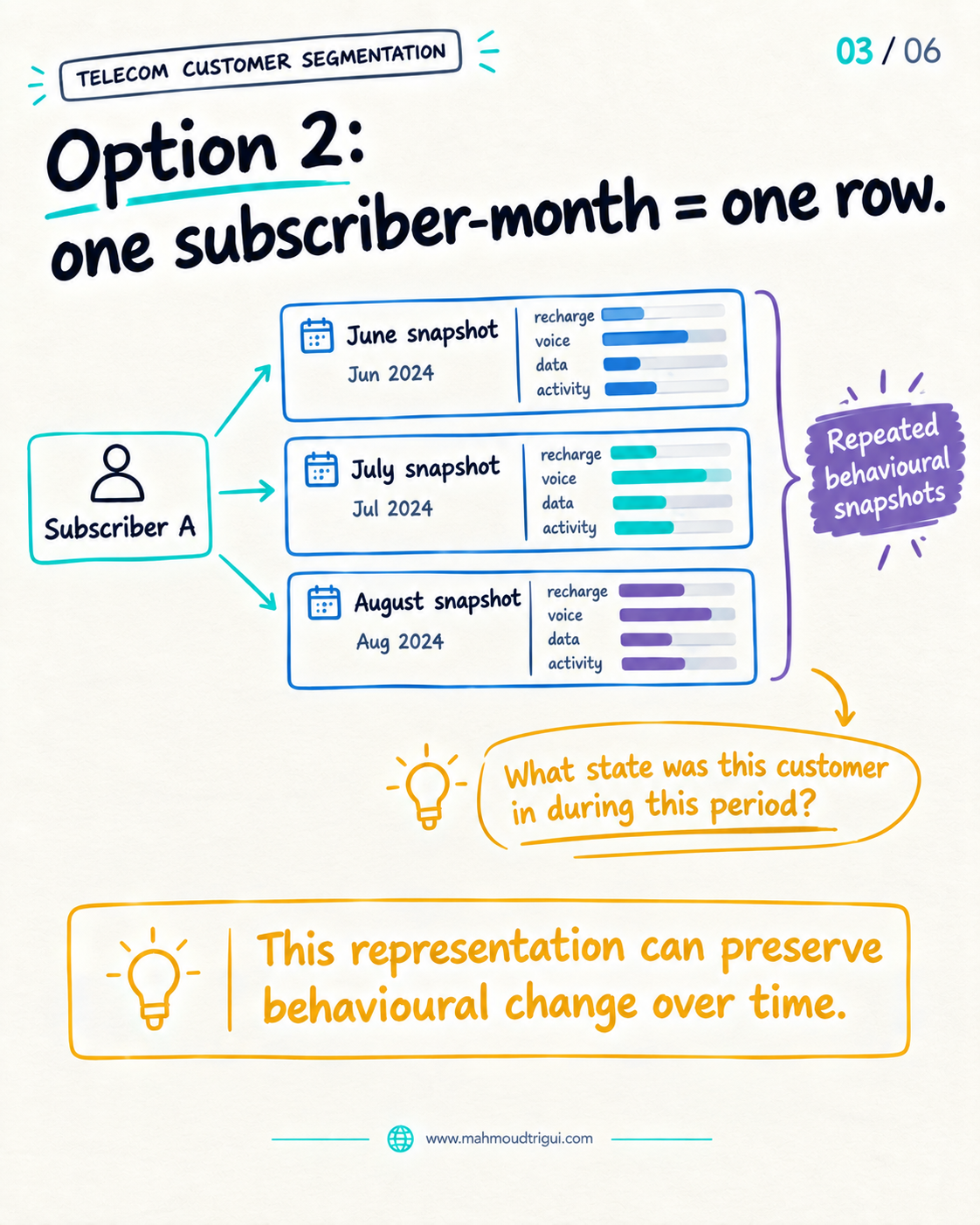
One subscriber-month = one row
Keep each monthly behavioural snapshot as a separate observation, so the same subscriber can appear in several rows — June behaviour may not look like August behaviour. This segments behavioural states over time and answers "What state was this customer in during this period?"
Customer-level profiles support more stable, structural targeting. Monthly behavioural states support transition-sensitive actions: activation, declining engagement, service migration, or retention review.
Outcome
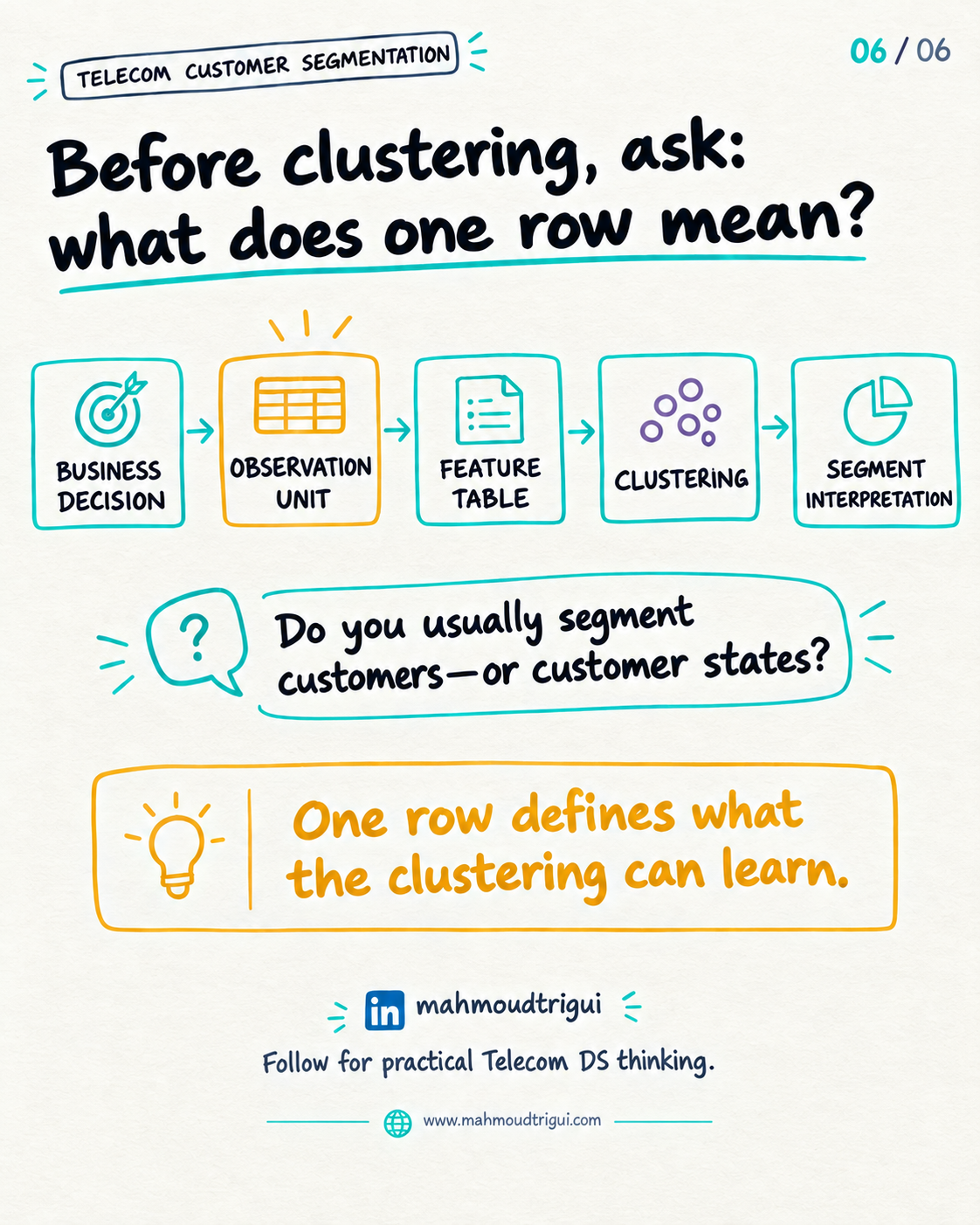
Before asking which clustering method, how many segments, which distance metric, and which normalisation, ask the first question: do we need stable customer types — or changing customer states?
In unsupervised learning, one row is not a formatting detail. It is a modelling decision about what the segment represents.
Key Takeaway
Design insight: Customer segmentation starts with the observation unit: choose between one stable profile per customer or one behavioural snapshot per subscriber-month, and let the business decision drive the representation. One row is a modelling decision about what the segment represents — it defines what the clustering can learn, before any distance metric, normalisation, or method is chosen.
Related
K-Means as Compression Before Hierarchical Clustering →Households vs Communities: Different Detection Tasks →Turning a Categorical Variable Into Behavioral Signal →Not Every Analytics Question Is About What Drives Outcome →Encoding Is a Modeling Decision, Not a Checkbox →Cell Tower Dominance Is More Than a Demographic Feature →When the Label Does Not Exist: Define the Behaviour First →Feature Engineering Is Assembling Evidence Across Systems →LLM Semantic Features: Propose, Then Earn Their Place →
FAQ
What is the key takeaway from "One Row Is a Modelling Decision: Customer or State?"?
Customer segmentation starts with the observation unit: choose between one stable profile per customer or one behavioural snapshot per subscriber-month, and let the business decision drive the representation. One row is a modelling decision about what the segment represents — it defines what the clustering can learn, before any distance metric, normalisation, or method is chosen.
Who wrote this and what is it about?
This was written by Mahmoud Trigui, Senior Data Scientist. Customer segmentation starts with the observation unit: one profile per customer, or one behavioural snapshot per customer-month.