LLM Semantic Features: Propose, Then Earn Their Place
One interesting use of LLMs in tabular machine learning is not prediction — it is semantic feature generation.
TL;DR: LLM feature generation for tabular machine learning turns a domain hypothesis into a candidate semantic feature through a controlled label set, then requires the same rigorous evaluation as any feature: out-of-sample lift, stability, prediction-time availability, and privacy-cost constraints. Use the LLM to propose a semantic layer, and let the baseline decide whether it matters — no generated label becomes a feature until it outperforms the numerical baseline and survives leakage-aware validation.
Visual Summary
The Problem
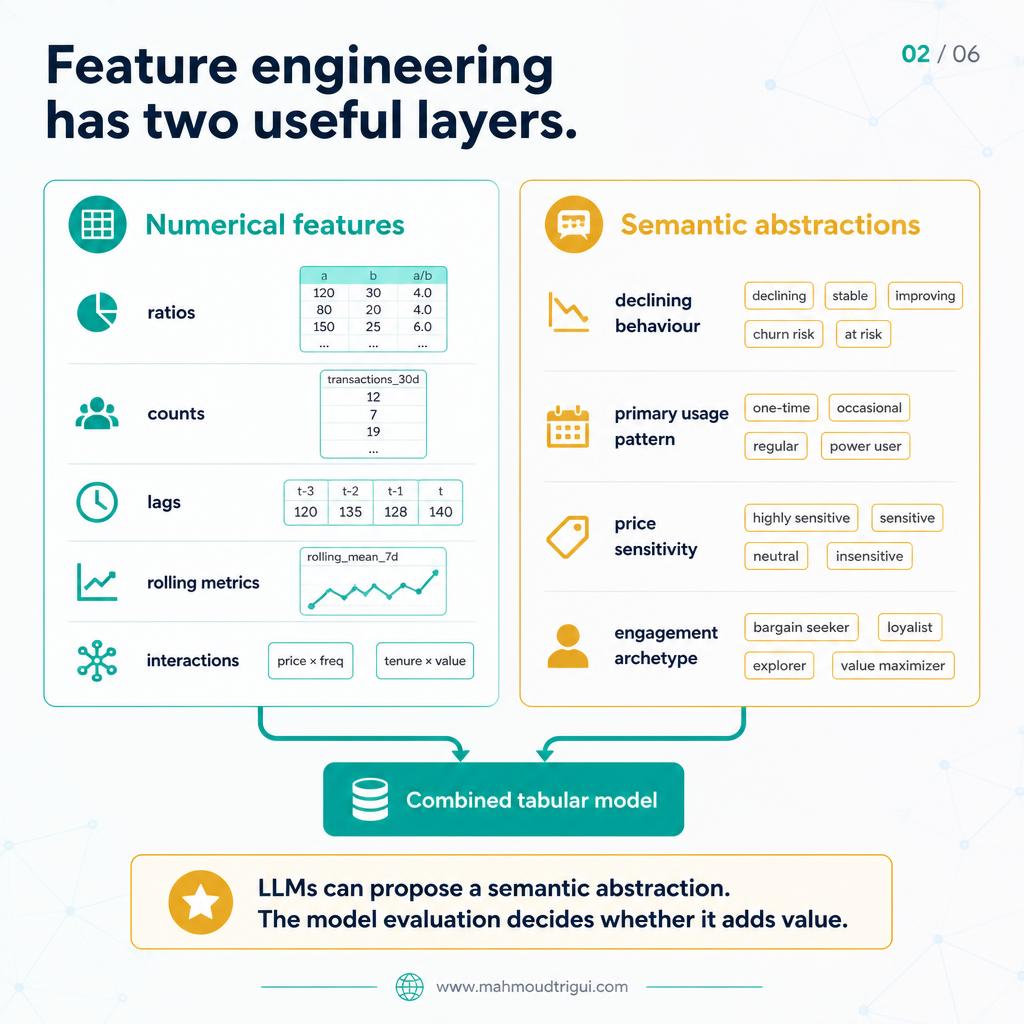
Traditional feature engineering creates ratios, counts, lags, rolling statistics, interactions, and aggregates. But domain experts also reason in concepts: likely primary SIM, secondary SIM behaviour, declining engagement, newly activated usage, a price-sensitive profile.
Those concepts are not necessarily absent from the raw data. A tree model may learn parts of them from ARPU, recharge frequency, active days, and network behaviour. But can an LLM help turn a domain hypothesis into an explicit, testable feature?
The Approach
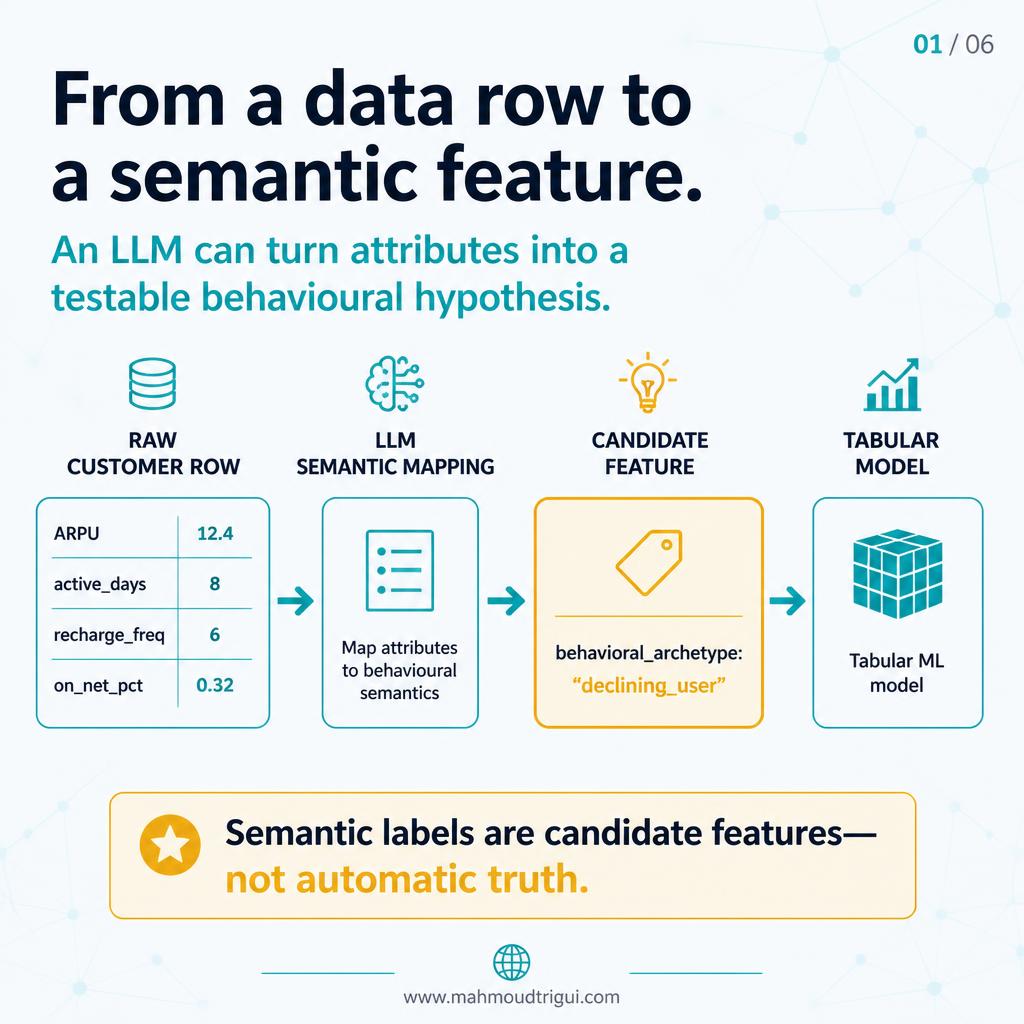
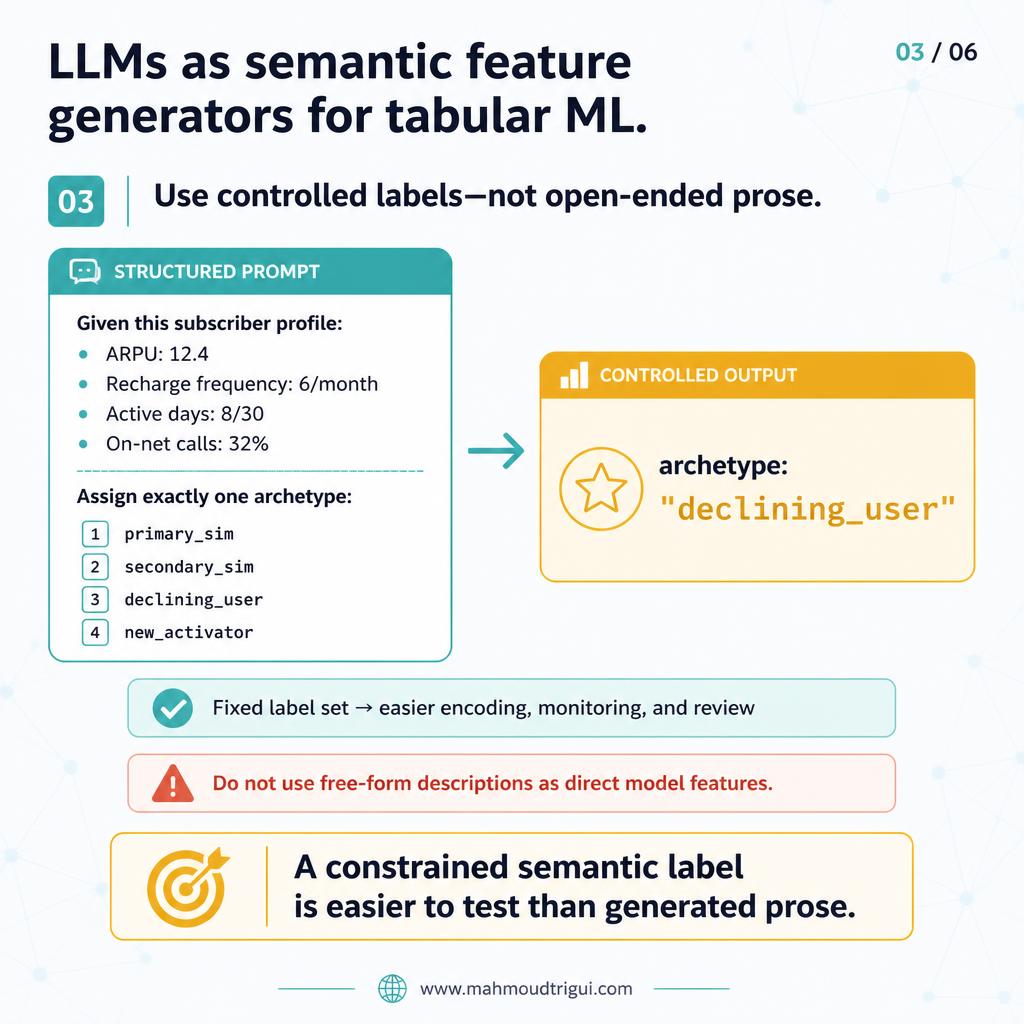
Ask the LLM something specific: "Given this customer profile, assign one behavioural archetype from a controlled list." The resulting label becomes a candidate feature for a downstream model — and the important word is candidate.
Use controlled labels, not prose
A fixed label set (primary_sim, secondary_sim, declining_user, new_activator) is easier to encode, monitor, and review. Free-form descriptions are not direct model features.
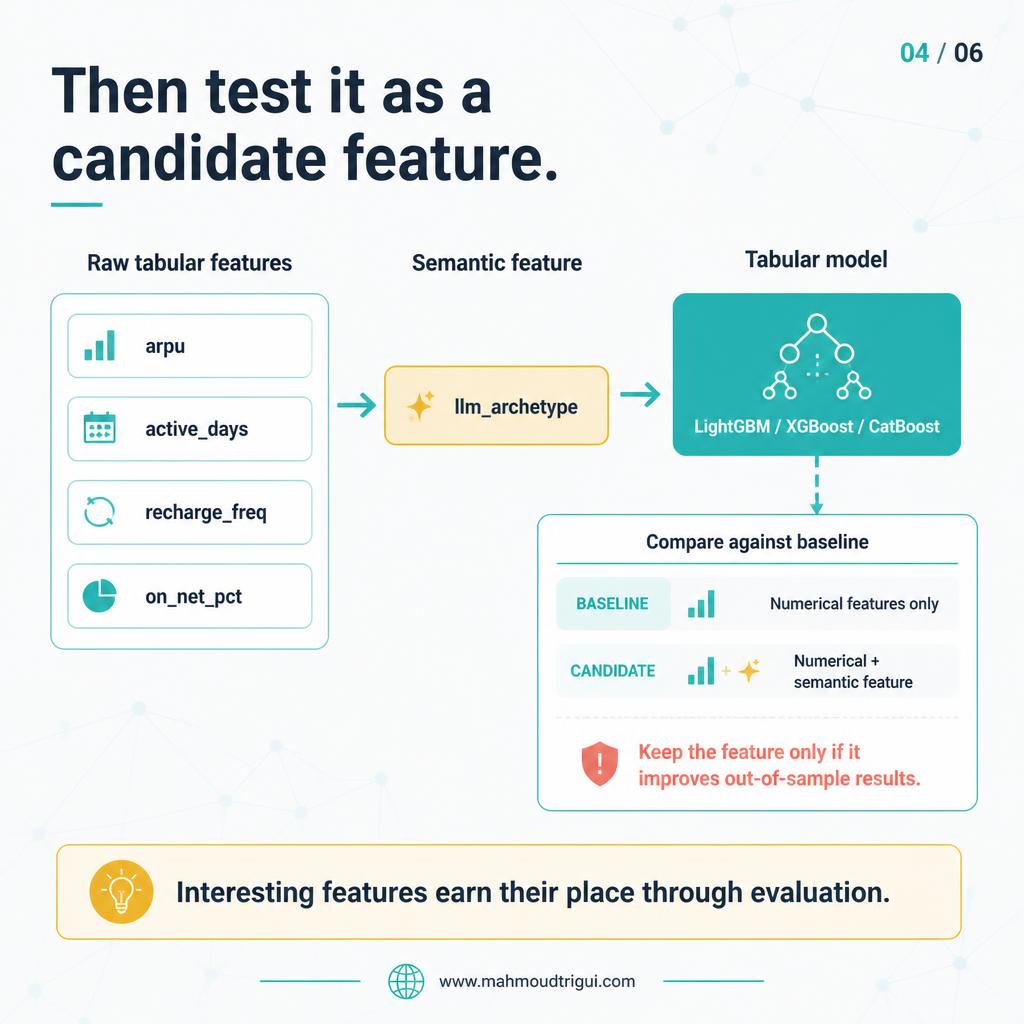
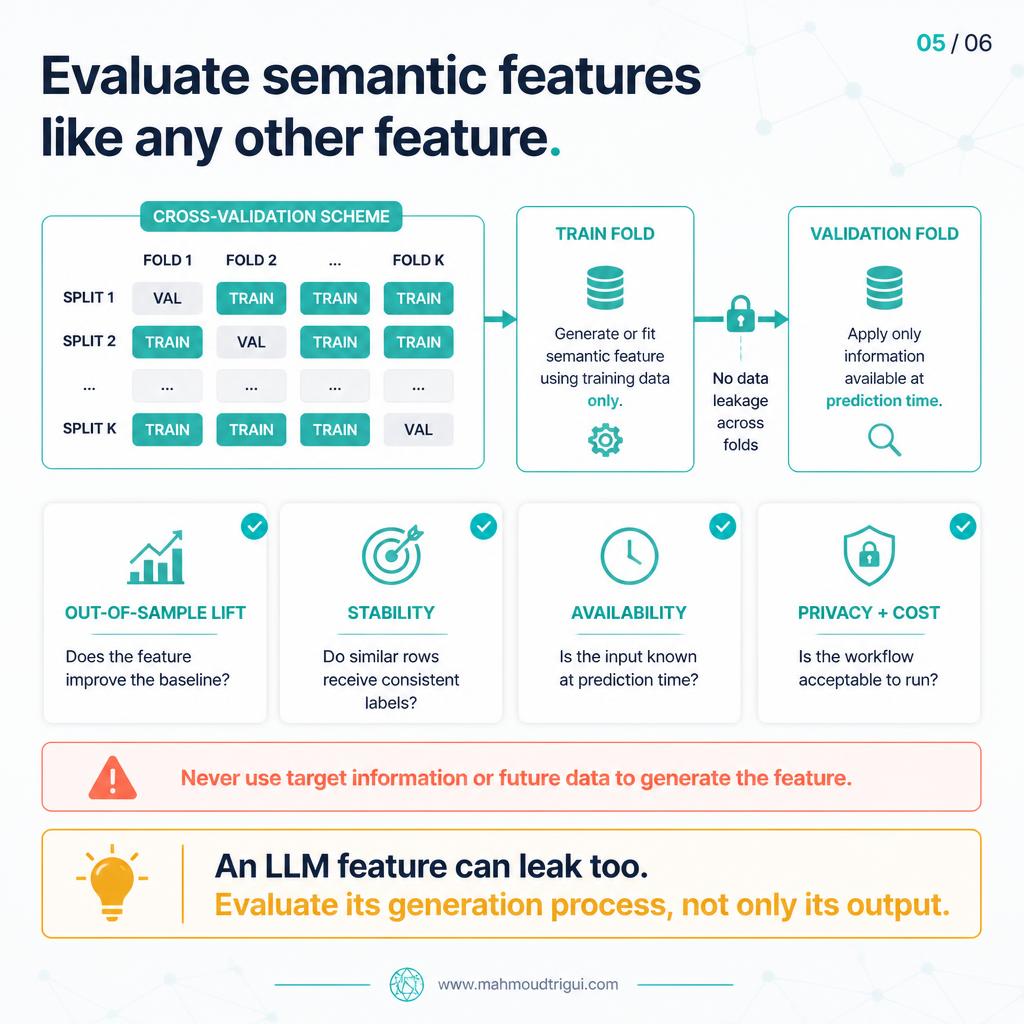
Evaluate against a strong baseline
Does it improve out-of-sample performance? Does it add value beyond numerical features? Is it stable across similar inputs? Is all input available at prediction time? Does the workflow meet privacy, cost, and latency constraints?
Watch the generation process, not only the output
Generate features within the training process — without using target information or future data from validation rows. An LLM feature can leak too.
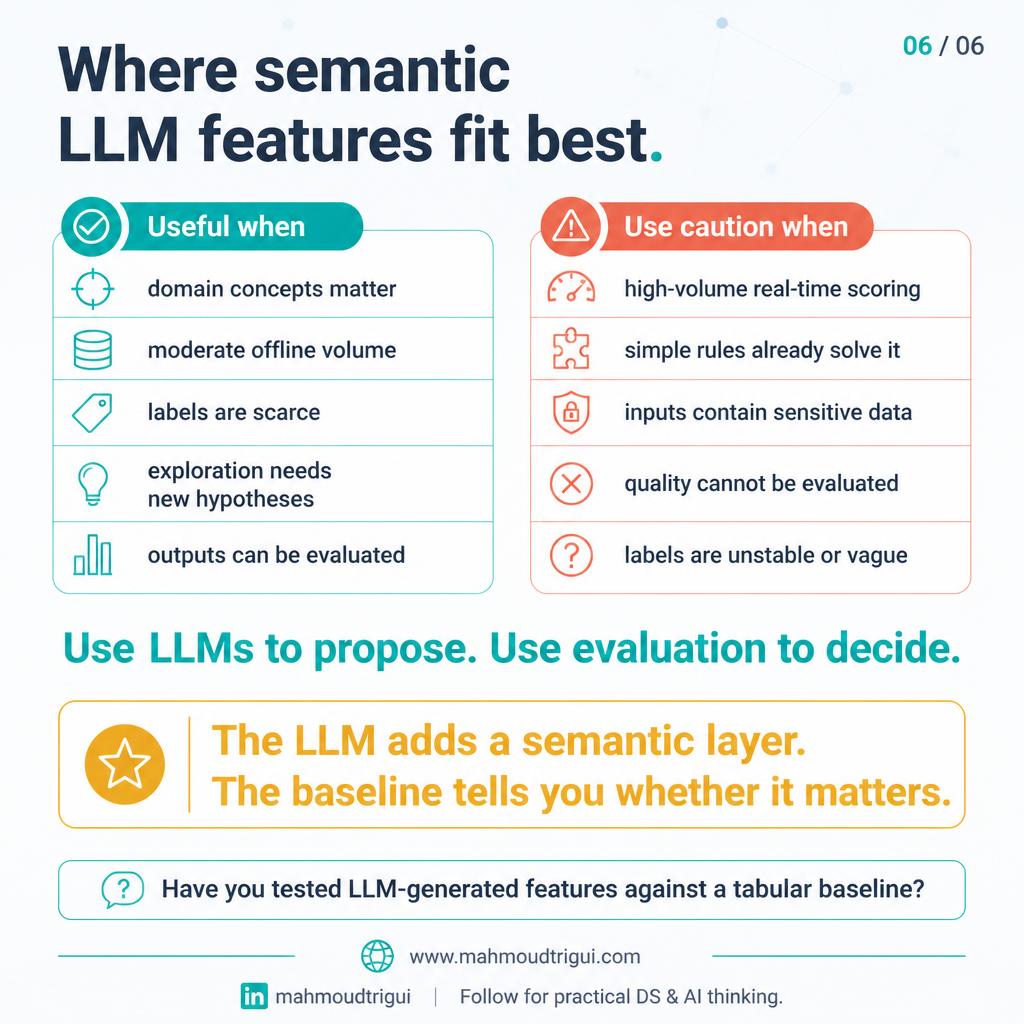
This pattern fits feature discovery, offline enrichment, domain-heavy classification, moderate-volume workflows, and interpretable behavioural segments.
Outcome
The LLM does not replace feature engineering. It helps propose a semantic layer that you can measure, challenge, and keep only if it earns its place.
Semantic labels are candidate features — not automatic truth. Interesting features earn their place through evaluation.
Key Takeaway
Design insight: LLM feature generation for tabular machine learning turns a domain hypothesis into a candidate semantic feature through a controlled label set, then requires the same rigorous evaluation as any feature: out-of-sample lift, stability, prediction-time availability, and privacy-cost constraints. Use the LLM to propose a semantic layer, and let the baseline decide whether it matters — no generated label becomes a feature until it outperforms the numerical baseline and survives leakage-aware validation.
Related
Turning a Categorical Variable Into Behavioral Signal →Don't Ask Your Model to Learn What a Formula Knows →Categorical Encoding Cheat Sheet for Tabular ML →Structured Outputs for Reliable LLM Pipelines →Enterprise LLM Wrapper: The API Call Is the Smallest Part →Adversarial Validation: Detect Data Shift Before It Hurts →Not Every Analytics Question Is About What Drives Outcome →One Row Is a Modelling Decision: Customer or State? →
FAQ
What is the key takeaway from "LLM Semantic Features: Propose, Then Earn Their Place"?
LLM feature generation for tabular machine learning turns a domain hypothesis into a candidate semantic feature through a controlled label set, then requires the same rigorous evaluation as any feature: out-of-sample lift, stability, prediction-time availability, and privacy-cost constraints. Use the LLM to propose a semantic layer, and let the baseline decide whether it matters — no generated label becomes a feature until it outperforms the numerical baseline and survives leakage-aware validation.
Who wrote this and what is it about?
This was written by Mahmoud Trigui, Senior Data Scientist. LLM feature generation for tabular ML: turn domain hypotheses into candidate semantic features, then keep them only if they beat the baseline.