Adversarial Validation: Detect Data Shift Before Your Model Fails in Production
A model can look excellent in cross-validation and still fail in production — simply because the world it was trained on is not the world it is scoring in.
TL;DR: A model can look excellent in cross-validation and still fail in production simply because the world it was trained on is not the world it is scoring in. Adversarial validation gives you a fast way to detect that mismatch before deployment — not after.
Visual Summary
The Problem
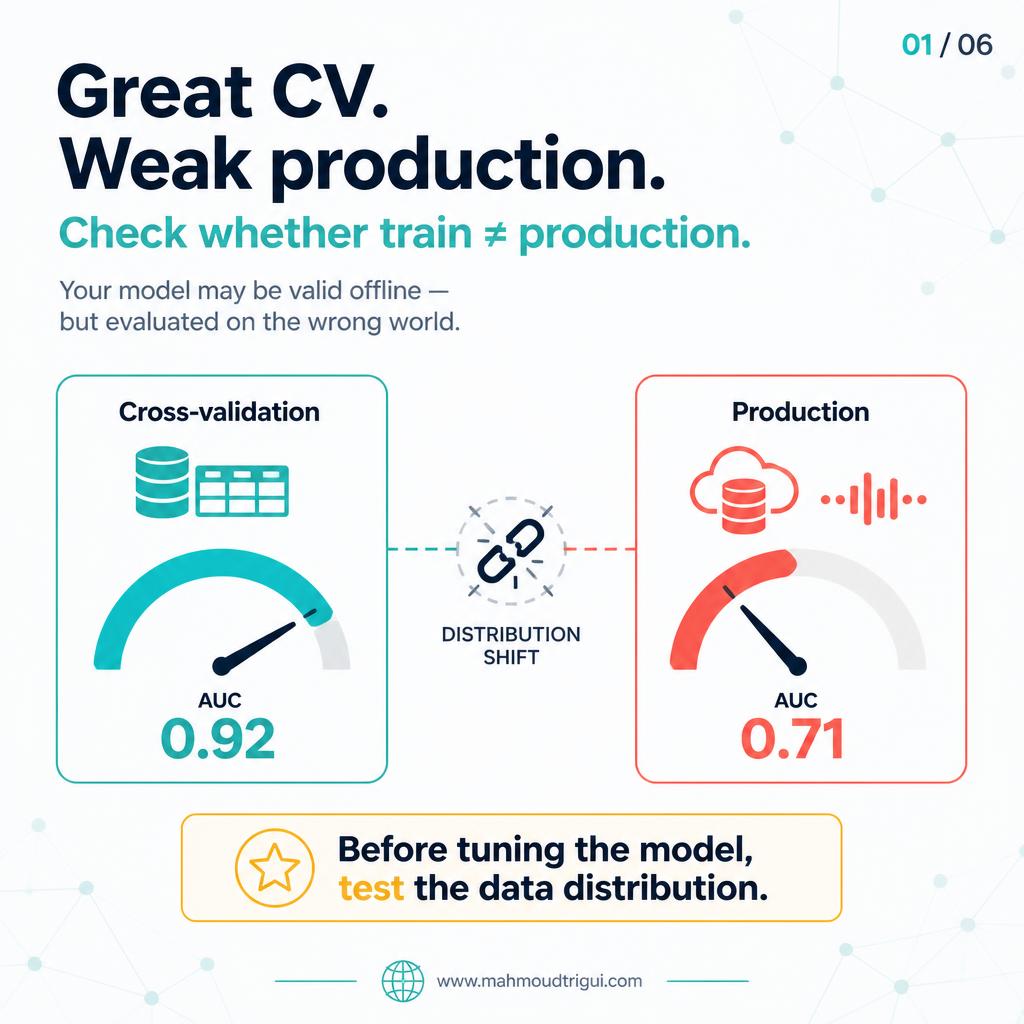
Your model gets AUC 0.92 in cross-validation. You deploy it, and in production it drops to 0.71. This is the classic story of a model that looks excellent offline and quietly degrades in the real world.
Sometimes the model is not the problem. Sometimes training and production data simply do not look like the same world — the distribution moved between the data you validated on and the data the model now scores.
The Approach: Adversarial Validation
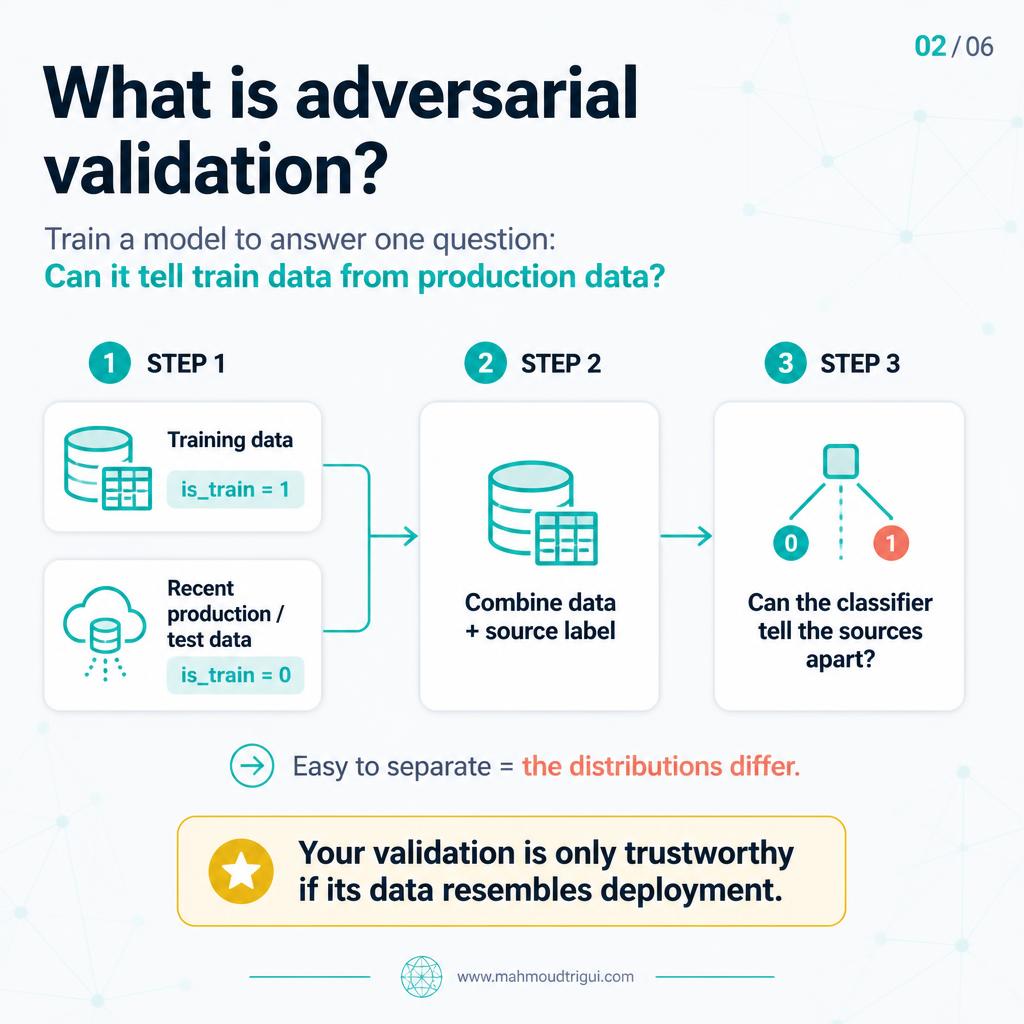
One fast way to detect that mismatch is adversarial validation. The idea is simple:
- Step 1: Combine your training data with recent production (or representative test) data
- Step 2: Label the source:
train = 1,production = 0 - Step 3: Train a classifier to tell the two datasets apart
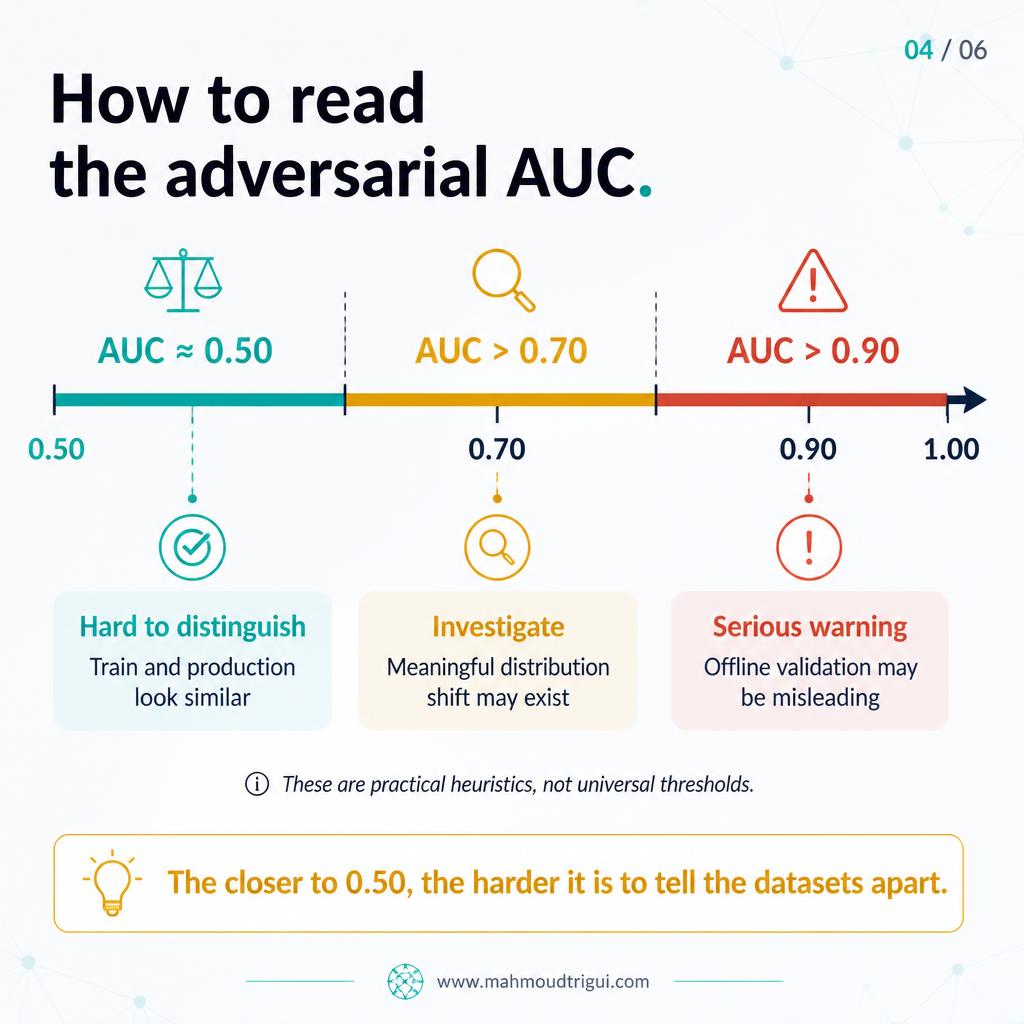
A practical interpretation of the adversarial model's AUC:
AUC ≈ 0.50
Reassuring: train and production are hard to separate. The validation set still represents the deployment reality.
AUC clearly above 0.70
Investigate: a meaningful shift may exist between the two worlds.
AUC above 0.90
Serious warning: offline validation may not represent deployment reality at all.
When Shift Is Detected
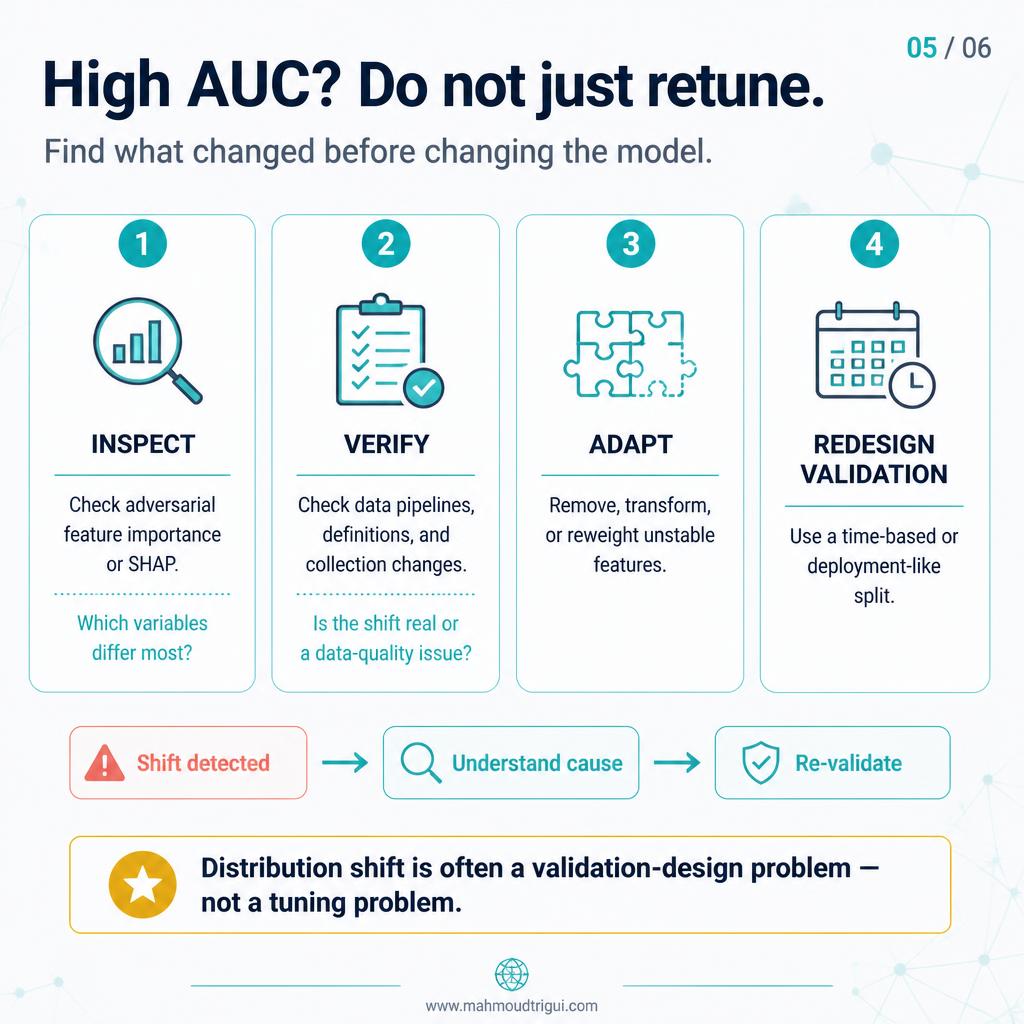
The adversarial model's feature importance tells you which variables differ most between train and production. Ask yourself:
- Is there a time effect?
- Is a feature leaking collection-process information?
- Should you remove, transform, reweight, or redesign your validation split?
Then act:
- Step 1: Check SHAP for the adversarial model → which features differ most?
- Step 2: Remove or transform those features
- Step 3: Adjust validation: weight samples closer to the test distribution
- Step 4: Consider a time-based split instead of a random one
When to Use This
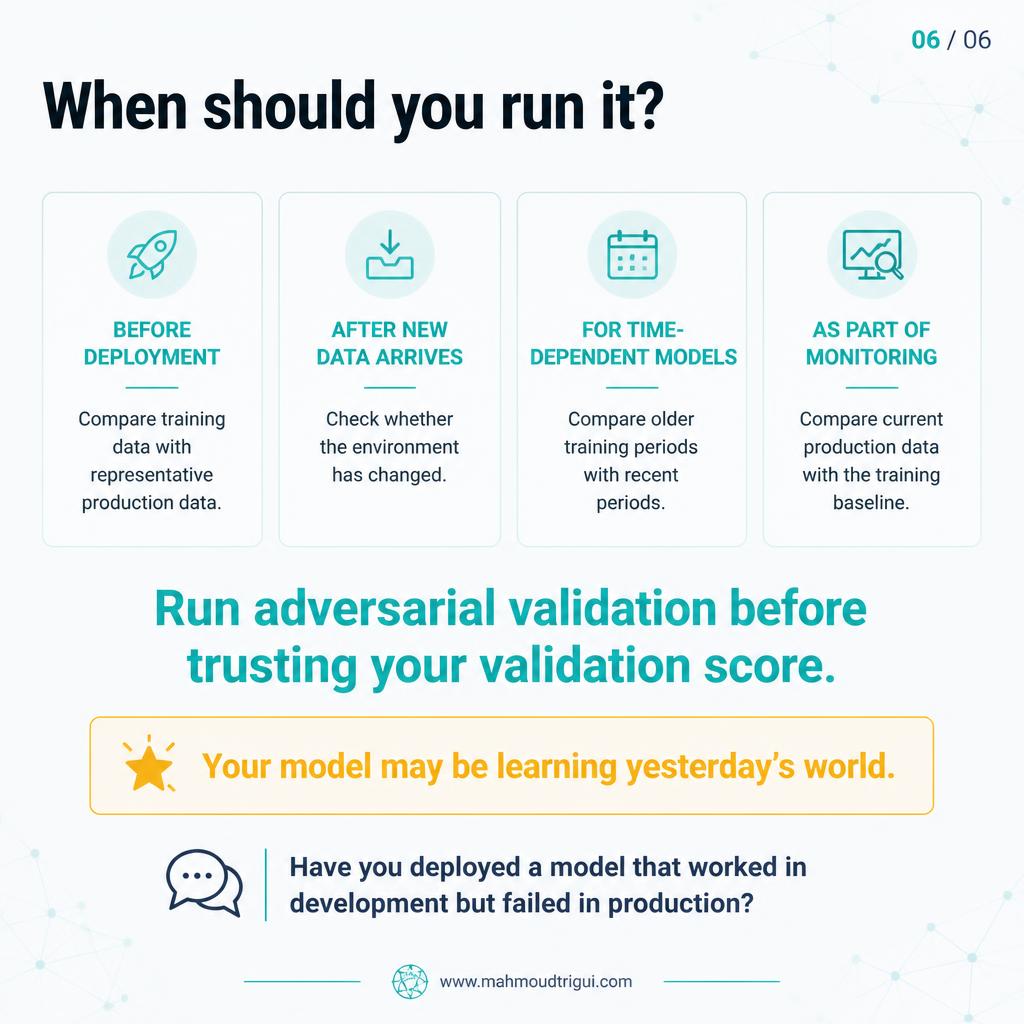
- Before deploying ANY model to production
- After collecting new data — has the world changed?
- In competitions: to verify train/test similarity
- Monthly production monitoring: current month vs training data
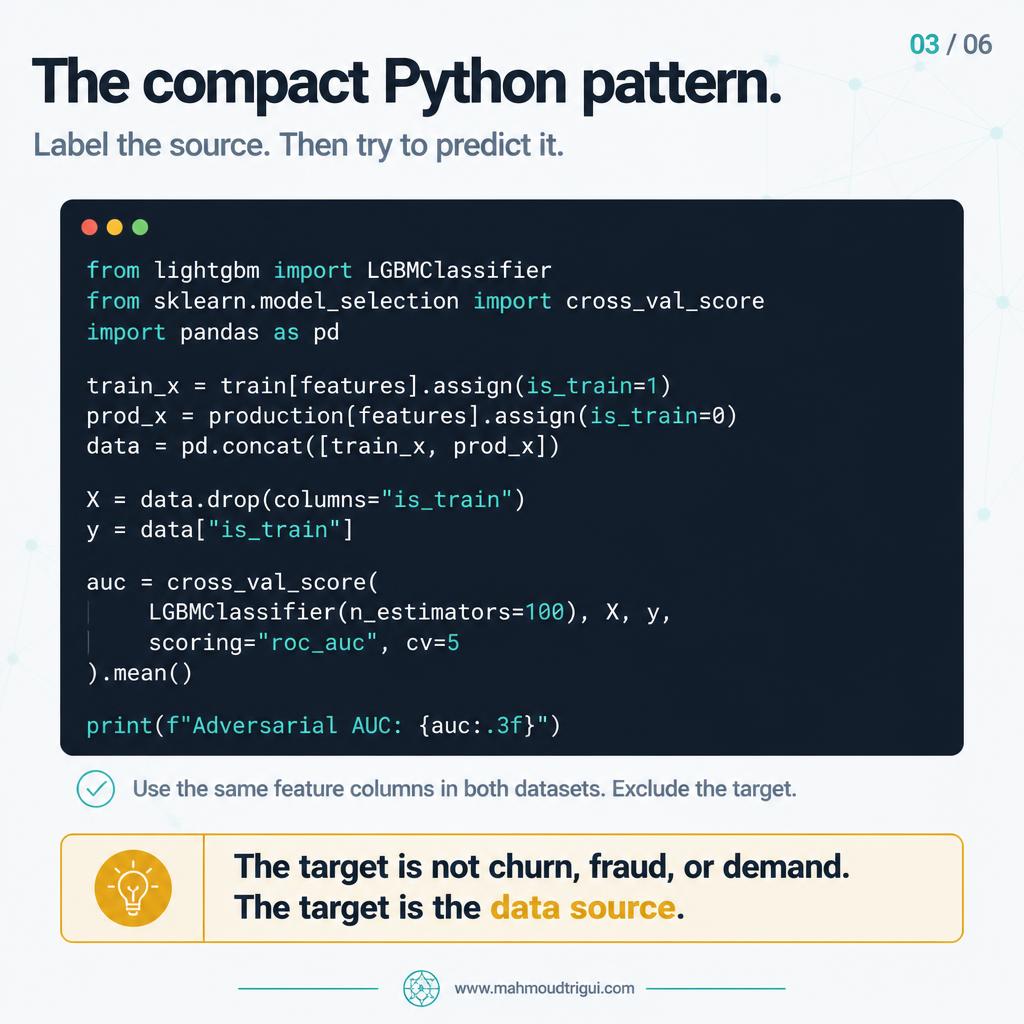
10 lines of code. It saves you from deploying a model that is already outdated.
Key Takeaway
Design insight: A model can look excellent in cross-validation and still fail in production simply because the world it was trained on is not the world it is scoring in. Adversarial validation gives you a fast way to detect that mismatch before deployment — not after.
Related
Silent Model Failure: When the Dashboard Stays Green →Time-Series Cross-Validation: Train Past, Validate Future →Preprocessing should have one source of truth →SMOTE Is Not the Default Answer to Class Imbalance →Purged Cross-Validation Is Not for Every Time Series →Prompt Versioning: How LLMOps Makes Prompts Reversible →Route Structurally Inactive Series Before Forecasting →Seed Sensitivity Is Part of Model Selection →Delegate Optuna Boilerplate to an AI Coding Assistant →AI Production Readiness: 5 Red Flags →Automate Maintenance, Keep Judgment Human →AI-Assisted Coding: Specification →The Most Dangerous Label in ML →AI Replaced the Training Backlog →Categorical Encoding Cheat Sheet →SHAP Waterfall Local Explanation →Focal Loss for Imbalanced Classification →Multimodal Late Fusion →AI Can Review Feature Code. It Cannot Approve It →When the Label Does Not Exist: Define the Behaviour First →LLM Semantic Features: Propose, Then Earn Their Place →From Cluster to Operational Segment: Assignment First →AI-Generated Validation Can Pass While Data Is Still Wrong → Postman API Testing for LLM Workflow Contracts →
FAQ
What is the key takeaway from "Adversarial Validation: Detect Data Shift Before Your Model Fails in Production"?
A model can look excellent in cross-validation and still fail in production simply because the world it was trained on is not the world it is scoring in. Adversarial validation gives you a fast way to detect that mismatch before deployment — not after.
Who wrote this and what is it about?
This was written by Mahmoud Trigui, Senior Data Scientist. Your model scores AUC 0.92 in cross-validation but drops to 0.71 in production. Adversarial validation is a fast way to detect train/production data shift before you deploy.