Silent Model Failure: When the Dashboard Stays Green
A production model can pass every technical check after launch and still quietly stop being useful. The fix is not only retraining — it is a system with an owned feedback loop.
TL;DR: A successful deployment is not a running pipeline — it is a system with an owned feedback loop. A production model can pass every technical health check and still fail quietly, because a feature changes meaning when the business process changes while the dashboard keeps reporting success. Pipeline uptime cannot catch that; model relevance needs a named owner, a review cadence over feature shifts and delayed segment outcomes, and a fallback rule defined before quality deteriorates. Architecture enables; ownership sustains.
Visual Summary
The Problem
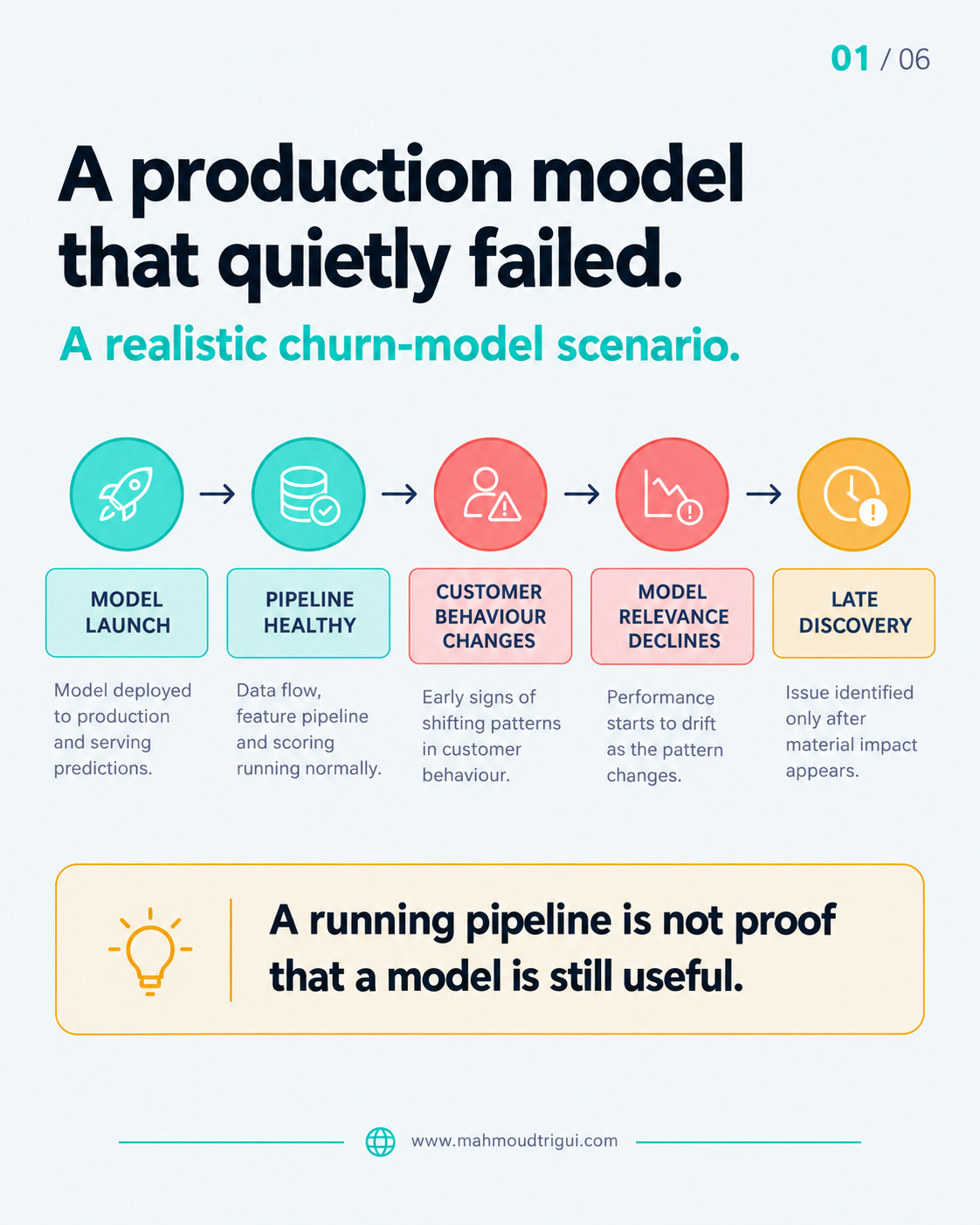
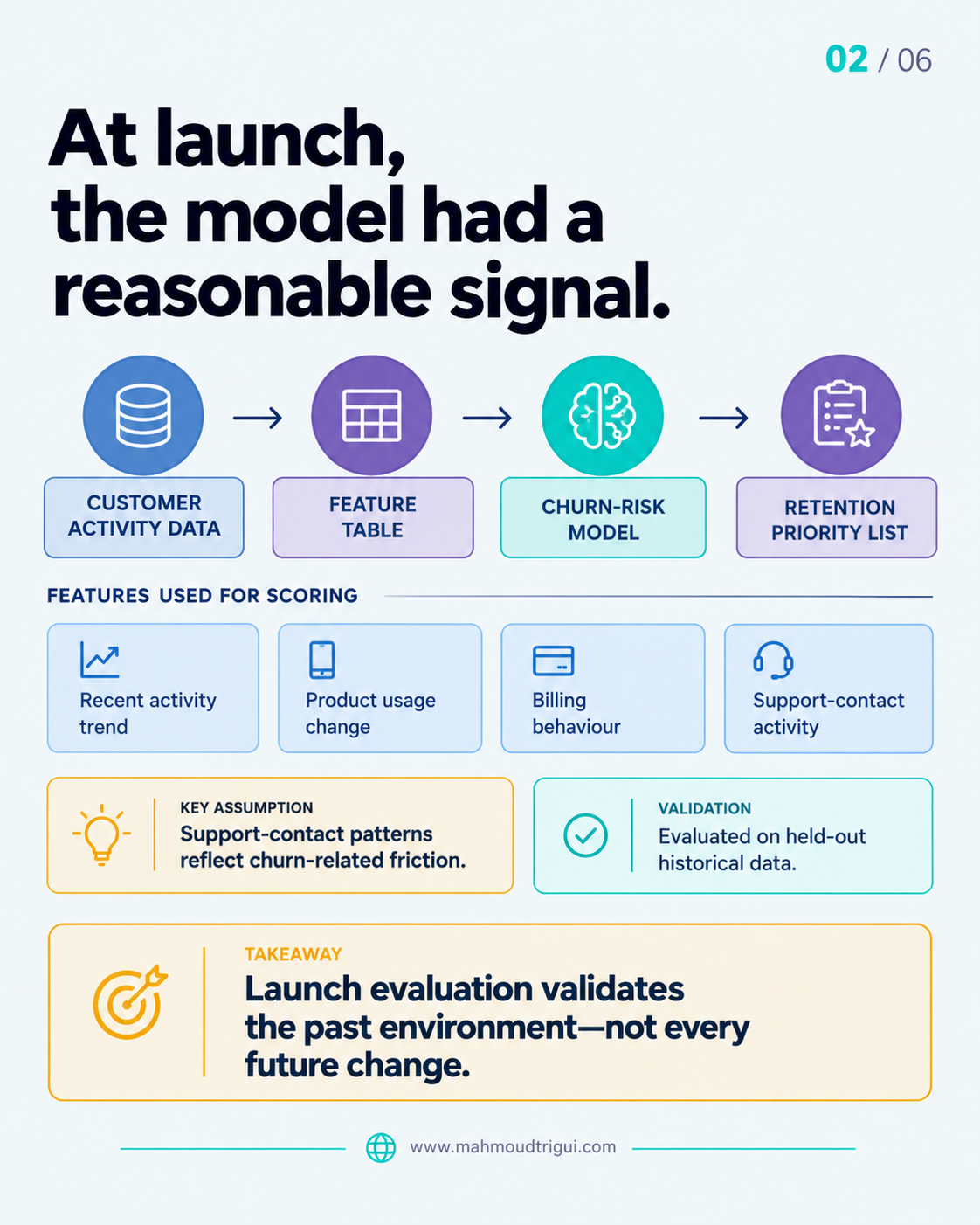
A production model can look successful at launch and still fail quietly afterward. Take a realistic churn scenario: a weekly model that scores which customers are likely to churn in the next 30 days, using signals such as declining recent activity, reduced product usage, billing behaviour, and support-contact patterns. It performs well on held-out historical data, the retention team prioritises outreach from its scores, and launch looks like a success.
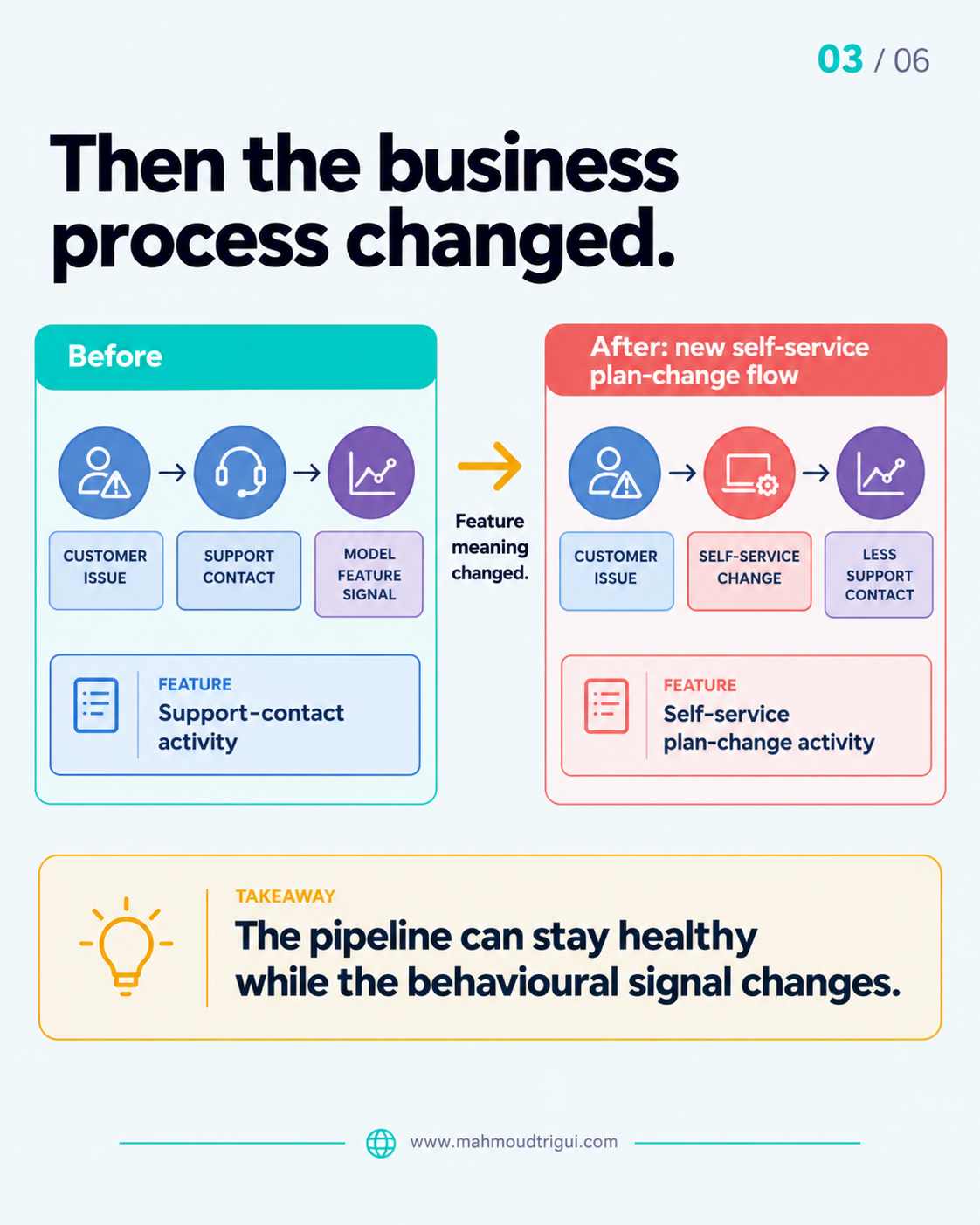
Then the business changes. A new self-service plan-change flow removes the need for customers to contact support, so one previously useful feature — support-contact activity — now means something different. The pipeline still runs, the model still produces scores, the dashboard stays green, and the model keeps prioritising customers using an outdated behavioural pattern.
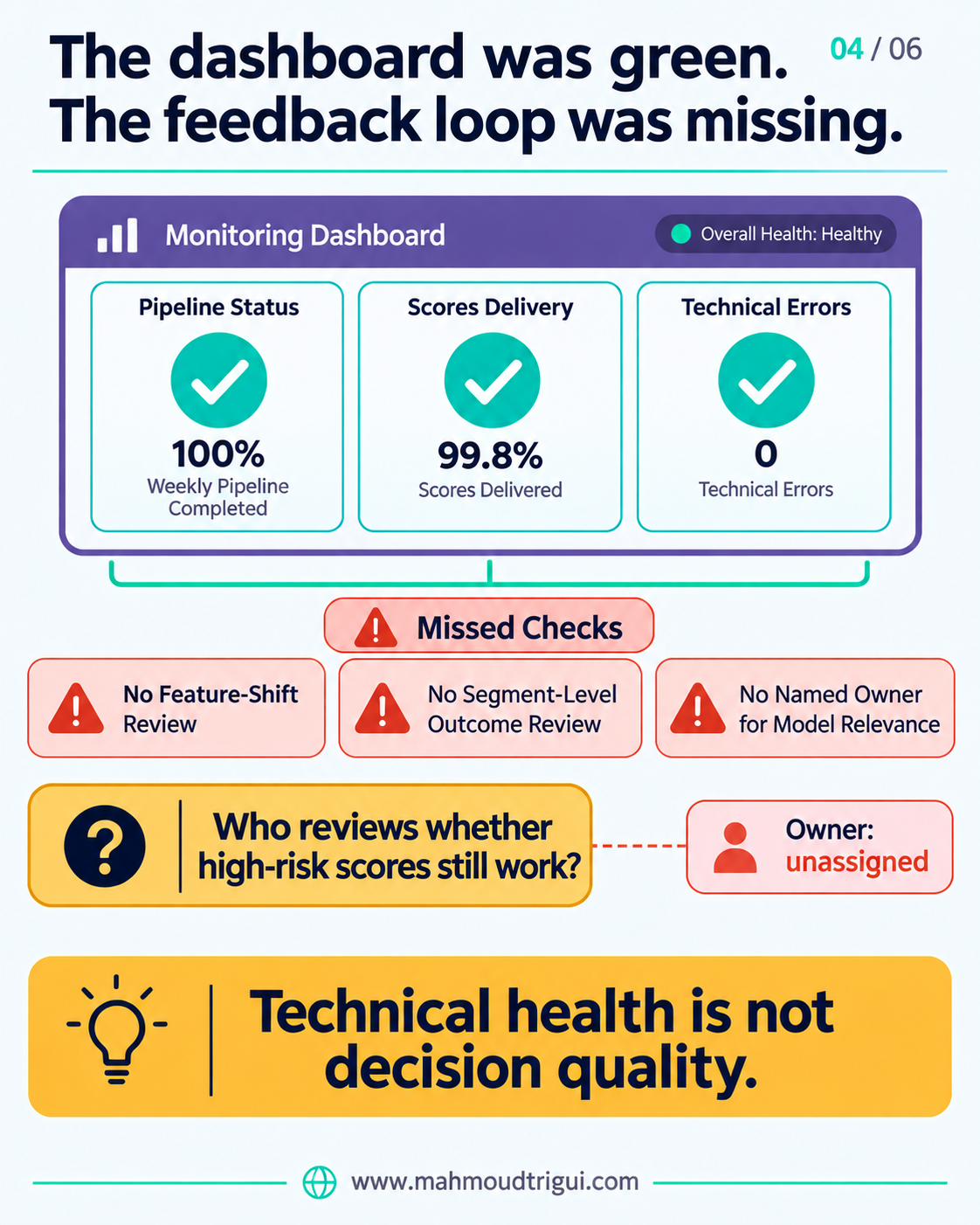
Nobody notices immediately, because the dashboard tracks technical health: pipeline completed, scores generated, records delivered. The harder questions have no owner — did feature distributions change, are high-risk scores still identifying the right customers, is campaign performance stable by segment, and who decides whether the model should be updated, paused, or replaced. The cost is not a dramatic outage. It is quieter: limited outreach capacity spent on lower-priority customers while more relevant cases are missed.
The Approach
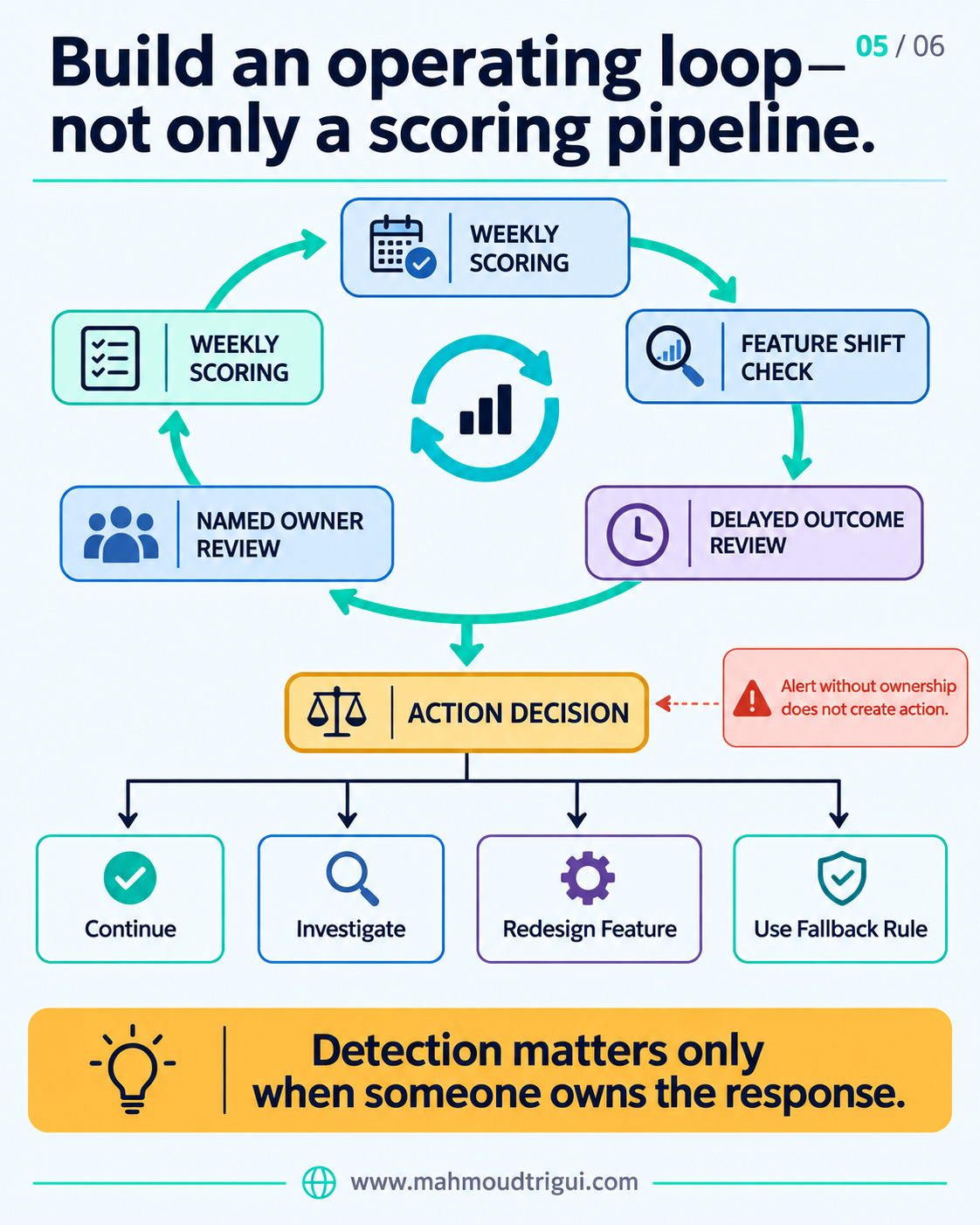
The fix is not only retraining. Retraining refreshes the weights; it never decides whether the model should still run at all. What I build around a deployed model is an operating loop — five commitments, each with an owner, that decide whether the model is updated, paused, or replaced.
Monitor the important feature shifts
Track the features the model actually leans on, not every column in the table. A feature can keep its distribution and still lose its meaning when a business process changes — support-contact activity is the classic case.
Measure delayed outcomes by segment
Churn and conversion resolve weeks after the score, so review whether high-risk scores still identify the right customers and whether campaign performance is stable by segment instead of in aggregate.
Assign a model owner
One named role owns model relevance, not just pipeline uptime. An alert without an owner does not create action, and nobody reviews what nobody owns.
Review performance on a defined cadence
A scheduled review of feature distributions, segment outcomes, and score quality — not an ad-hoc check triggered by an outage, because a silent failure never raises one.
Define a fallback rule before quality deteriorates
Agree in advance what happens when a signal degrades: investigate, redesign the feature, revert to a champion, pause scoring, or fall back to a transparent rule. The decision is made calmly, not during the incident.
The loop closes back into weekly scoring: monitor, measure, review, decide — with continue, investigate, redesign feature, or use the fallback rule as explicit, pre-agreed options rather than improvised reactions.
Outcome
With the loop in place, the question changes from "is the pipeline up?" to "is the model still right for the current business process?". Relevance is reviewed by segment on a fixed cadence, so limited outreach capacity stops leaking to lower-priority customers while more relevant cases are missed — the quiet failure mode gets caught while it is still cheap to fix.
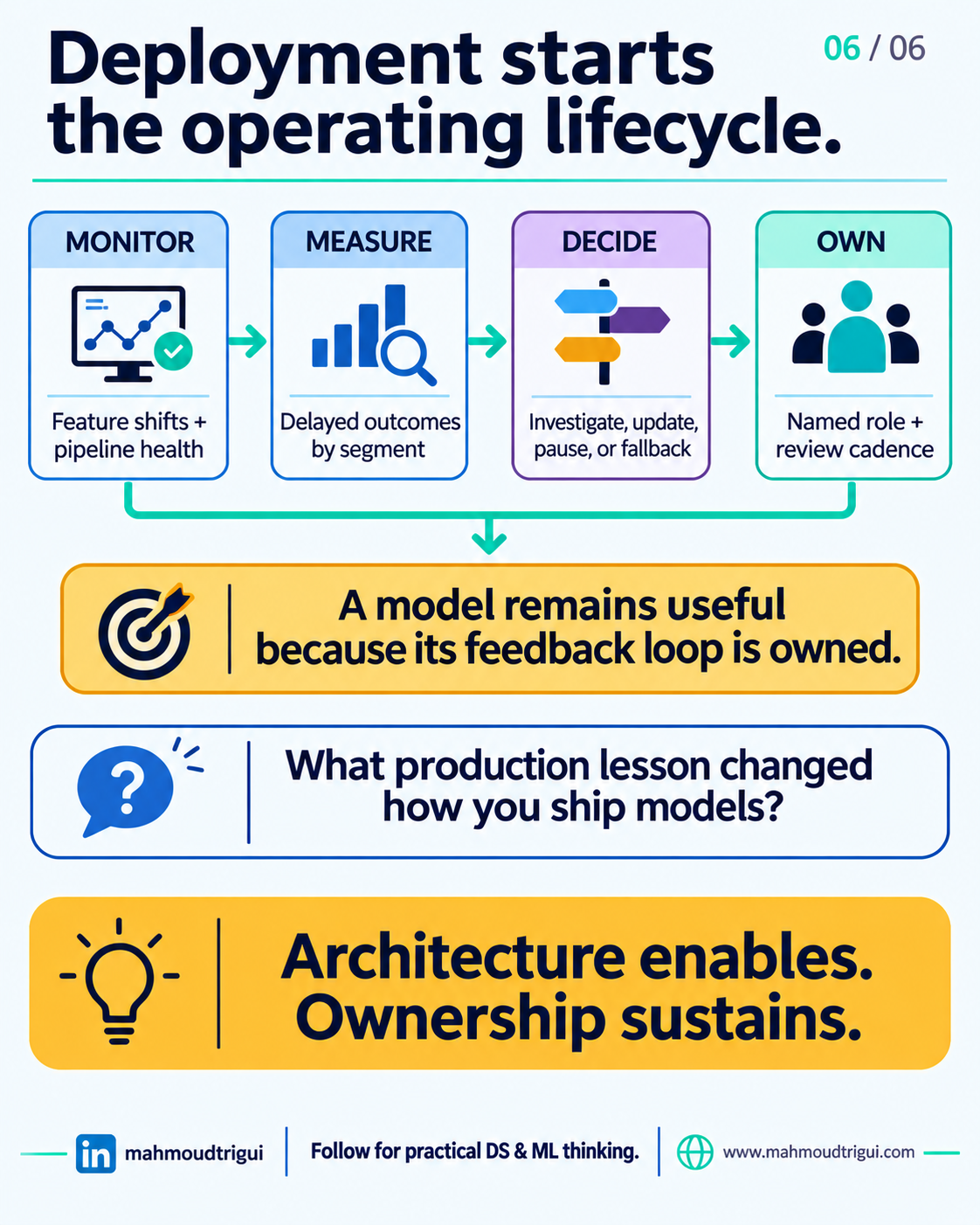
Deployment then stops being the end of the project and becomes the start of the operating lifecycle: monitor feature shifts, measure delayed outcomes, decide, and keep a named owner on the system. The dashboard still stays green, but now green means something, because somebody is accountable for whether the scores still work.
Key Takeaway
Design insight: A successful deployment is not a running pipeline — it is a system with an owned feedback loop. A production model can pass every technical health check and still fail quietly, because a feature changes meaning when the business process changes while the dashboard keeps reporting success. Pipeline uptime cannot catch that; model relevance needs a named owner, a review cadence over feature shifts and delayed segment outcomes, and a fallback rule defined before quality deteriorates. Architecture enables; ownership sustains.