5 Signs Your AI Architecture Is Not Production-Ready
Some AI systems look impressive in a demo and fragile in production. Five red flags in any LLM workflow reveal whether the system is really observable, controllable, and recoverable.
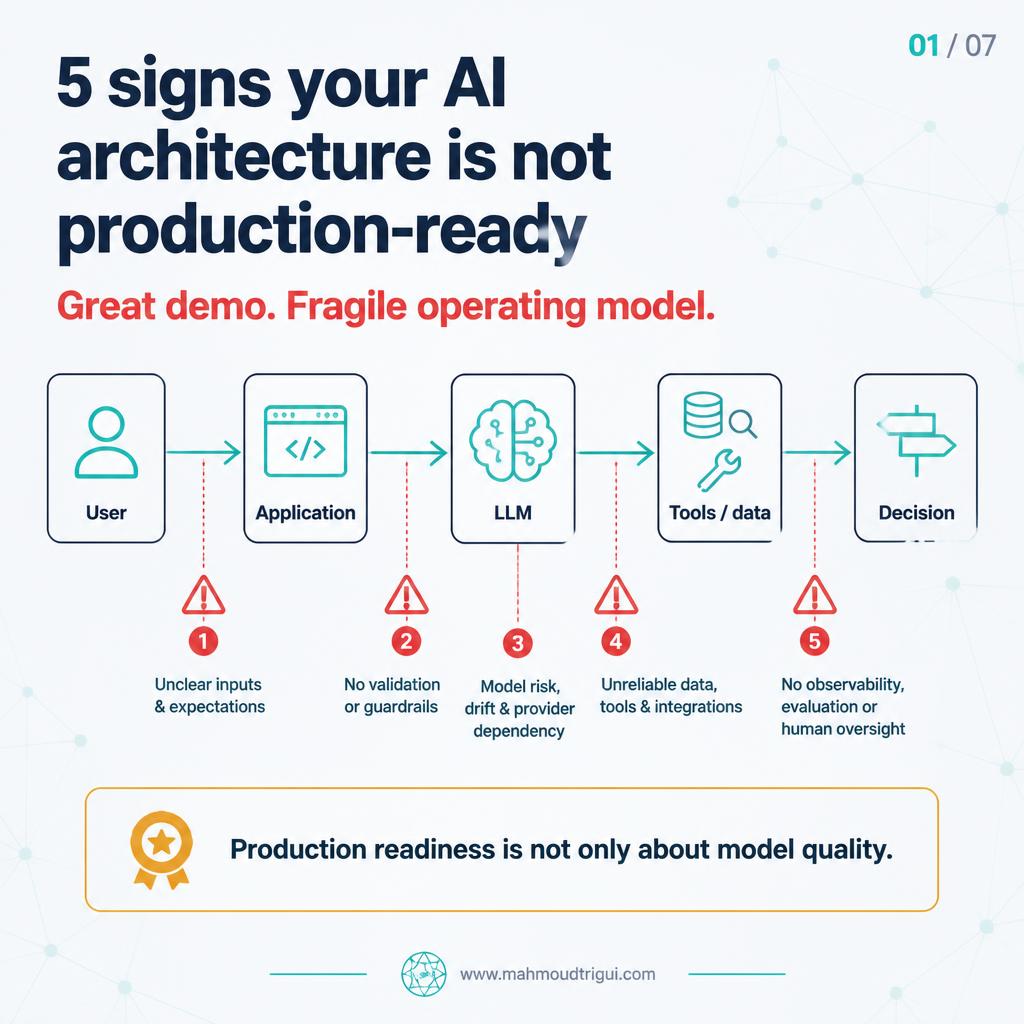
TL;DR: AI production readiness is not about the happy path - it is about whether a system stays observable, controllable, and recoverable when reality becomes inconvenient. Five red flags mark the operating model, not the model itself: no fallback path, prompts buried in code, no cost visibility, output acting without validation, and no regression testing. The fix is to add fallback, visibility, validation, and change controls around the LLM, because good AI systems are not only smart - they are survivable.
Visual Summary
The Problem
Some AI systems look impressive in a demo and fragile in production. The difference usually shows up in a few predictable places, most of which have nothing to do with the quality of the model. When I review an AI or LLM workflow, I look for recurring structural gaps: a missing fallback path, prompts buried inside application code, no cost visibility, output that feeds an action without validation, and no regression suite for prompt or model changes. These are not model problems - they are operating-model problems, and they decide whether a system survives reality.
The Approach
I treat a production AI review as an audit of the operating model around the model, not a leaderboard check. Five red flags cover most of what goes wrong in the field.
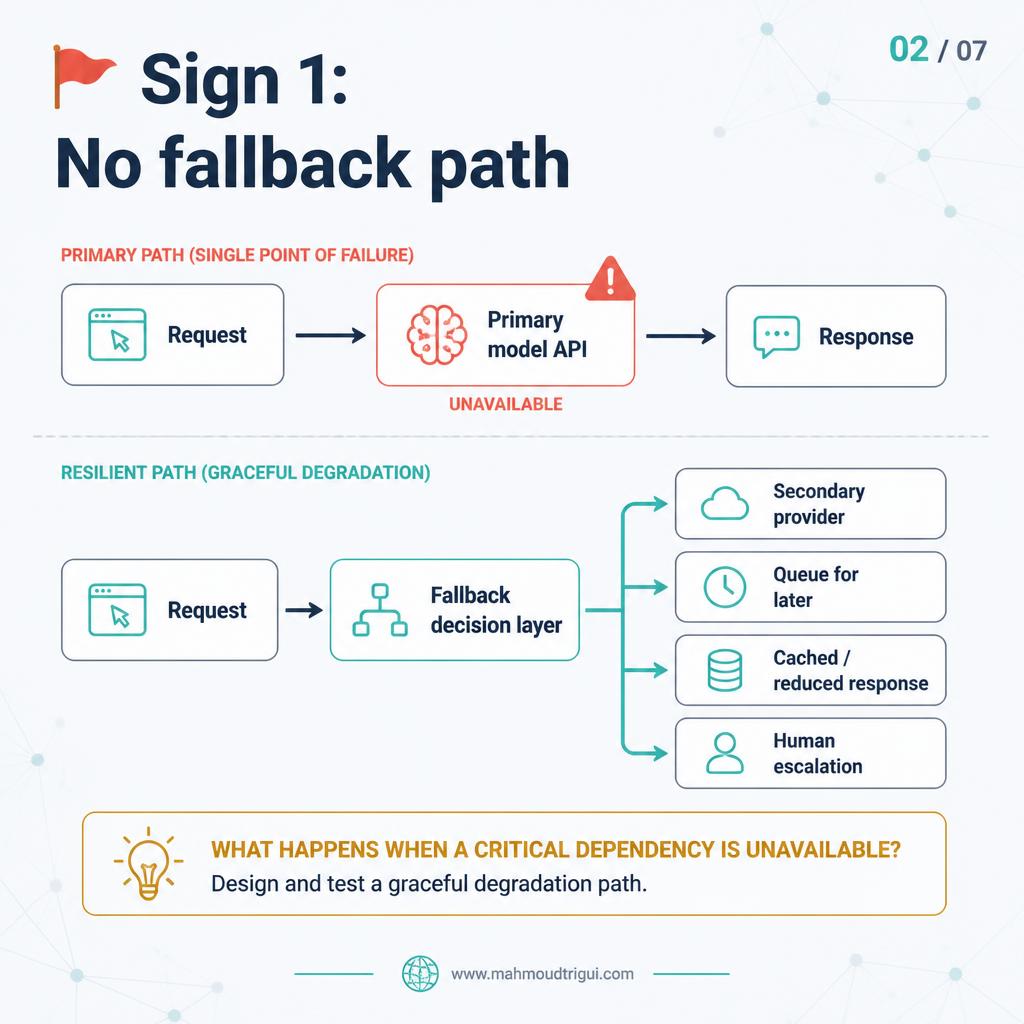
No fallback path
If the primary model or provider fails, does the whole workflow stop? A fallback can be a secondary model or provider, a queue, a cache, a reduced-functionality response, a rules-based workflow, or a human escalation route - chosen to match criticality, cost, and service levels.
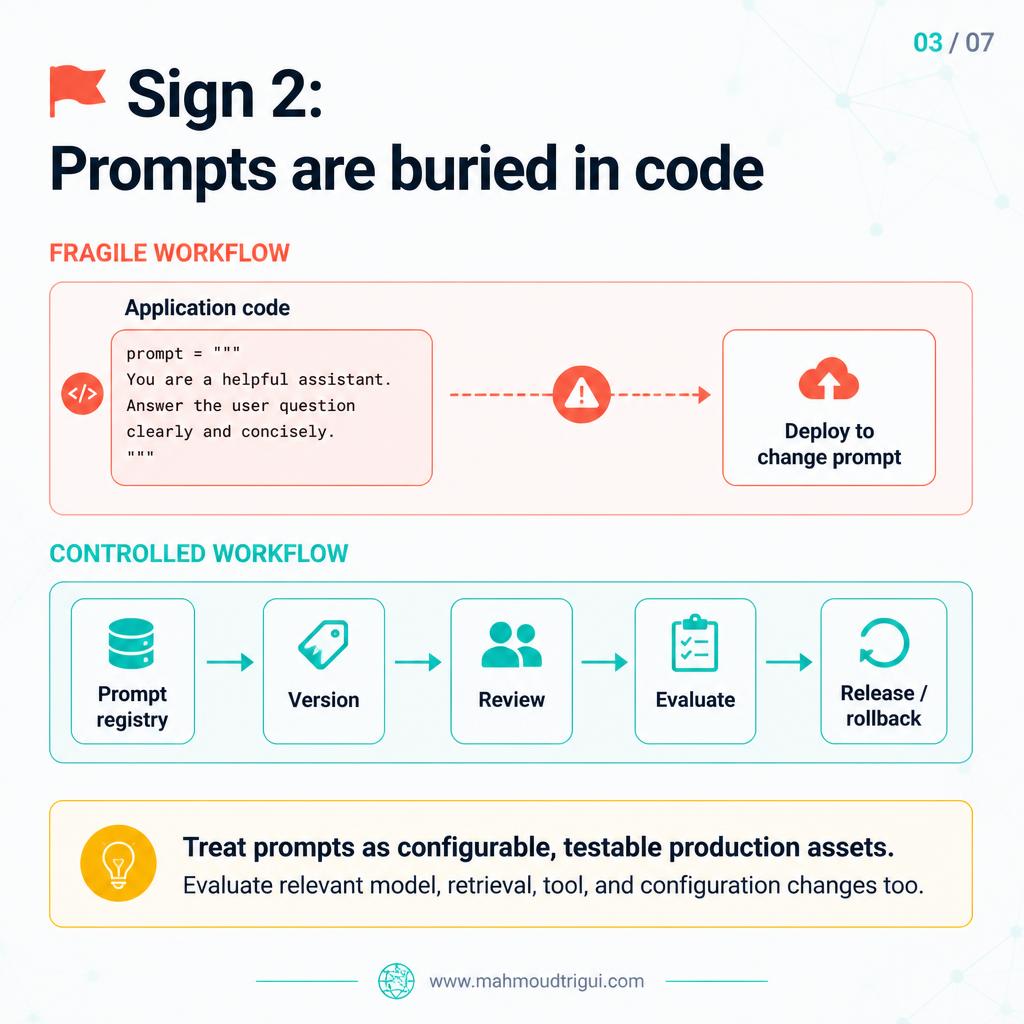
Prompts are buried inside application code
No separate versioning, no independent testing, no reliable rollback path. Treat prompts as configurable, testable production assets with a prompt registry, evaluation, and a release or rollback flow.
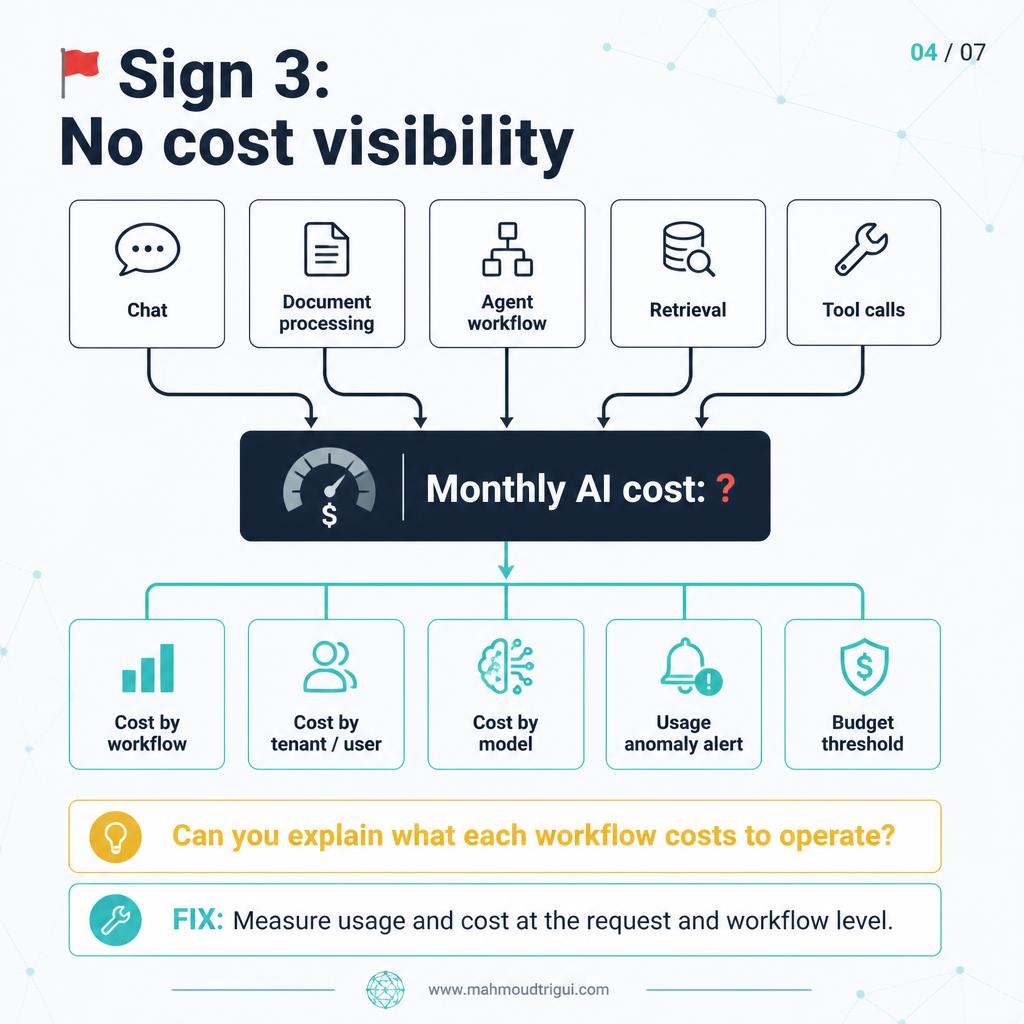
No cost visibility
If nobody knows the cost per request, task, or workflow, the system is not fully under control. Measure usage and cost at the request and workflow level - model calls, tokens, retrieval, tools - and set budget thresholds.
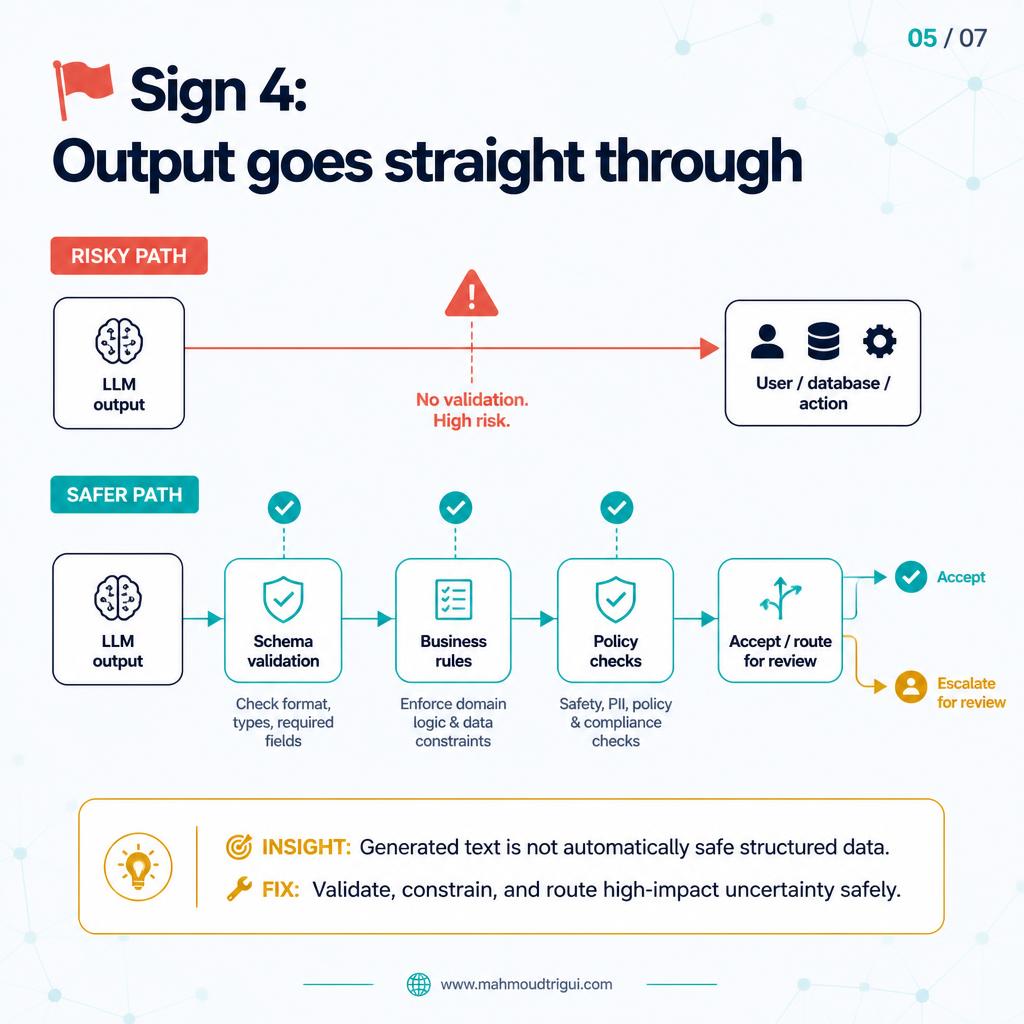
Output goes directly into an action without validation
No schema checks, no business rules, no risk routing for uncertain cases. Generated text is not automatically safe structured data - validate, constrain, and route high-impact uncertainty to review.
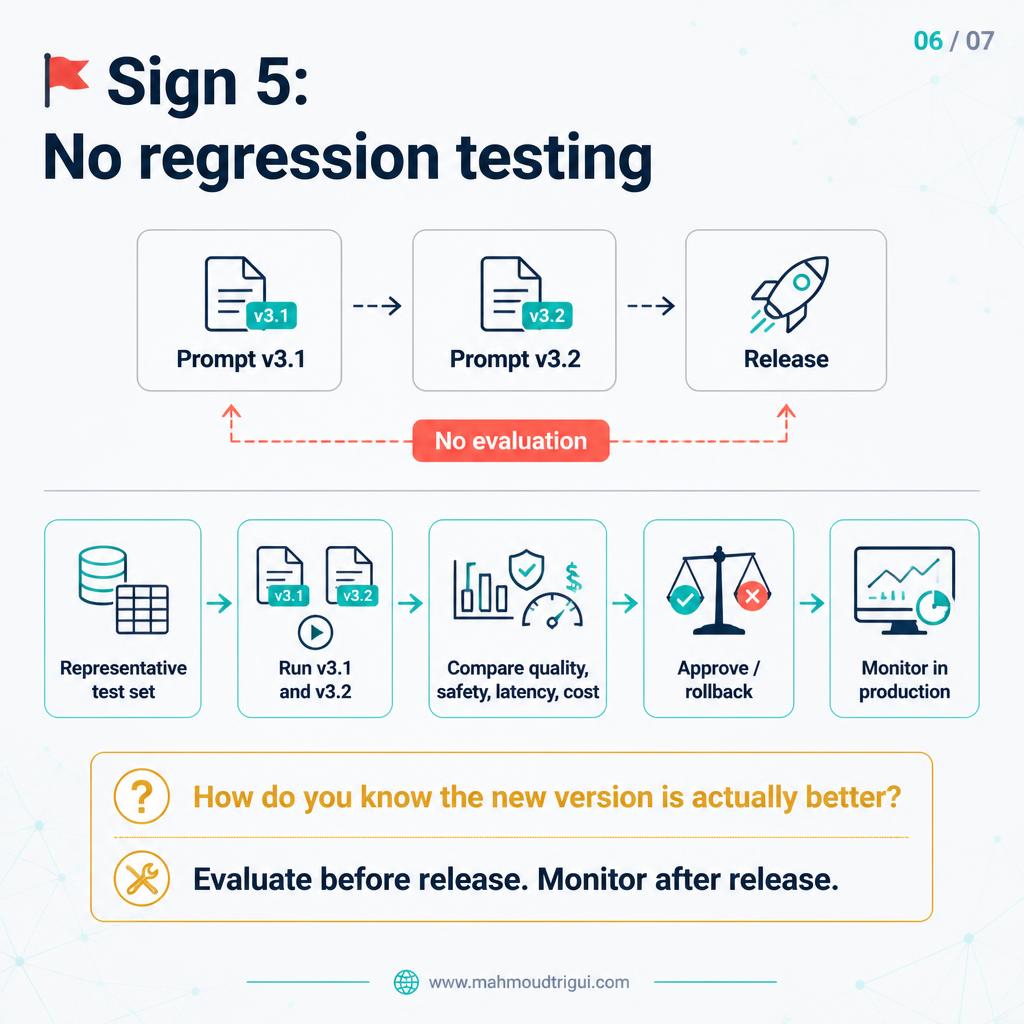
No regression suite for prompt or model changes
A prompt can look better on a few examples while quietly reducing quality on real inputs. Evaluate against a representative test set before release, and monitor production outcomes after release.
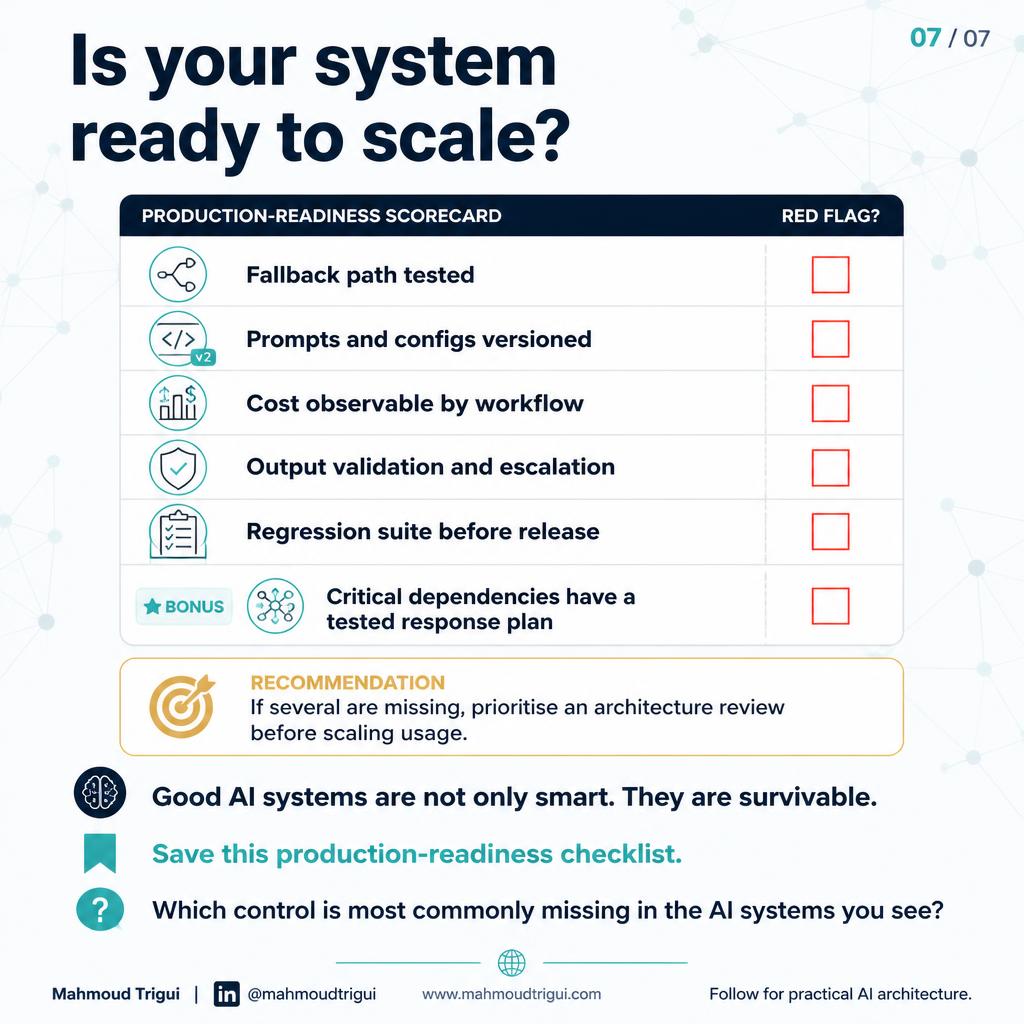
There is one additional risk I always check: a single model, a single provider, and no tested recovery path. None of these are model problems - the model may be excellent - but if the surrounding system lacks fallback, visibility, validation, and change controls, operational risk stays high.
Outcome
Production readiness is not proving that a workflow succeeds on the happy path. It is proving that the system remains observable, controllable, and recoverable when reality becomes inconvenient. These red flags are not a formal audit threshold - treat them as a signal to prioritise a review before scaling usage. The more flags apply, the more operational risk the system carries. Good AI systems are not only smart. They are survivable.
Key Takeaway
Design insight: AI production readiness is not about the happy path - it is about whether a system stays observable, controllable, and recoverable when reality becomes inconvenient. Five red flags mark the operating model, not the model itself: no fallback path, prompts buried in code, no cost visibility, output acting without validation, and no regression testing. The fix is to add fallback, visibility, validation, and change controls around the LLM, because good AI systems are not only smart - they are survivable.
Related
TabPFN: a Pre-Trained Prior for Tabular ML →Structured Outputs for Reliable LLM Pipelines → Enterprise LLM Wrapper → Stable vs Changing LLM Context → Should This Be a Rule, a Model, or an LLM? → The AI Didn't Replace the Classifier → A Predictive Model Is Not a Decision System → Adversarial Validation →
FAQ
What is the key takeaway from "AI Architecture Production Readiness"?
AI production readiness is not about the happy path - it is about whether a system stays observable, controllable, and recoverable when reality becomes inconvenient. Five red flags mark the operating model, not the model itself: no fallback path, prompts buried in code, no cost visibility, output acting without validation, and no regression testing. The fix is to add fallback, visibility, validation, and change controls around the LLM, because good AI systems are not only smart - they are survivable.
Who wrote this and what is it about?
This was written by Mahmoud Trigui, Senior Data Scientist. AI production readiness review: five red flags in LLM systems — no fallback, prompts in code, no cost visibility, unvalidated output, no regression testing.