TabPFN: Use a Pre-Trained Prior as an Additional Model Opinion
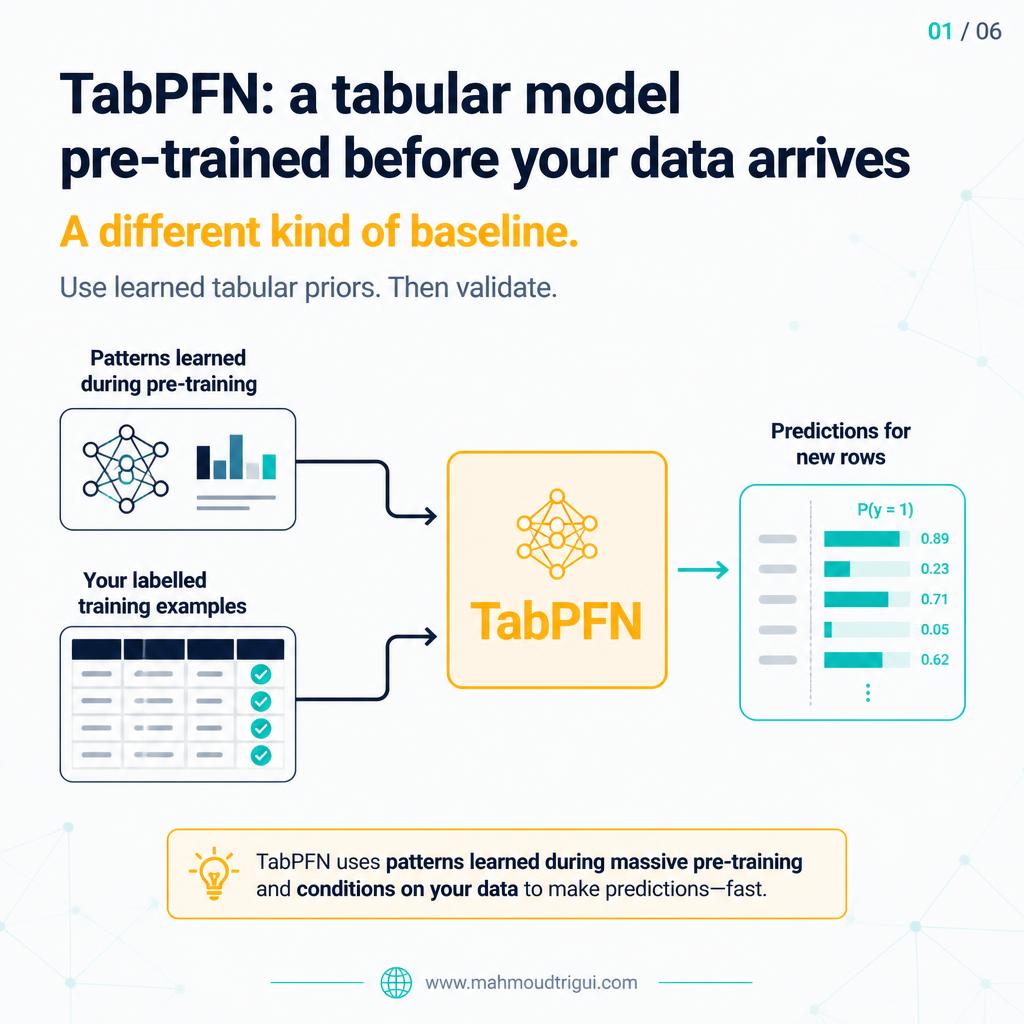
TabPFN is pre-trained on a broad distribution of tabular problems before your data arrives. Treat its prediction as another model opinion - then validate.
TL;DR: TabPFN is a useful reminder that tabular ML now includes pre-trained priors. Use its out-of-fold predictions as an additional model opinion - not as a drop-in replacement for LightGBM or XGBoost. Keep it when it adds validated signal, move on when it does not. The decision should be driven by the validation protocol, not by novelty.
Visual Summary
The Problem
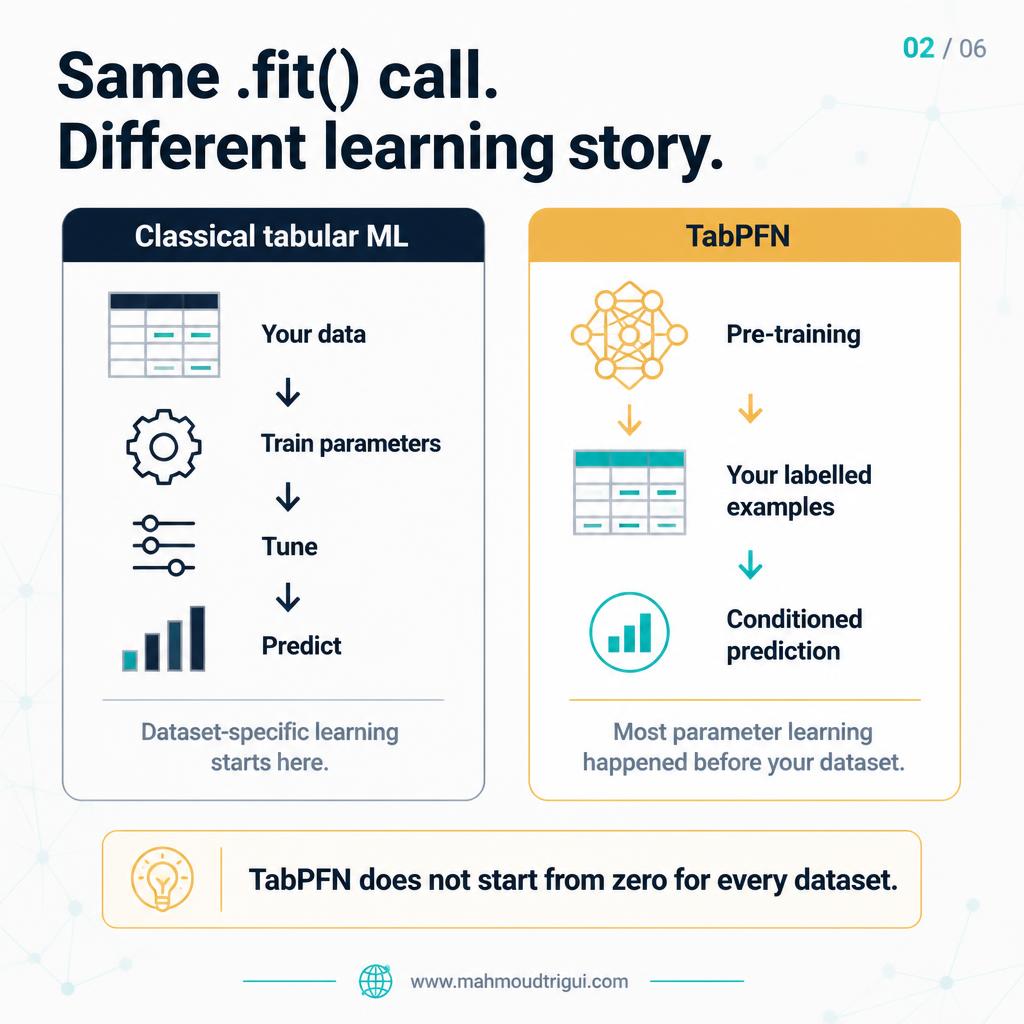
In classical tabular ML the workflow is familiar: choose a model, train it on your dataset, tune it, compare it, repeat. TabPFN changes the story - most of the learning happened before your dataset arrived.
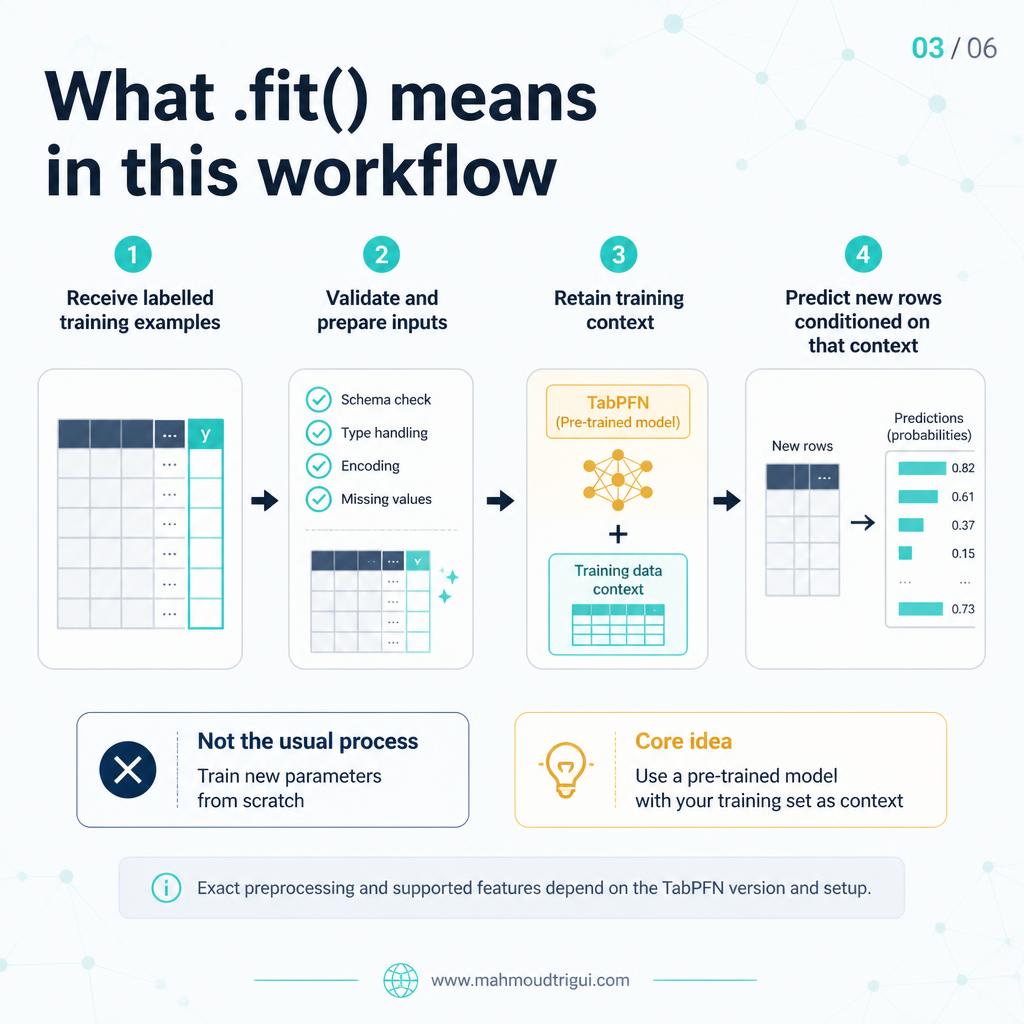
You still call .fit(). But that is not the same as running a conventional,
dataset-specific gradient-descent training loop from scratch. TabPFN is pre-trained on a
broad distribution of tabular problems, and at inference time it uses your training
examples as context to make predictions for new rows.
The Approach
TabPFN is particularly interesting for fast baseline experiments, small-to-medium tabular datasets, low-budget model comparison, ensembling experiments, and generating an additional predictive signal for another model.
Use it as an additional model opinion
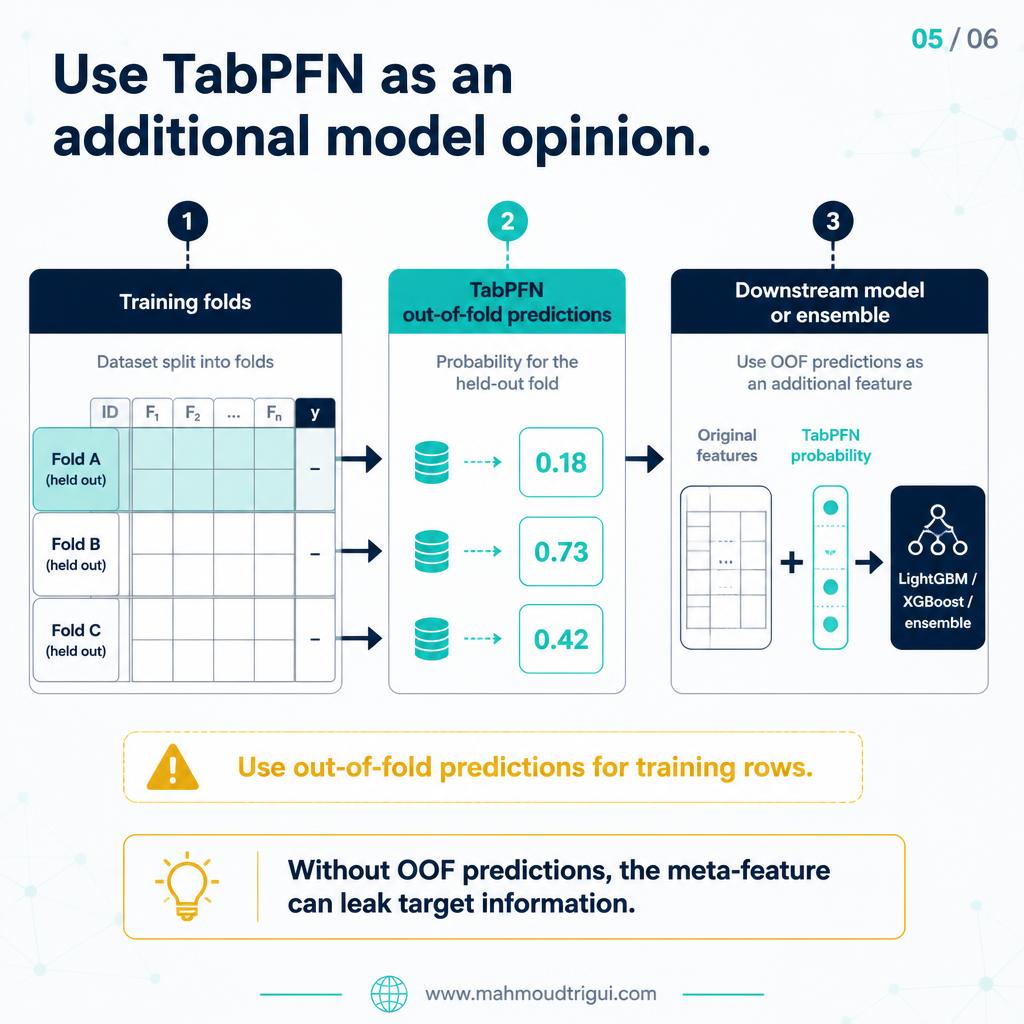
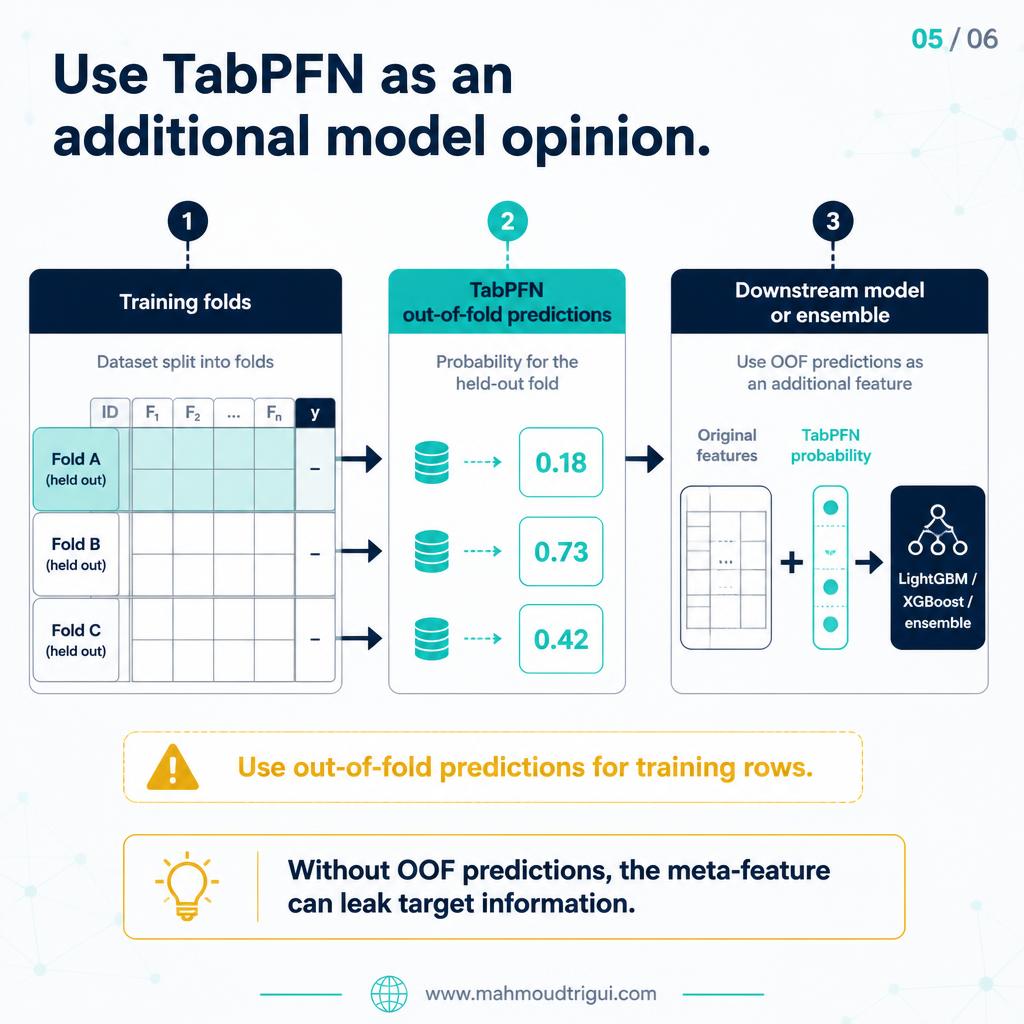
Instead of expecting TabPFN to replace LightGBM or XGBoost, treat its prediction as another opinion. For a binary classification task, that may be a predicted probability.
The out-of-fold step matters
Generate out-of-fold TabPFN probabilities for the training data, then predictions for validation or test data, and add those probabilities as a feature to your downstream model or ensemble. If you generate predictions on the same rows used to fit TabPFN and feed them back into a second model, you risk leakage and overly optimistic validation results.
Compare against a clean baseline
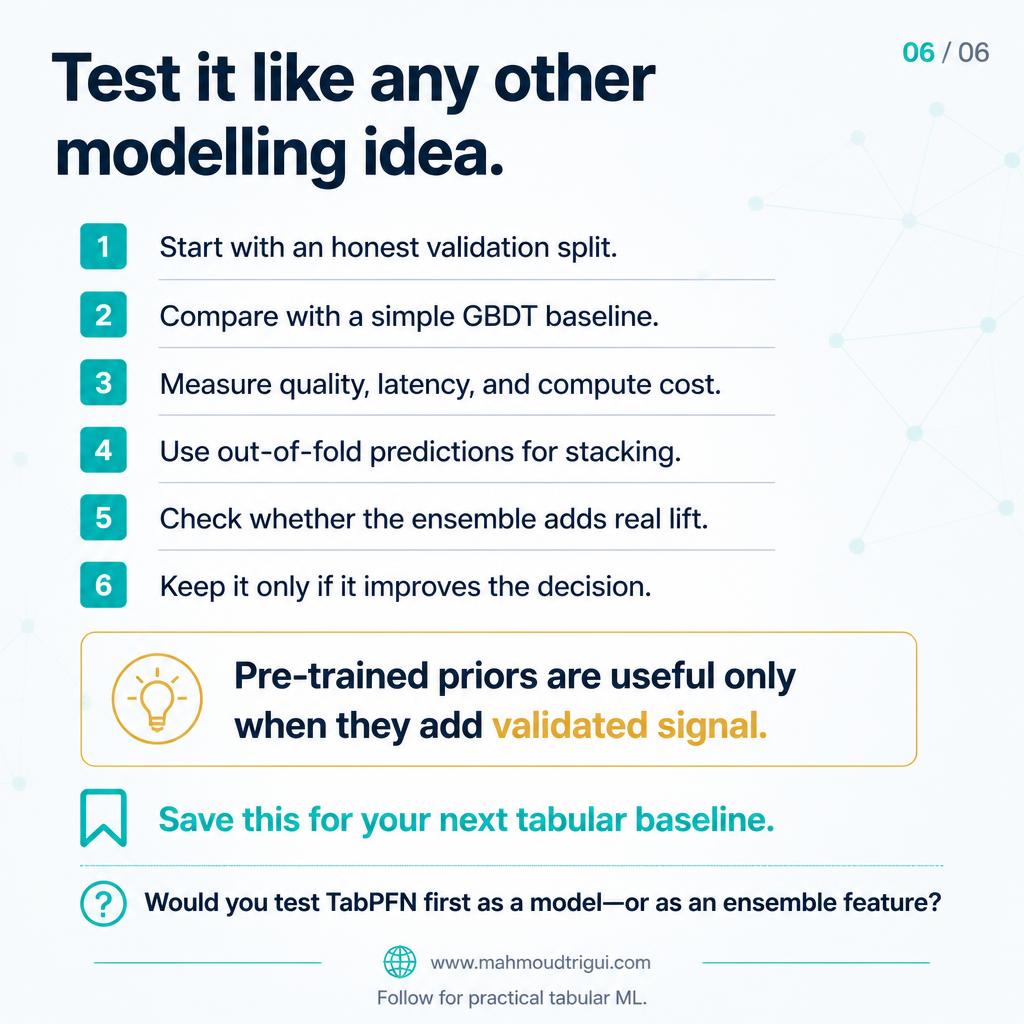
Use the same validation protocol as your LightGBM or XGBoost baseline. Measure quality, latency, and compute cost, and keep the ensemble signal only if it improves the decision.
Not a universal GBDT replacement
TabPFN will not be the right tool for every dataset. Dataset size, feature count, class count, data modality, compute budget, and domain structure all matter.
The Outcome
- Fast baselines: get a strong reference quickly, before deep tuning.
- Ensemble signal: an independent model opinion that may add validated lift.
- Mindset shift: tabular ML is no longer only "which model should I train from scratch?" - it can also be "what pre-trained prior can add signal to my existing stack?"
Key Takeaway
Design insight: TabPFN is a useful reminder that tabular ML now includes pre-trained priors. Use its out-of-fold predictions as an additional model opinion - not as a drop-in replacement for LightGBM or XGBoost. Keep it when it adds validated signal, move on when it does not. The decision should be driven by the validation protocol, not by novelty.
Related
AI Production Readiness →Nixtla Forecasting Libraries →LightGBM vs XGBoost in 2026 →Encoding Is a Modeling Decision →MLforecast Forecasting Pipeline →Enterprise LLM Wrapper →Open Source Coding Agents →
FAQ
How do I use TabPFN as an ensemble feature without leakage?
Generate out-of-fold TabPFN probabilities for the training data - each row is predicted by a fit that did not see that row - then predict validation or test data, and feed those probabilities as a meta-feature into your downstream model or ensemble. If you predict the same rows used to fit TabPFN and feed them back into a second model, you leak target information and your validation results become overly optimistic.
When should I try TabPFN instead of LightGBM or XGBoost?
Use it for fast baselines, small-to-medium tabular datasets, low-budget model comparison, and ensembling experiments. Do not treat it as a universal gradient boosting replacement: dataset size, feature count, class count, data modality, compute budget, and domain structure all matter. Compare against a clean GBDT baseline using the same validation protocol, and keep it only when it adds validated signal.