Structured Outputs for Reliable LLM Pipelines
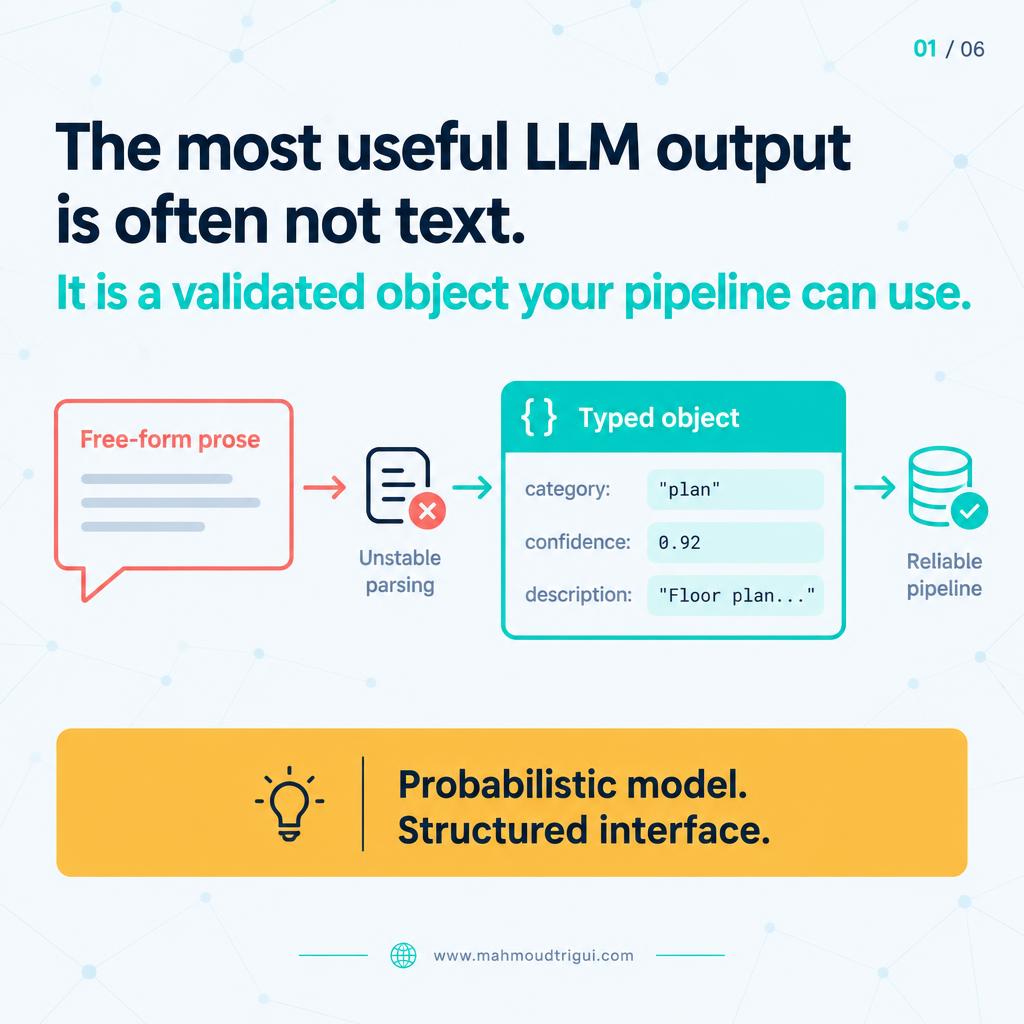
The most useful LLM output is often not text — it is a validated, typed object your pipeline can act on. Schema-constrained outputs remove the most fragile parsing logic in AI workflows.
TL;DR: The most useful LLM output is often not text but a validated, typed object your pipeline can use. Define the response schema with Pydantic before calling the model, and your application receives predictable fields instead of prose to parse. Structured outputs do not make the model deterministic — factual validation, business rules, and monitoring are still required — but they remove the unstructured interface between probabilistic models and deterministic systems, the most fragile parsing logic in LLM-driven workflows.
Visual Summary
The Problem
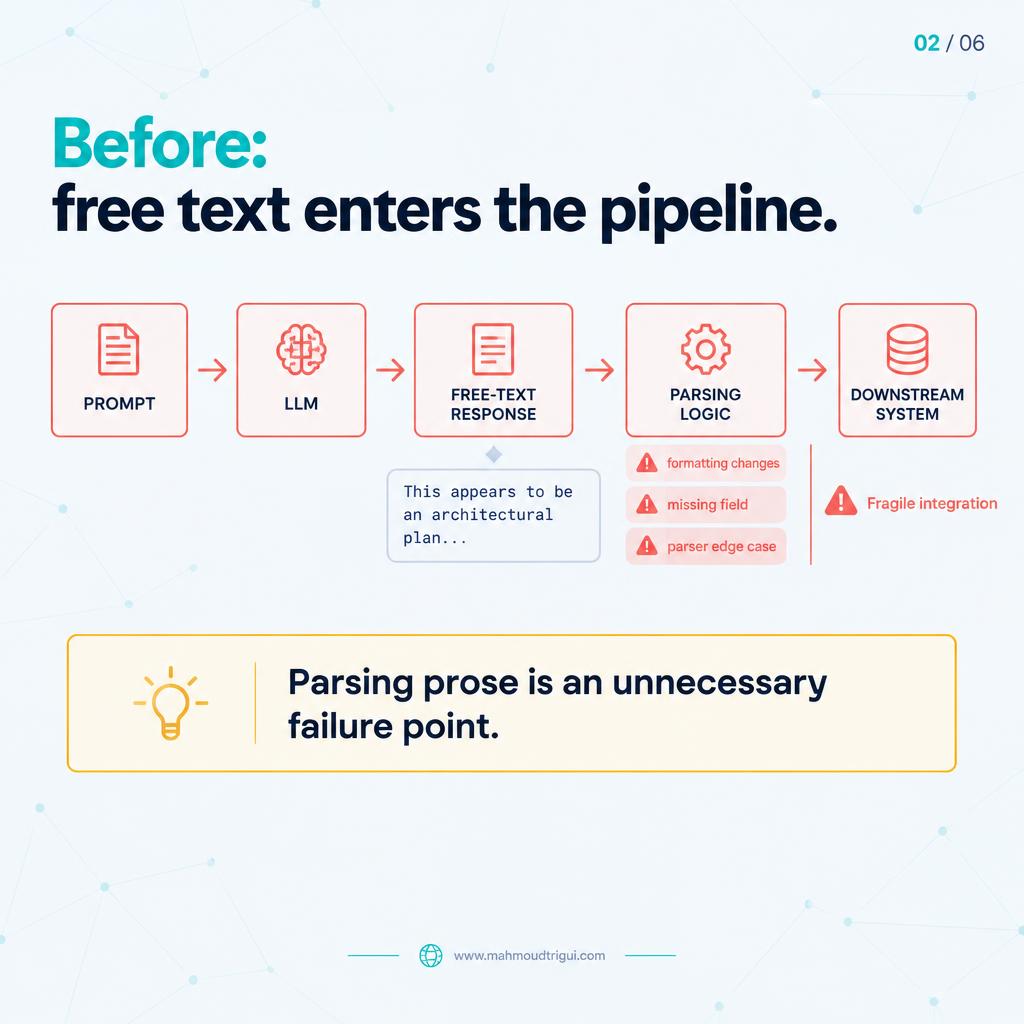
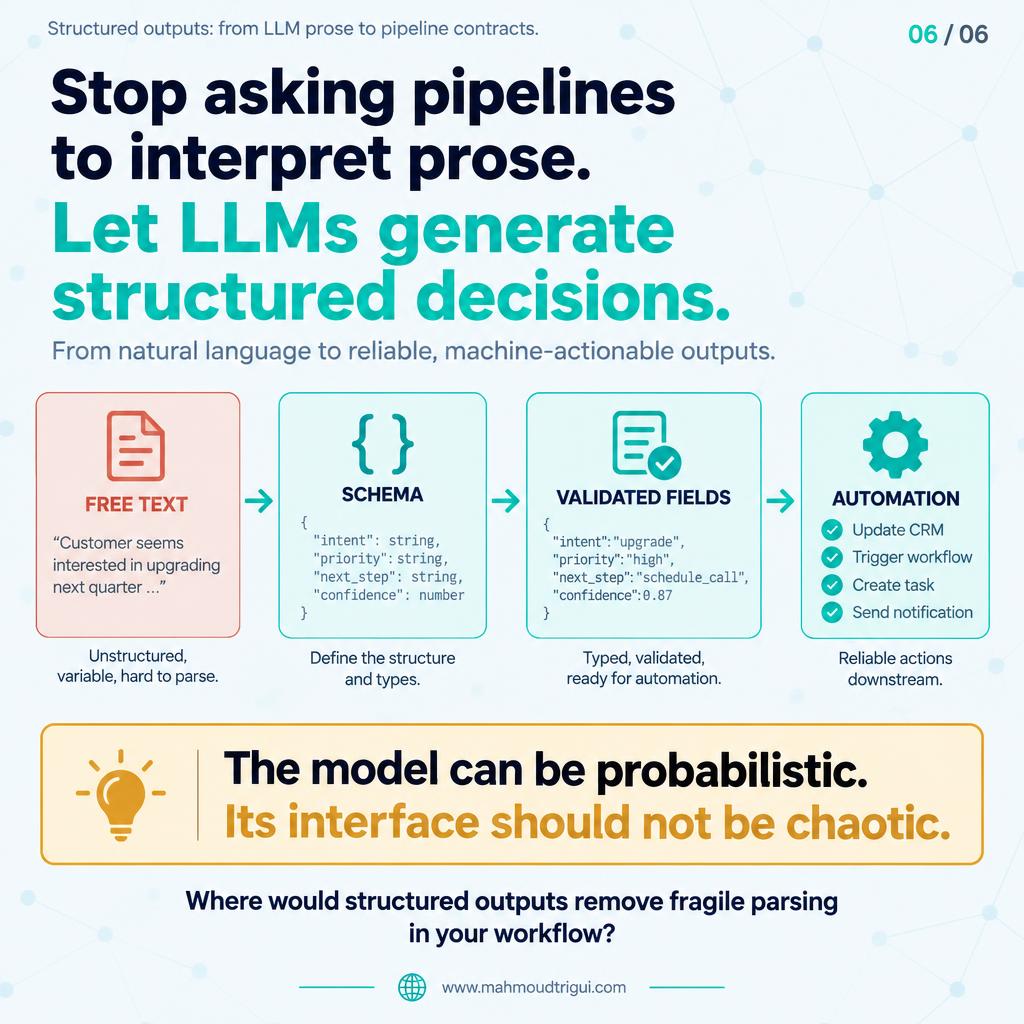
Before structured outputs, an LLM integration usually looked the same way: ask a question, receive free text, parse it with JSON rules or regex, handle formatting variations, and hope the response stays usable. That works for prototypes. It becomes fragile the moment the output drives a downstream workflow — document extraction, image or ticket classification, routing decisions, data-quality review, or downstream automation. Every variation in formatting becomes a parsing failure, and parsing failures break the systems the model is supposed to feed.
The Approach
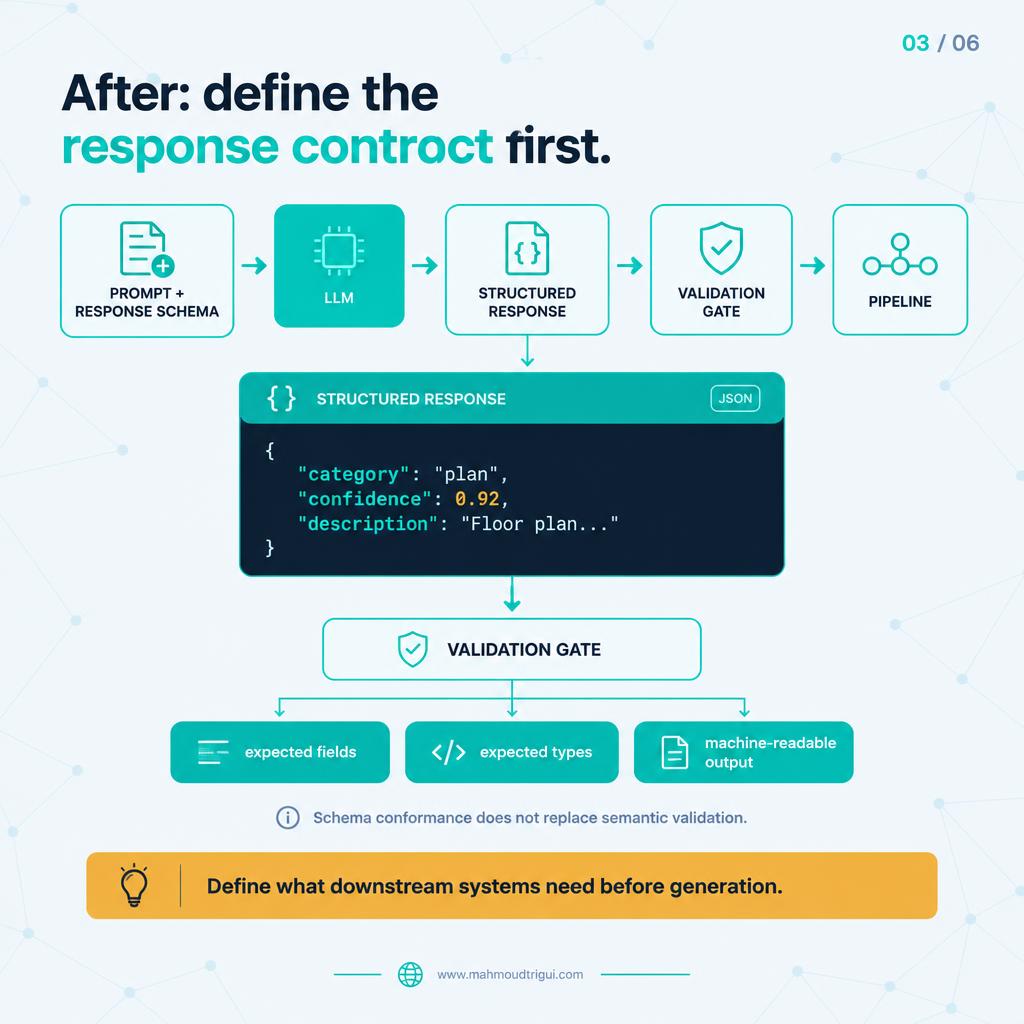
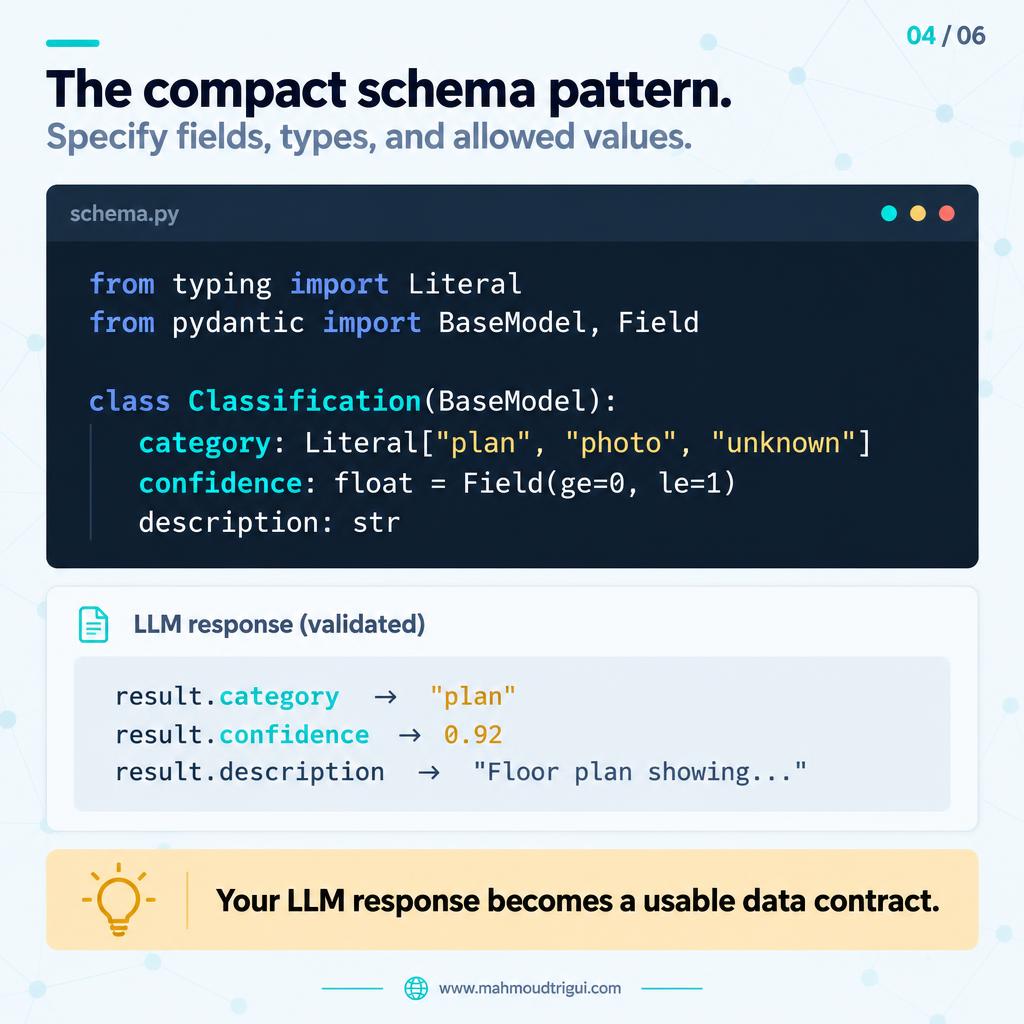
Instead of parsing prose after the call, I define the expected response before calling the model. A Pydantic schema states exactly which fields, types, and allowed values the downstream system needs:
from typing import Literal
from pydantic import BaseModel, Field

class Classification(BaseModel):
    category: Literal["plan", "photo", "unknown"]
    confidence: float = Field(ge=0, le=1)
    description: str
Then I ask the model to return data that follows that schema. My application receives
predictable fields — result.category, result.confidence,
result.description — and works with a structured contract instead of a string
to reverse-engineer.
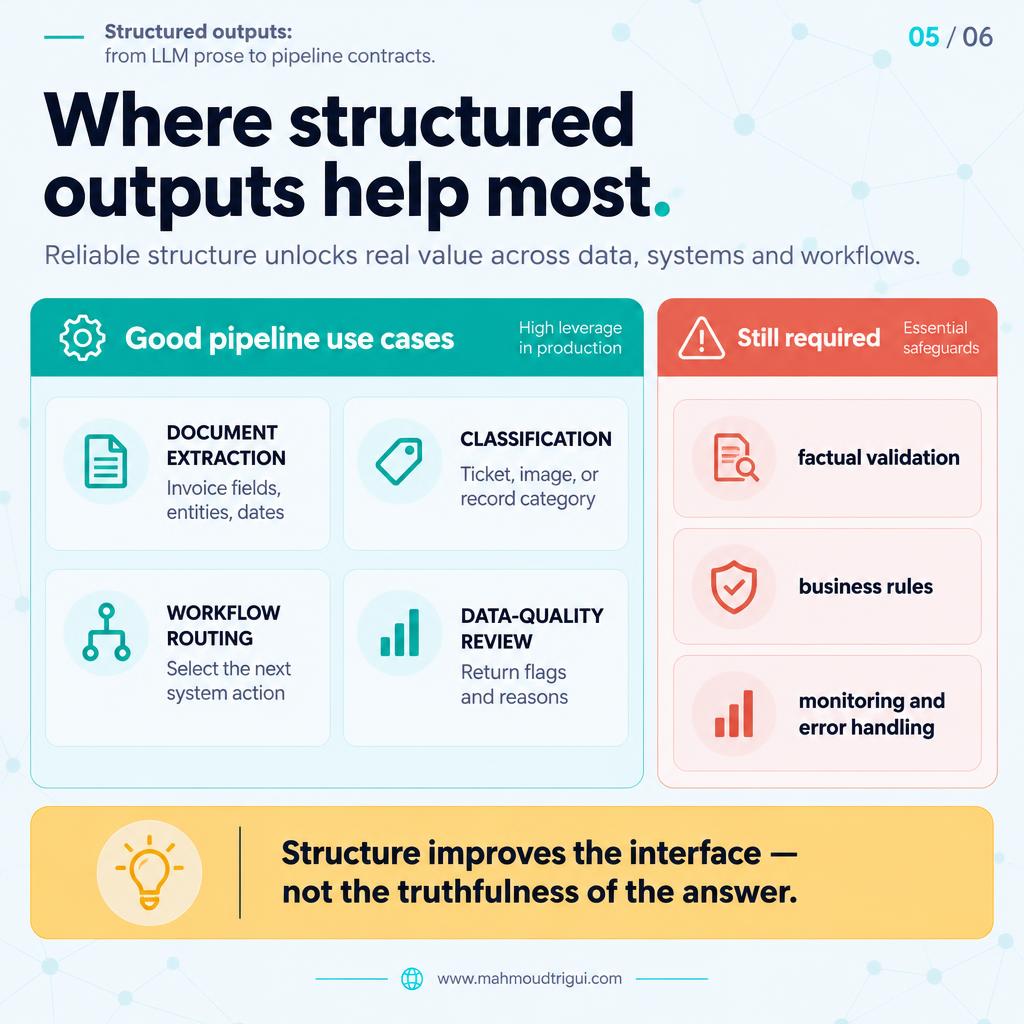
This pattern helps most where an LLM result must trigger another system:
Document extraction
Invoice fields, entities, and dates come back as validated fields instead of prose to parse.
Classification
Ticket, image, or record categories are returned as a typed enum with a confidence score.
Workflow routing
The model selects the next system action directly, inside the schema.
Data-quality review
Flags and reasons are returned in machine-readable form, ready for a review queue.
Structured outputs do not make the model deterministic. I still validate business logic, handle refusals and errors, monitor quality, and check whether the answer is actually correct. Schema conformance never replaces semantic validation. But it removes an unnecessary source of pipeline fragility: the unstructured interface between a probabilistic model and a deterministic system.
Outcome
This is why schema-constrained outputs are one of the first patterns I reach for whenever an LLM result must trigger another system. It is cheap to implement, removes whole classes of parser edge cases, and keeps the modeling layer free to stay probabilistic. In document-processing and classification work it turned what used to be regex surgery into a typed contract the rest of the pipeline could rely on. The model can remain probabilistic — its interface should not be chaotic.
Key Takeaway
Design insight: The most useful LLM output is often not text but a validated, typed object your pipeline can use. Define the response schema with Pydantic before calling the model, and your application receives predictable fields instead of prose to parse. Structured outputs do not make the model deterministic — factual validation, business rules, and monitoring are still required — but they remove the unstructured interface between probabilistic models and deterministic systems, the most fragile parsing logic in LLM-driven workflows.
Related
TabPFN: a Pre-Trained Prior for Tabular ML →AI Production Readiness: 5 Red Flags →The Prompt That Classifies Images Without a Model → Enterprise LLM Wrapper → Stable vs Changing LLM Context → NLP Classification vs LLMs → Should This Be a Rule, a Model, or an LLM? → The AI Didn't Replace the Classifier → AI-Assisted Coding Moved the Hard Part →
FAQ
What is the key takeaway from "Structured Outputs for Reliable LLM Pipelines"?
The most useful LLM output is often not text but a validated, typed object your pipeline can use. Define the response schema with Pydantic before calling the model, and your application receives predictable fields instead of prose to parse. Structured outputs do not make the model deterministic — factual validation, business rules, and monitoring are still required — but they remove the unstructured interface between probabilistic models and deterministic systems, the most fragile parsing logic in LLM-driven workflows.
Who wrote this and what is it about?
This was written by Mahmoud Trigui, Senior Data Scientist. LLM structured outputs turn free text into validated, typed objects your pipeline can act on. Fewer parsers, more reliable AI integration.