AI Post-Launch Ownership: Who Owns the System in 6 Months?
Many AI projects do not lose value because the first model was weak. They lose value because nobody clearly owns what happens after launch — and the fix is not more architecture, it is clear post-launch ownership.
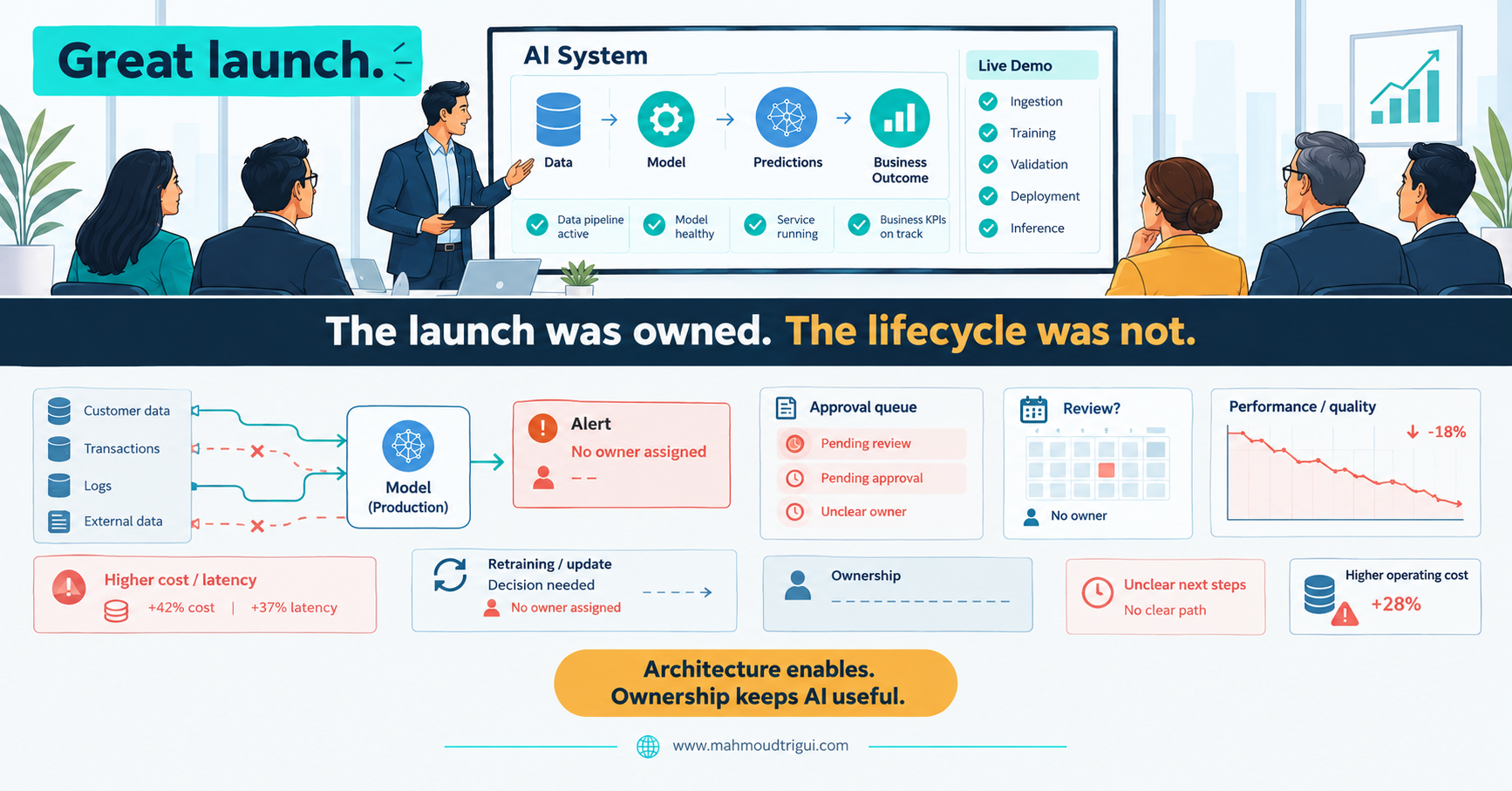
TL;DR: Most AI projects do not lose value because the first model was weak — they lose value because nobody clearly owns what happens after launch. Who monitors data quality and system health? Who reviews output quality, investigates degradation, approves a retrained model, prompt change or rollback, owns cost and reliability alerts, and decides the fallback when the system is not trustworthy enough? Without named owners these responsibilities become shared in theory and invisible in practice, and an impressive launch quietly becomes an unmaintained decision system. Architecture enables a system. Ownership keeps it useful.
The Problem
Many AI projects do not lose value because the first model was weak. They lose value because nobody clearly owns what happens after launch. The pattern is familiar: a successful demo, a launch, stakeholder excitement, and then the delivery team moves to the next priority. Data, user behaviour, source systems, or business conditions change; quality quietly degrades; and nobody is accountable for noticing early or deciding what happens next.
For predictive models, that might look like worsening forecast error, drift, or outdated labels. For LLM systems, it may show up as reduced answer quality, retrieval failures, higher cost, latency issues, changing source documents, or more human overrides. Whatever the surface symptom, the hole is the same: a gap in ownership, not in the model.
The Approach
The fix is not automatically more architecture. It is clear post-launch ownership. A production AI system needs a named owner for each responsibility, so I test any deployed system against six questions.
Monitoring data quality and system health
Who watches the inputs and the infrastructure the system depends on, and notices when either starts drifting? For a model that is data distribution and forecast error; for an LLM workflow it is retrieval quality, latency, and cost.
Reviewing performance and output quality
Who reviews predictions or generated output on a cadence, not just when something breaks? A named reviewer turns “somebody will notice” into a scheduled check.
Investigating degradation
Who is accountable for finding the cause when results degrade — a data change, a source-system change, or model decay — instead of treating the alert as noise?
Approving change
Who approves a retrained model, a prompt change, a retrieval update, or a rollback? Without an approver, every update is either blocked forever or ungoverned.
Owning cost and reliability alerts
Who responds when spend climbs or latency and error rates cross thresholds? Cost and reliability are operational risks, and they need a name attached.
Defining the fallback
What happens when the system is not trustworthy enough, and who decides when to trigger it? A fallback with no owner is a plan nobody executes.
Without named owners, these responsibilities become shared in theory and invisible in practice. That is how an impressive launch becomes an unmaintained decision system.
Outcome
The unglamorous truth: architecture enables a system; ownership keeps it useful. The organisations that keep AI value are not always the ones with the strongest models — they are the ones where the post-launch questions have answers with names attached.
Before celebrating deployment, ask one question: who owns this system six months from now? If the answer is everyone and no one, the launch was the easy part.
Key Takeaway
Design insight: Most AI projects do not lose value because the first model was weak — they lose value because nobody clearly owns what happens after launch. Who monitors data quality and system health? Who reviews output quality, investigates degradation, approves a retrained model, prompt change or rollback, owns cost and reliability alerts, and decides the fallback when the system is not trustworthy enough? Without named owners these responsibilities become shared in theory and invisible in practice, and an impressive launch quietly becomes an unmaintained decision system. Architecture enables a system. Ownership keeps it useful.
Related
AI Maturity Levels: From Demo to Platform →AI Architecture Production Readiness — 5 Red Flags →LLM Fallback Strategy: What Happens When the Model Fails? →Prompt Versioning: How LLMOps Makes Prompts Reversible →The AI Didn't Replace the Classifier. It Replaced the Training Backlog. →Enterprise LLM Wrapper: The API Call Is the Smallest Part →A Predictive Model Is Not a Decision System →The Most Dangerous Label in ML: Validity Over Time →
FAQ
What is the key takeaway from "AI Post-Launch Ownership: Who Owns the System in 6 Months?"?
Most AI projects do not lose value because the first model was weak — they lose value because nobody clearly owns what happens after launch. Who monitors data quality and system health? Who reviews output quality, investigates degradation, approves a retrained model, prompt change or rollback, owns cost and reliability alerts, and decides the fallback when the system is not trustworthy enough? Without named owners these responsibilities become shared in theory and invisible in practice, and an impressive launch quietly becomes an unmaintained decision system. Architecture enables a system. Ownership keeps it useful.
Who wrote this and what is it about?
This was written by Mahmoud Trigui, Senior Data Scientist. AI post-launch ownership: most AI projects do not fail because the model is weak — they lose value when nobody owns monitoring, quality, and retraining.
Why do AI systems lose value after launch when the model still works?
Because the operating context moves and nobody is accountable for keeping up. Data distributions shift, source systems change their behaviour, business conditions evolve, and for LLM systems retrieval sources and expected output drift too. Forecast error worsens, answer quality drops, latency and cost climb, and human overrides multiply. None of those are model bugs that a better first model would have avoided — they are post-launch events that need a named owner who notices early and decides what happens next.
What does accountability for AI look like in practice — who should own what?
One named owner per responsibility, written down, not shared by default. Someone monitors data quality and system health, someone reviews output quality on a cadence, someone investigates when results degrade, someone approves a retrained model, prompt change, retrieval update or rollback, someone owns cost and reliability alerts, and someone decides and triggers the fallback when the system is not trustworthy enough. When every responsibility has a name, the launch stops being a one-off event and becomes a system that is deliberately kept useful.