LLM Fallback Strategy: What Happens When the Model Fails?
Your prompt can be excellent and your LLM workflow can still fail. Design a fallback strategy, because reliable AI is better architecture.
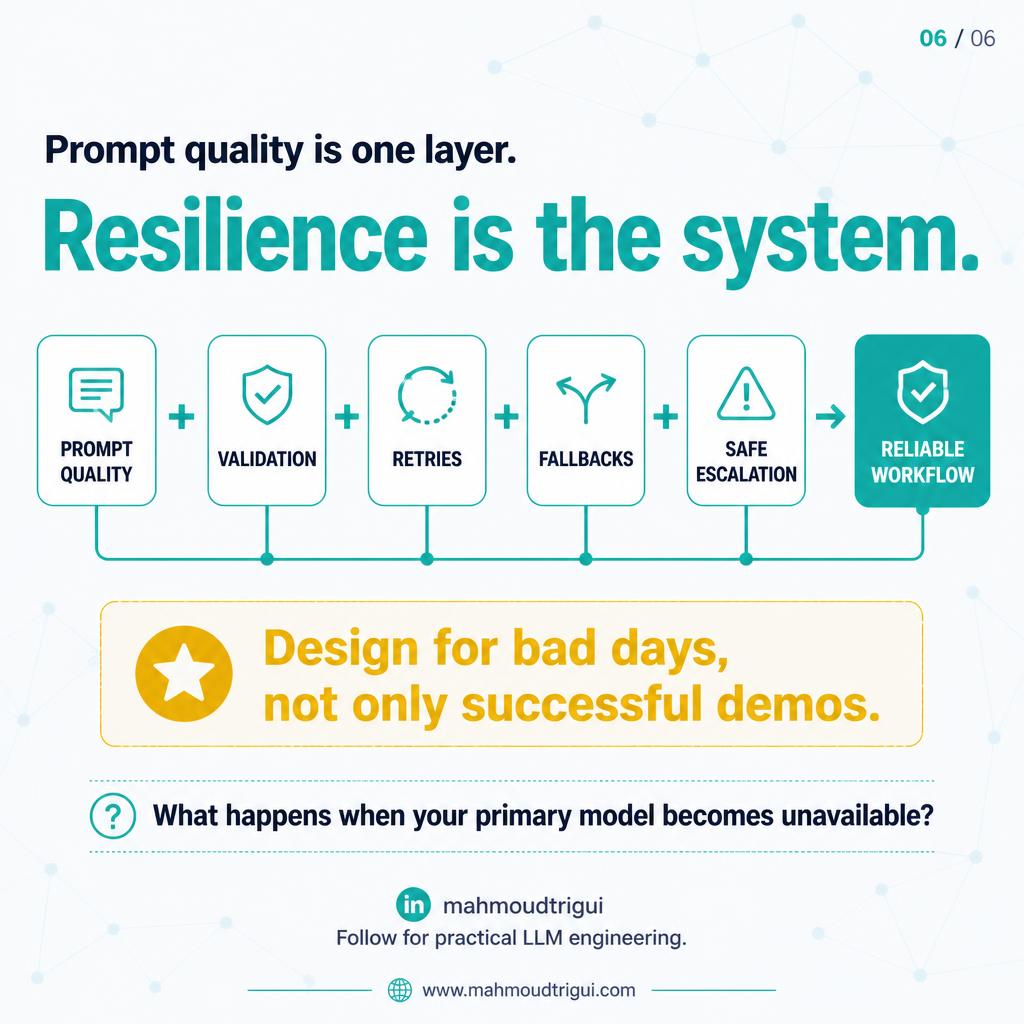
TL;DR: Prompt quality is one layer — resilience is the system. A good prompt cannot prevent a dependency failure. Production LLM systems need a fallback strategy: a primary model, bounded retries with backoff, a tested compatible fallback, a safe degraded mode with partial results clearly flagged for review, and a queue plus escalation path that preserves the task. Validate the fallback model for schema compatibility, output quality, latency and cost, privacy, and failure behaviour — and design for bad days, not only successful demos.
Visual Summary
The Problem
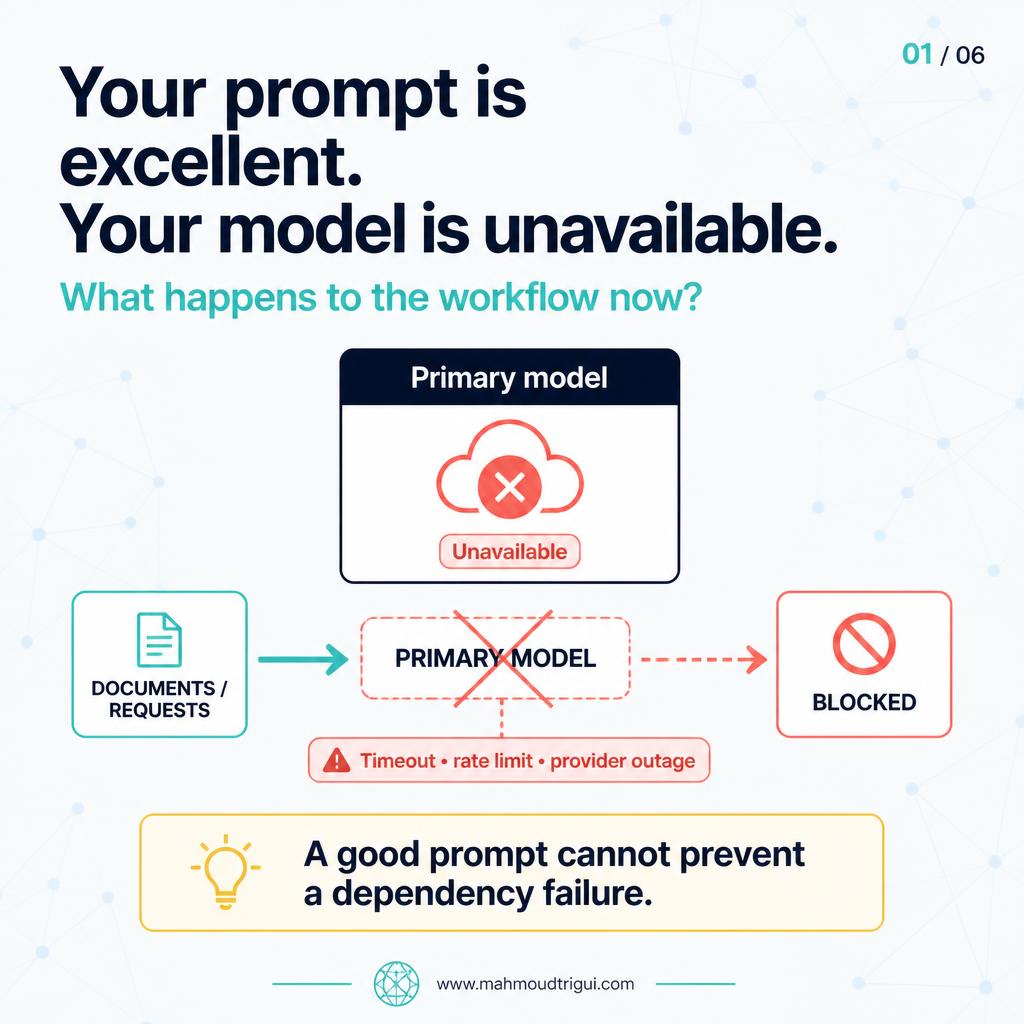
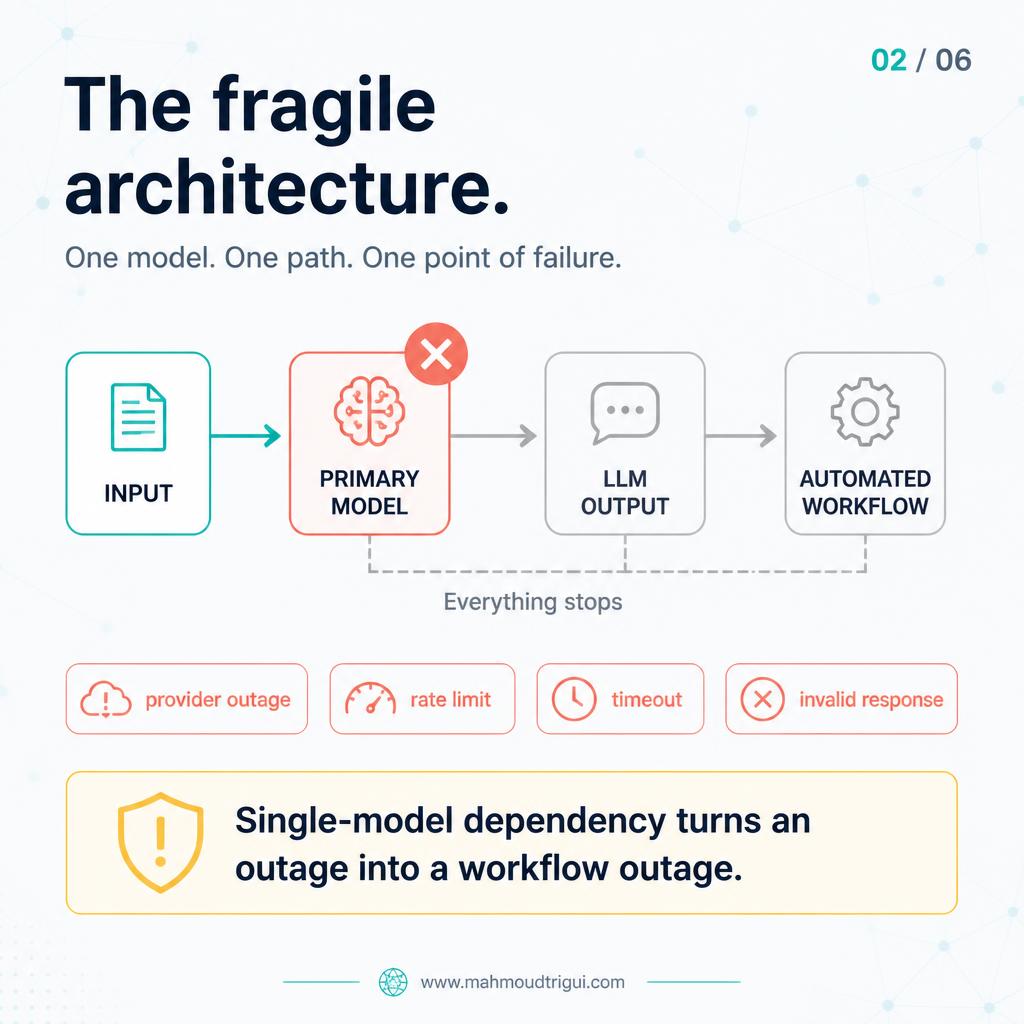
A provider can time out. A rate limit can be reached. Latency can spike. A model can return an invalid response. None of those problems are solved by a better prompt.
Production LLM systems need more than a primary model and a carefully written instruction. They need a fallback strategy. A single-model dependency turns an outage into a workflow outage.
The Approach
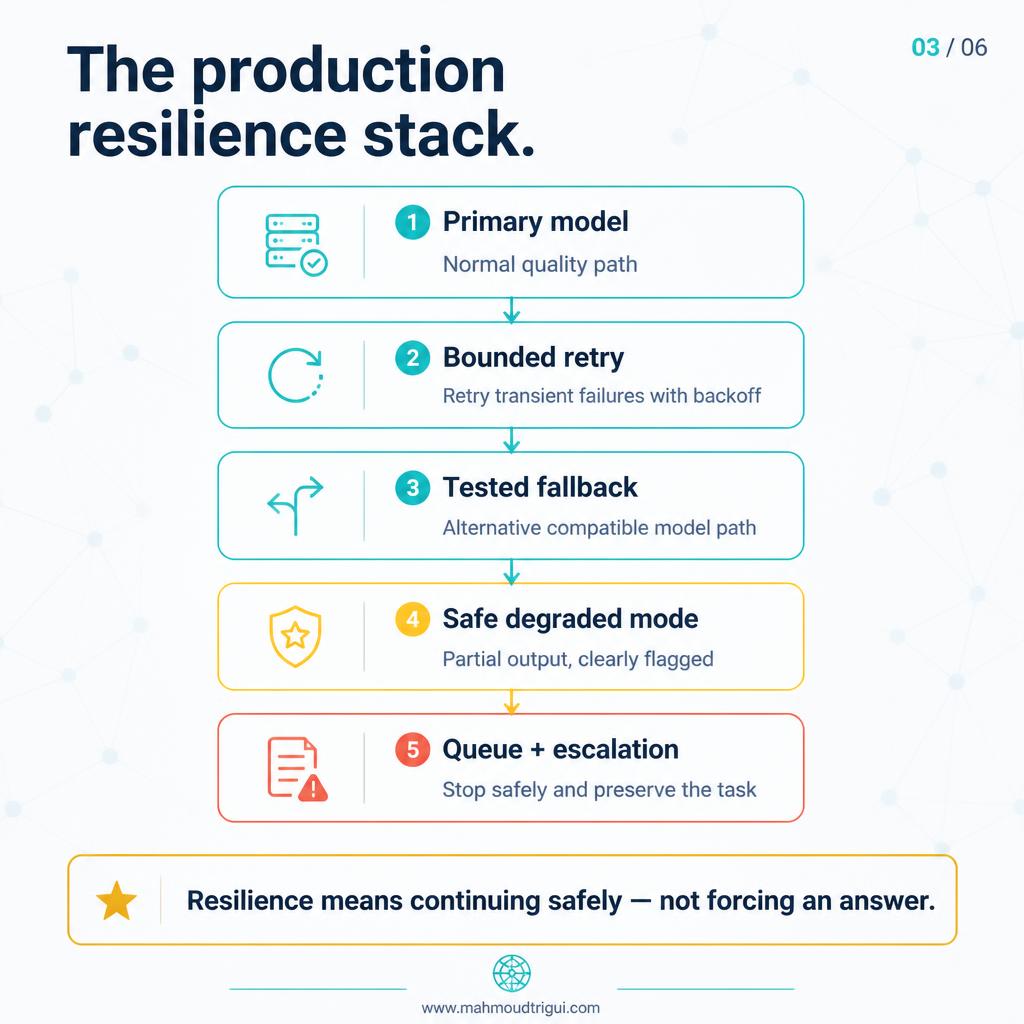
A practical resilience pattern covers five levels:
Primary model
Use the model that meets your quality, latency, and cost requirements on the healthy path.
Bounded retries
Retry transient failures with limits and backoff. Do not retry forever.
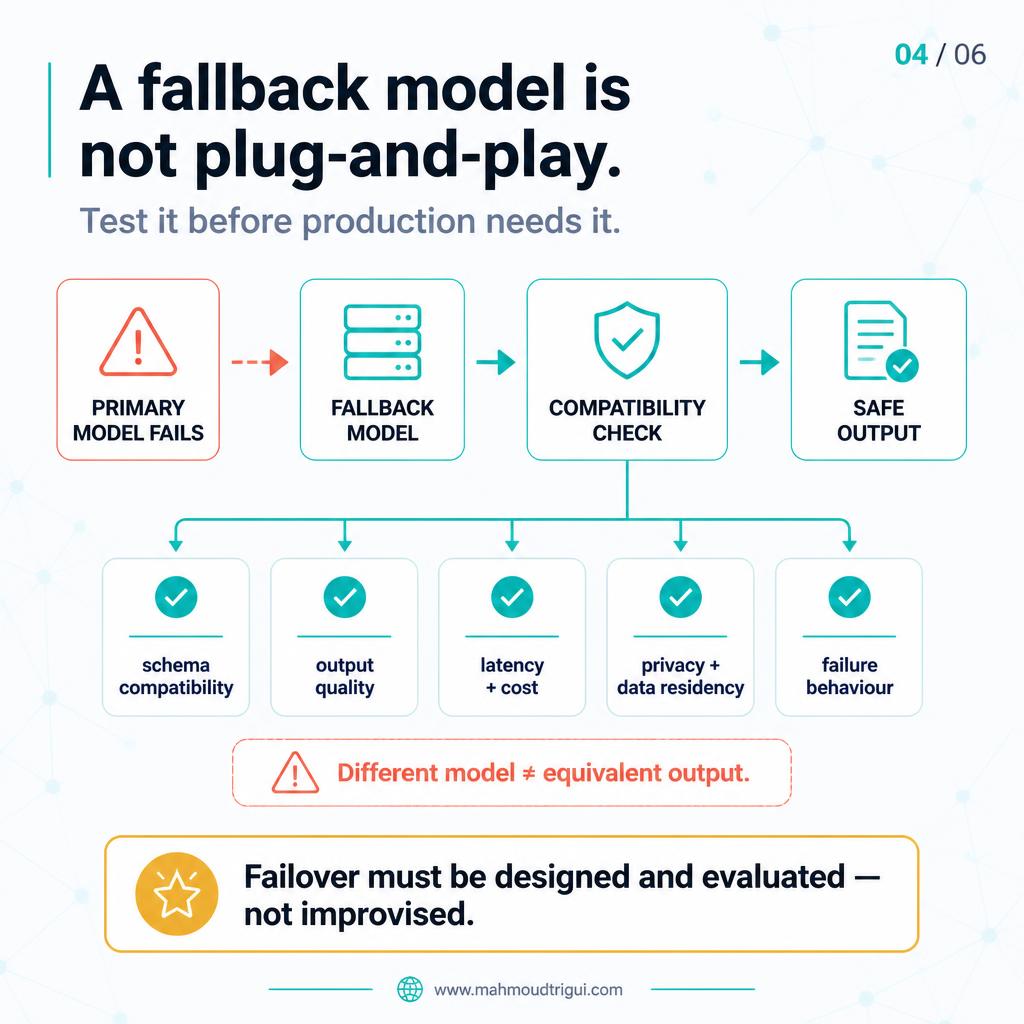
Compatible fallback
Route to a tested alternative model or provider when the primary path is unavailable. A fallback model is not automatically interchangeable — validate schema compatibility, output quality, latency and cost, privacy and data-residency requirements, and failure behaviour.
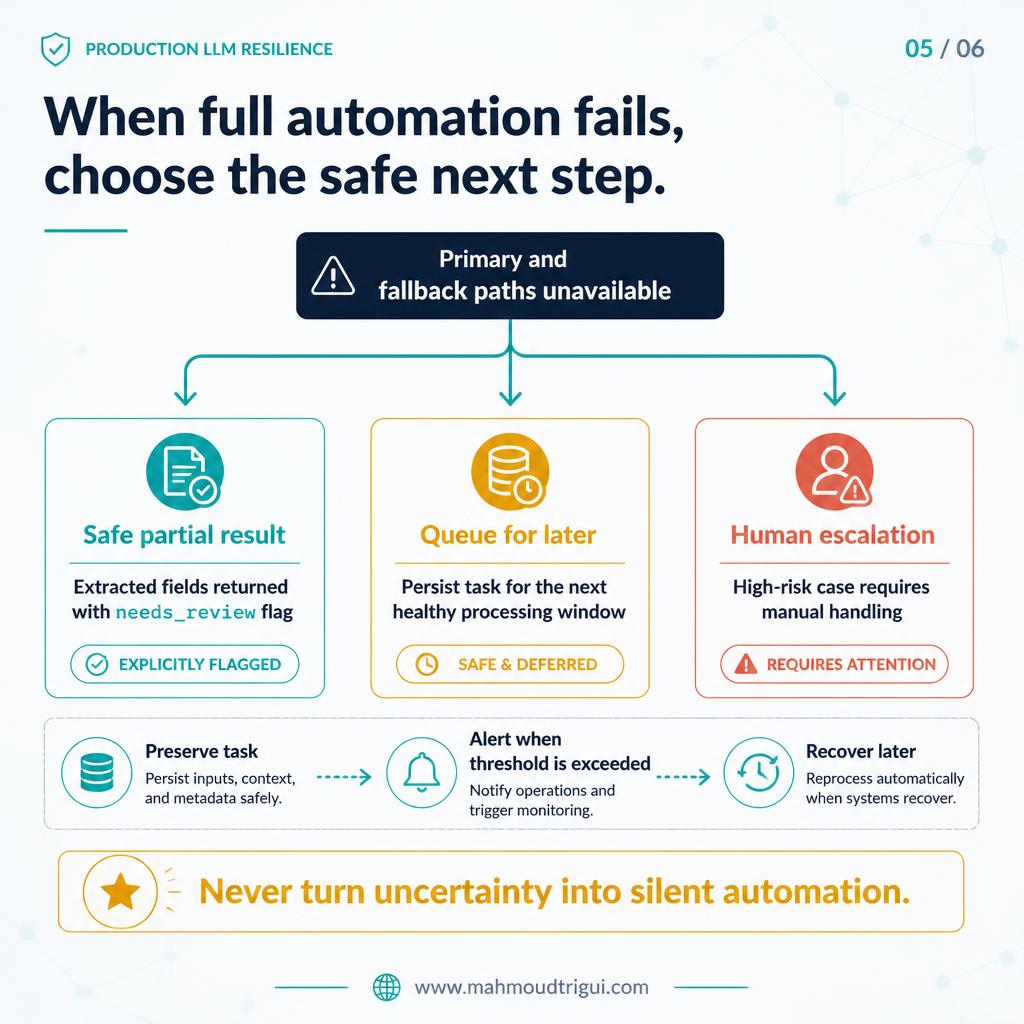
Safe degraded mode
If full extraction or reasoning is unavailable, return only safe partial results — clearly flagged for review. Never turn uncertainty into silent automation.
Queue and escalate
If the workflow cannot safely continue, preserve the task, alert the right team, and process it later or route it to a human.
Prompt engineering improves what happens on a healthy request. Fallback design determines what happens when the healthy path disappears.
Outcome
The important word is safe. Resilience means continuing safely — not forcing an answer. Failover must be designed and evaluated, not improvised.
Reliable AI is not just better wording. It is better architecture. Design for bad days, not only successful demos.
Key Takeaway
Design insight: Prompt quality is one layer — resilience is the system. A good prompt cannot prevent a dependency failure. Production LLM systems need a fallback strategy: a primary model, bounded retries with backoff, a tested compatible fallback, a safe degraded mode with partial results clearly flagged for review, and a queue plus escalation path that preserves the task. Validate the fallback model for schema compatibility, output quality, latency and cost, privacy, and failure behaviour — and design for bad days, not only successful demos.
Related
A Valid LLM Response Is Not Necessarily a Safe Decision →Structured Outputs for Reliable LLM Pipelines →AI Architecture Production Readiness — 5 Red Flags →Rule vs Model vs LLM — Which Should You Use? →Enterprise LLM Wrapper: The API Call Is the Smallest Part →Stable vs Changing LLM Context — Cache, Retrieve, Validate →A Predictive Model Is Not a Decision System →Automate Maintenance, Keep Judgment Human →
FAQ
What is the key takeaway from "LLM Fallback Strategy: What Happens When the Model Fails?"?
Prompt quality is one layer — resilience is the system. A good prompt cannot prevent a dependency failure. Production LLM systems need a fallback strategy: a primary model, bounded retries with backoff, a tested compatible fallback, a safe degraded mode with partial results clearly flagged for review, and a queue plus escalation path that preserves the task. Validate the fallback model for schema compatibility, output quality, latency and cost, privacy, and failure behaviour — and design for bad days, not only successful demos.
Who wrote this and what is it about?
This was written by Mahmoud Trigui, Senior Data Scientist. LLM fallback strategy: bounded retries, a tested fallback model, safe partial results, and queue or human escalation when the primary model is unavailable.