A Strong AutoML Baseline Can Beat Hand-Tuned Models
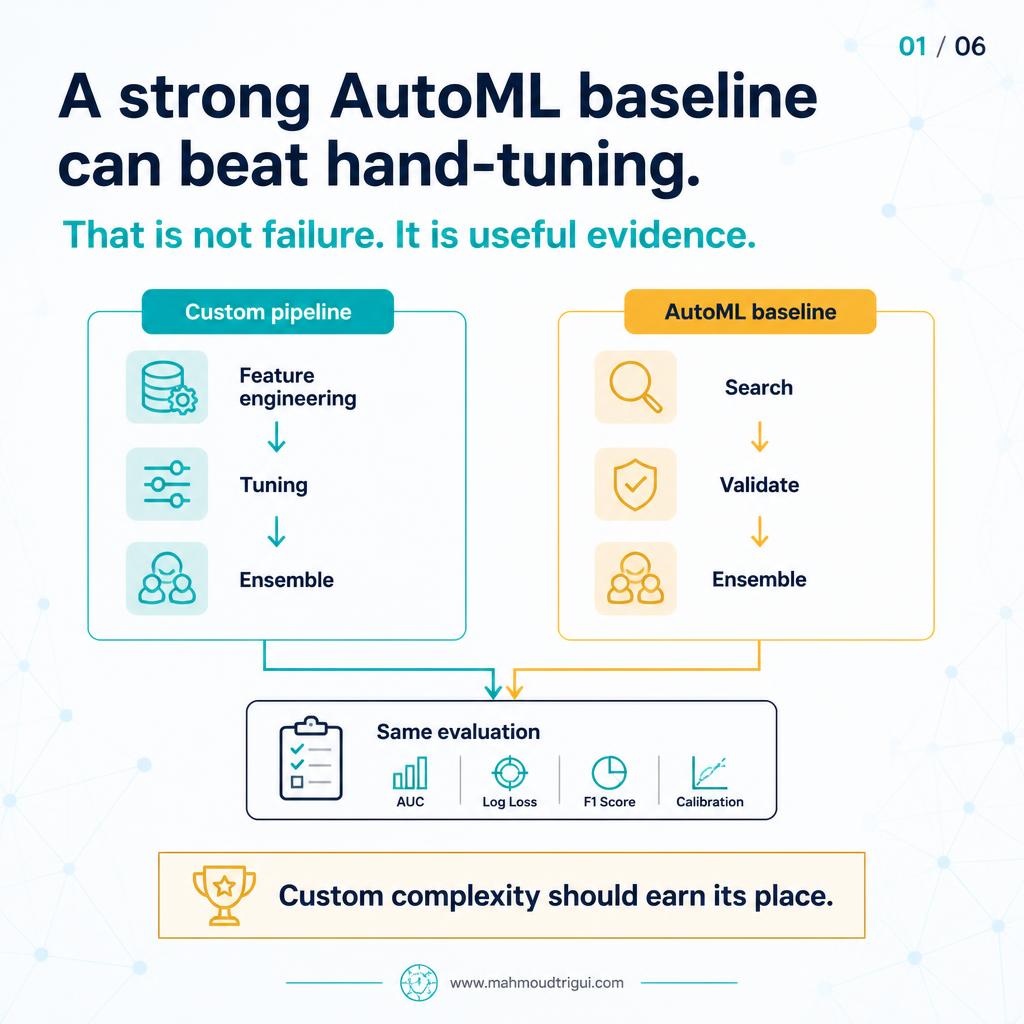
A strong AutoML baseline can beat a hand-tuned pipeline — and when it does, that is not a failure. It is useful evidence.
TL;DR: An AutoML baseline can beat a hand-tuned pipeline — and that is not failure, it is useful evidence. Run a strong automated benchmark (model diversity, consistent validation, ensembling, robust defaults) under the same validation design as your custom pipeline, then keep custom complexity only when it earns its place through measurable value: domain features, deployment fit, critical segments, explainability, or governance. AutoML does not end ML engineering. It raises the baseline.
Visual Summary
The Problem
The comparison has changed. The question is no longer "Can I beat one default XGBoost model?" It is now "Can my custom pipeline beat a strong automated baseline — and justify the extra complexity?"
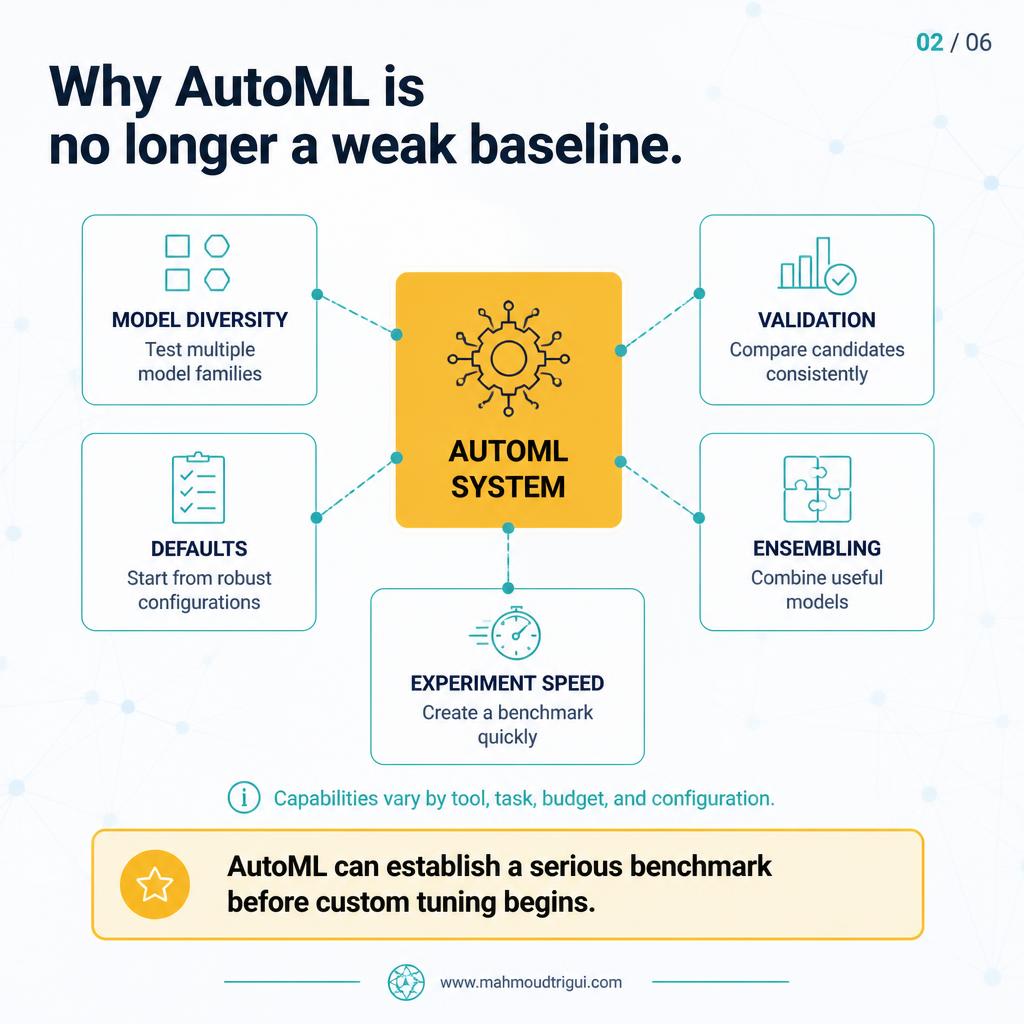
For tabular problems, tools such as AutoGluon can quickly establish a serious benchmark through combinations of multiple model families, cross-validation or bagging, model selection, ensembling or stacking, and strong default configurations.
The Approach
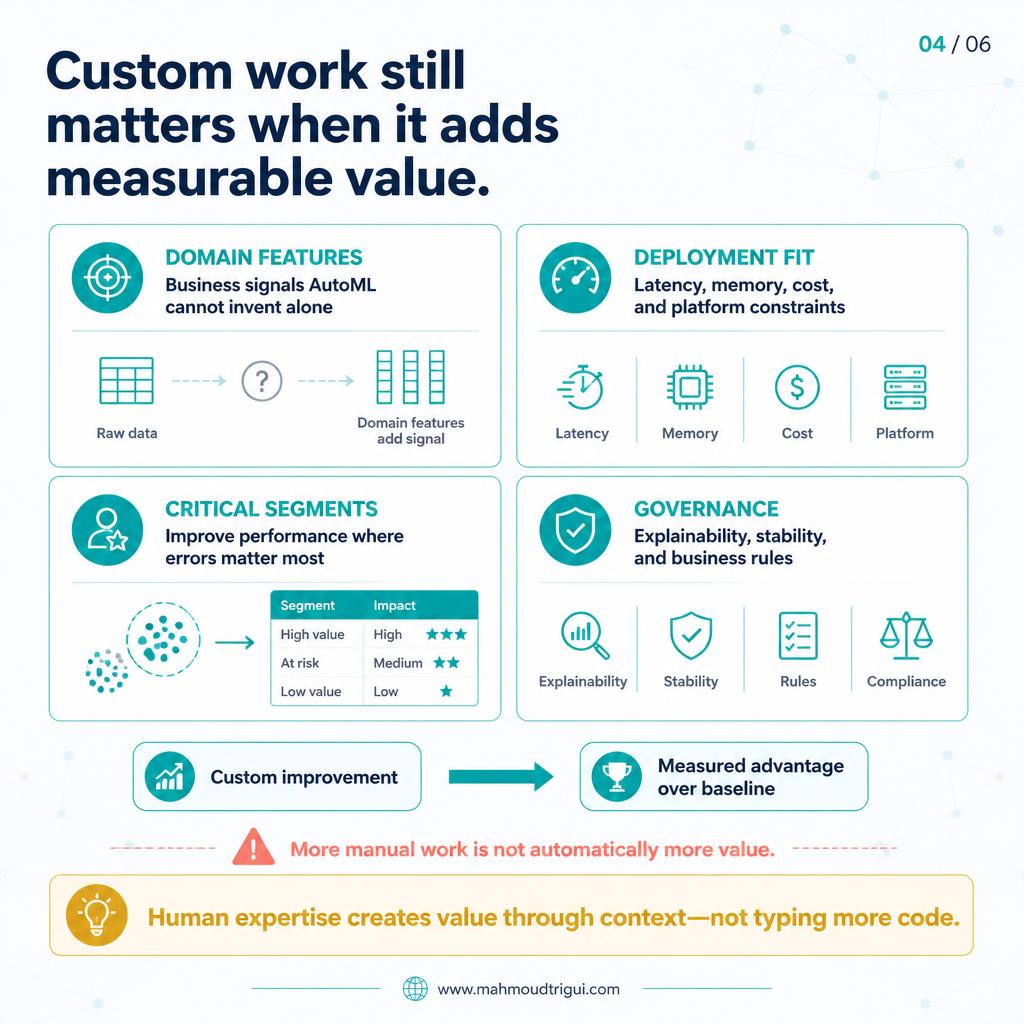
A custom workflow may still be the right choice when it delivers measurable value through domain-specific features, a validation design that matches deployment reality, better performance on critical segments, lower inference latency or cost, clearer explainability, governance or deployment constraints, and specialised business rules.
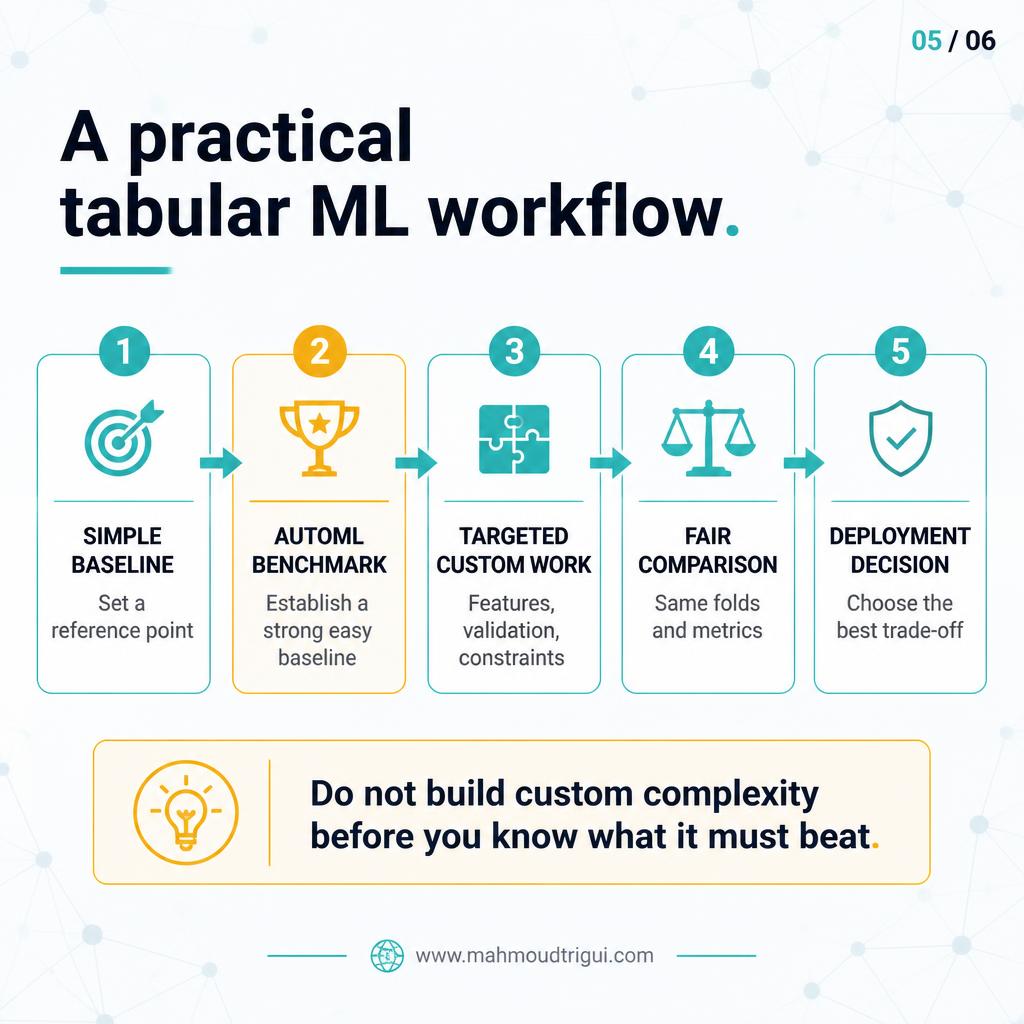
But those advantages should be demonstrated, not assumed. A practical workflow:
Build a simple baseline
Set a reference point with a straightforward model before adding any complexity.
Run a strong AutoML benchmark
AutoGluon and similar tools establish a strong, easy baseline through model diversity, consistent validation, ensembling, and robust defaults.
Build targeted custom improvements
Invest where the baseline is weak for your problem: domain features, validation design, critical segments, latency, explainability, or governance.
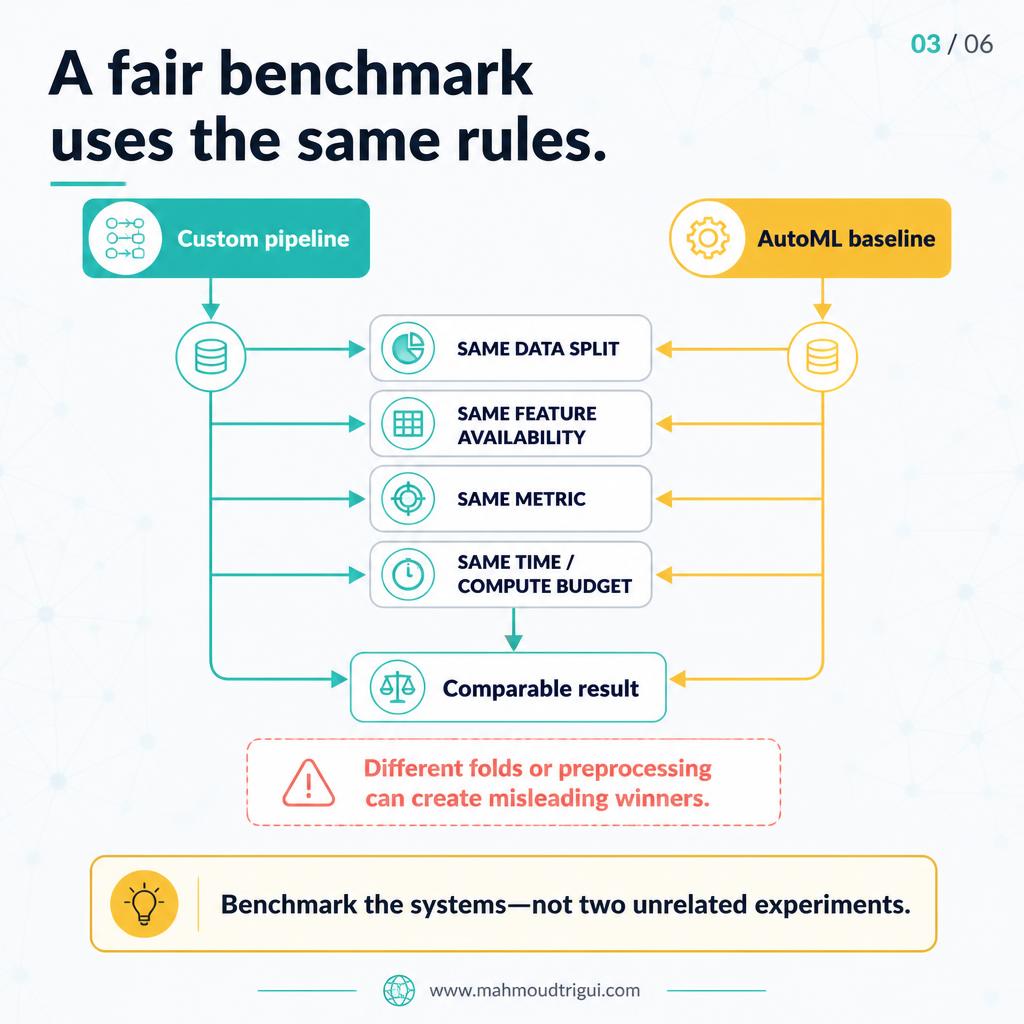
Compare under the same rules
Same data split, same feature availability, same metric, and same time or compute budget. Different folds or preprocessing can create misleading winners — benchmark the systems, not two unrelated experiments.
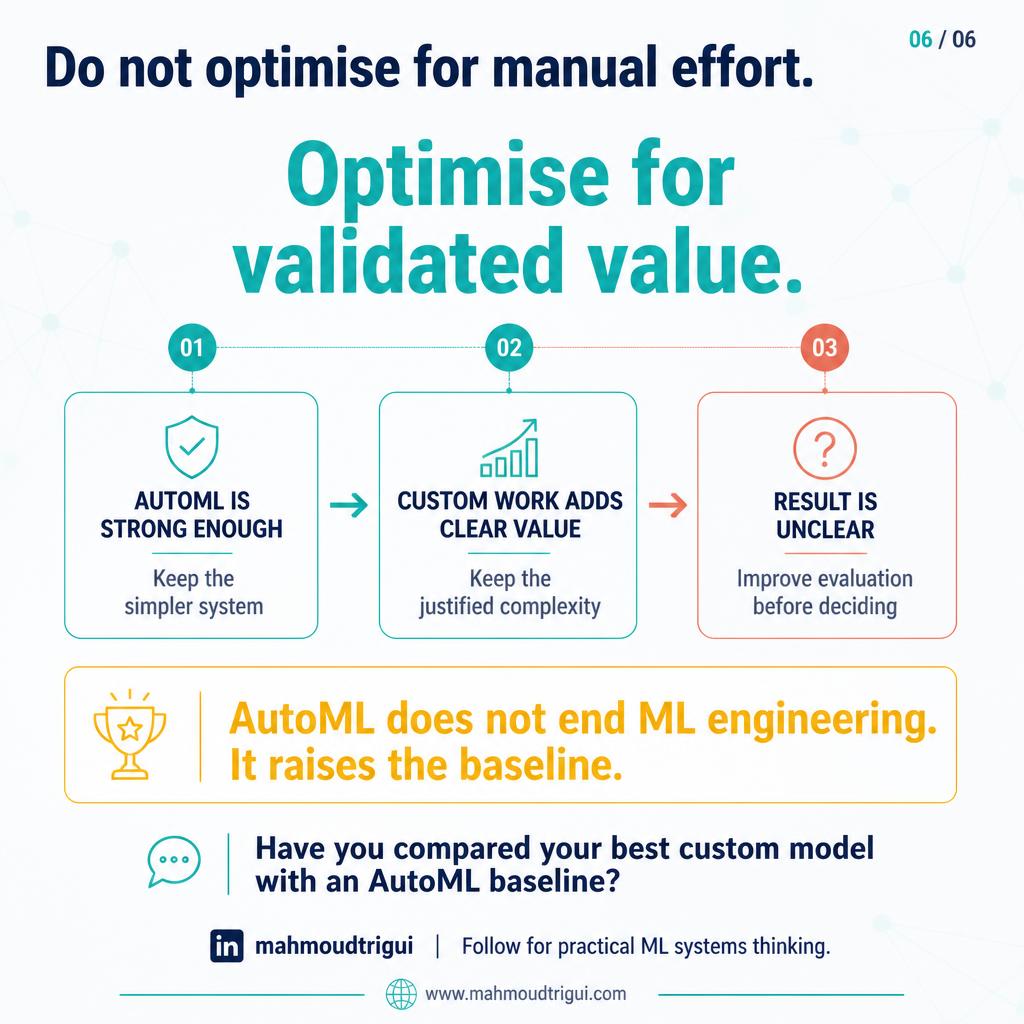
Keep complexity only when it earns its place
If the result is unclear, improve the evaluation before deciding. More manual work is not automatically more value.
AutoML does not remove the need for feature engineering. It makes weak custom pipelines easier to identify. And that is healthy.
Outcome
The strongest model is not always the most manually tuned one. It is the one that performs reliably under the real constraints of the problem.
Human expertise creates value through context — not by typing more code. AutoML does not end ML engineering. It raises the baseline.
Key Takeaway
Design insight: An AutoML baseline can beat a hand-tuned pipeline — and that is not failure, it is useful evidence. Run a strong automated benchmark (model diversity, consistent validation, ensembling, robust defaults) under the same validation design as your custom pipeline, then keep custom complexity only when it earns its place through measurable value: domain features, deployment fit, critical segments, explainability, or governance. AutoML does not end ML engineering. It raises the baseline.
Related
TabPFN: a Pre-Trained Prior for Tabular ML →LightGBM vs XGBoost in 2026: A Practical Tabular Guide →Foundation Models Raise the Baseline →Zero-Shot Forecasting Changes the Baseline →StatsForecast, MLForecast, NeuralForecast: One Ecosystem →A Predictive Model Is Not a Decision System →Not Every Analytics Question Is About What Drives Outcome →MLforecast Forecasting Pipeline — No More Feature Plumbing →
FAQ
What is the key takeaway from "A Strong AutoML Baseline Can Beat Hand-Tuned Models"?
An AutoML baseline can beat a hand-tuned pipeline — and that is not failure, it is useful evidence. Run a strong automated benchmark (model diversity, consistent validation, ensembling, robust defaults) under the same validation design as your custom pipeline, then keep custom complexity only when it earns its place through measurable value: domain features, deployment fit, critical segments, explainability, or governance. AutoML does not end ML engineering. It raises the baseline.
Who wrote this and what is it about?
This was written by Mahmoud Trigui, Senior Data Scientist. An AutoML baseline can beat hand-tuning, and that is useful evidence. Compare both under the same validation design and keep complexity when it earns its place.