Zero-Shot Forecasting Changes the Baseline
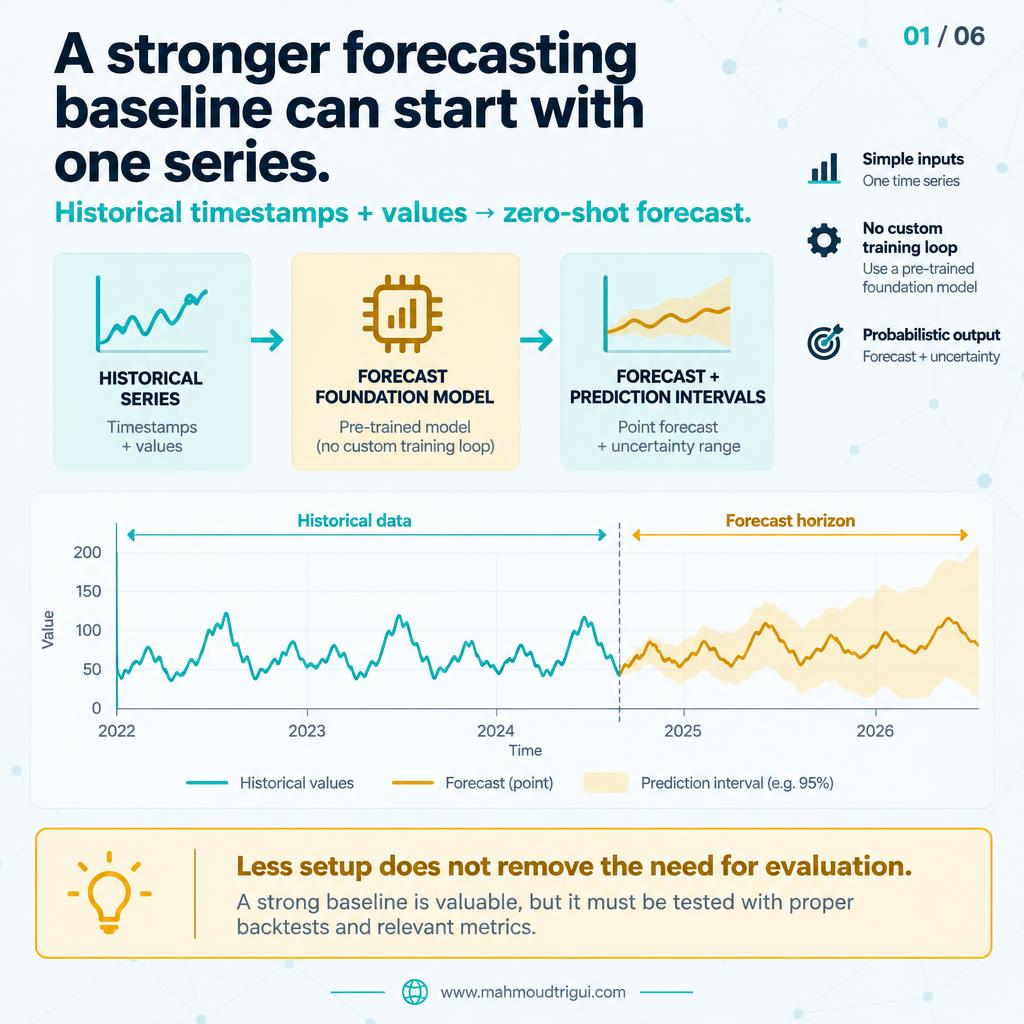
Zero-shot forecasting models return a forecast with intervals from a single series — no lags, no tuning, no training loop. That changes what a strong baseline can look like before you build anything engineered.
TL;DR: A zero-shot forecasting foundation model returns a forecast with prediction intervals from a single series — no lags, no tuning, no training loop. It is a serious early baseline, not an automatic production solution. Compare the statistical baseline, the zero-shot benchmark, and the engineered pipeline with rolling-origin backtesting, then ship the approach with the best trade-off between accuracy, cost, latency, explainability, and operational complexity. Build complexity only when it earns its place.
Visual Summary
The Problem
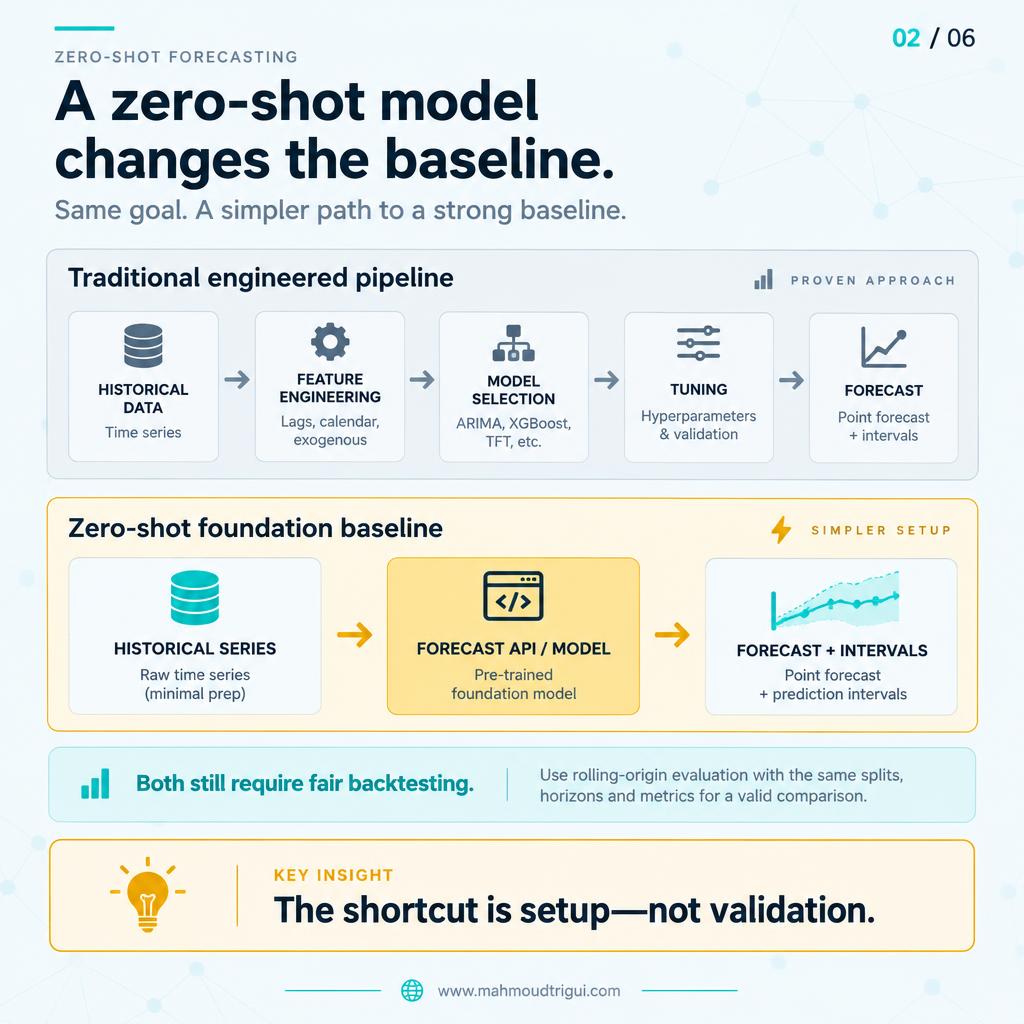
The classic forecasting workflow starts with setup: choose a statistical or ML model, prepare lags and calendar features, tune parameters, backtest, generate forecasts. Every step adds hand-built assumptions before the first forecast exists.
A zero-shot forecasting foundation model changes that starting point. Give it a series — timestamps and values — and it returns a forecast with prediction intervals. No manually engineered lags. No hyperparameter search. No model-training loop in the notebook. That is useful — not because it automatically becomes the best production solution, but because it forces the next system to earn its complexity.
The Approach
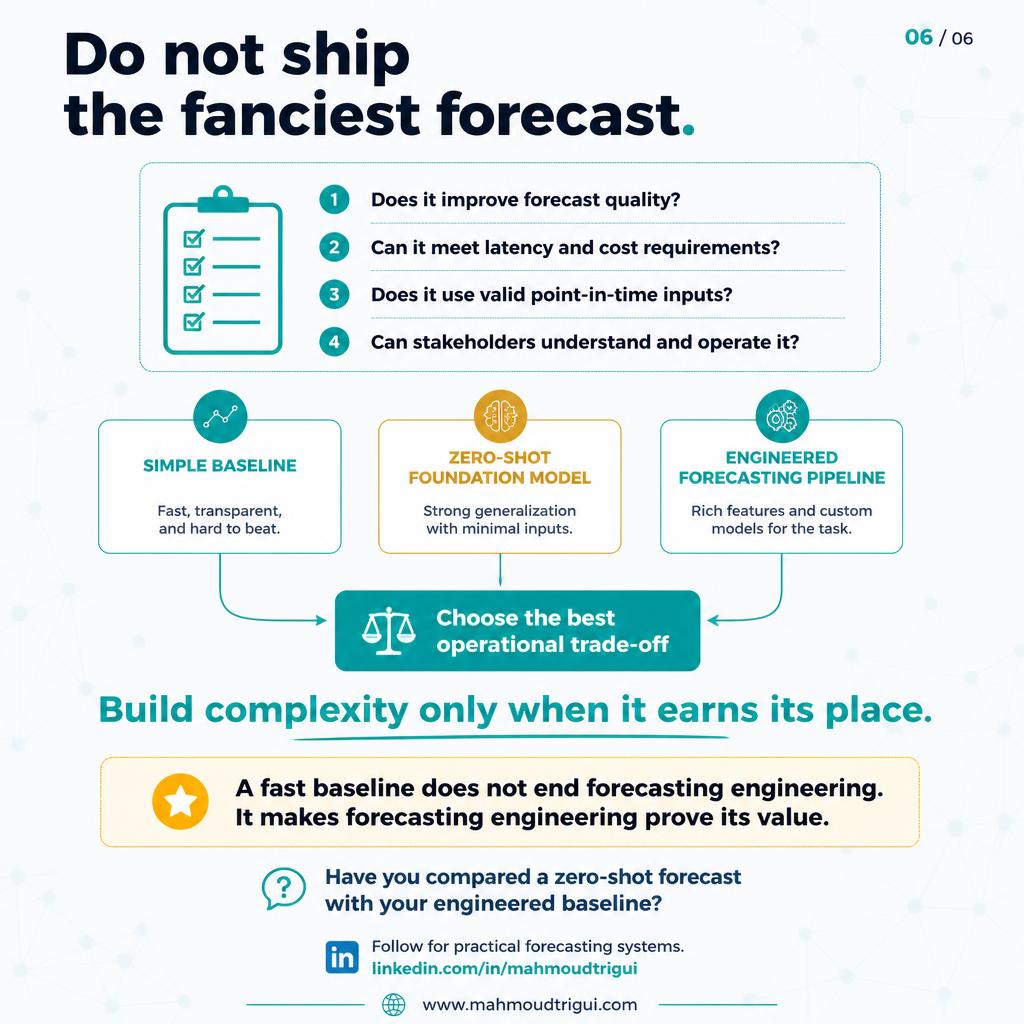
My preferred workflow does not replace engineering with a foundation model. It makes the comparison fair: simple baseline first, zero-shot benchmark next, then an engineered pipeline — and only the approach that wins on the trade-off gets shipped.
Establish a simple statistical baseline
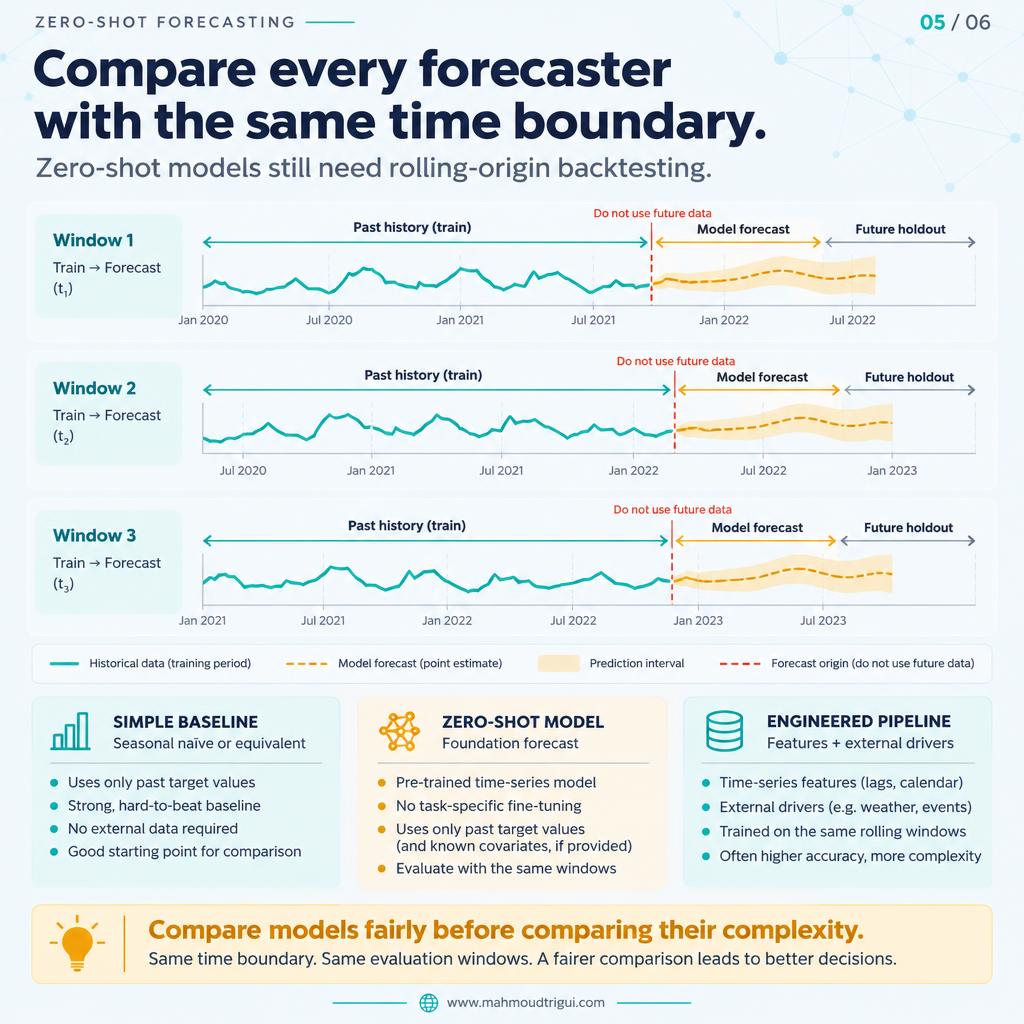
A seasonal naïve or equivalent reference gives every other candidate something concrete to beat before any engineering begins.
Add a zero-shot foundation-model benchmark
A single historical series becomes a forecast plus prediction intervals through the foundation model — a serious benchmark with minimal initial setup.
Build the engineered forecasting pipeline
Lags, calendar features, and external drivers come in step by step. Complexity becomes a deliberate choice reviewed against the baseline, not the default.
Compare every model at the same time boundary
Rolling-origin backtesting gives every candidate the same treatment — no future data leaks into the forecast window, whether the model is simple or engineered.
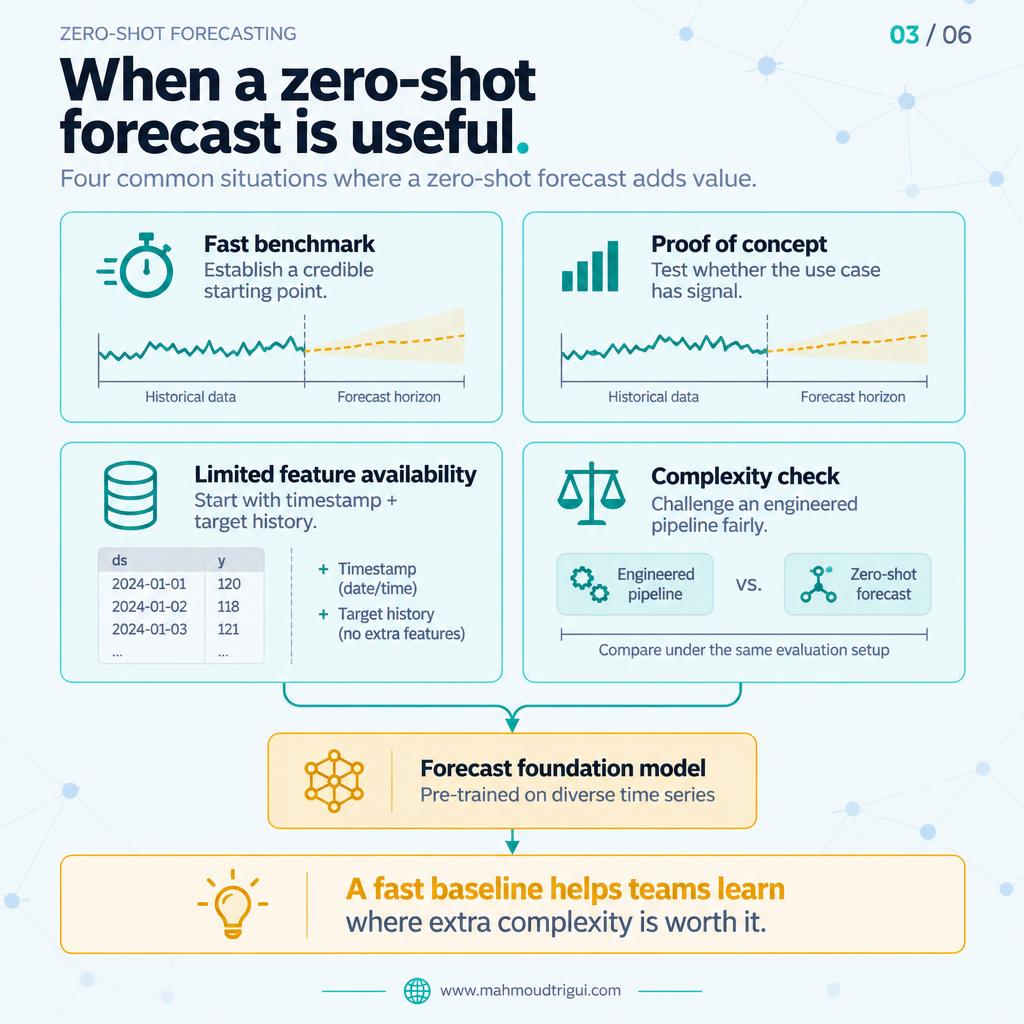
A zero-shot foundation forecast is most useful when historical target data is available, you need a fast proof of concept, or you want to benchmark a more complex ML pipeline. It is also convenient when domain covariates are limited or unavailable, because a timestamp plus target history is enough to start.
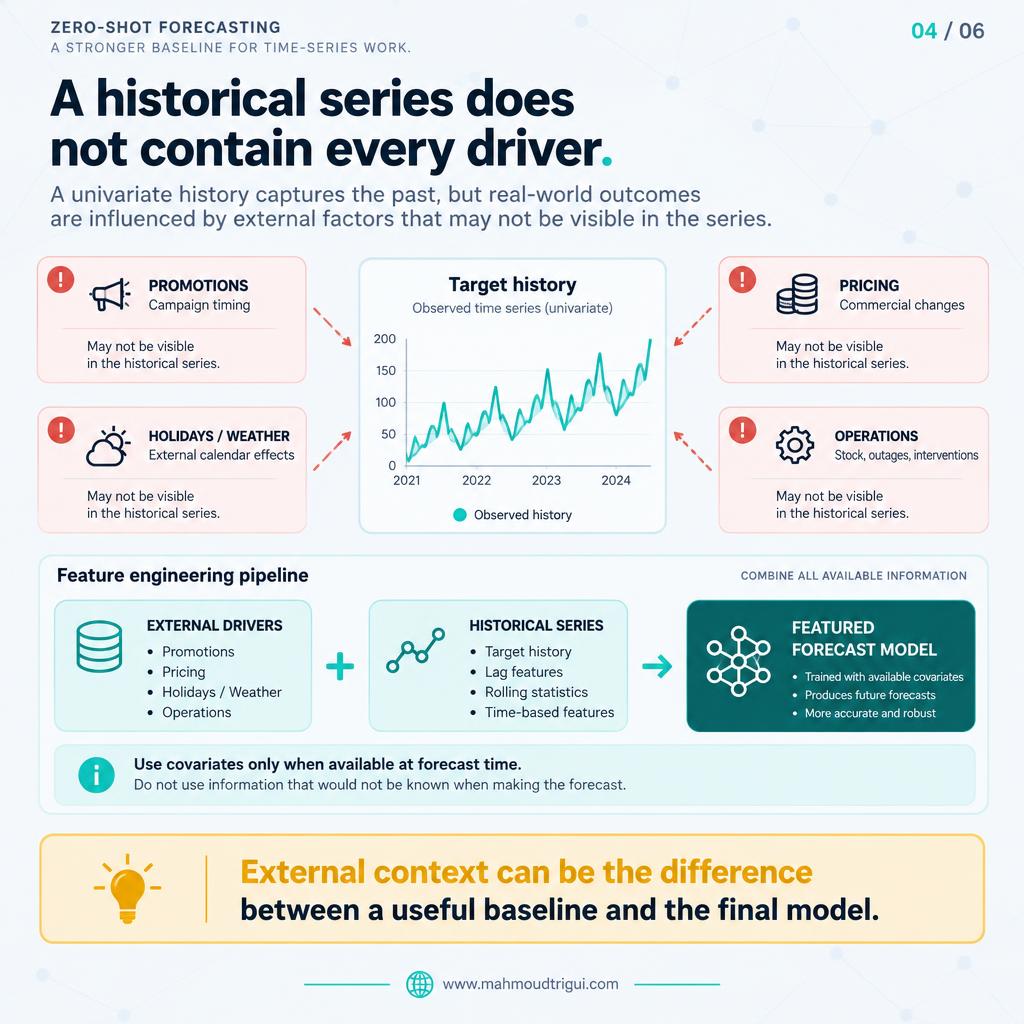
It may be less suitable when the forecast depends on promotions, pricing, holidays, weather, operational events and interventions, or domain-specific external regressors — and when strict explainability requirements, specialised constraints, or business rules matter more than setup speed.
Outcome
The decision becomes sharper. The question is not "can a foundation model forecast my series?" The question is "does my additional complexity create enough value to justify itself?"
A zero-shot forecast can be a strong early baseline, but it does not end forecasting engineering — it makes forecasting engineering prove its value. I ship whichever approach offers the best trade-off between accuracy, cost, latency, explainability, and operational complexity.
Key Takeaway
Design insight: A zero-shot forecasting foundation model returns a forecast with prediction intervals from a single series — no lags, no tuning, no training loop. It is a serious early baseline, not an automatic production solution. Compare the statistical baseline, the zero-shot benchmark, and the engineered pipeline with rolling-origin backtesting, then ship the approach with the best trade-off between accuracy, cost, latency, explainability, and operational complexity. Build complexity only when it earns its place.
Related
Foundation Models Raise the Baseline →MLforecast Forecasting Pipeline →Turning Decomposition Into a Forecasting Strategy →LightGBM vs XGBoost in 2026 →Conformal Prediction: When the Model Is Uncertain →TabPFN: a Pre-Trained Prior for Tabular ML →A predictive model is not a decision system →Not Every Analytics Question Is About What Drives Outcome →Cyclical Encoding: Months Are a Circle, Not a Line →A Strong AutoML Baseline Can Beat Hand-Tuned Models →
FAQ
What is the key takeaway from "Zero-Shot Forecasting Changes the Baseline"?
A zero-shot forecasting foundation model returns a forecast with prediction intervals from a single series — no lags, no tuning, no training loop. It is a serious early baseline, not an automatic production solution. Compare the statistical baseline, the zero-shot benchmark, and the engineered pipeline with rolling-origin backtesting, then ship the approach with the best trade-off between accuracy, cost, latency, explainability, and operational complexity. Build complexity only when it earns its place.
Who wrote this and what is it about?
This was written by Mahmoud Trigui, Senior Data Scientist. Zero-shot forecasting models create a strong baseline with minimal setup. Compare them fairly against simple baselines and engineered pipelines.