A Valid LLM Response Is Not Necessarily a Safe Decision
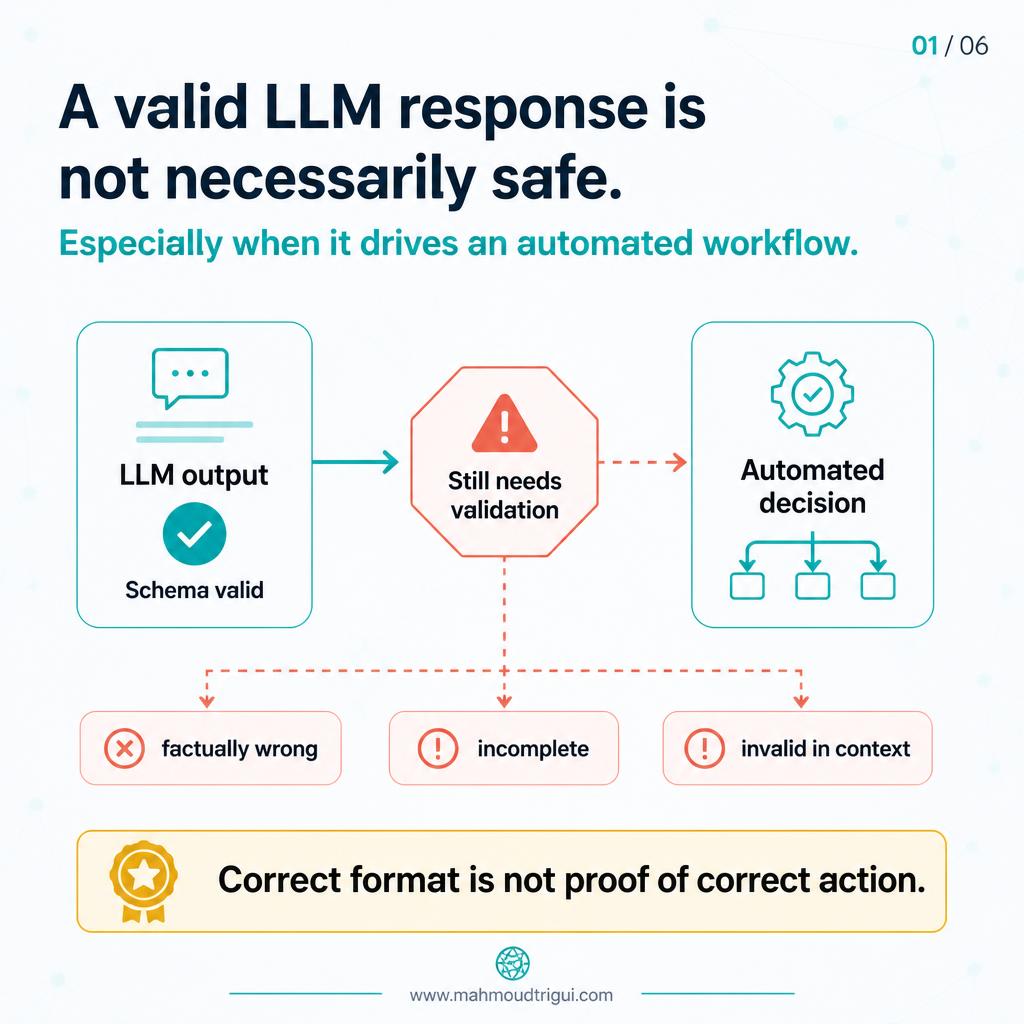
The output may be correctly formatted but factually wrong, plausible but incomplete, or valid in schema yet invalid for the business. Before an LLM response can trigger an automated workflow, it needs at least three control layers.
TL;DR: A valid LLM response is not a safe automated decision. Before structured LLM output can trigger a workflow it must pass three control layers: schema validation for fields, types, and allowed values; risk routing to decide automate, review, or reject from calibrated signals like retrieval evidence and rule-check results; and business-rule validation for answers that make sense in context. Correct format is not proof of correct action. “The model answered” is not the same as “the action is safe” — automate only inside a defined trust boundary.
Visual Summary
The Problem
A valid LLM response is not necessarily a safe automated decision — that is the production mistake I see most often. The output may be correctly formatted but factually wrong, plausible but incomplete, grounded in the wrong source, or valid according to a schema but invalid for the business. Each one looks like a success at the interface and becomes a failure the moment it triggers an automated workflow.
The Approach
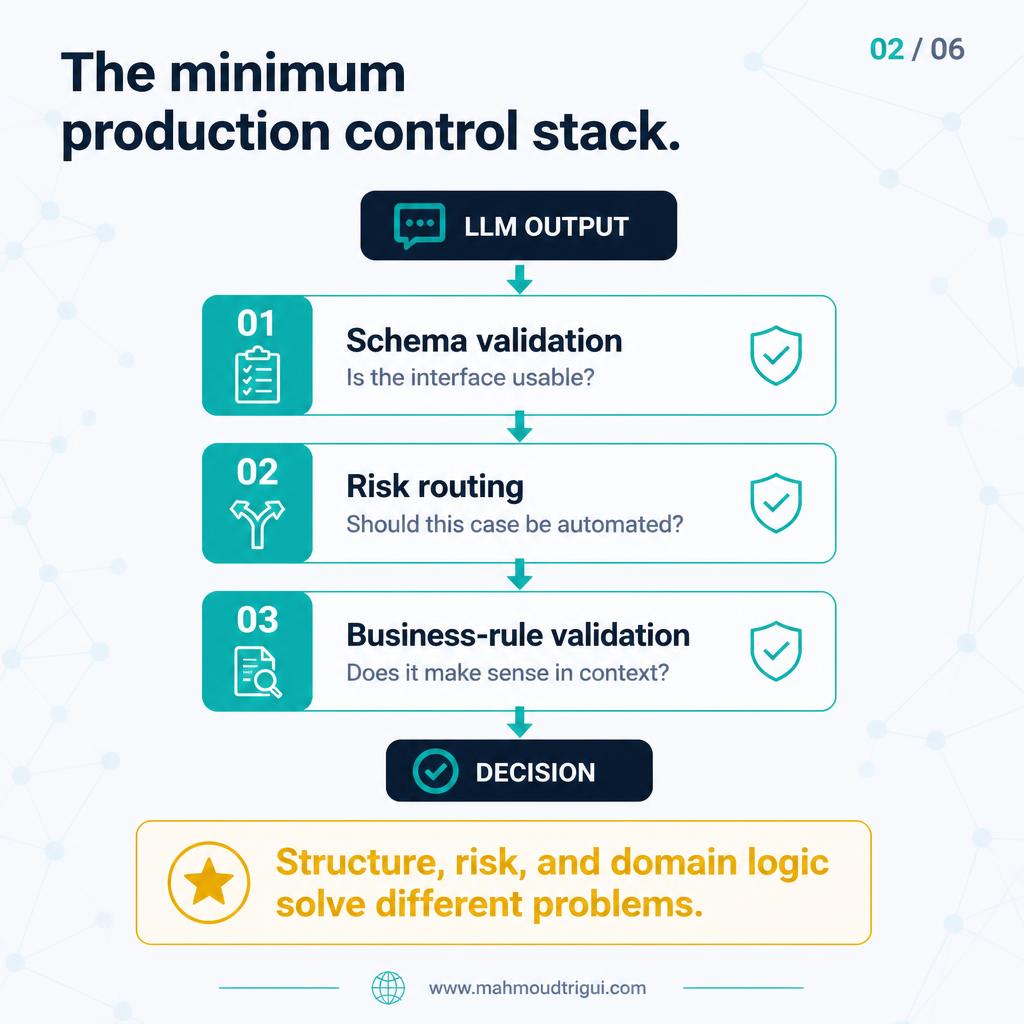
Before an LLM output can trigger an automated workflow, I want at least three control layers. The first protects the interface, the second decides who acts, and the third checks whether the answer makes sense in context.
Schema validation
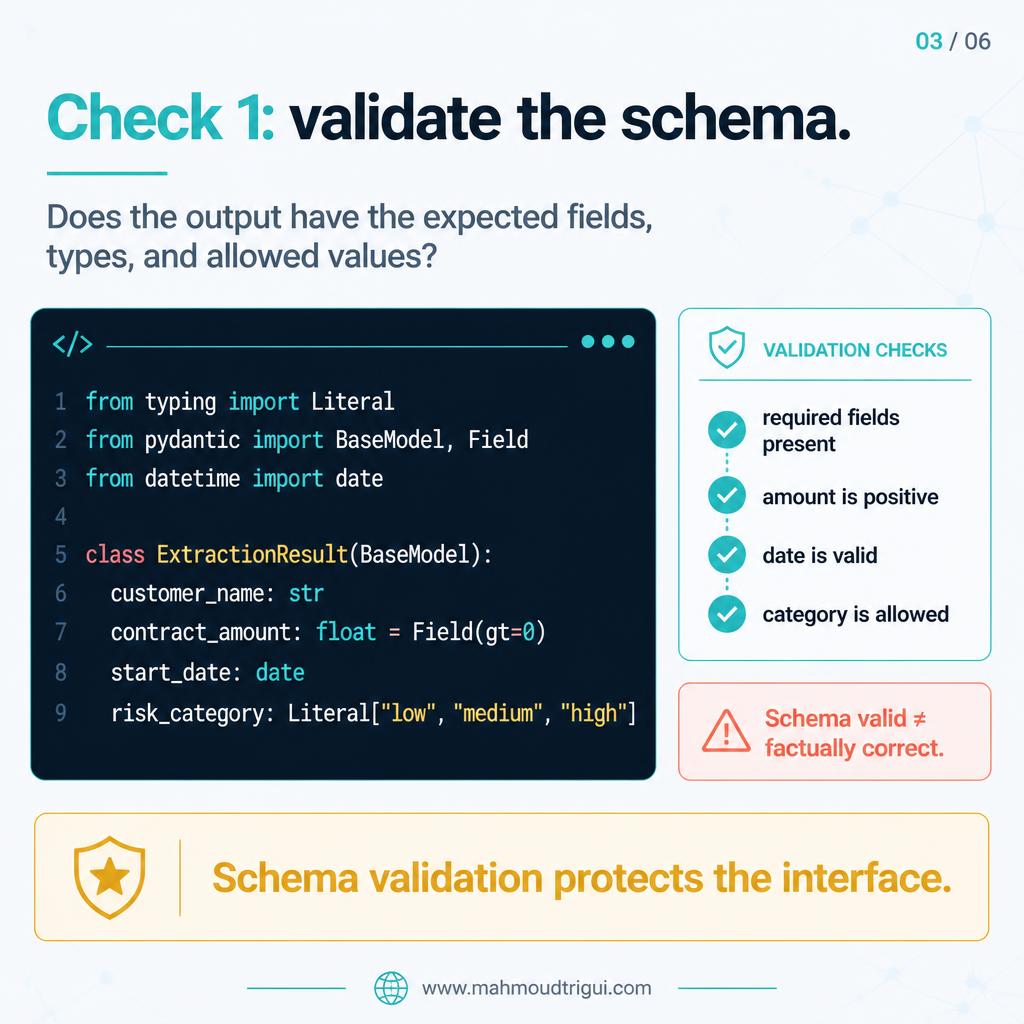
Did the model return the fields, types, and allowed values the system expects — a date is a date, an amount is numeric, a category belongs to an approved list, required fields are present? This protects the interface. It does not prove the content is correct.
from typing import Literal
from pydantic import BaseModel, Field
from datetime import date

class ExtractionResult(BaseModel):
    customer_name: str
    contract_amount: float = Field(gt=0)
    start_date: date
    risk_category: Literal["low", "medium", "high"]
Risk routing
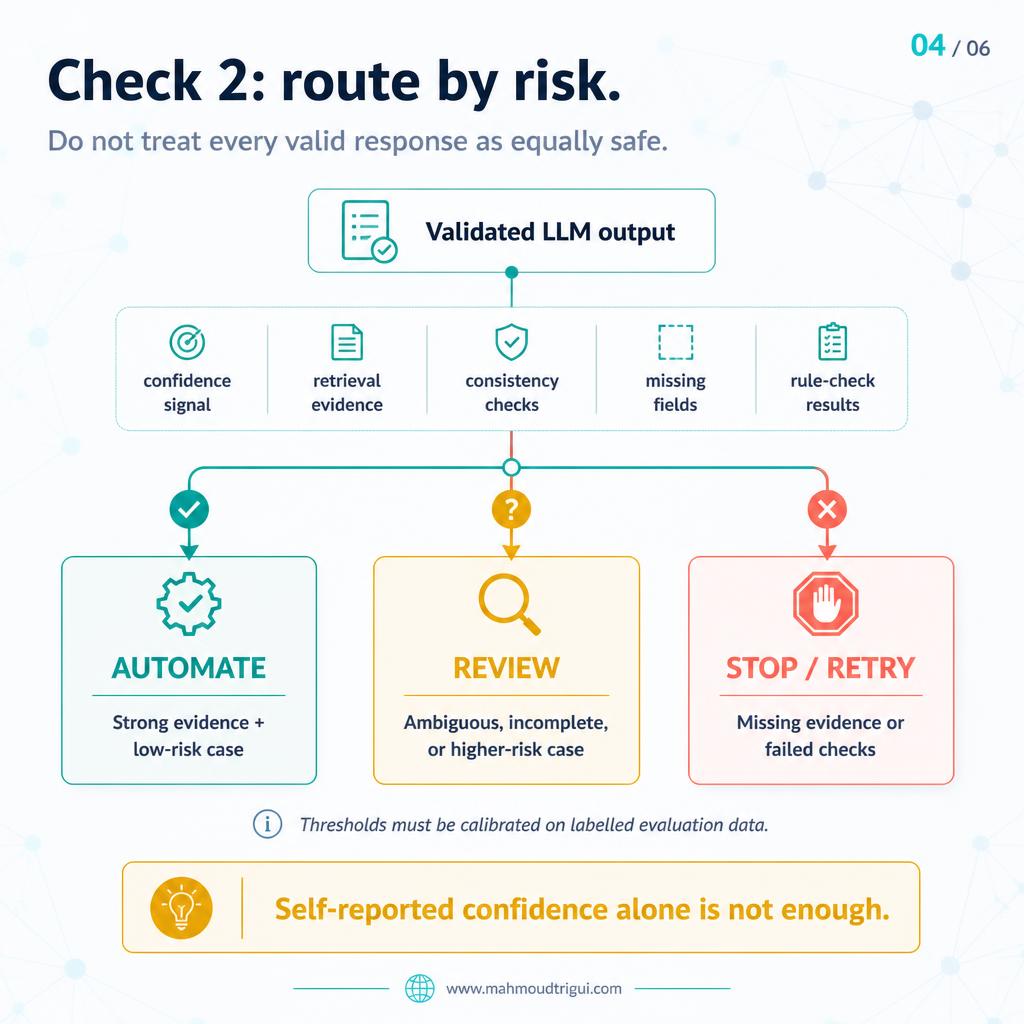
Should this case be automated, reviewed, or rejected? Use model confidence with caution, retrieval evidence or citations, rule-check results, ambiguity or missing fields, and disagreement between multiple checks. Calibrate the thresholds on real evaluation data — not copied from a tutorial.
Business-rule validation
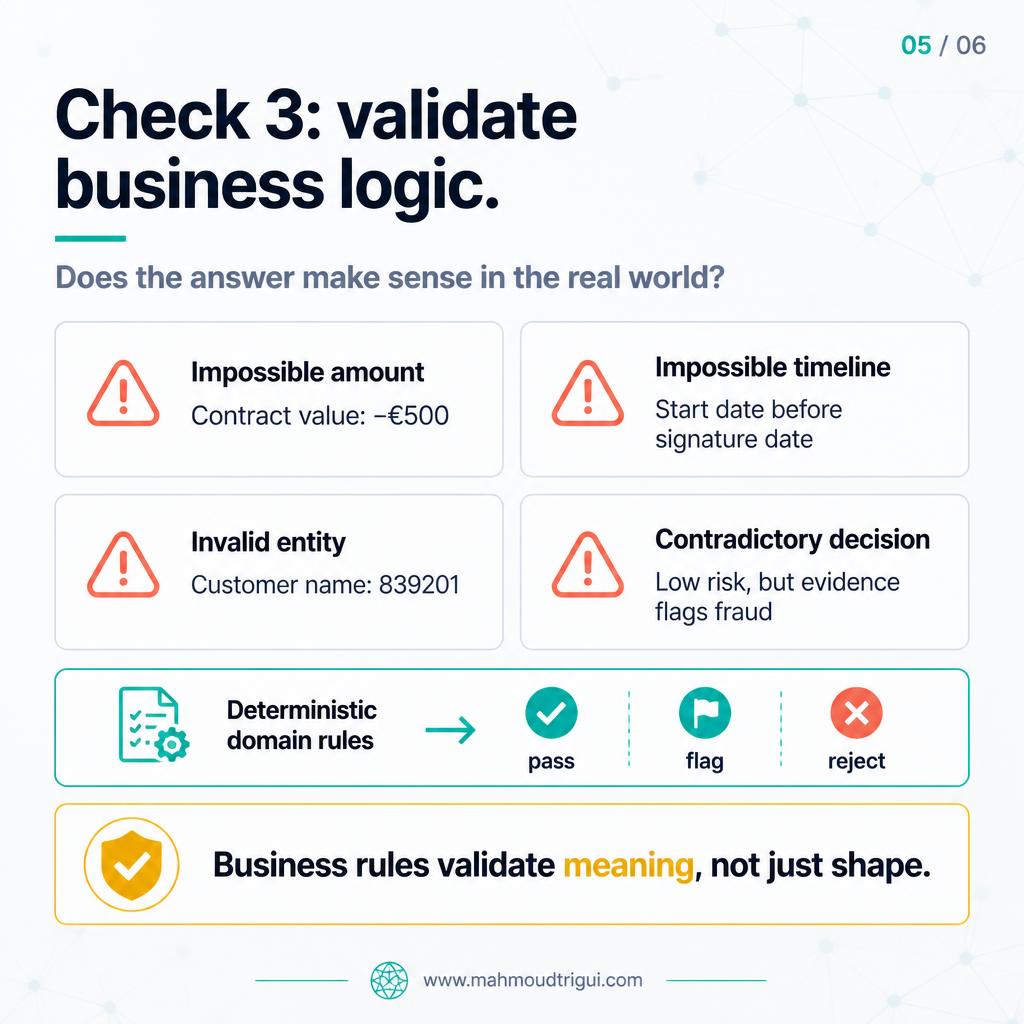
Does the answer make sense in context? A negative invoice amount, a contract that begins before it was signed, a customer name made only of digits, or a low-risk label that conflicts with extracted evidence. Deterministic domain rules decide pass, flag, or reject.
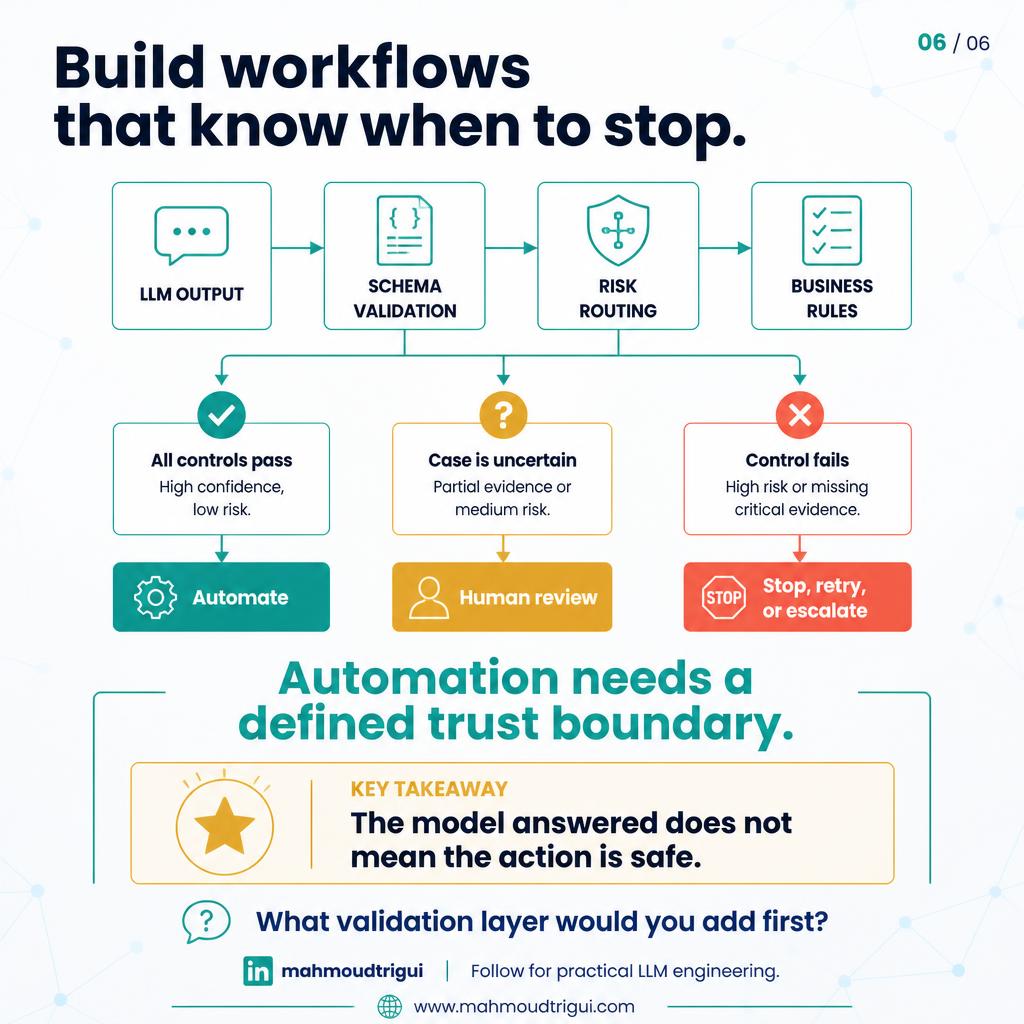
The operating pattern is simple: Schema → risk routing → business rules. If the controls pass, automate within a defined risk boundary. If they fail, send the case to review, request clarification, or stop the workflow. “The model answered” is not the same as “the action is safe.”
Outcome
I now treat validation as part of the workflow itself, not a post-processing nicety. Document extraction, classification, and routing decisions only automate inside a defined trust boundary; uncertain cases go to human review, and failed controls stop, retry, or escalate. The conversation I keep having with teams starts with one simple question: what validation layer would you add first to an LLM workflow?
Key Takeaway
Design insight: A valid LLM response is not a safe automated decision. Before structured LLM output can trigger a workflow it must pass three control layers: schema validation for fields, types, and allowed values; risk routing to decide automate, review, or reject from calibrated signals like retrieval evidence and rule-check results; and business-rule validation for answers that make sense in context. Correct format is not proof of correct action. “The model answered” is not the same as “the action is safe” — automate only inside a defined trust boundary.
Related
FAQ
What is the key takeaway from "A Valid LLM Response Is Not Necessarily a Safe Decision"?
A valid LLM response is not a safe automated decision. Before structured LLM output can trigger a workflow it must pass three control layers: schema validation for fields, types, and allowed values; risk routing to decide automate, review, or reject from calibrated signals like retrieval evidence and rule-check results; and business-rule validation for answers that make sense in context. Correct format is not proof of correct action. “The model answered” is not the same as “the action is safe” — automate only inside a defined trust boundary.
Who wrote this and what is it about?
This was written by Mahmoud Trigui, Senior Data Scientist. A valid LLM response is not necessarily a safe automated decision. Run schema validation, risk routing, and business-rule validation before the output acts.