Delegate the Optuna Scaffold. Not the Tuning Strategy.
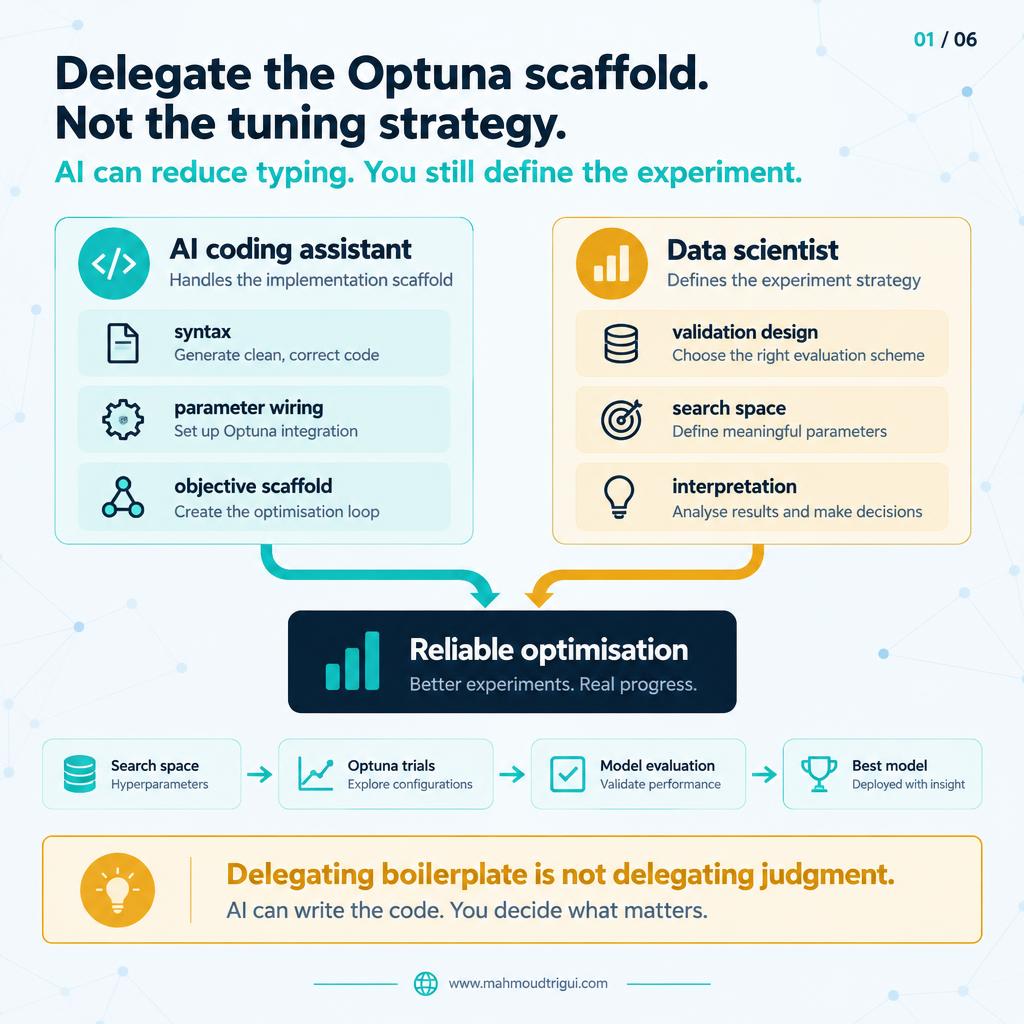
An Optuna objective is full of repeatable implementation patterns: parameter suggestions, model wiring, the evaluation loop. Delegate that scaffold to an AI coding assistant - but keep the search strategy, validation design, and interpretation yourself.
TL;DR: delegating Optuna boilerplate to an AI coding assistant is not delegating judgment. Use the assistant for the scaffold - suggesting parameters, wiring the model, running the evaluation loop, hooking pruning - and keep the metric choice, validation design, search space, and interpretation with the data scientist. AI can reduce typing, not thinking. It protects your attention for the parts of modelling that actually require expertise.
Visual Summary
The Problem
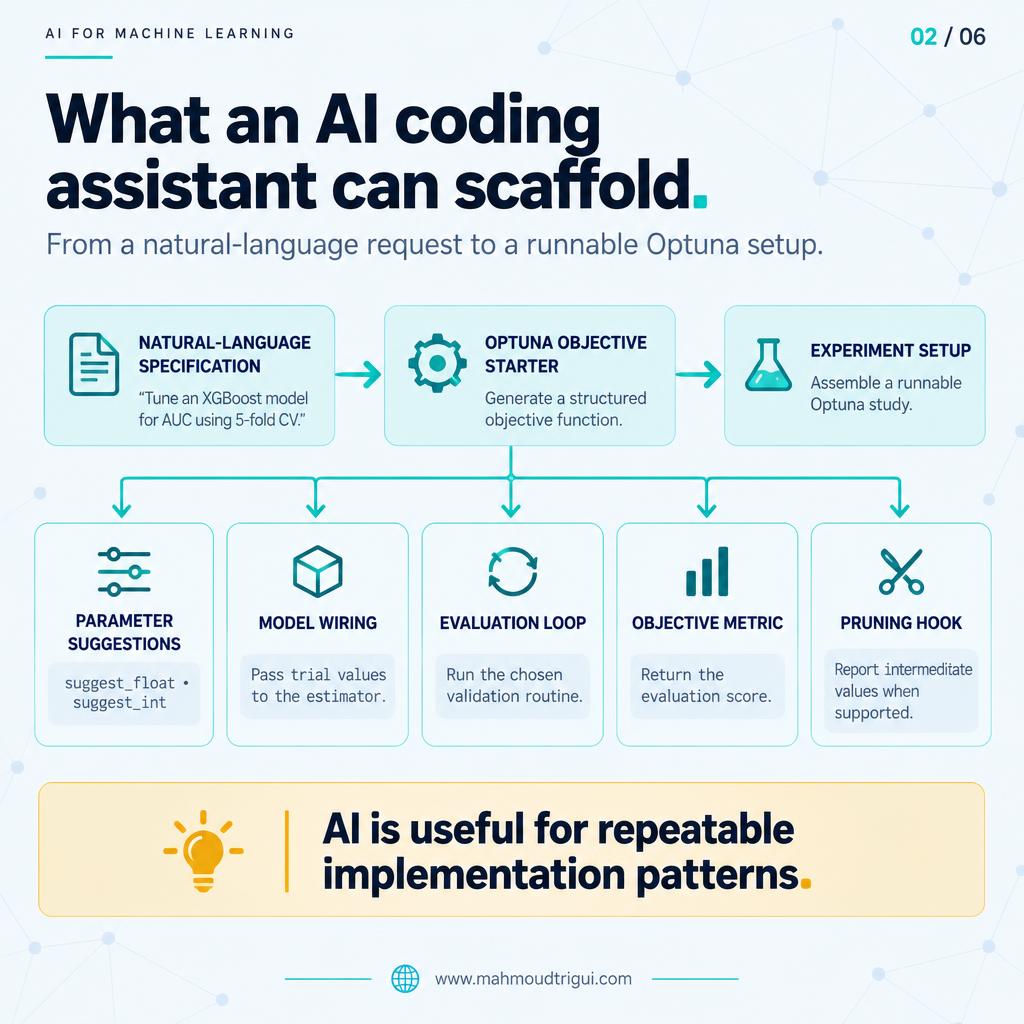
An Optuna objective often contains the same repeated implementation work: define the parameter suggestions, wire them into the model, run the evaluation loop, report the optimisation metric, connect compatible pruning logic, and return the objective value.
That is useful work for an AI coding assistant. You can describe the initial scaffold in plain language and get a starting point quickly. The danger is treating the rest as if it were scaffold too.
The Approach
Describe the scaffold in plain language. For example: create an Optuna objective for a LightGBM binary classifier, optimise PR-AUC, use a validation strategy appropriate for the data, tune learning rate, tree complexity, regularisation, and sampling parameters, and return the mean validation score.
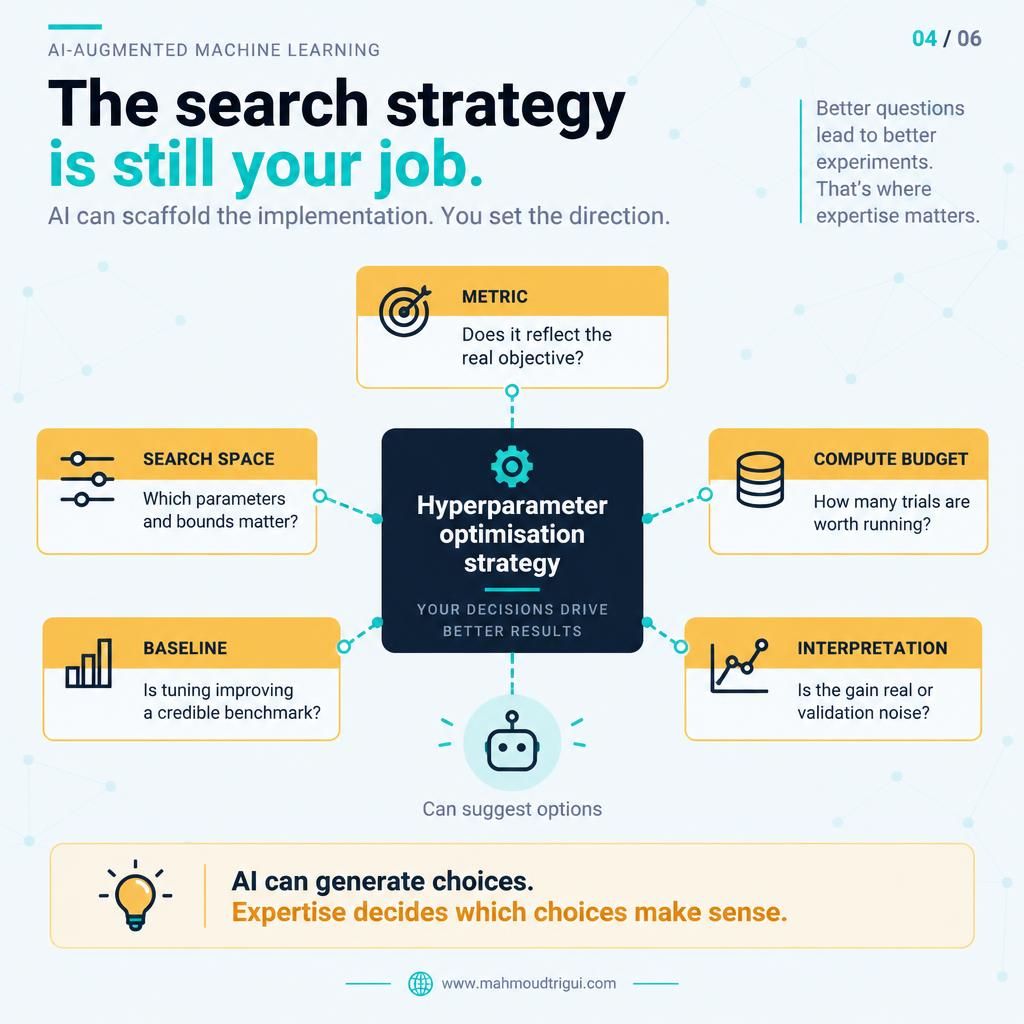
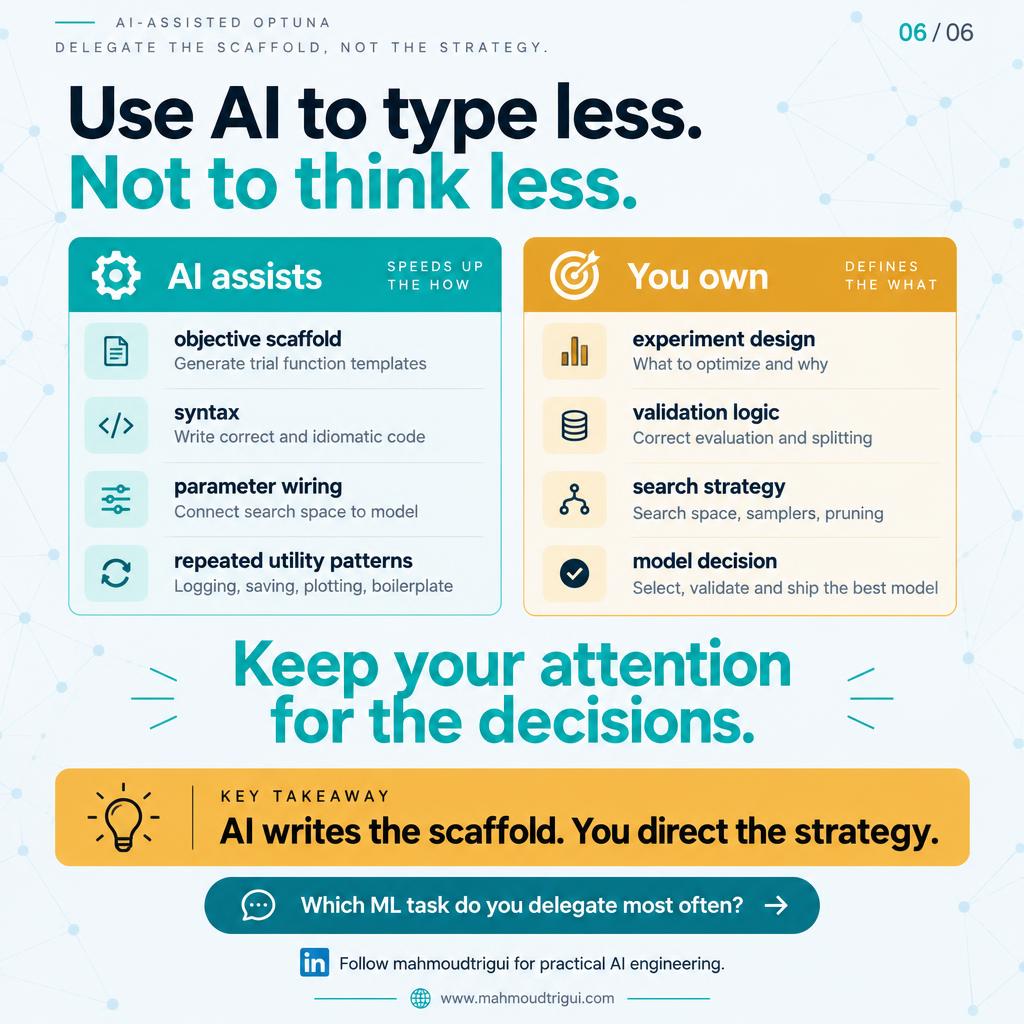
The highest-value decisions stay with you
Which metric reflects the business problem? Should validation be stratified, grouped, or time-based? Which parameters are worth tuning and what ranges are realistic for this dataset? Is the gain real, or just validation noise? Is further tuning worth the compute budget? The helper can fill in the quality of a strong objective.
A better request creates a better starting point
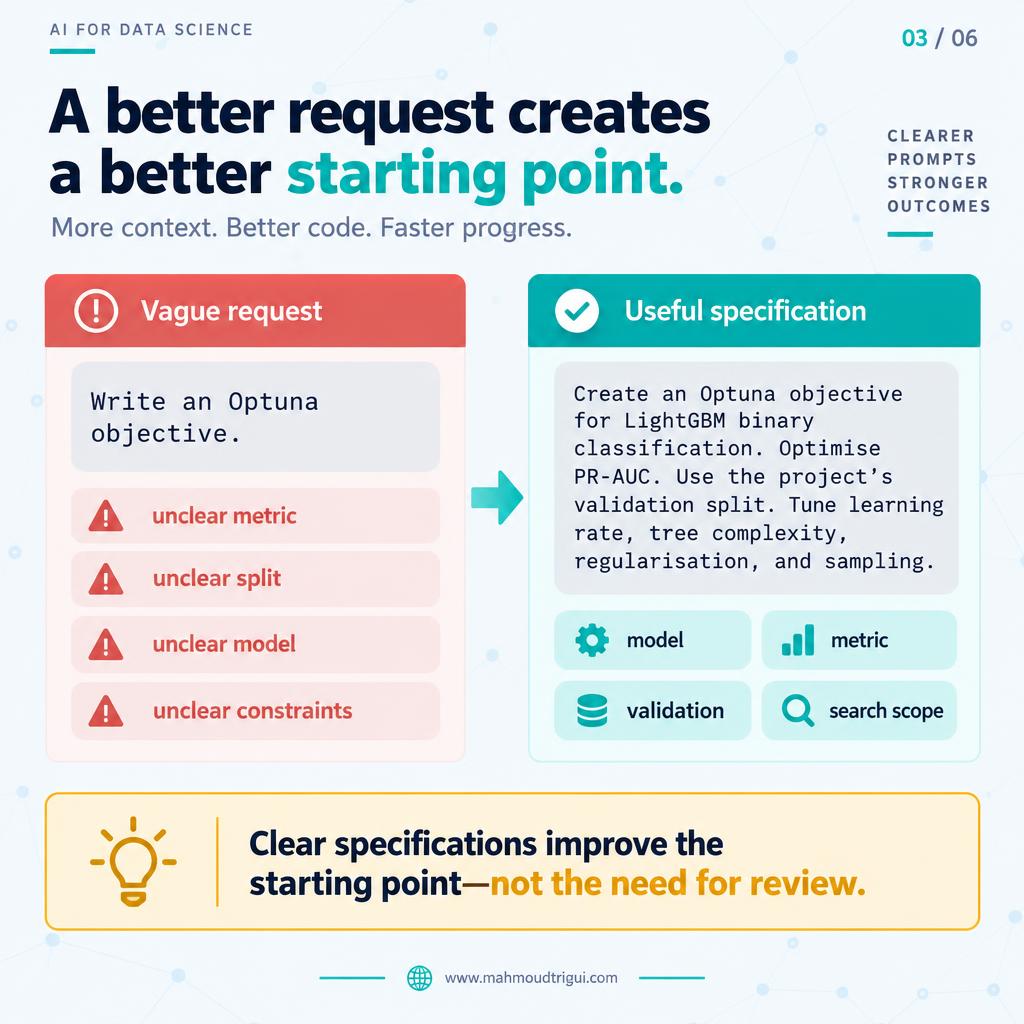
A vague request such as "write an Optuna objective" leaves metric, split, model, and constraints unclear. A useful specification names the model, the metric, the validation approach, and the search scope - which improves the starting point, even if the result still needs review.
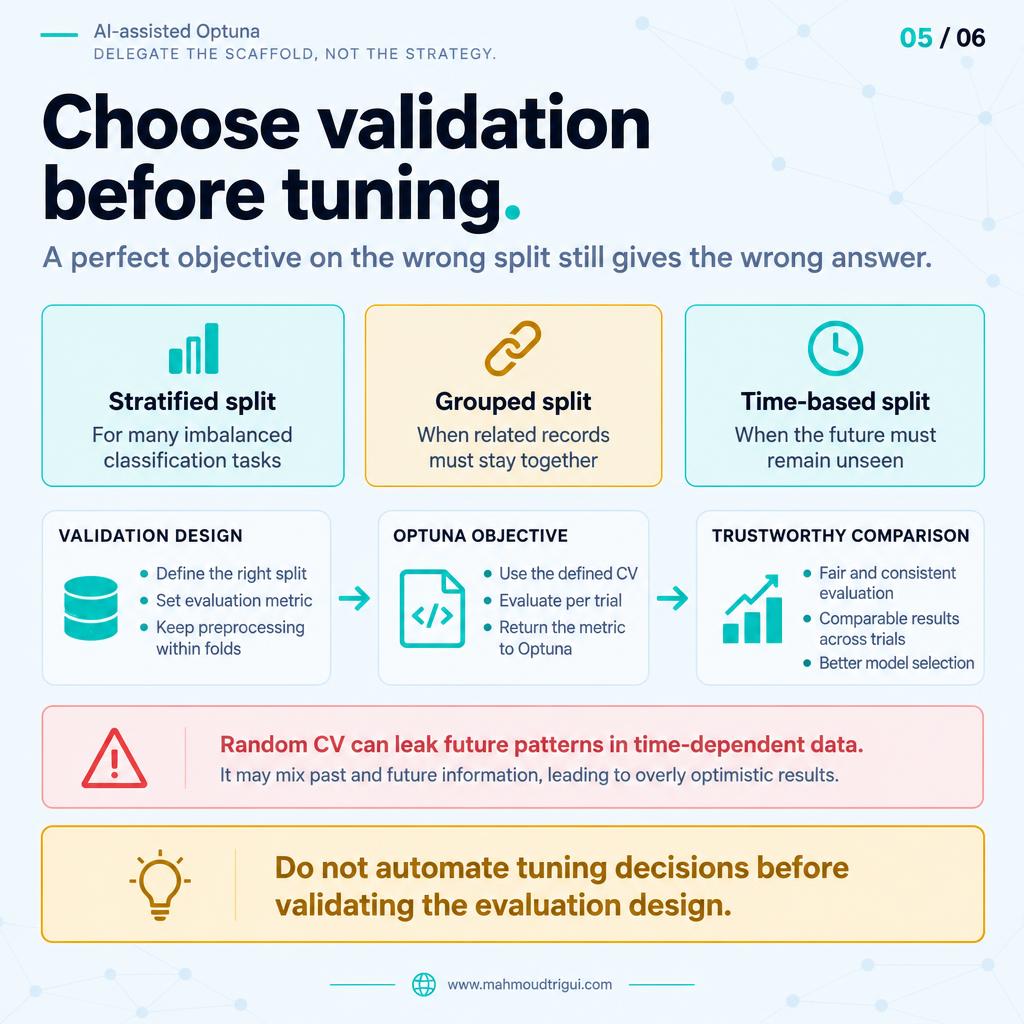
Choose validation before tuning
A perfect objective on the wrong split still gives the wrong answer. Stratified splits fit many imbalanced classification tasks, grouped splits keep related records together, and time-based splits keep the future unseen. Random cross-validation can leak future patterns in time-dependent data.
The Outcome
- Less typing: the assistant handles syntax, parameter wiring, and the objective scaffold.
- Protected attention: you spend your effort on experiment design, validation logic, and interpretation.
- Clear split: delegating boilerplate is not delegating judgment.
Key Takeaway
Design insight: delegating Optuna boilerplate to an AI coding assistant is not delegating judgment. Use the assistant for the scaffold - suggesting parameters, wiring the model, running the evaluation loop, hooking pruning - and keep the metric choice, validation design, search space, and interpretation with the data scientist. AI can reduce typing, not thinking. It protects your attention for the parts of modelling that actually require expertise.
Related
AI-Assisted Coding Specification →Open Source Coding Agents →Stable vs Changing LLM Context →LightGBM vs XGBoost in 2026 →Encoding Is a Modeling Decision →Adversarial Validation →A Predictive Model Is Not a Decision System →Enterprise LLM Wrapper →
When should I try TabPFN instead of LightGBM or XGBoost?
Use it for fast baselines, small-to-medium tabular datasets, low-budget model comparison, and ensembling experiments. Do not treat it as a universal gradient boosting replacement: dataset size, feature count, class count, data modality, compute budget, and domain structure all matter. Compare against a clean GBDT baseline using the same validation protocol, and keep it only when it adds validated signal.
FAQ
How should I prompt an AI coding assistant to write an Optuna objective?
Describe the scaffold in plain language and be specific about the four things a vague request leaves unclear: the model, the metric, the validation scheme, and the search scope. For example: create an Optuna objective for a LightGBM binary classifier, optimise PR-AUC, use the project's validation split, and tune learning rate, tree complexity, regularisation, and sampling.
Why should the search strategy stay with the data scientist when an AI writes the objective?
Because the decisions that determine whether tuning helps - metric choice, validation design, search ranges, compute budget, and interpreting whether a gain is real or validation noise - require modelling judgement. The assistant reduces the friction of writing familiar boilerplate; it does not replace the interpretation that validates the experiment.