Prompt Versioning: How LLMOps Makes Prompts Reversible
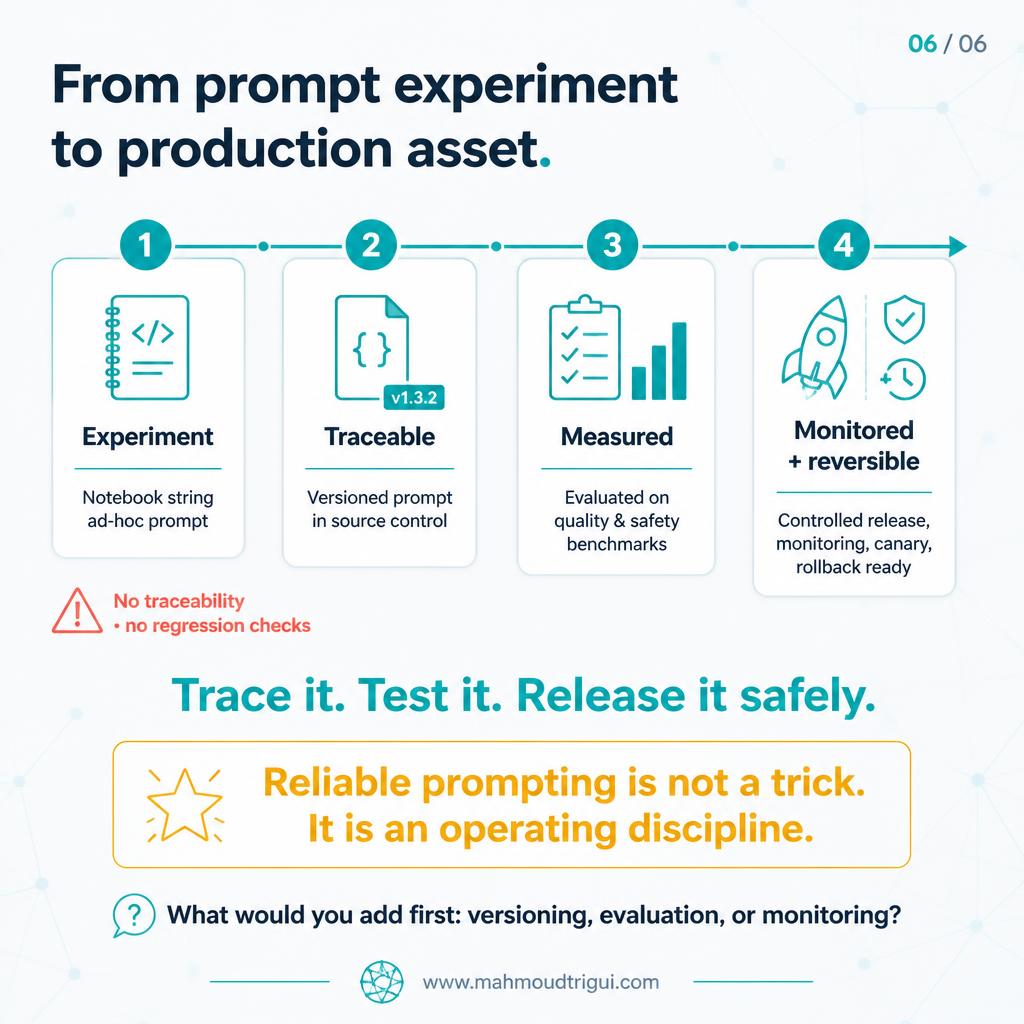
A prompt in a notebook is an experiment. A prompt that affects a production workflow is a production asset. Version it, evaluate it, release it gradually, and monitor it, so a small wording change stays traceable and reversible.
TL;DR: Prompting stops being ad hoc when changes become traceable, evaluated, and reversible. A prompt that shapes extraction quality, classification decisions, safety behaviour, token cost or latency is part of the system configuration, so it deserves the same discipline as a model version or an API contract. Version the prompt, model, schema and examples together, evaluate a candidate against the current version on representative and previously failed cases, release gradually, and monitor quality and cost. You would not change a production model without testing it. Prompts that influence decisions deserve the same care.
Visual Summary
The Problem
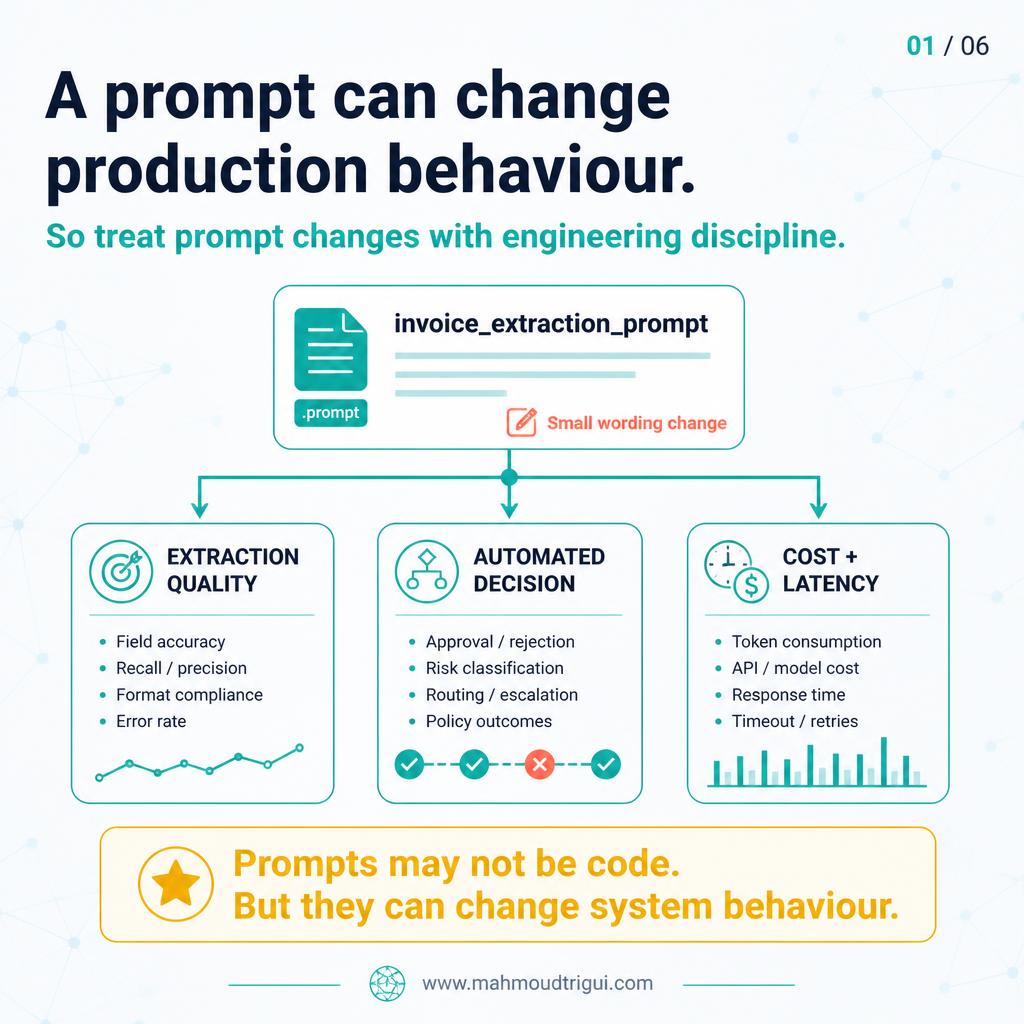
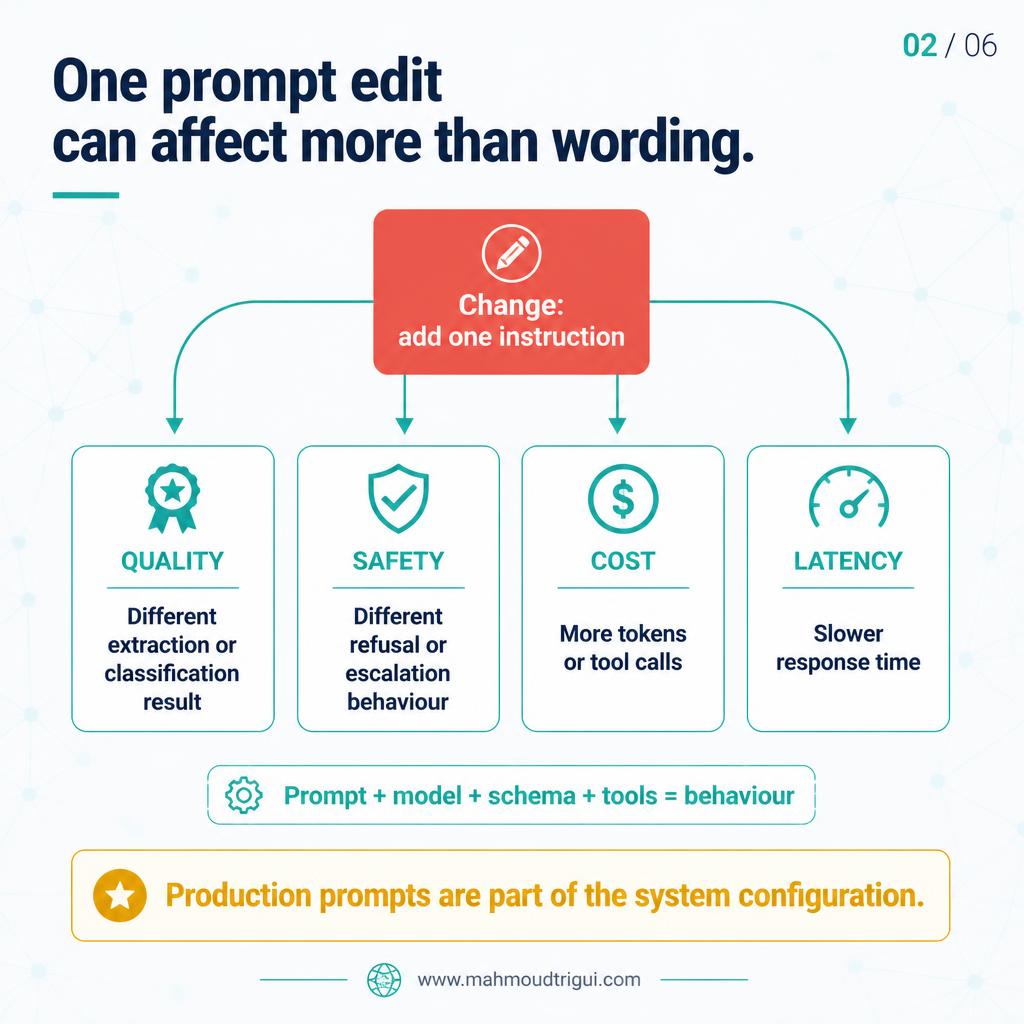
A prompt in a notebook is an experiment. A prompt that affects a production workflow is a production asset. It may not be code in the strict sense, but a small wording change can alter extraction quality, classification decisions, tool selection, safety behaviour, token usage, latency, and whatever runs downstream from the answer. The output still looks plausible, so nothing crashes and nothing alerts. The quality simply moved, and nobody knows which change moved it.
This is the part I had to unlearn. Prompting was the one part of an LLM system that we still changed by feel: a cleaner instruction here, a stricter format there, edited during a live incident and fixed again the next morning. Every change was local and reasonable, and the cumulative effect was a system nobody could reason about. The prompt had become configuration without versioning.
The Approach
The fix is not a better prompt. It is the same discipline we already apply to a model version or an API contract, pointed at the text itself. Four practices are the minimum.
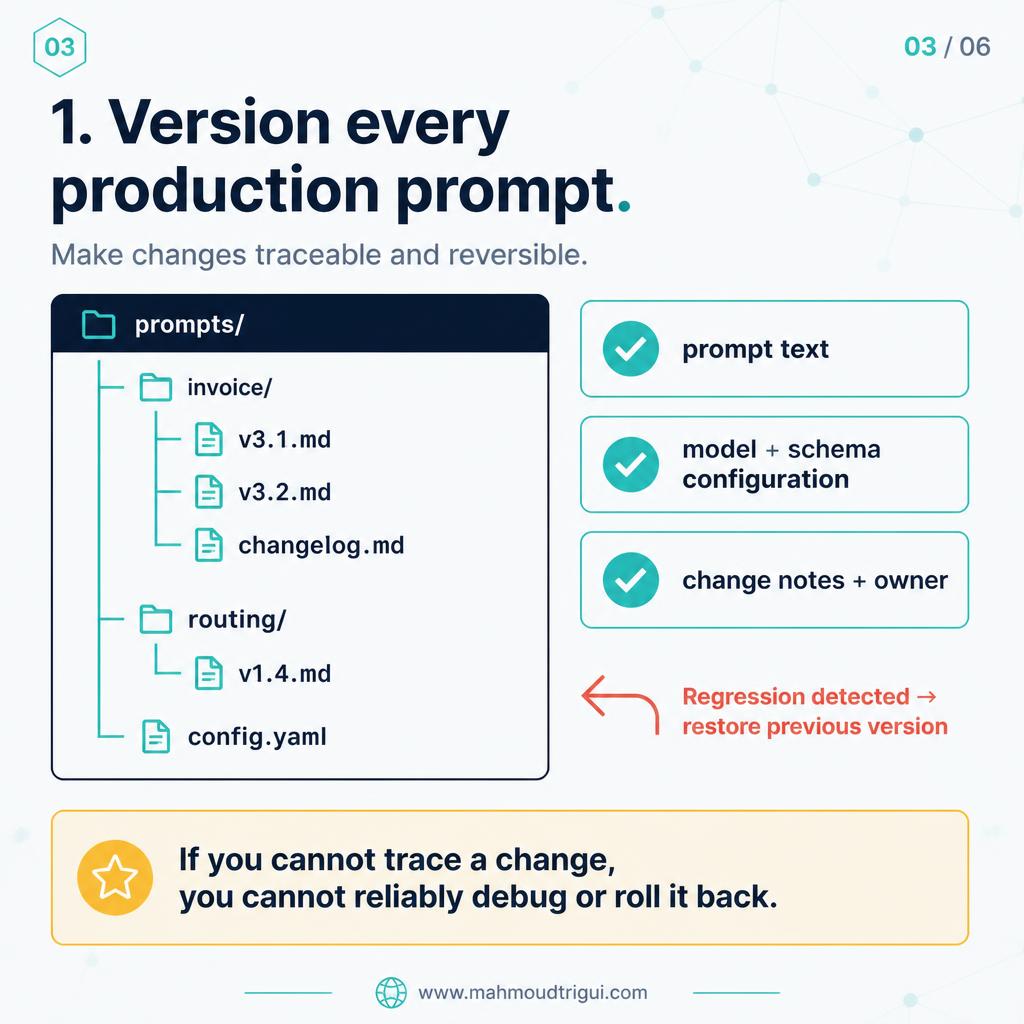
1. Version every production prompt
Keep the prompt, model configuration, schema, examples, and change notes traceable together, because they behave as one unit. When quality drops I need to know what changed, and I need to be able to restore the previous version without reconstructing it from memory. A prompt change is a change to the system, so it gets an identity and an owner.
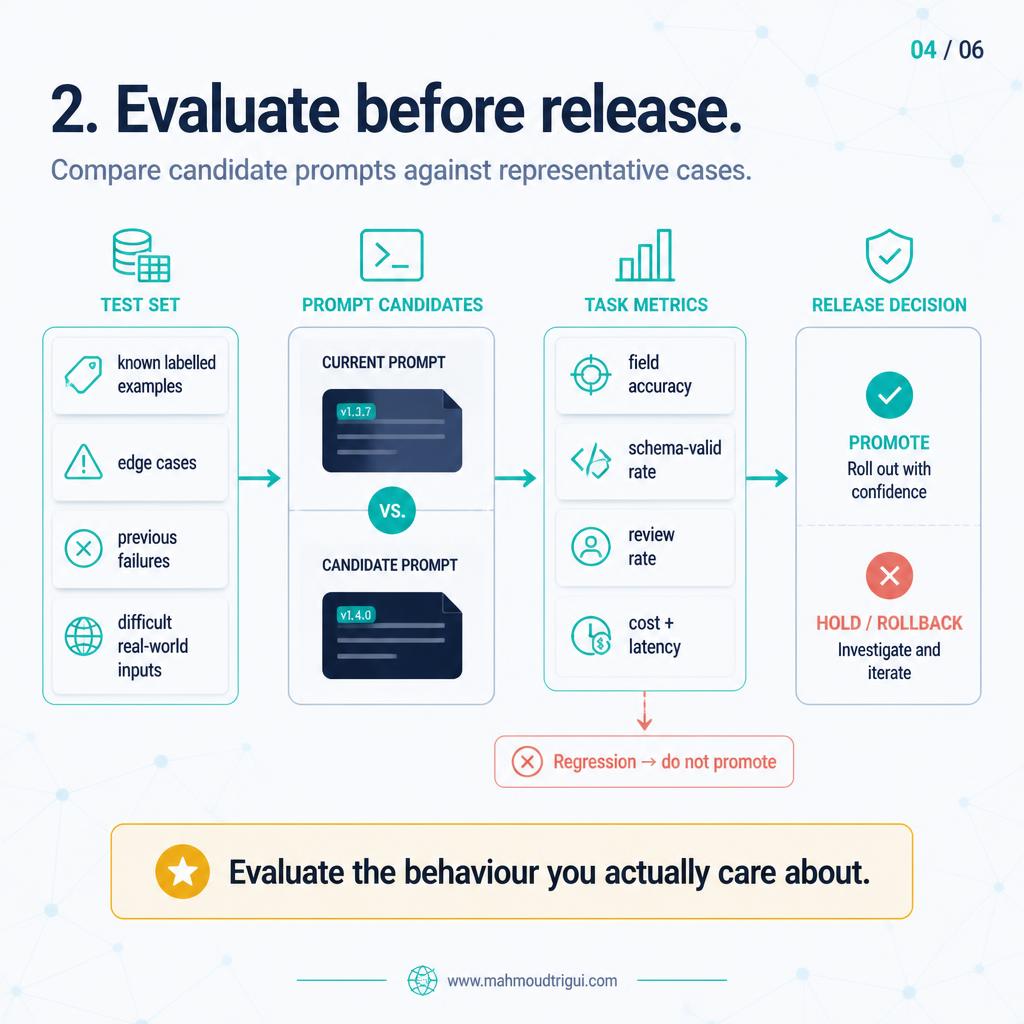
2. Evaluate before release
Build a representative test set: known documents or inputs, expected labels or fields, difficult edge cases, and the previous failure cases. Then compare the candidate prompt against the current version on that same set. Comparing against the version already in production is what makes the result interpretable; an absolute score on its own hides the only question that matters, which is whether this candidate is actually better.
3. Roll out gradually
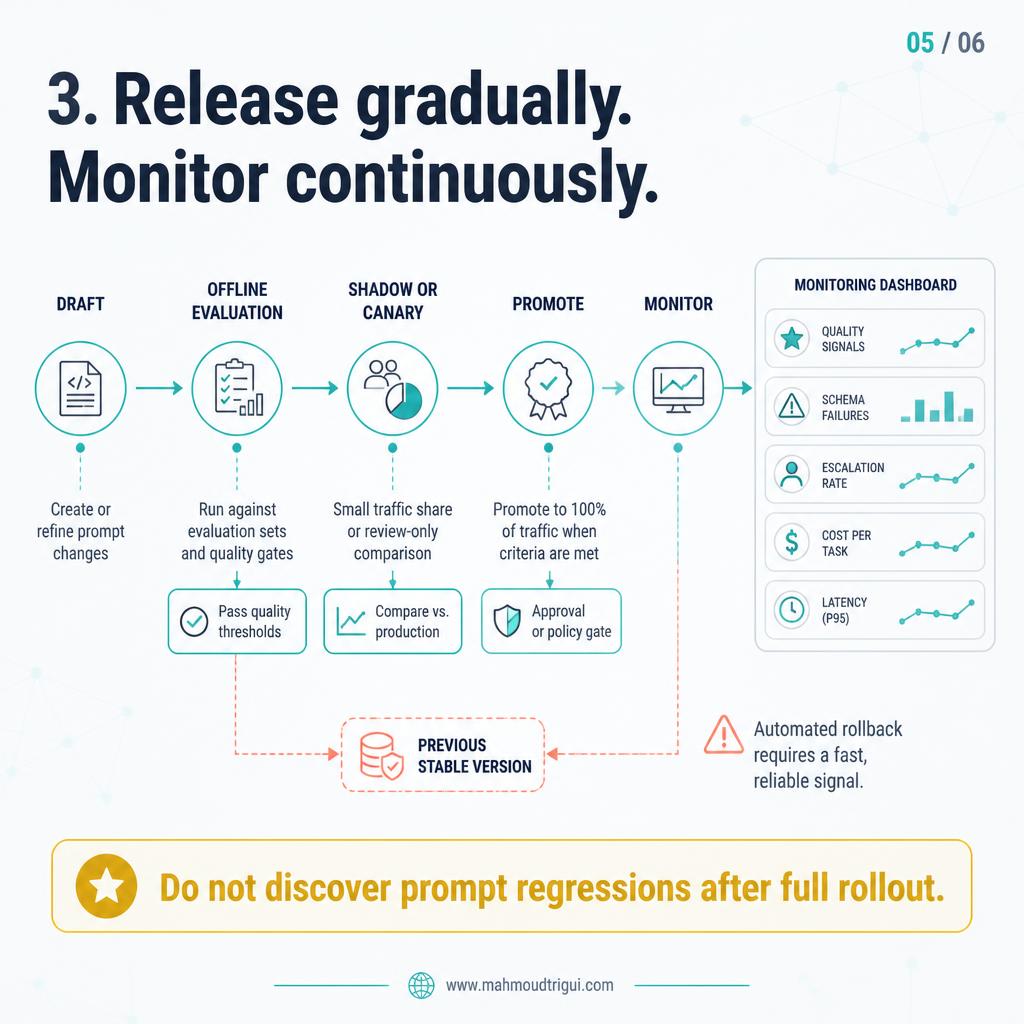
For high-impact workflows, do not send all traffic to a new prompt immediately. Use a small canary release, a shadow evaluation that compares without affecting the user, or a human review path first. Gradual release converts a silent quality regression into a bounded, observable one, while the previous version is still serving traffic.
4. Monitor quality and cost
A prompt version should be measured on more than output quality: the schema-valid response rate, task-level accuracy, the review or escalation rate, latency, and token usage and cost. A prompt that improves accuracy while doubling tokens and tripling latency is not an improvement, it is a trade the monitoring has to surface before the rollout rather than after.
Outcome
Prompting stops being ad hoc when changes become traceable, evaluated, and reversible. That is the whole shift. The work is not glamorous, and it does not appear in a demo, but it is the difference between a prompt you tune and a prompt you can operate. The four practices also make the failure cheap: a bad prompt version is detected on a test set, contained by a canary, and reverted in one action, instead of being discovered by a customer weeks later.
No universal accuracy threshold
What I resist is a single pass/fail number for prompts. The bar depends on the cost of the error, the reversibility of the decision, and how much human review sits downstream, so it differs per workflow. What does not differ is the requirement: a candidate prompt is compared against the current version on cases that represent the behaviour I actually care about, including the failures that already happened.
Automated rollback needs a reliable signal
The instinct is to automate the rollback. I would only do that once the trigger signal is fast and trustworthy, because a rollback driven by a noisy metric is its own incident. Until then, automated monitoring with a human decision is the honest setup: the signal tells you when quality moved, and the release process decides what happens next.
You would not change a production model, an API contract, or a business rule without testing it. A prompt that influences decisions deserves the same care. The first practice I would add is versioning, because without it the other three have nothing to compare against.
Key Takeaway
Design insight: Prompting stops being ad hoc when changes become traceable, evaluated, and reversible. A prompt that shapes extraction quality, classification decisions, safety behaviour, token cost or latency is part of the system configuration, so it deserves the same discipline as a model version or an API contract. Version the prompt, model, schema and examples together, evaluate a candidate against the current version on representative and previously failed cases, release gradually, and monitor quality and cost. You would not change a production model without testing it. Prompts that influence decisions deserve the same care.
Related
Structured Outputs for Reliable LLM Pipelines → An AI Endpoint Is a Workflow Contract, Not Just a Response → If your AI coding assistant keeps missing your standards, the problem may not be the model → A Valid LLM Response Is Not Necessarily a Safe Decision → 5 Signs Your AI Architecture Is Not Production-Ready → Stable vs Changing LLM Context — Cache and Retrieve Strategically → LLM Fallback Strategy: What Happens When the Model Fails? → AI-Assisted Coding Moved the Hard Part of Data Science to Specification → A Strong AutoML Baseline Can Beat Hand-Tuned Models → Adversarial Validation: Detect Data Shift Before Your Model Fails in Production →