AI Maturity Levels: From Demo to Platform
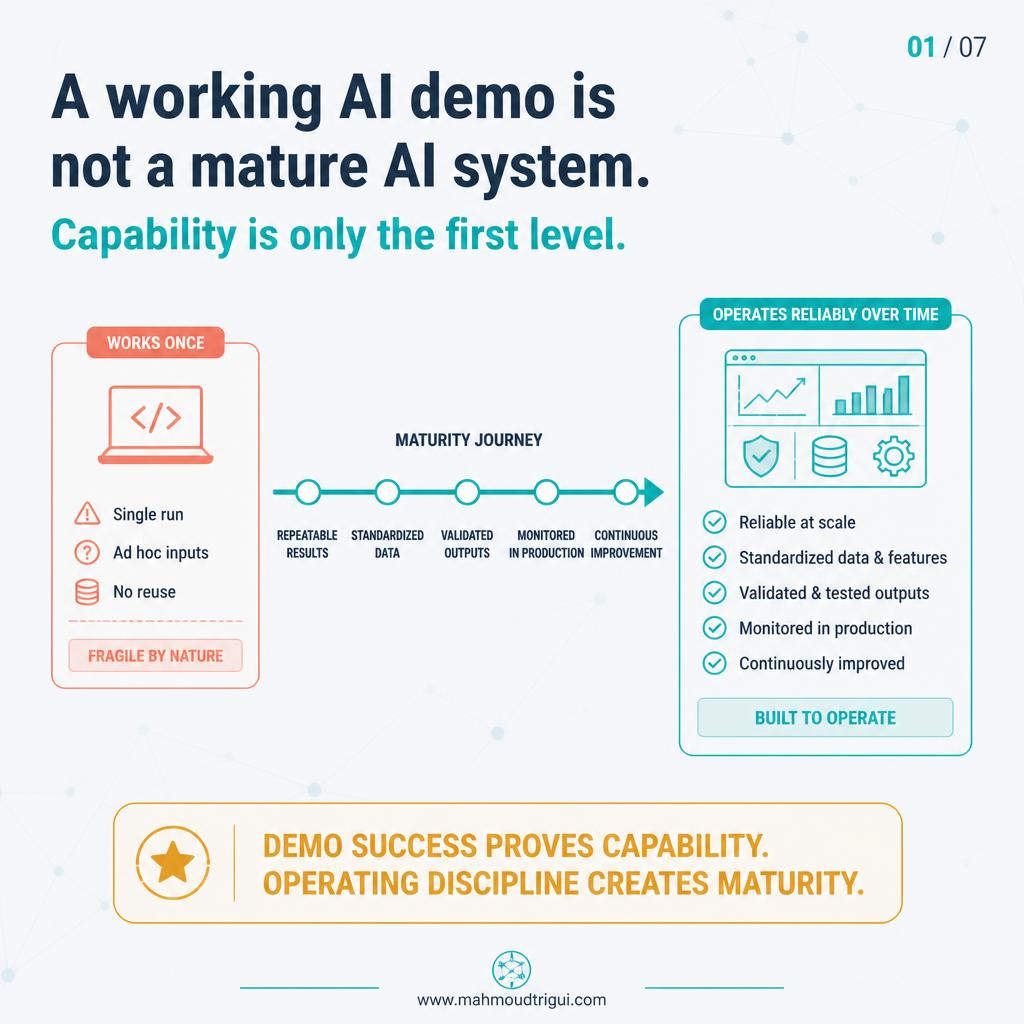
A prototype answers a question once. A mature system keeps operating when inputs change, dependencies fail, prompts evolve, and someone else has to maintain it. This is the five-level map I use to tell the two apart — and the one missing control that usually blocks the next level.
TL;DR: A working AI demo and a mature AI system look identical until something breaks. I use five levels — prototype, deployed, production-controlled, managed and measured, platform — to make the difference explicit, because the useful question is not “is it in production?” but “can it be operated, measured, and recovered?” For most teams the gap to the next level is a single missing control: versioning, evaluation, validation, fallback, monitoring, or ownership. Capability starts the journey; operating discipline creates maturity.
Visual Summary
The Problem
A working demo proves the model can do the task once, in front of an audience, on inputs somebody curated. It says very little about what happens next, when inputs drift, a dependency fails, a prompt gets edited, costs rise, or ownership changes hands.
The gap is easy to miss because nothing breaks on the way up. A prototype that works and a system that operates look identical in a screenshot. The difference only becomes visible later, usually as an incident rather than as a design review.
So teams ask the wrong question — is it in production? — and treat the answer as maturity. It is not the same thing, and the gap between them is where most of the operational risk actually lives.
The Approach
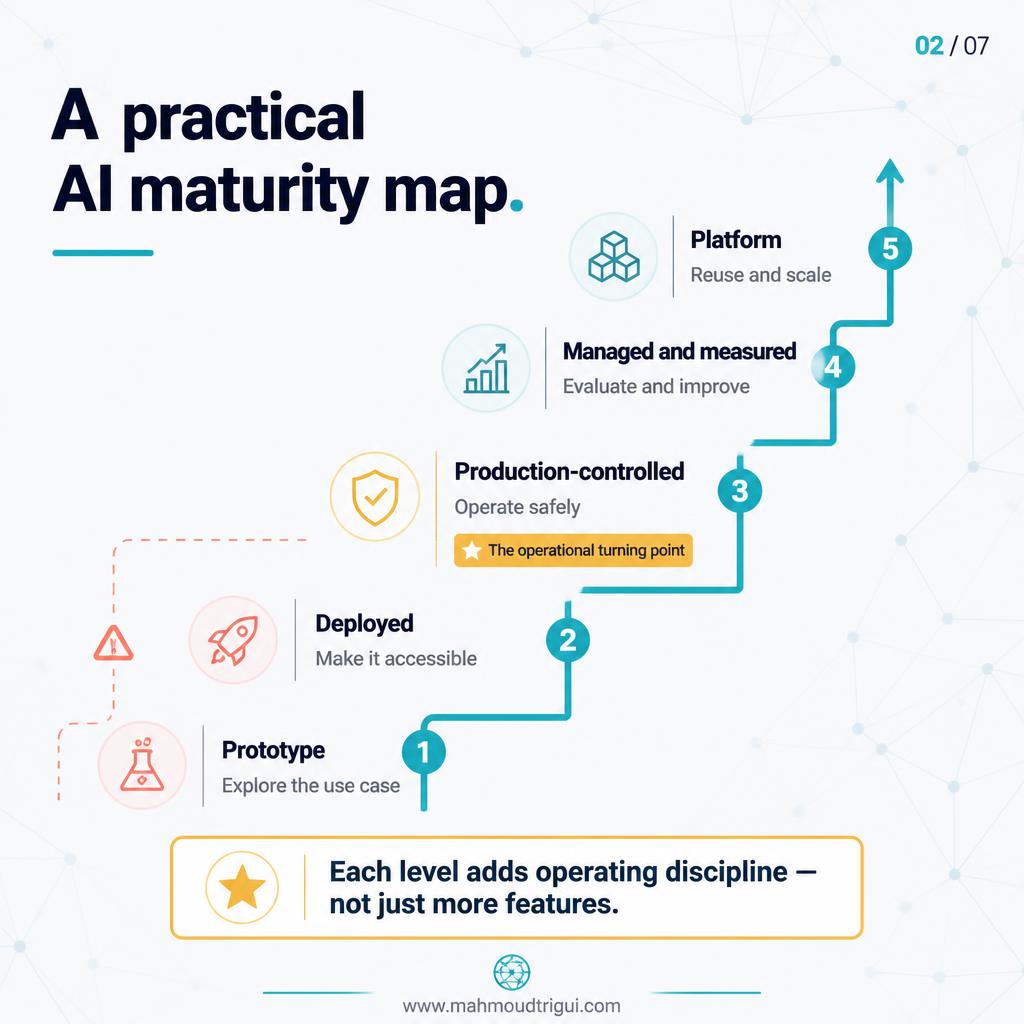
I find it more useful to think about AI systems as a maturity journey than as a binary of demo versus production. Five levels, each one defined by the operating discipline it adds rather than the features it ships.
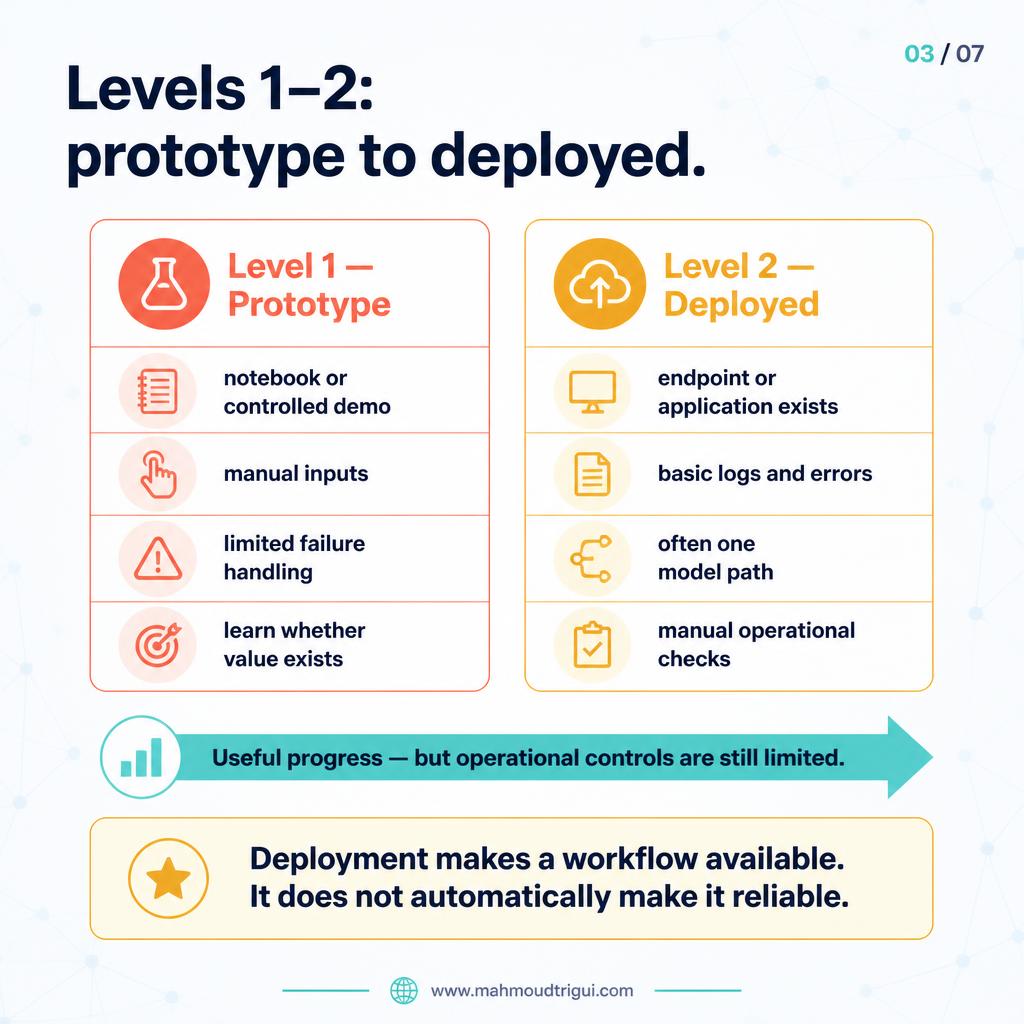
Level 1 — Prototype
The workflow works in a notebook or a controlled demo. The goal here is learning: does this use case have potential at all? Manual inputs and thin failure handling are fine at this level.
Level 2 — Deployed
There is an endpoint or an application, so the workflow is reachable. But it may still lean on one model path, manual checks, basic logs, and fragile prompt configuration. Deployment makes a workflow available, not reliable.
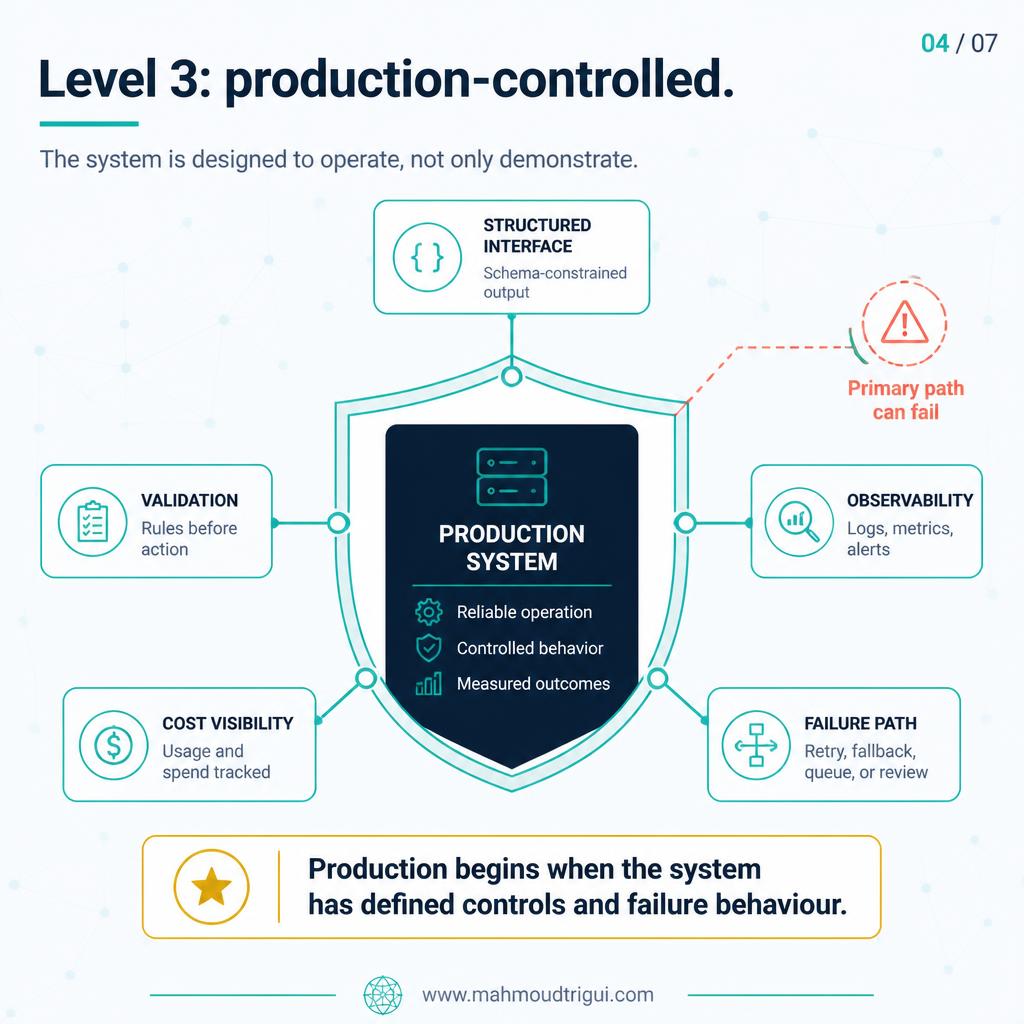
Level 3 — Production-controlled
The operational turning point: structured outputs, validation gates, observability, cost visibility, and a defined failure path. The system is designed to operate, not only to demonstrate.
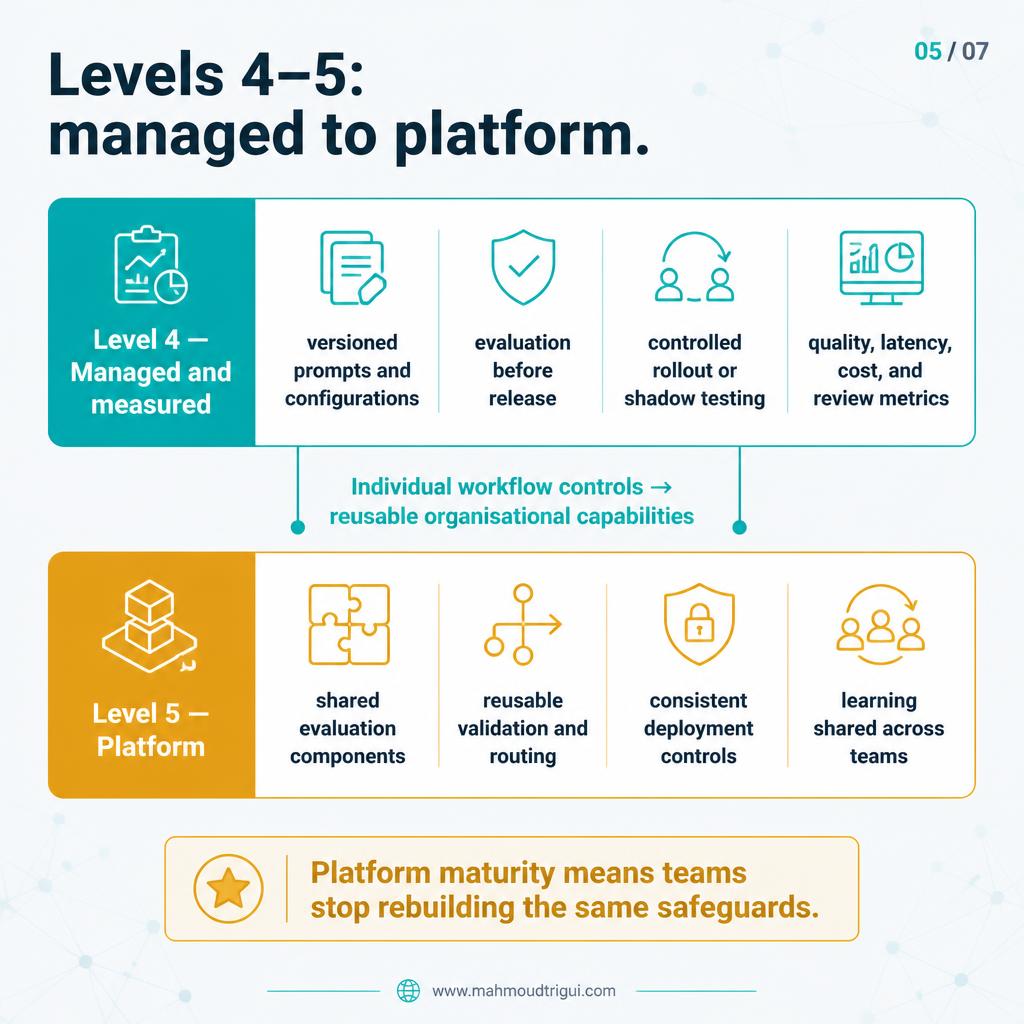
Level 4 — Managed and measured
Changes are evaluated before release, prompt and model versions are traceable, quality, latency, cost, and escalation rates are monitored, and high-impact changes roll out gradually.
Level 5 — Platform
Teams reuse shared components for evaluation, routing, validation, observability, and deployment, so the organisation learns across use cases instead of rebuilding the same controls every time.
The level names matter less than the question they force: what prevents this system from safely reaching the next one? For a lot of teams the blocker is not a more capable model. It is one missing operating control.
The Six Controls
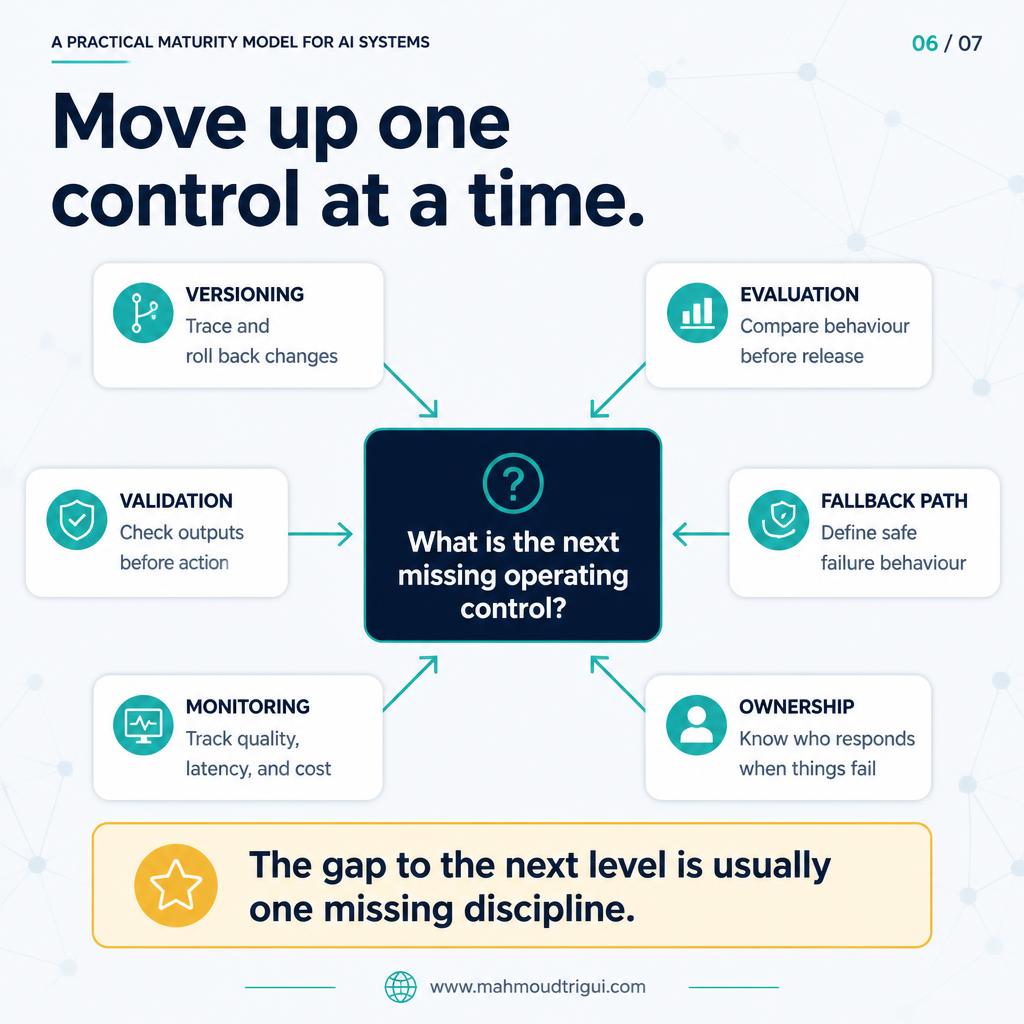
Across the five levels, the same six controls keep showing up as the difference between a system that runs and one that can be trusted to run unattended. Most teams are missing one or two, not all six.
Versioning
Trace and roll back changes. Version prompts, models, schemas, and configuration together, so any release can be explained and reversed.
Evaluation
Compare behaviour before release. Measure a candidate against the current version on representative and previously failed cases instead of eyeballing it.
Validation
Check outputs before action. A schema or rule gate turns a malformed response into a decision rather than a crash somewhere downstream.
Fallback path
Decide the safe failure behaviour in advance — retry, fallback, queue, or human review — before the primary path fails for the first time.
Monitoring
Track quality, latency, and cost together, so degradation is visible before a user reports it.
Ownership
Know who responds when things fail, and what they are authorised to change.
Outcome
What changes when a system climbs a level is rarely the model. It is the amount of surprise the system can absorb. A prototype absorbs none of it; a production-controlled system can absorb a failing dependency or a malformed response without pretending the answer is trustworthy.
The levels are also not a one-time achievement. Prompts get edited, models get swapped, costs move, and ownership rotates. Maturity is what lets a team absorb those changes and still know what the system is doing.
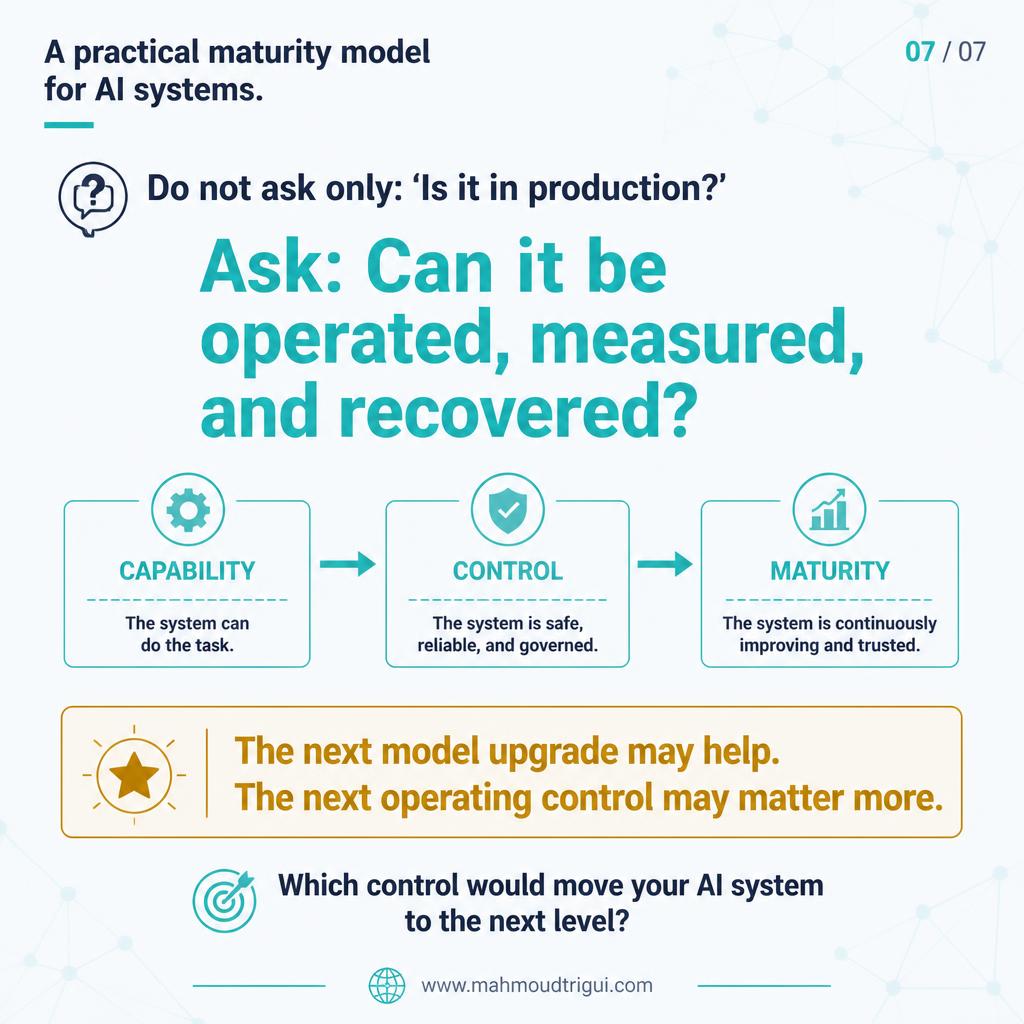
Capability gets you to the first level. Control is what turns a working demo into something you can operate, measure, and recover.
Key Takeaway
Design insight: A working AI demo and a mature AI system look identical until something breaks. I use five levels — prototype, deployed, production-controlled, managed and measured, platform — to make the difference explicit, because the useful question is not “is it in production?” but “can it be operated, measured, and recovered?” For most teams the gap to the next level is a single missing control: versioning, evaluation, validation, fallback, monitoring, or ownership. Capability starts the journey; operating discipline creates maturity.
Related
AI Architecture Production Readiness — 5 Red Flags →Prompt Versioning: How LLMOps Makes Prompts Reversible →LLM Fallback Strategy: What Happens When the Model Fails? →Structured Outputs for Reliable LLM Pipelines →A Valid LLM Response Is Not Necessarily a Safe Decision →Enterprise LLM Wrapper: The API Call Is the Smallest Part →Stable vs Changing LLM Context — Cache, Retrieve, Validate →Postman API Testing for LLM Workflow Contracts →Document AI Is a Pipeline, Not One LLM Call →AI-Assisted Coding Moves Data Science to Specification →
FAQ
What are the five levels of AI maturity?
Prototype, where the workflow works in a notebook or controlled demo. Deployed, where there is an endpoint or application but possibly one model path, manual checks, and fragile prompt configuration. Production-controlled, with structured outputs, validation gates, observability, cost visibility, and a defined failure path. Managed and measured, where changes are evaluated before release and prompt and model versions are traceable. Platform, where teams reuse shared evaluation, routing, validation, observability, and deployment components. Each level adds operating discipline rather than features.
What is the difference between a working AI demo and a mature AI system?
A demo proves the model can do the task once, in front of an audience, on inputs somebody curated. A mature AI system keeps operating when inputs change, dependencies fail, prompts evolve, and someone else has to maintain it. The two look identical in a screenshot, which is why the useful test is not whether a system is in production but whether it can be operated, measured, and recovered.
Which operating control should an AI team add first?
Whichever one is actually missing, and teams most often lack versioning or evaluation, because a prompt or model change can then ship without ever being measured or reversed. The practical first step is to name the single control that currently blocks the next maturity level, rather than buying a more capable model. Demo success proves capability; operating discipline is what creates maturity.
Does every AI system need to reach the platform level?
No. The levels are a way to expose the next missing control, not a scorecard every organisation has to max out. A single internal use case can be perfectly healthy at the production-controlled level. The platform level only matters when several teams would otherwise keep rebuilding the same evaluation, routing, validation, or deployment safeguards.