Preprocessing should have one source of truth
Preprocessing bugs rarely come from sophisticated modelling mistakes. They come from ordinary transformation logic repeated by hand in different places — and a Pipeline is how you stop that.
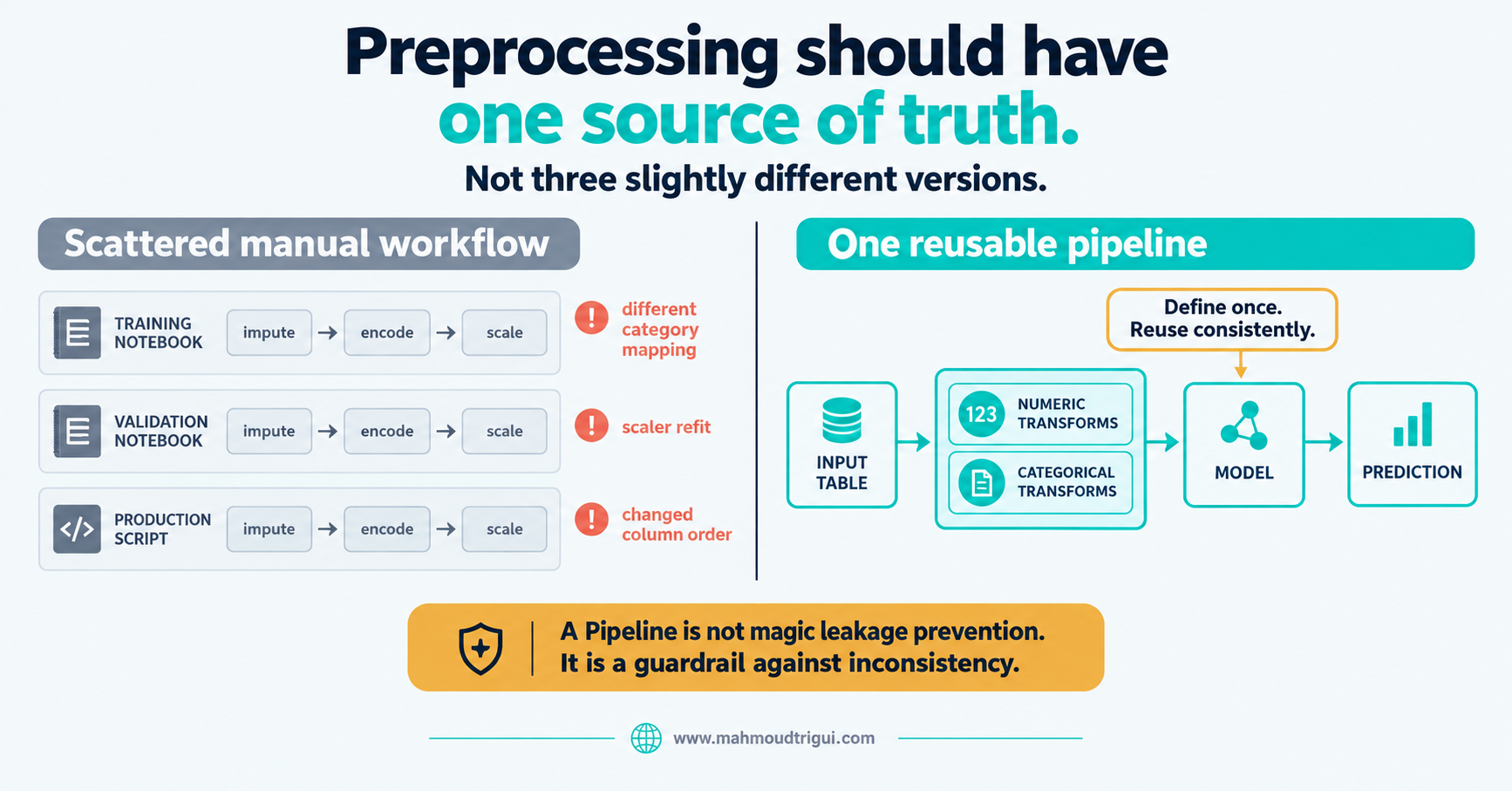
TL;DR: A Pipeline is not magic leakage prevention. It is a guardrail against inconsistency. Define preprocessing once, let the pipeline learn its parameters from training data only, and reuse the same object consistently — then handle leakage with deliberate validation design.
The Problem
A lot of preprocessing bugs do not come from sophisticated modelling mistakes. They come from ordinary transformation logic being repeated manually in different places.
One notebook cell imputes missing values. Another encodes categories. Another scales numerical features. Then a similar — but slightly different — version is applied to validation data, test data, or production inputs.
That is how inconsistency enters a machine-learning workflow. No single step looks wrong in isolation, which is exactly why these bugs stay silent until the numbers stop making sense.
The Approach
This is why I rely on Pipeline and ColumnTransformer. They let you define preprocessing once — numeric imputation, categorical encoding, scaling where appropriate, feature selection, and the final estimator — and then bind all of it to a single object.
pipeline.fit(X_train, y_train)
pipeline.predict(X_test)
The important benefit is not fewer lines of code. It is repeatable transformation logic. The same object that was fitted on training data is the one that transforms new data, so the transformations cannot silently diverge between then and now.
Used correctly, a pipeline helps ensure that preprocessing parameters are learned from training data only and applied consistently to new data. That is the source-of-truth property: one definition, reused everywhere.
The Important Caveat
A pipeline does not automatically prevent every form of leakage. It removes one class of error — repeated, drifting transformation logic — but it does not design your validation for you.
You still need to:
- split data before fitting;
- place preprocessing inside cross-validation;
- preserve point-in-time feature availability;
- generate target-derived features safely;
- validate the full workflow against deployment conditions.
A pipeline is not a substitute for sound validation design. It is a way to make sound design easier to apply consistently.
Outcome
One transformation graph. Fewer manual differences. Fewer places for silent bugs to hide. When preprocessing is defined once and applied through the same object at training and inference, the gap between the notebook and production stops being a guessing game.
Is your preprocessing defined once — or copied across notebooks and scripts?
Key Takeaway
Design insight: A Pipeline is not magic leakage prevention. It is a guardrail against inconsistency. Define preprocessing once, let the pipeline learn its parameters from training data only, and reuse the same object consistently — then handle leakage with deliberate validation design.
Related
AI Can Review Feature Code. It Cannot Approve It →Preprocessing Is Vocabulary Design for Noisy NLP Text →isnull() Is a Feature — Missingness as a Signal →Categorical Encoding Cheat Sheet for Tabular ML →Encoding Is a Modeling Decision, Not a Checkbox →CatBoost Ordered Target Encoding: Controlling Leakage →Don't Ask Your Model to Learn What a Formula Knows →Adversarial Validation: Detect Data Shift Before It Hurts →Purged Cross-Validation Is Not for Every Time Series →
FAQ
What is the key takeaway from "scikit-learn Pipeline: One Source of Truth for Preprocessing"?
A Pipeline is not magic leakage prevention. It is a guardrail against inconsistency. Define preprocessing once, let the pipeline learn its parameters from training data only, and reuse the same object consistently — then handle leakage with deliberate validation design.
Who wrote this and what is it about?
This was written by Mahmoud Trigui, Senior Data Scientist. Preprocessing bugs come from transformation logic copied across notebooks. A scikit-learn Pipeline defines it once and reuses it at training and inference.