AI Can Review Feature Code. It Cannot Approve It
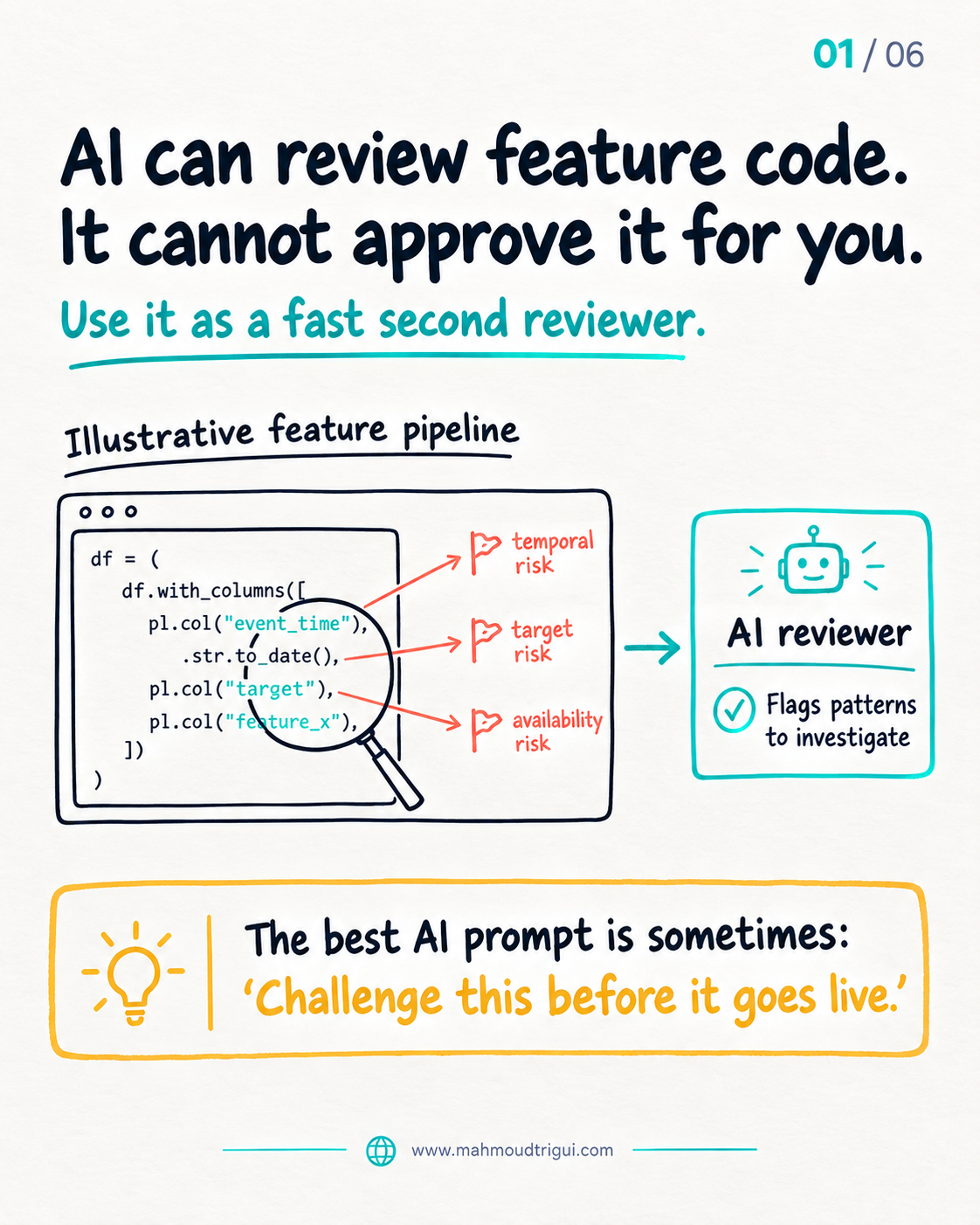
One of the best uses of AI in data science is not generation — it is review. Use an AI reviewer as a fast second pair of eyes on your feature pipeline.
TL;DR: AI can review feature code — it cannot approve it for you. Use an AI reviewer as a fast second pair of eyes on the feature pipeline: it flags suspicious patterns, generates review questions, and suggests safer alternatives. The data scientist still verifies timestamps and data availability, validation-fold design, data contracts, and business meaning before approving any change. AI feedback is a hypothesis, not proof.
Visual Summary
The Problem
A feature pipeline can look plausible at first glance and still leak. A centred rolling
window may use data from after the prediction timestamp. Target statistics may be calculated
on rows that later appear in validation. A post-event variable such as
resolution_time may be known only after a case closes — long after the
prediction is made.
These patterns make evaluation optimistic and predictions wrong at inference time. That is why one of the best uses of AI in data science is not generation — it is review.
The Approach
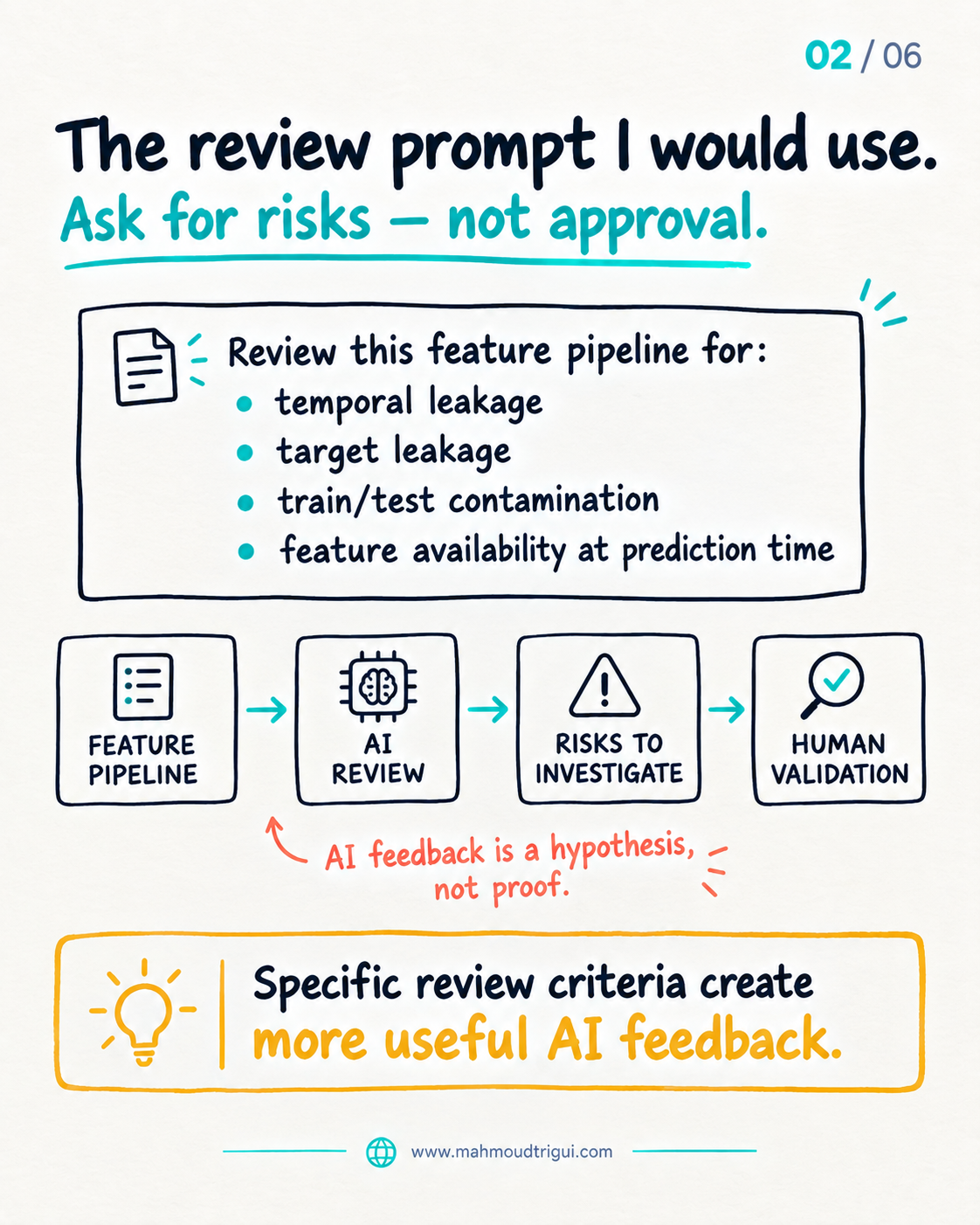
Use an AI reviewer as a second pair of eyes. Give it explicit review criteria and ask for risks — not approval:
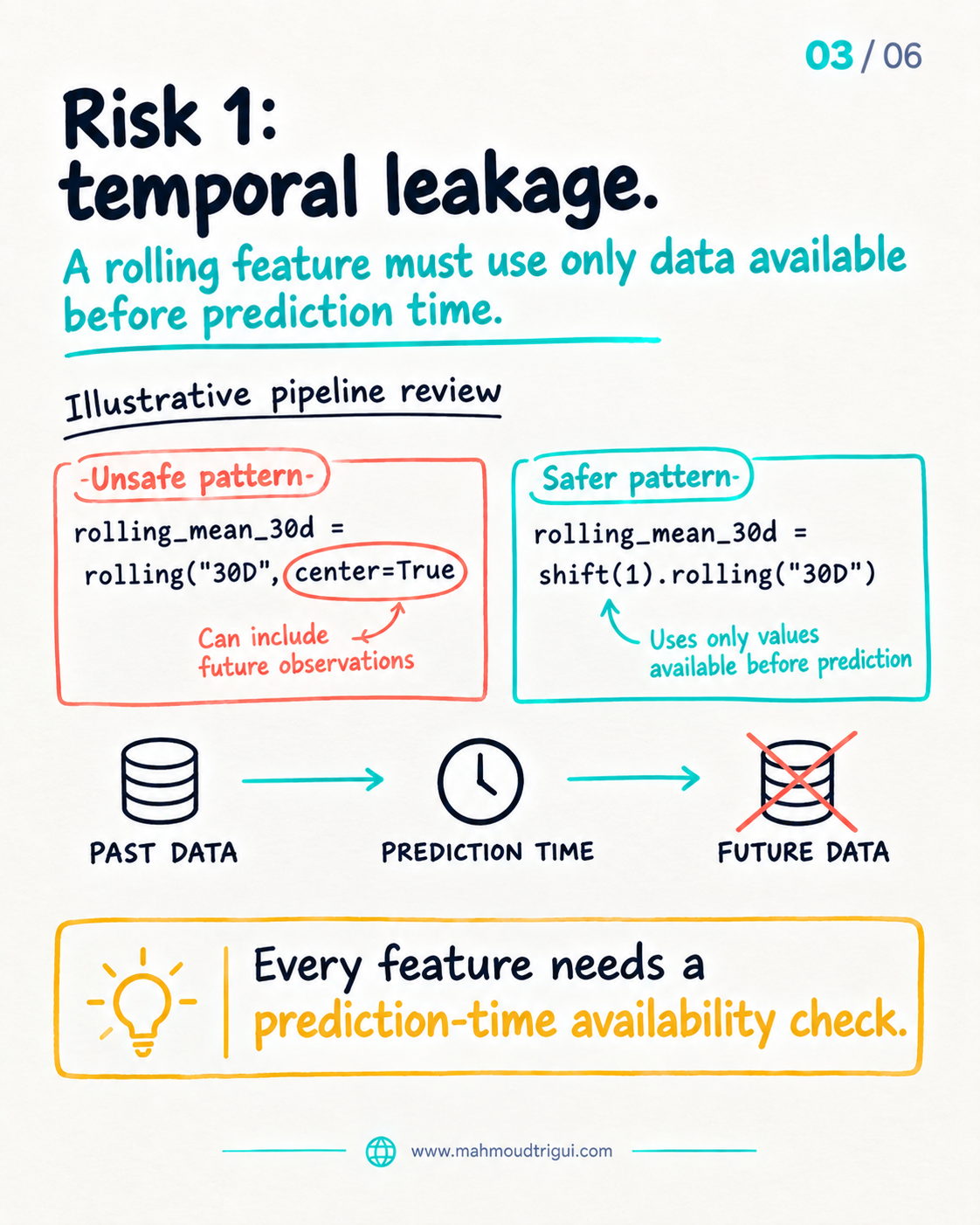
Risk 1 — Temporal leakage
A rolling window that could include future observations. A centred window
(rolling("30D", center=True)) can use data from after the prediction
timestamp. The safer pattern is shift(1).rolling("30D") — values available
before prediction time only. Every feature needs a prediction-time availability check.
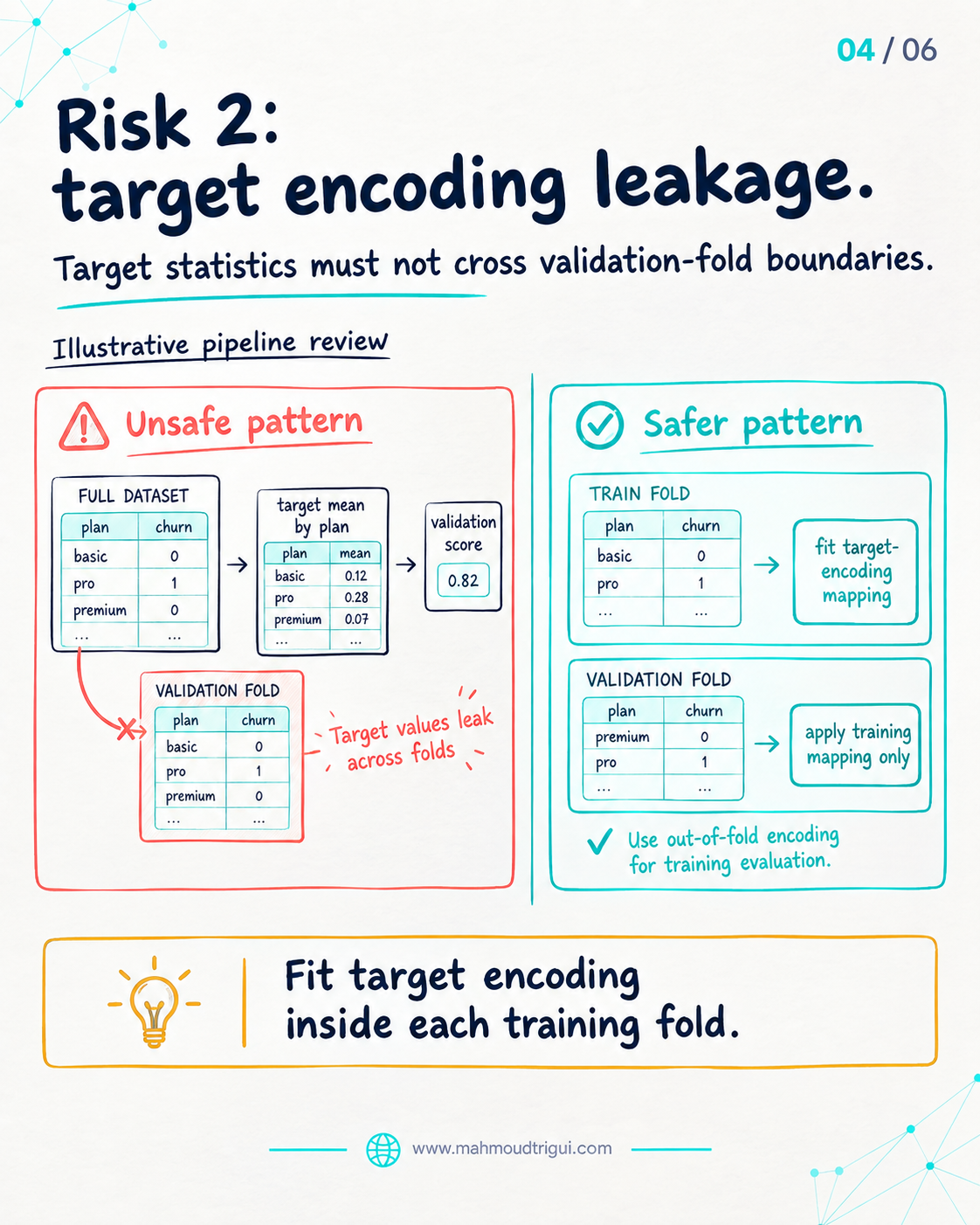
Risk 2 — Target encoding leakage
Target encoding fitted before fold separation leaks target statistics across folds and makes evaluation optimistic. Fit the target-encoding mapping inside each training fold and apply the training mapping only when scoring validation. Use out-of-fold encoding for training evaluation.
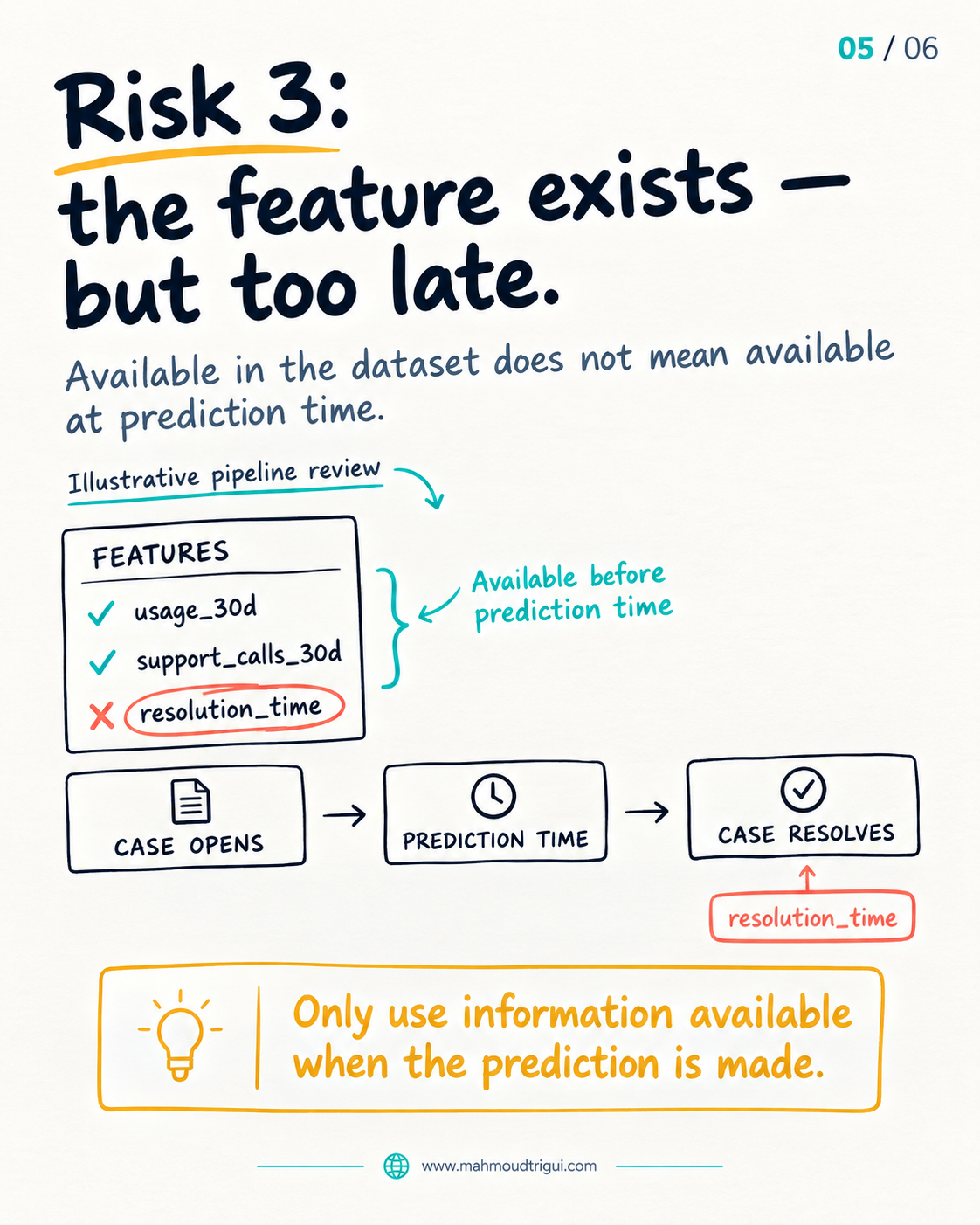
Risk 3 — Feature availability
A variable such as resolution_time exists in the dataset but is known only
after the case resolves — it cannot be used when the prediction is made. Available in the
dataset does not mean available at prediction time. Only use information available when
the prediction happens.
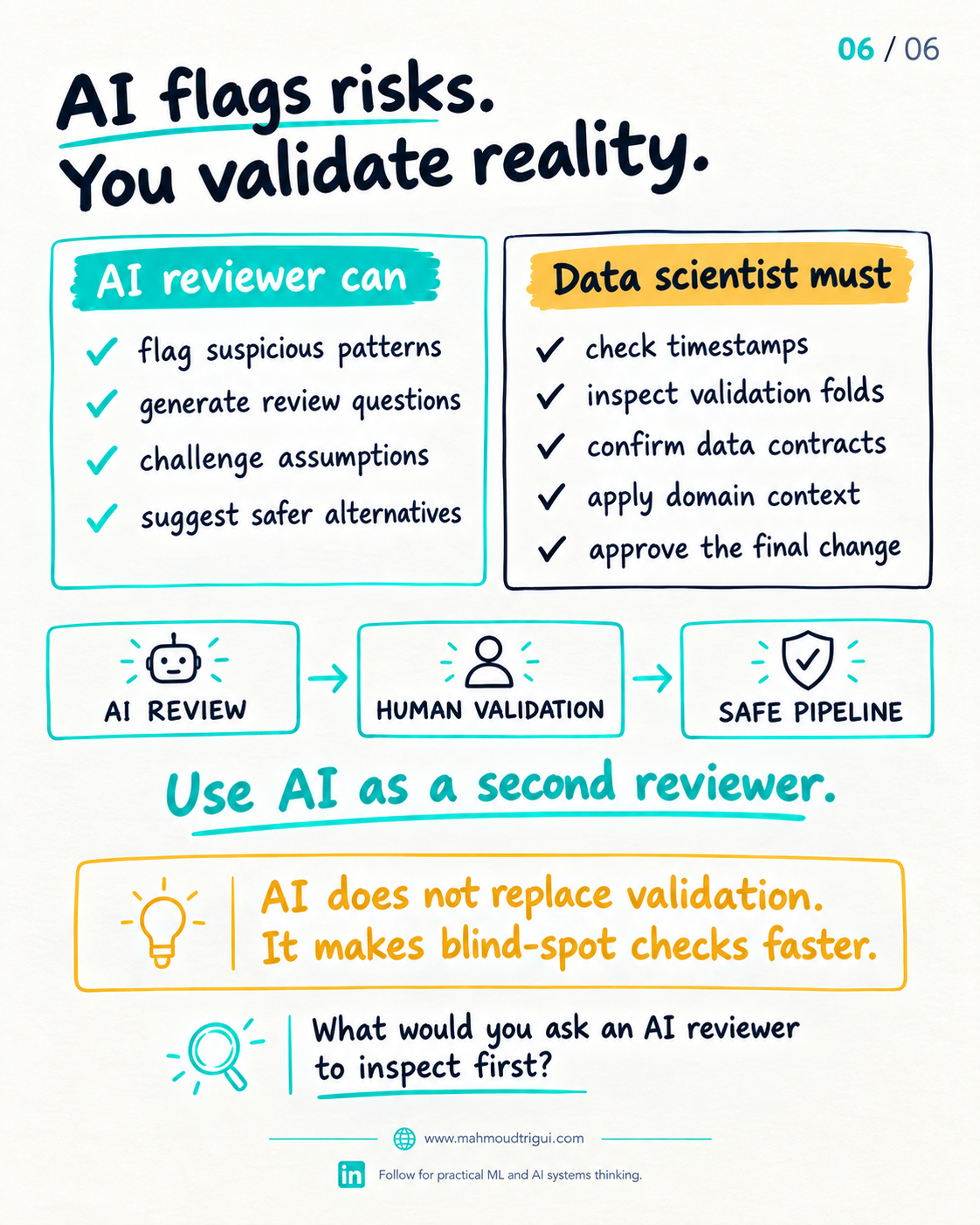
The useful part is not that AI knows the business better — it does not. It is a fast second reviewer that can challenge code which looks plausible at first glance. You still verify timestamps and data availability, validation-fold design, data contracts, business meaning, and whether the flagged risk is real.
This review loop is faster, broader, and less attached to the original implementation.
Outcome
The highest-leverage prompt is not "Write this for me." It is "Challenge this before it goes live."
AI does not replace validation. It makes blind-spot checks faster — specifically by flagging temporal leakage, target leakage, train/test contamination, and features unavailable at prediction time before a pipeline ships.
Key Takeaway
Design insight: AI can review feature code — it cannot approve it for you. Use an AI reviewer as a fast second pair of eyes on the feature pipeline: it flags suspicious patterns, generates review questions, and suggests safer alternatives. The data scientist still verifies timestamps and data availability, validation-fold design, data contracts, and business meaning before approving any change. AI feedback is a hypothesis, not proof.
Related
Adversarial Validation: Detect Data Shift Before It Hurts →The Most Dangerous Label in ML Looks Correct But Isn't →Categorical Encoding Cheat Sheet for Tabular ML →Turning a Categorical Variable Into Behavioral Signal →isnull() Is a Feature — Missingness as a Signal →Encoding Is a Modeling Decision, Not a Checkbox →Claude Code Project Instructions: Layered CLAUDE.md →Don't Ask Your Model to Learn What a Formula Knows →
FAQ
What is the key takeaway from "AI Can Review Feature Code. It Cannot Approve It"?
AI can review feature code — it cannot approve it for you. Use an AI reviewer as a fast second pair of eyes on the feature pipeline: it flags suspicious patterns, generates review questions, and suggests safer alternatives. The data scientist still verifies timestamps and data availability, validation-fold design, data contracts, and business meaning before approving any change. AI feedback is a hypothesis, not proof.
Who wrote this and what is it about?
This was written by Mahmoud Trigui, Senior Data Scientist. An AI reviewer flags temporal leakage, target leakage, train-test contamination, and features unavailable at prediction time, so validate before shipping.