A Reranker Cannot Rank What It Never Receives
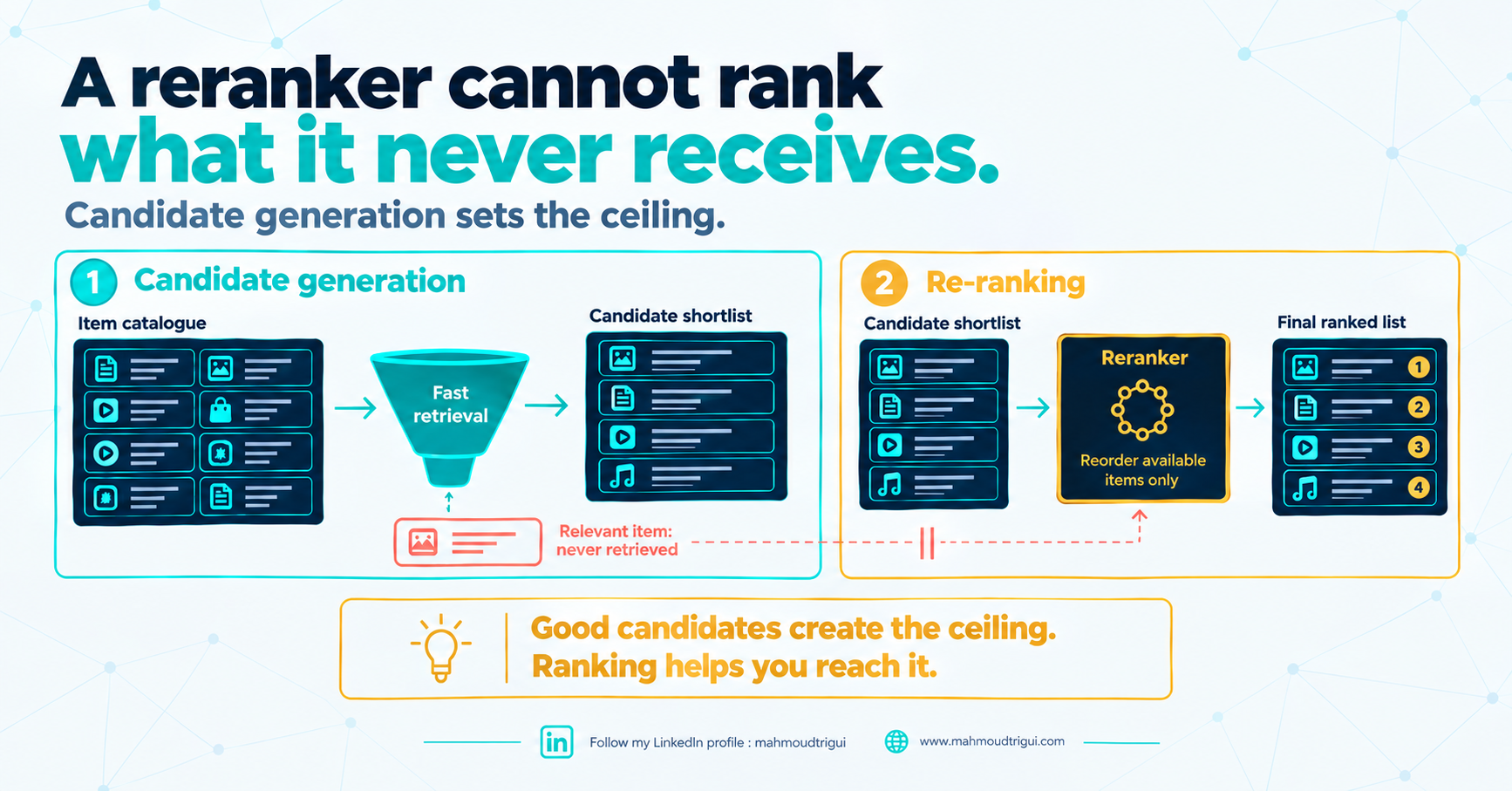
Recommender quality starts with candidate generation, not ranking. Fast retrieval sets the ceiling — a richer re-ranker only reaches it.
TL;DR: A reranker cannot rank what it never receives. Candidate generation sets the quality ceiling for the entire recommender system — use fast retrieval to build a broad, relevant shortlist, then apply a richer re-ranker only to what the shortlist provides. Evaluate candidate recall@K, ranking quality, latency and cost, diversity, coverage, and business constraints separately, and place expensive reasoning where it adds measurable value. Good candidates create the ceiling; better ranking helps you reach it.
Visual Summary
The Problem
A production recommender system is not one model making one prediction. It is a pipeline: retrieve a broad shortlist, then score and order only what the system can surface. If retrieval misses a relevant item, no re-ranker — however powerful — can recover it.
Most teams invest heavily in the ranking layer: learning-to-rank models, cross-encoders, and more recently LLM-based re-rankers. But the candidate generation step often gets less attention, even though it determines the ceiling of the whole system.
The Approach
A two-stage architecture is simple: candidate generation first, re-ranking second. The two stages solve different problems and should be evaluated separately.
Candidate generation sets the ceiling
Use fast retrieval methods to build a reasonably broad shortlist: collaborative filtering, co-visitation signals, content-based retrieval, embedding retrieval, or popularity and business-rule candidates. The goal is not perfect ordering — it is recall. Did the system retrieve the items worth considering?
Re-ranking reaches the ceiling
Score only the shortlisted candidates with a richer model: a learning-to-rank model, a cross-encoder, a business-rule layer, or — for selected use cases — an LLM-based re-ranker. The richer model can only work with what candidate generation provides.
Use LLM re-rankers where semantics matter
An LLM adds value when semantic interpretation or natural-language context matters: a user expresses intent in text, item metadata is rich but sparse, session context changes the meaning of relevance, or cold-start items need content understanding. Use expensive reasoning where it adds measurable value.
There is one hard limit: if the relevant item never enters the candidate set, no reranker can recover it. Evaluate the system in stages — candidate recall@K, ranking quality on the shortlist, latency and cost, diversity and coverage, and business constraints.
Keep broad retrieval fast and place expensive ranking only on the shortlist. That split is what makes a recommender practical at production scale.
Outcome
When candidate generation is strong, a simpler re-ranker can outperform a complex one that starts from a weaker candidate set. The payoff of the whole pipeline is bounded by what retrieval manages to surface.
The hardest part of a recommender system today is often not the ranking model — it is whether the right candidates made it into the shortlist.
Key Takeaway
Design insight: A reranker cannot rank what it never receives. Candidate generation sets the quality ceiling for the entire recommender system — use fast retrieval to build a broad, relevant shortlist, then apply a richer re-ranker only to what the shortlist provides. Evaluate candidate recall@K, ranking quality, latency and cost, diversity, coverage, and business constraints separately, and place expensive reasoning where it adds measurable value. Good candidates create the ceiling; better ranking helps you reach it.
Related
Rule vs Model vs LLM — Which Should You Use? →AI Architecture Production Readiness — 5 Red Flags →A predictive model is not a decision system →The prompt that classifies 500 images without a model →TabPFN: a Pre-Trained Prior for Tabular ML →Not Every Analytics Question Is About What Drives Outcome →Focal Loss for Imbalanced Classification →Structured Outputs for Reliable LLM Pipelines →
FAQ
What is the key takeaway from "A Reranker Cannot Rank What It Never Receives"?
A reranker cannot rank what it never receives. Candidate generation sets the quality ceiling for the entire recommender system — use fast retrieval to build a broad, relevant shortlist, then apply a richer re-ranker only to what the shortlist provides. Evaluate candidate recall@K, ranking quality, latency and cost, diversity, coverage, and business constraints separately, and place expensive reasoning where it adds measurable value. Good candidates create the ceiling; better ranking helps you reach it.
Who wrote this and what is it about?
This was written by Mahmoud Trigui, Senior Data Scientist. Recommender quality starts with candidate generation, not ranking. A reranker cannot rank what it never receives — set the ceiling with broad retrieval.