Preprocessing Is Vocabulary Design for Noisy NLP Text
In noisy short-text NLP, the model can lose before training starts. Normalise what is safely equivalent; preserve what carries meaning.
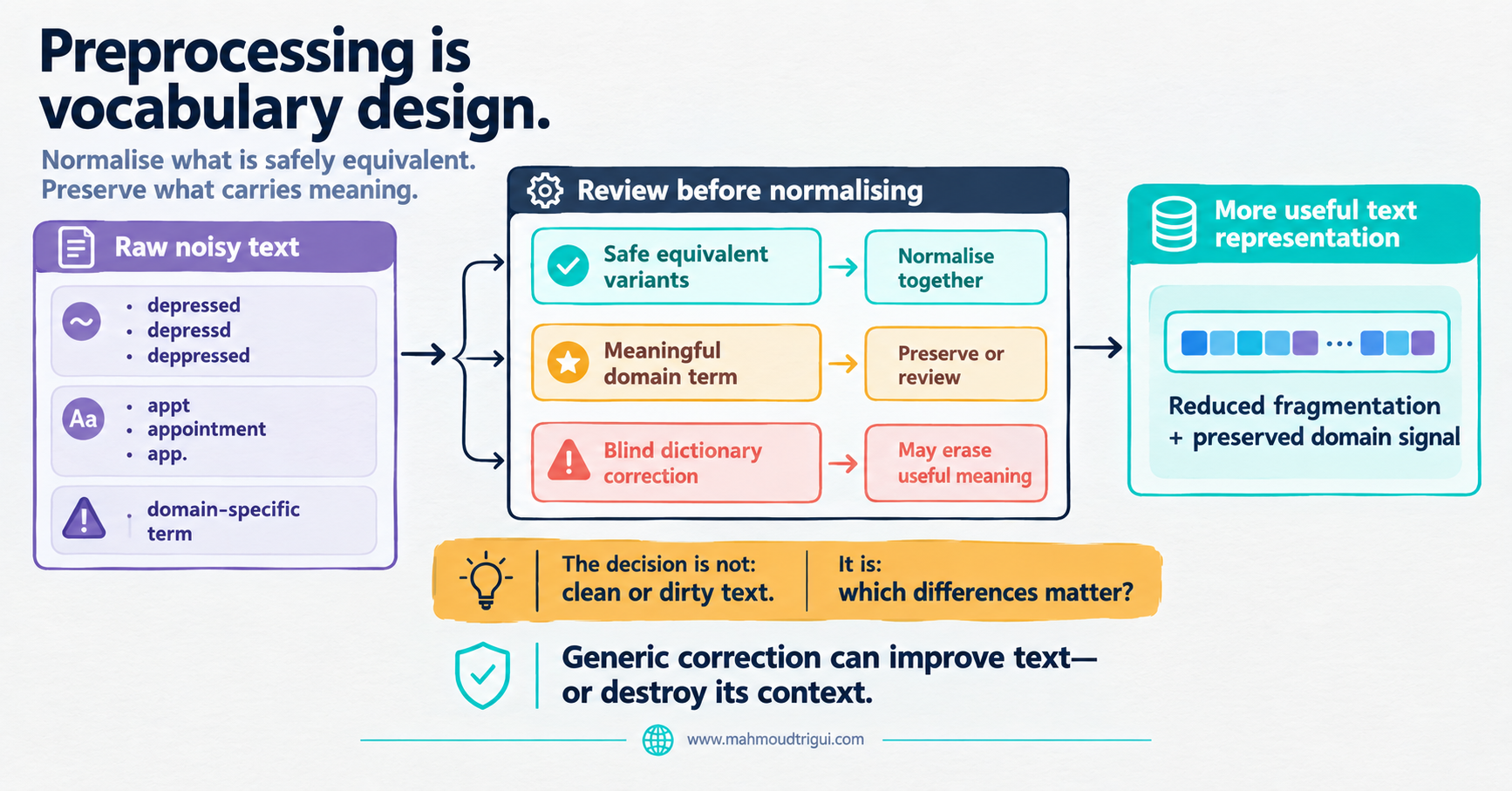
TL;DR: Noisy short text fragments the vocabulary for sparse methods such as TF-IDF, so preprocessing became a vocabulary-design decision: normalise what is safely equivalent, review unknown tokens rather than replacing them blindly, and preserve terms that carry domain meaning. Preprocessing always encodes assumptions about which differences matter.
The Problem
In noisy short-text NLP, the model can lose before training starts. Short text often contains spelling mistakes, abbreviations, slang, inconsistent word forms, local terminology, and partial sentences.
For sparse methods such as TF-IDF, this can fragment the vocabulary. depressed,
depressd, and deppressed may become separate tokens even though they
refer to the same concept, weakening the signal.
The Approach
The answer is not simply "correct every unfamiliar word". Generic spell correction can erase domain meaning: a local term, product abbreviation, medication name, technical label, or community-specific phrase may be flagged as incorrect by a standard dictionary, even when it carries important predictive meaning.
So preprocessing became a vocabulary-design decision. The key questions were:
Which variants should be normalised together?
Spelling variants of the same concept should collapse into one canonical token.
Which terms should be preserved exactly?
Local terms, abbreviations, and domain labels may be standard dictionary errors but real signals.
Which corrections can be made confidently?
Only unambiguous transforms, never blind dictionary-driven rewrites.
Which unknown tokens should be reviewed rather than replaced?
Unknown tokens can be preserved, flagged, and reviewed instead of destroyed.
Does normalisation improve validation performance without removing useful context?
Every normalisation rule should earn its place by validation, not by clean-looking text.
The goal was not perfectly clean language. It was a representation that reduced accidental fragmentation while retaining meaningful terminology.
Outcome
This applies beyond NLP. Preprocessing always encodes assumptions about what differences matter. In text, those assumptions decide whether two expressions are treated as noise, variants of the same concept, or distinct domain signals.
Treating preprocessing as a design task — with review and validation — keeps the signal instead of polishing it away.
Key Takeaway
Design insight: Preprocessing is vocabulary design, not just cleaning. Spelling mistakes, slang, and abbreviations fragment a sparse vocabulary like TF-IDF, but a generic dictionary fix can erase the exact domain terms that carry predictive meaning. Normalise what is safely equivalent, review unknown tokens instead of replacing them, and validate every rule — because preprocessing always encodes assumptions about which differences matter. Normalise what is safely equivalent; preserve what carries meaning.
Related
NLP Classification: Interface Changed, Engineering Didn't →Unpack a Categorical Variable Into Behavioural Mechanisms →Turning One Categorical Variable into Behavioral Signal →Encoding Is a Modeling Decision →Categorical Encoding Cheat Sheet →isnull() Is a Feature →Don't Ask Your Model to Learn What a Formula Already Knows →Preparing Feature Spaces for Distance-Based Clustering →
FAQ
Why is preprocessing a vocabulary-design decision in noisy text?
Short noisy text fragments the vocabulary for sparse methods like TF-IDF: depressed, depressd, and deppressed become separate tokens. Normalising what is safely equivalent keeps variants together, while preserving domain terms avoids erasing predictive meaning.
Why is generic spell correction dangerous for domain text?
A local term, product abbreviation, medication name, technical label, or community-specific phrase may be flagged as incorrect by a standard dictionary even when it carries important predictive meaning, so correcting every unfamiliar word can erase the signal.