Unpack a Categorical Variable Into Behavioural Mechanisms

Do not treat a categorical variable as one flat label when it actually contains several behavioural mechanisms - a raw category is often not the business concept itself.
Income Source Income Regularity Financial-Access Context Feature Validation
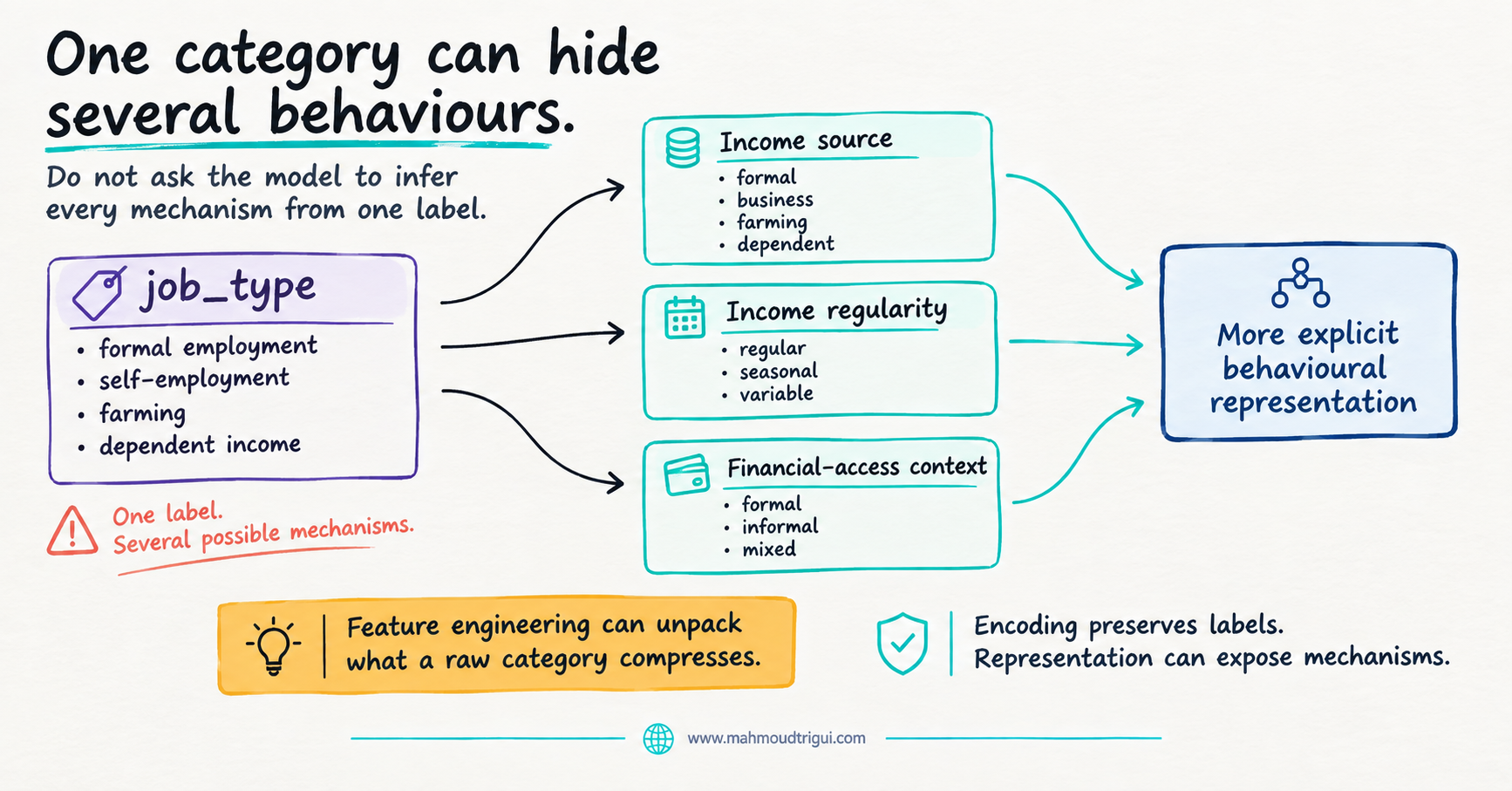
One category can hide several behaviours - decompose a flat job_type label into income source, income regularity, and financial-access context features before asking the model to infer every mechanism from one label

TL;DR: Do not treat a categorical variable as one flat label when it mixes several behavioural mechanisms. Translate the raw field into domain-informed representations - income source, income regularity, financial-access context - and validate them, because a raw category is often not the business concept itself.

The Problem

In a tabular classification project, one variable looked simple: job_type. It contained categories such as employment, farming, self-employment, dependency, and other occupational situations. A standard encoding could represent those categories directly.

But that would leave the model to infer several different behavioural dimensions from one label. Depending on the domain, an occupation category may partly reflect: how income is generated, how regular income is likely to be, the seasonality or volatility of earnings, likely access to formal financial services, and how savings or payments may be managed.

The Approach

Rather than treating the field only as a raw category, I translated it into several domain-informed representations.

Income source type

Formal employment, business activity, farming, dependent income, other.

Income regularity

Regular, seasonal, variable, unknown.

Financial-access context

Formal, informal, mixed, unknown.

This does not mean the derived features are automatically more accurate. They can oversimplify reality, introduce subjective assumptions, or duplicate information already present elsewhere. They need validation.

Outcome

The broader principle matters: a raw category is often not the business concept itself. It may be a compressed label that mixes several mechanisms together.

Good feature engineering can unpack a category into the dimensions that matter for the decision.

Key Takeaway

Design insight: Encoding preserves labels; representation can expose mechanisms. Before you encode a categorical field, ask what business concept the raw category actually compresses — and whether a domain-informed decomposition such as income source or income regularity will serve the decision better than one flat label. Decompose, then validate, because derived features are hypotheses, not automatic improvements.

FAQ

Why is a categorical variable more than one flat label?

A category such as an occupation may compress several behavioural mechanisms at once: how income is generated, how regular it is, its seasonality, likely access to formal financial services, and how savings or payments are managed. Encoding alone would leave the model to infer all of those from one label.

How do you decompose a categorical variable?

Translate the raw field into several domain-informed representations - for job_type: income source type, income regularity, and financial-access context. Then validate: derived features can oversimplify, duplicate existing information, or carry subjective assumptions.

Comments

Machine Learning Feature Engineering MLForecast Time Series Decomposition Forecasting LightGBM XGBoost Catboost Clustering Segmentation NLP LLMs Web App R Markdown SQL Oracle DB SAS-Guide SAS E-Miner Dataiku BigQuery GCP Python R CRISP-DM Hypothesis Testing ANOVA Data Analytics Dimensionality Reduction Recommendation System Network Analysis Geospace Analysis Spatial Data Embedding Sampling Techniques Decision Rules Data Storytelling CVM Churn Fraud Detection Sentiment Analysis Topic Modeling IBM Watson PowerBI Looker Studio VBA Statistical Learning Ensemble Modeling Stacking Cross-Validation Profiling ABT Construction Plumber Tidyverse Shiny Prophet Deep Learning Scikit-Learn JSON SAS Programming Git VS Code CSS Styling Automated Reporting Outlier Detection Temporal Clustering Startup Survival Pre-Valuation Modeling K-Means Decision Trees Data Science Predictive Modeling SVM LDA Text Classification Weight Prediction Pattern Recognition Real-Time Detection Community Detection Pipeline Automation Data Quality Checks Data Reliability Specification Mapping Business Strategy Marketing Campaigns Try & Buy Frameworks KPI Dashboards Network Quality Sales Analytics Mentoring Statistics Lecturer Remote Work Hybrid Work Consulting Contract Full-Time Freelance Sofrecom Orange Group Tunisia Telecom Kiota Intelligence VC Analytics Series A Prediction Pre-Valuation Modeling Production ML Applied AI Prompt Engineering Business Forecasting Decision Systems Graph Analytics Household Detection Multi-SIM Detection FTTH Forecasting Audit Extraction Infrastructure Classification Pydantic GPT-4 OpenAI API Base64 Classification Zindi Codementor LAAS-CNRS ESSAI MIT xPRO Tunisia ML Competition Cell Tower Analysis Uber Logistics Uber Cape Town Necessary Condition Analysis Behavioral Signals Spike Smoothing Observation Unit Design Dendrogram Ward Clustering VIF Target Encoding Machine Learning Feature Engineering MLForecast Time Series Decomposition Forecasting LightGBM XGBoost Catboost Clustering Segmentation NLP LLMs Web App R Markdown SQL Oracle DB SAS-Guide SAS E-Miner Dataiku BigQuery GCP Python R CRISP-DM Hypothesis Testing ANOVA Data Analytics Dimensionality Reduction Recommendation System Network Analysis Geospace Analysis Spatial Data Embedding Sampling Techniques Decision Rules Data Storytelling CVM Churn Fraud Detection Sentiment Analysis Topic Modeling IBM Watson PowerBI Looker Studio VBA Statistical Learning Ensemble Modeling Stacking Cross-Validation Profiling ABT Construction Plumber Tidyverse Shiny Prophet Deep Learning Scikit-Learn JSON SAS Programming Git VS Code CSS Styling Automated Reporting Outlier Detection Temporal Clustering Startup Survival Pre-Valuation Modeling K-Means Decision Trees Data Science Predictive Modeling SVM LDA Text Classification Weight Prediction Pattern Recognition Real-Time Detection Community Detection Pipeline Automation Data Quality Checks Data Reliability Specification Mapping Business Strategy Marketing Campaigns Try & Buy Frameworks KPI Dashboards Network Quality Sales Analytics Mentoring Statistics Lecturer Remote Work Hybrid Work Consulting Contract Full-Time Freelance Sofrecom Orange Group Tunisia Telecom Kiota Intelligence VC Analytics Series A Prediction Pre-Valuation Modeling Production ML Applied AI Prompt Engineering Business Forecasting Decision Systems Graph Analytics Household Detection Multi-SIM Detection FTTH Forecasting Audit Extraction Infrastructure Classification Pydantic GPT-4 OpenAI API Base64 Classification Zindi Codementor LAAS-CNRS ESSAI MIT xPRO Tunisia ML Competition Cell Tower Analysis Uber Logistics Uber Cape Town Necessary Condition Analysis Behavioral Signals Spike Smoothing Observation Unit Design Dendrogram Ward Clustering VIF Target Encoding