Preparing Feature Spaces for Distance-Based Clustering
Before clustering telecom customers, I had to make the feature space usable — because distance-based methods inherit the shape of their inputs.
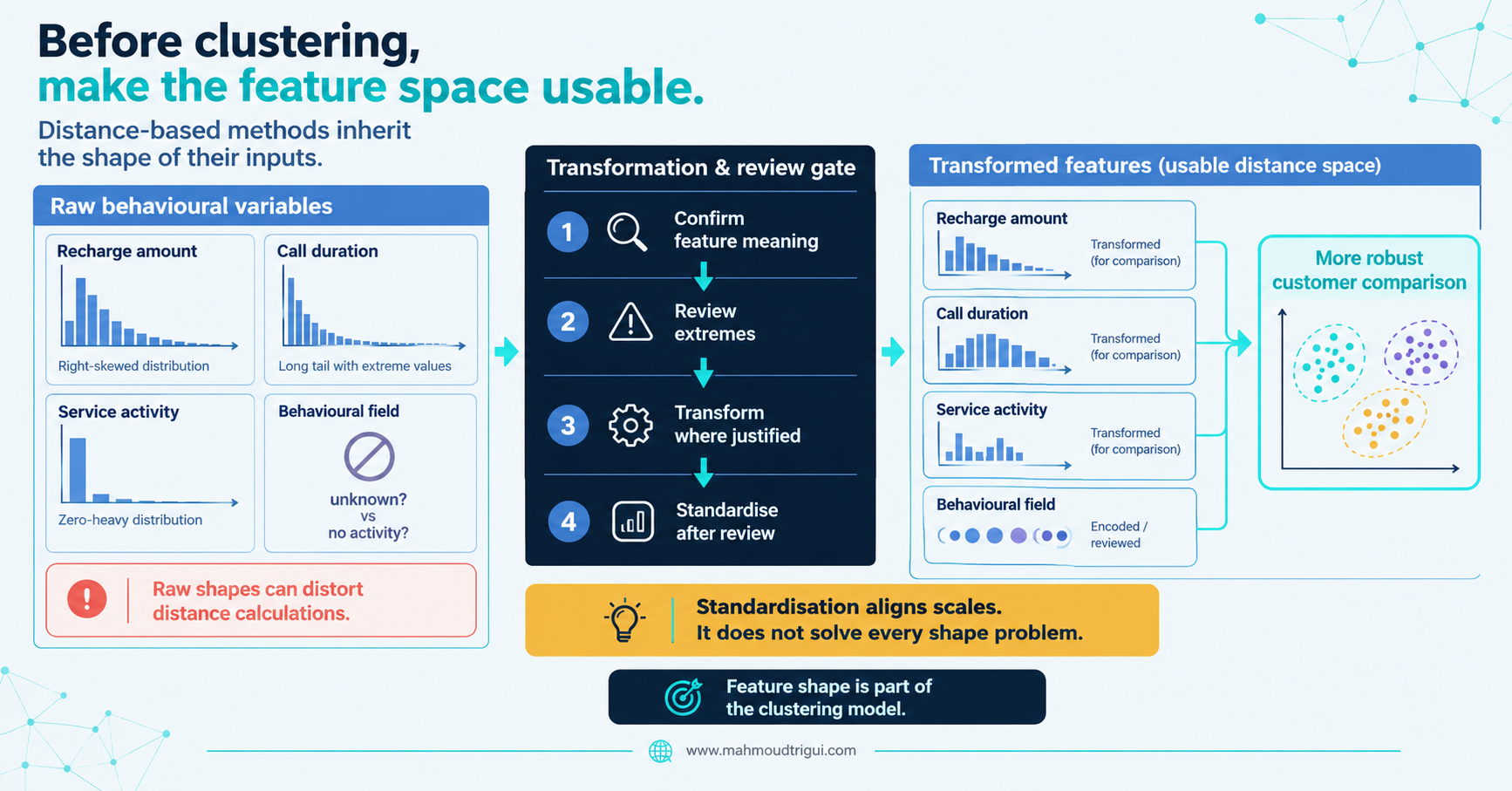
TL;DR: Standardisation aligns scales; it does not solve every shape problem. Prepare the feature space with deliberate decisions about missing values, extremes, and transformations — because distance methods inherit the shape of their inputs, feature shape is part of the clustering model.
The Problem
The difficult part was not selecting a clustering algorithm. It was preparing behavioural variables so that distance-based methods could compare customers meaningfully.
Telecom usage features often have difficult shapes: recharge amounts with long right tails, call durations with extreme values, sparse service-usage variables, zero-heavy activity measures, and behavioural fields where a missing value may actually mean “no activity.”
That matters because methods such as K-means use distance. If a few extreme values dominate the scale, they can dominate the geometry too.
The Approach
Standardisation helps align units — but it does not automatically solve heavy tails, sparse distributions, outliers, or variables whose missing values carry business meaning. So feature preparation required several separate decisions:
Decide whether missing means unknown or genuinely zero
A missing behavioural field may carry meaning. Treating it as unknown versus as “no activity” changes what similarity between customers means.
Review extremes and transform where justified
Cap or review extreme values only where justified, use transformations appropriate to the variable shape, and inspect skewness and tail behaviour before standardising.
Standardise after the semantics are understood
Standardise only after the feature semantics and shape are clear, and remove variables that remain unsuitable for the chosen distance-based representation.
This was not a generic “clean the data” step. It was part of defining what similarity between customers should mean.
Outcome
Before asking whether two variables are redundant, ask the more basic question: can these variables coexist in the same distance space without a few values distorting the result?
In distance-based unsupervised learning, feature shape is not only a preprocessing detail. It is part of the model definition.
Key Takeaway
Design insight: Standardisation aligns scales; it does not solve every shape problem. Prepare the feature space with deliberate decisions about missing values, extremes, and transformations — because distance methods inherit the shape of their inputs, feature shape is part of the clustering model.
Related
Preprocessing Is Vocabulary Design for Noisy NLP Text →Unpack a Categorical Variable Into Behavioural Mechanisms →Customer Segmentation Is Designed, Not Discovered →K-Means as Compression Before Hierarchical Clustering →Turning a Categorical Variable Into Behavioral Signal →isnull() Is a Feature: Missingness as a Signal →Feature Engineering Is Assembling Evidence Across Systems →Encoding Is a Modeling Decision, Not a Checkbox →Don't Ask Your Model to Learn What a Formula Knows →One Row Is a Modelling Decision: Customer or State? →K-Means Reduces the Scale; Hierarchy Explores Structure →
FAQ
What is the key takeaway from "Preparing Feature Spaces for Distance-Based Clustering"?
Standardisation aligns scales; it does not solve every shape problem. Prepare the feature space with deliberate decisions about missing values, extremes, and transformations — because distance methods inherit the shape of their inputs, feature shape is part of the clustering model.
Who wrote this and what is it about?
This was written by Mahmoud Trigui, Senior Data Scientist. Preparing the feature space for clustering: review shapes, extremes, and missing values before distance methods compare customers.