Customer Segmentation Is Designed, Not Discovered
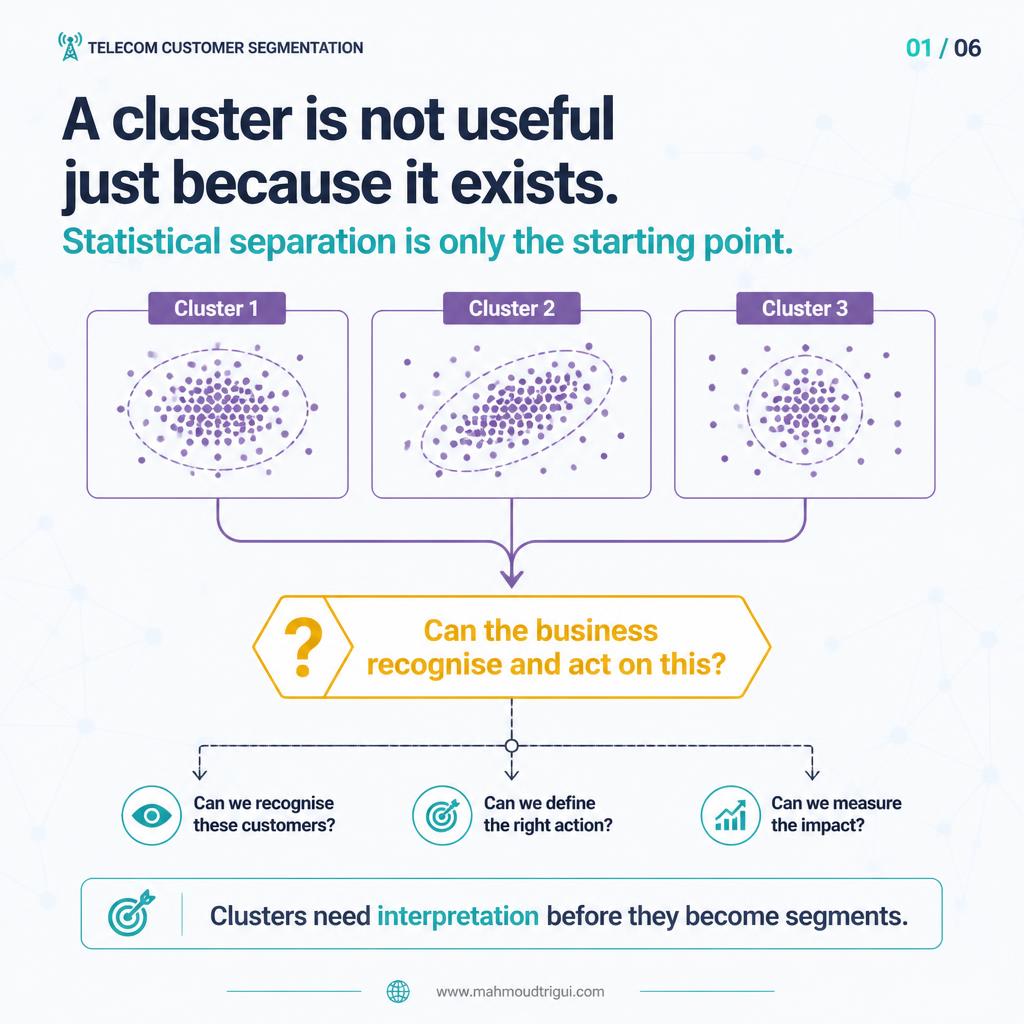
A clustering algorithm can produce groups that are mathematically distinct. But business teams cannot act on Cluster 1, Cluster 2, and Cluster 3 — they need to know who the group is, how it behaves, and what to do with it.
TL;DR: Segmentation iteration is the method, not the overhead. Represent, cluster, profile, rethink, and rebuild until each segment is recognisable, actionable, and stable — otherwise a mathematically distinct cluster is still not a useful segment.
Visual Summary
The Problem
In telecom customer segmentation, the first clustering result is rarely the final answer. A clustering algorithm can produce groups that are mathematically distinct — but business teams cannot act on Cluster 1, Cluster 2, or Cluster 3.
They need to understand: who is this group, how does it behave, and what distinguishes it from the wider base? Is there an appropriate treatment strategy? Is the segment stable enough to use responsibly?
The Approach
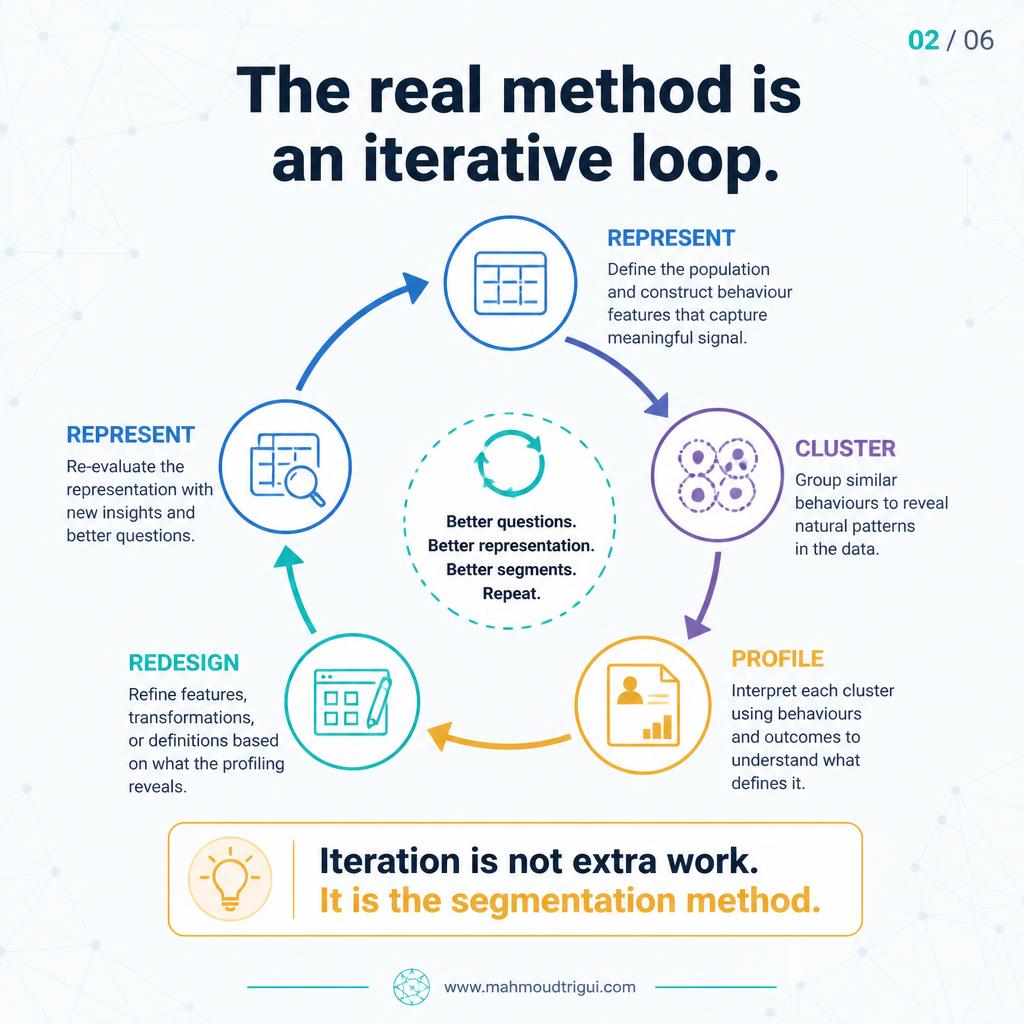
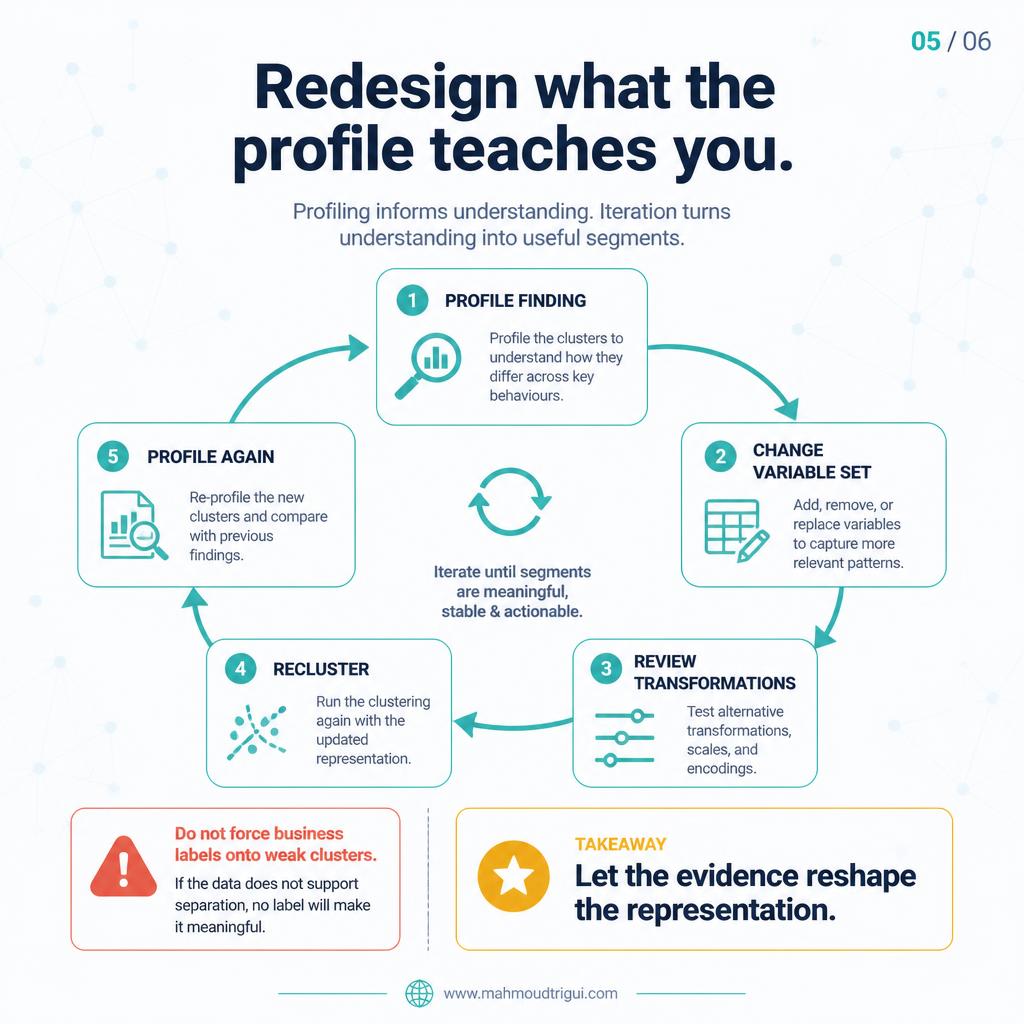
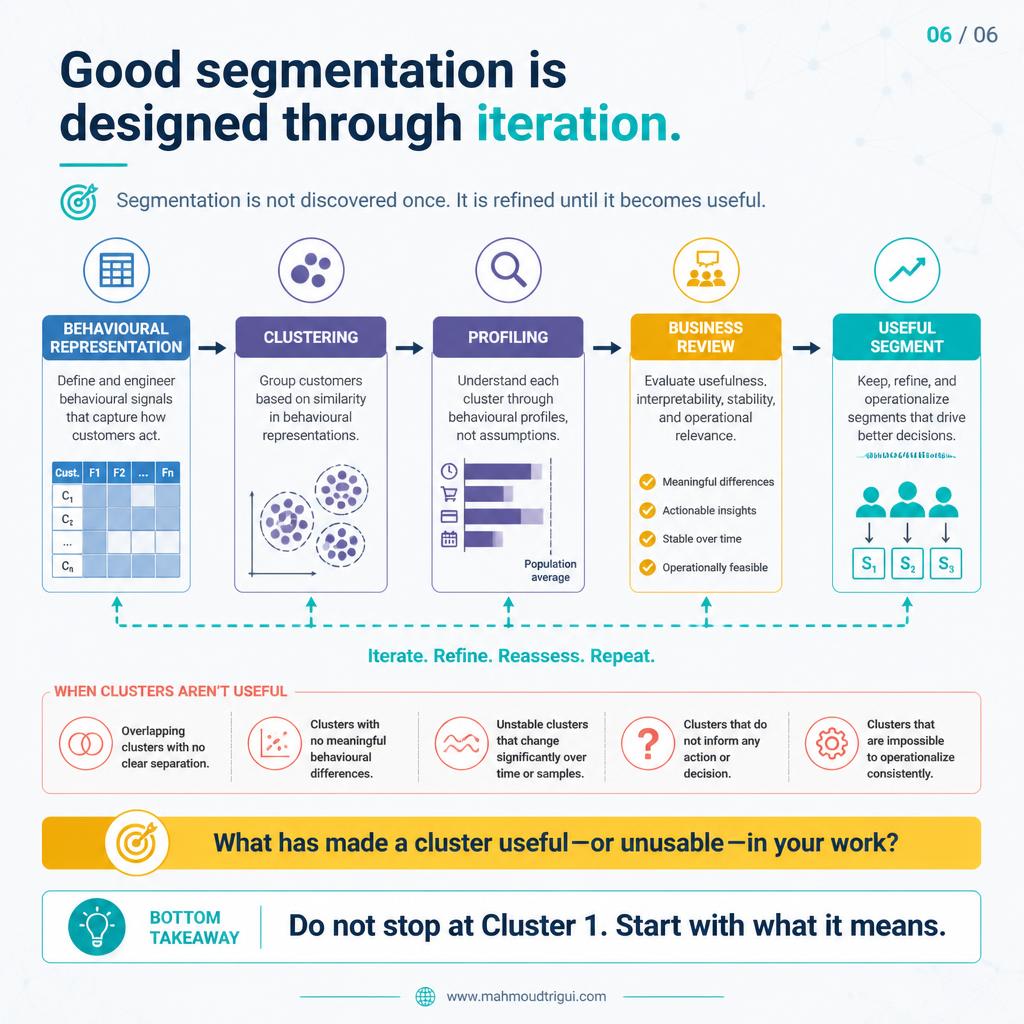
The practical method is an iterative loop: represent → cluster → profile → rethink → rebuild. Each profiling round can reveal issues — variables may represent the wrong behaviour, transformations may distort the distance space, or one cluster may be too broad while two others are operationally identical.
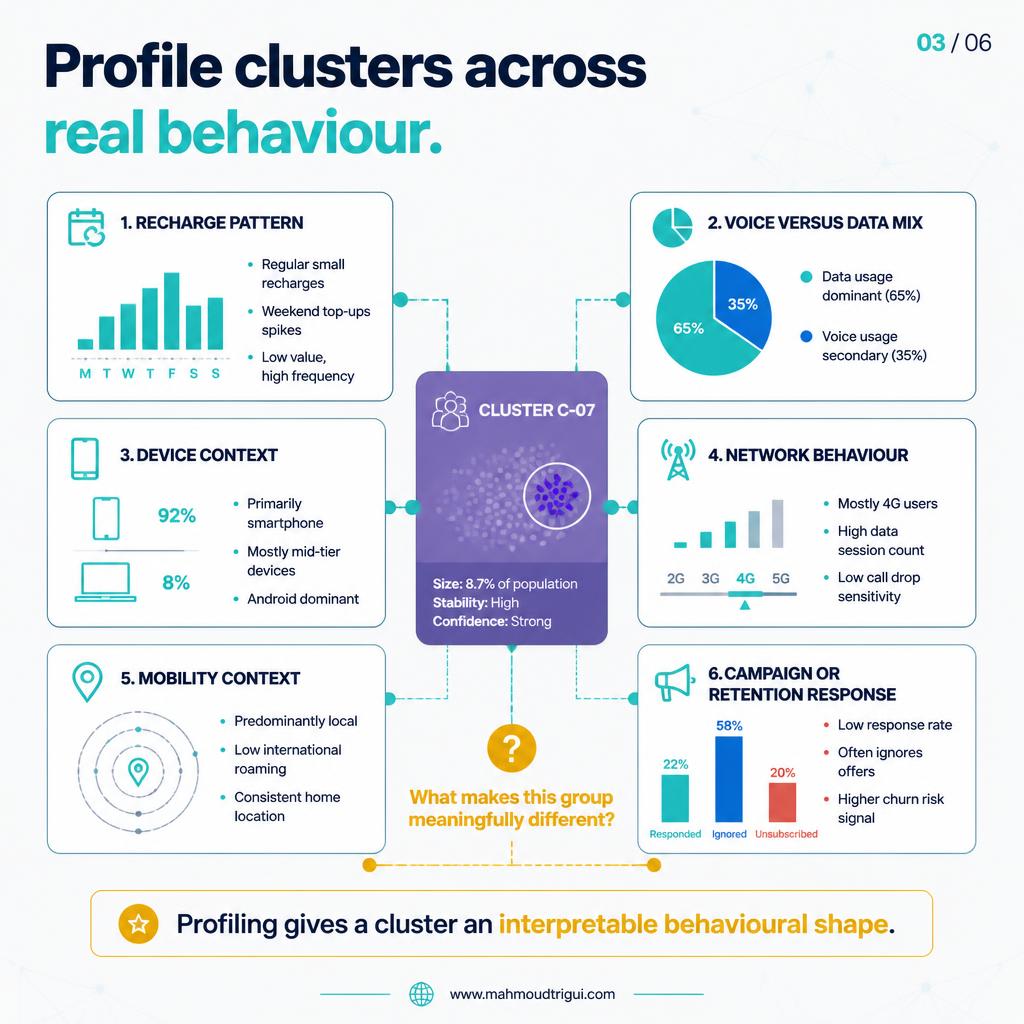
Profile across real behaviour
Profiling considered multiple behavioural dimensions: recharge patterns, voice and data mix, device context, network and community behaviour, geography and mobility, campaign response, and churn or fragility signals.
Let the evidence reshape the representation
The aim was not to force a business label onto every cluster. It was to keep refining the representation until the resulting groups could support a meaningful, approved customer strategy.
Do not force labels onto weak clusters
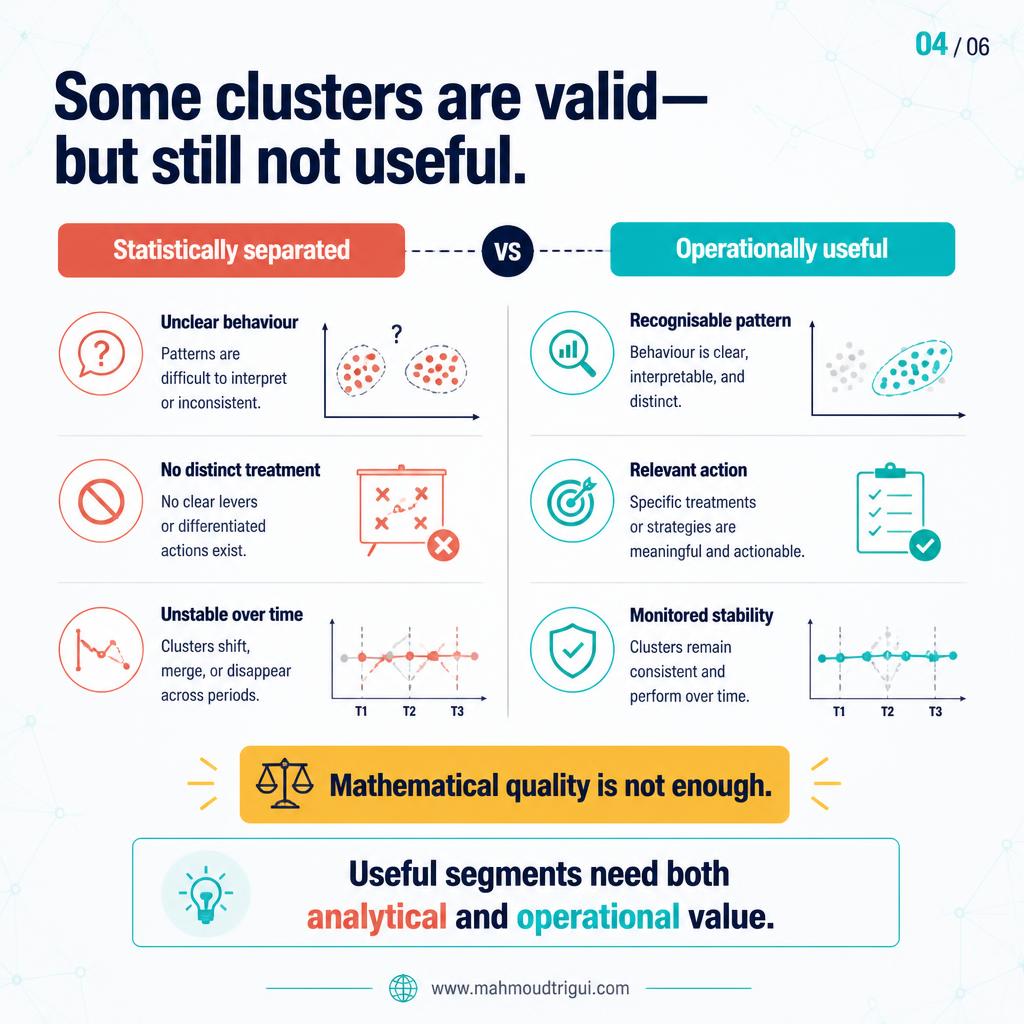
A segment may be statistically separated but operationally unusable — or look useful yet be too unstable over time. Mathematical quality is not enough.
Outcome
Useful segments need both analytical and operational value: a recognisable pattern, a relevant action, and monitored stability.
Good segmentation is not simply “found” by an algorithm. It is designed through repeated profiling, challenge, and redesign — until the resulting groups support a meaningful, approved customer strategy.
Key Takeaway
Design insight: Segmentation iteration is the method, not the overhead. Represent, cluster, profile, rethink, and rebuild until each segment is recognisable, actionable, and stable — otherwise a mathematically distinct cluster is still not a useful segment.
Related
From Cluster to Operational Segment: Assignment First →K-Means as Compression Before Hierarchical Clustering →One Row Is a Modelling Decision: Customer or State? →Households vs Communities: Different Detection Tasks →Cell Tower Dominance Is More Than a Demographic Feature →When the Label Does Not Exist: Define the Behaviour First →Feature Engineering Is Assembling Evidence Across Systems →Not Every Analytics Question Is About What Drives Outcome →
FAQ
What is the key takeaway from "Customer Segmentation Is Designed, Not Discovered"?
Segmentation iteration is the method, not the overhead. Represent, cluster, profile, rethink, and rebuild until each segment is recognisable, actionable, and stable — otherwise a mathematically distinct cluster is still not a useful segment.
Who wrote this and what is it about?
This was written by Mahmoud Trigui, Senior Data Scientist. Customer segmentation is designed, not discovered: iterate representation, clustering, and profiling until each segment is actionable and stable.