From Cluster to Operational Segment: Assignment First
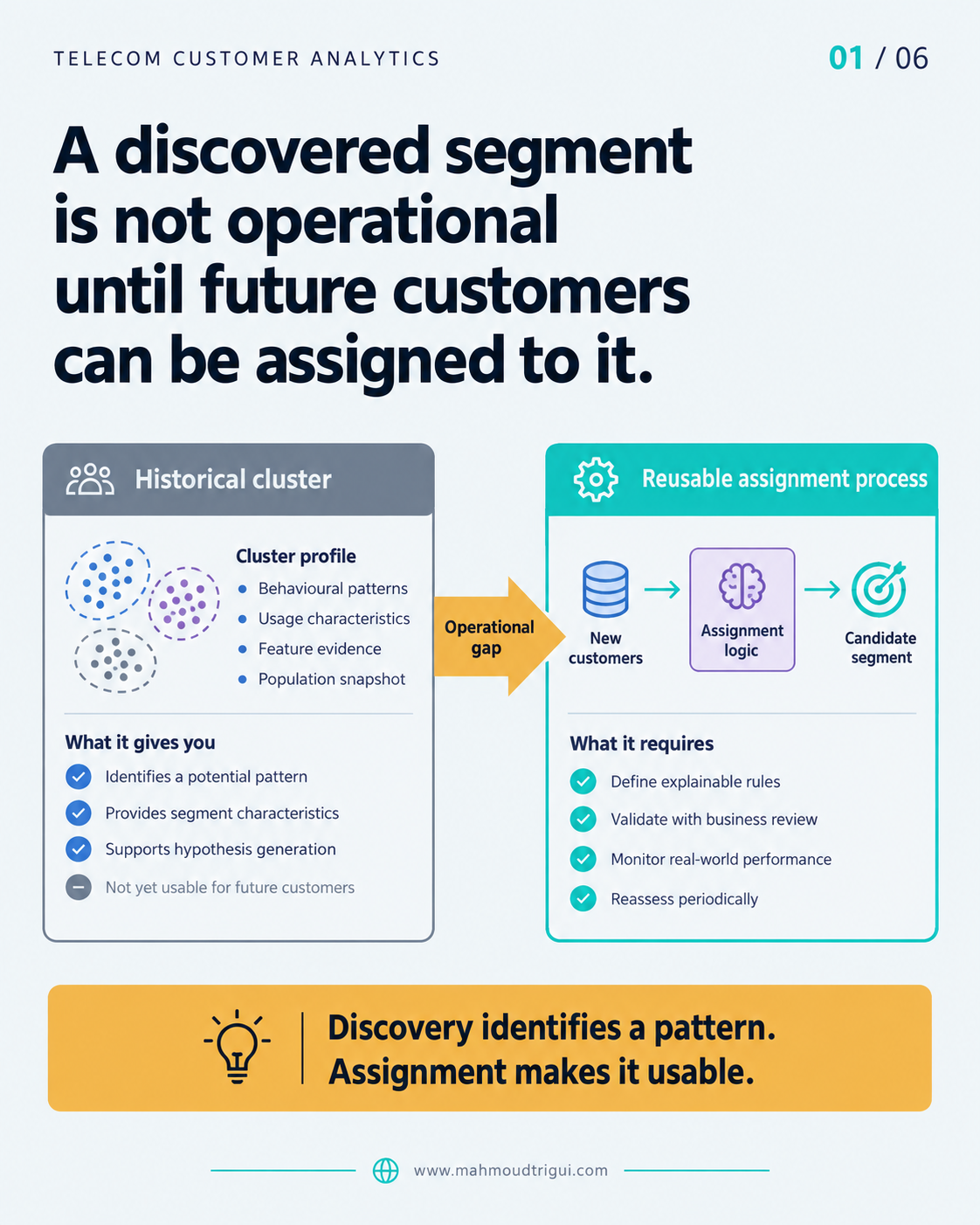
A discovered segment is not operational until future customers can be assigned to it. Discovery identifies a pattern; operationalisation makes it usable.
TL;DR: A discovered cluster is an analytical result, not yet an operating model. To use it, translate the pattern into an explainable assignment process — interpretable conditions derived from feature profiling, then governance, monitoring, and an agreed business use. Discovery identifies a pattern; operationalisation makes it usable — never confuse a historical cluster with permanent truth.
Visual Summary
The Problem
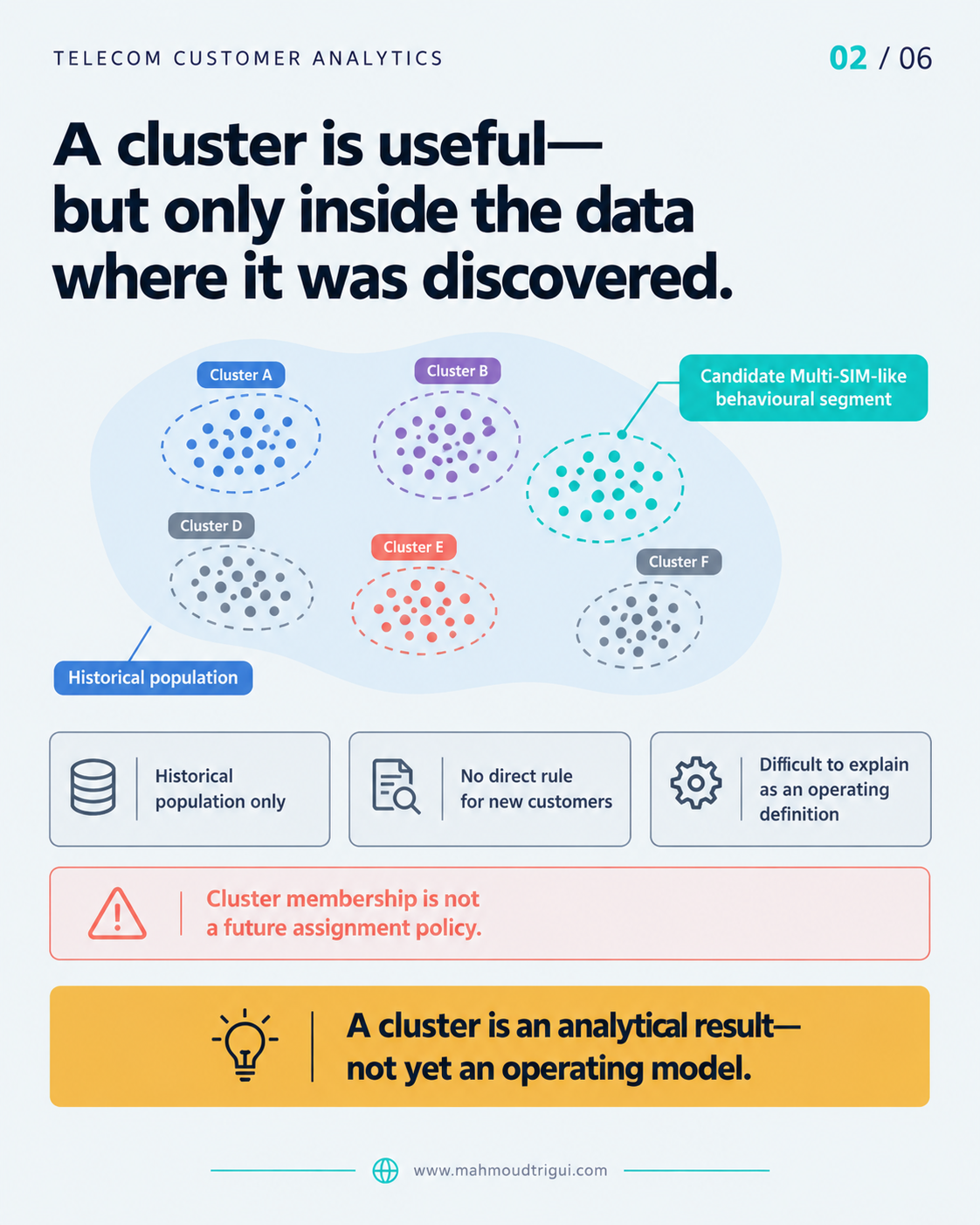
In a telecom Multi-SIM project, unsupervised segmentation helped identify a cluster that resembled a possible secondary-SIM behaviour pattern. That answered one question: where might the latent pattern be?
But it did not answer the next one: how can future customers be assessed consistently at scale? A cluster is a result inside one historical population — it does not automatically provide a clear operating definition for new customers, new periods, or changing behaviour.
The Approach
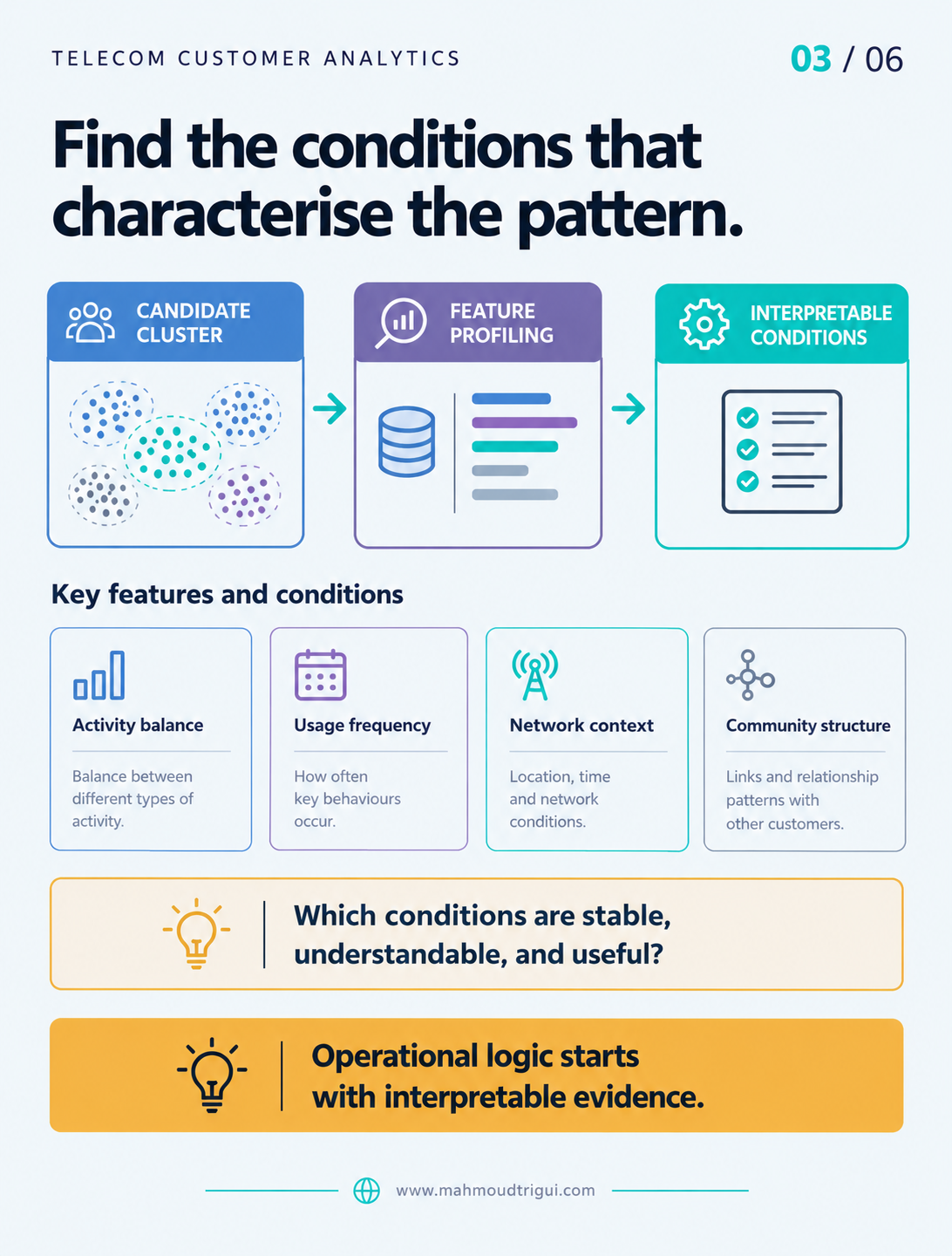
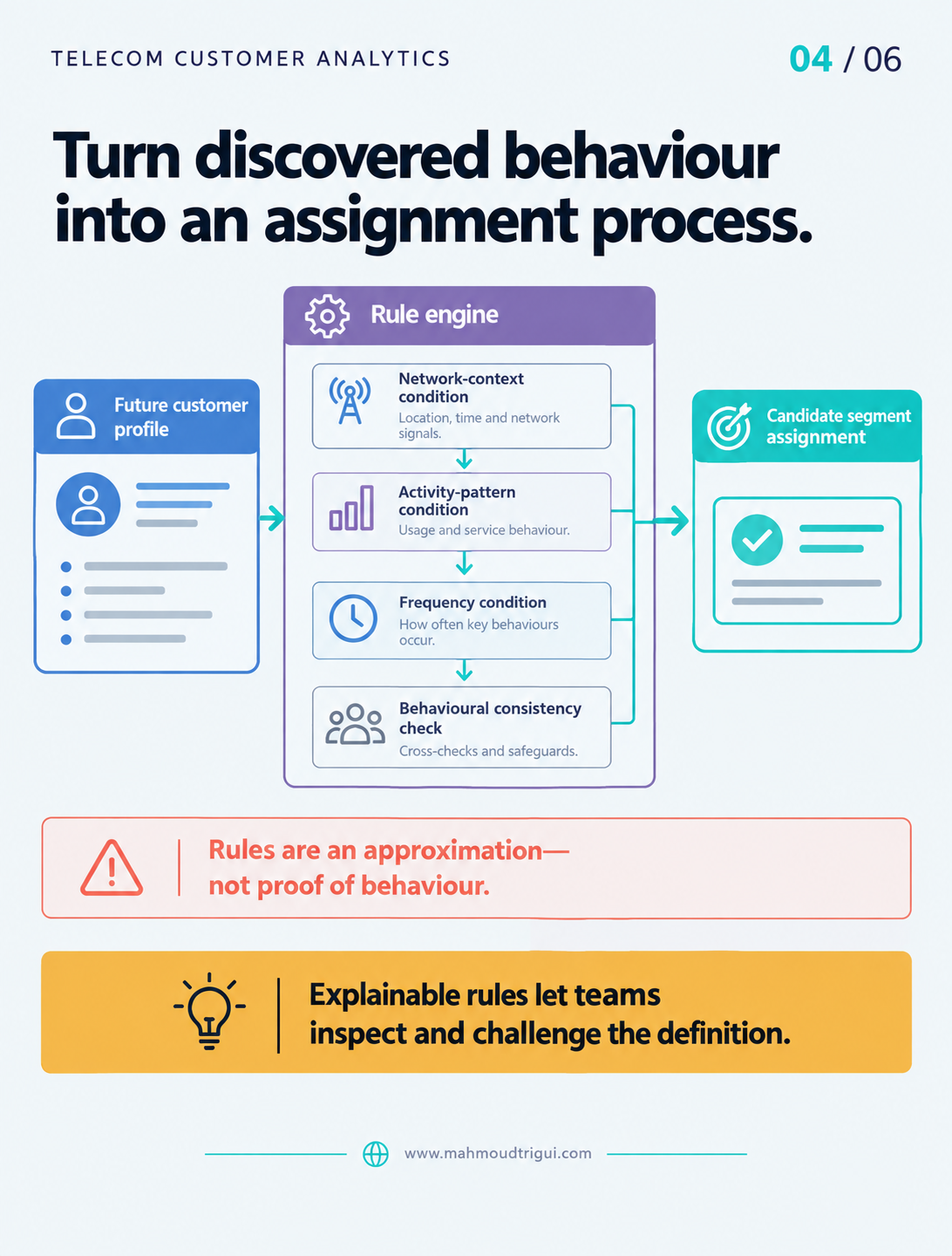
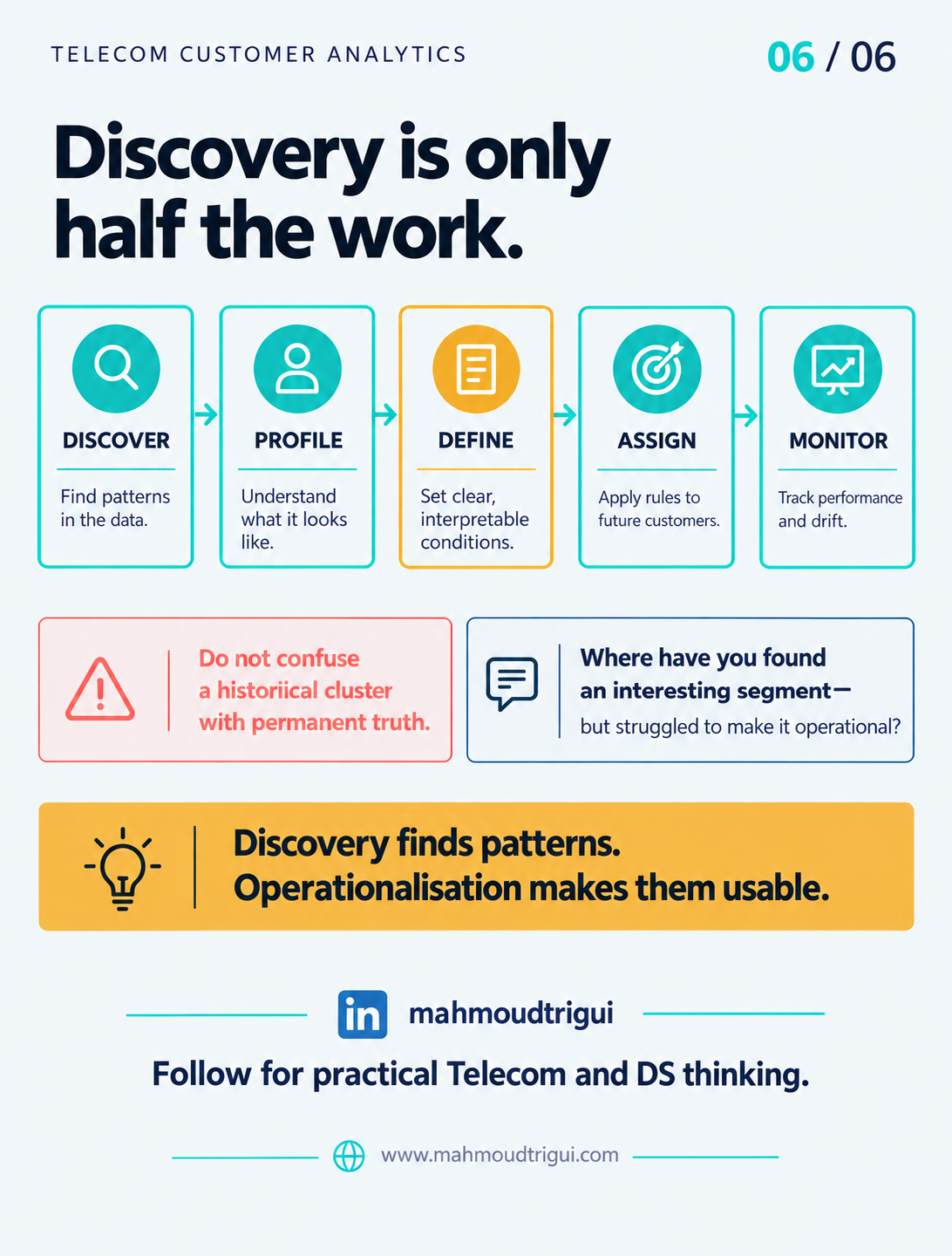
The next step was to translate the discovered pattern into explainable assignment logic: identify the features that best characterise the candidate segment and express them through interpretable conditions.
Feature profiling first
Find which conditions best characterise the candidate pattern — activity-balance patterns, network-context conditions, usage-frequency patterns, and community-structure signals.
Interpretable conditions, not cluster geometry
The purpose was not to perfectly reproduce the geometry of the original cluster. It was to create a practical definition that business teams can review.
Rules are an approximation
A rule set is not proof of behaviour — it is an operating approximation that must be applied, monitored, and challenged when behaviour changes.
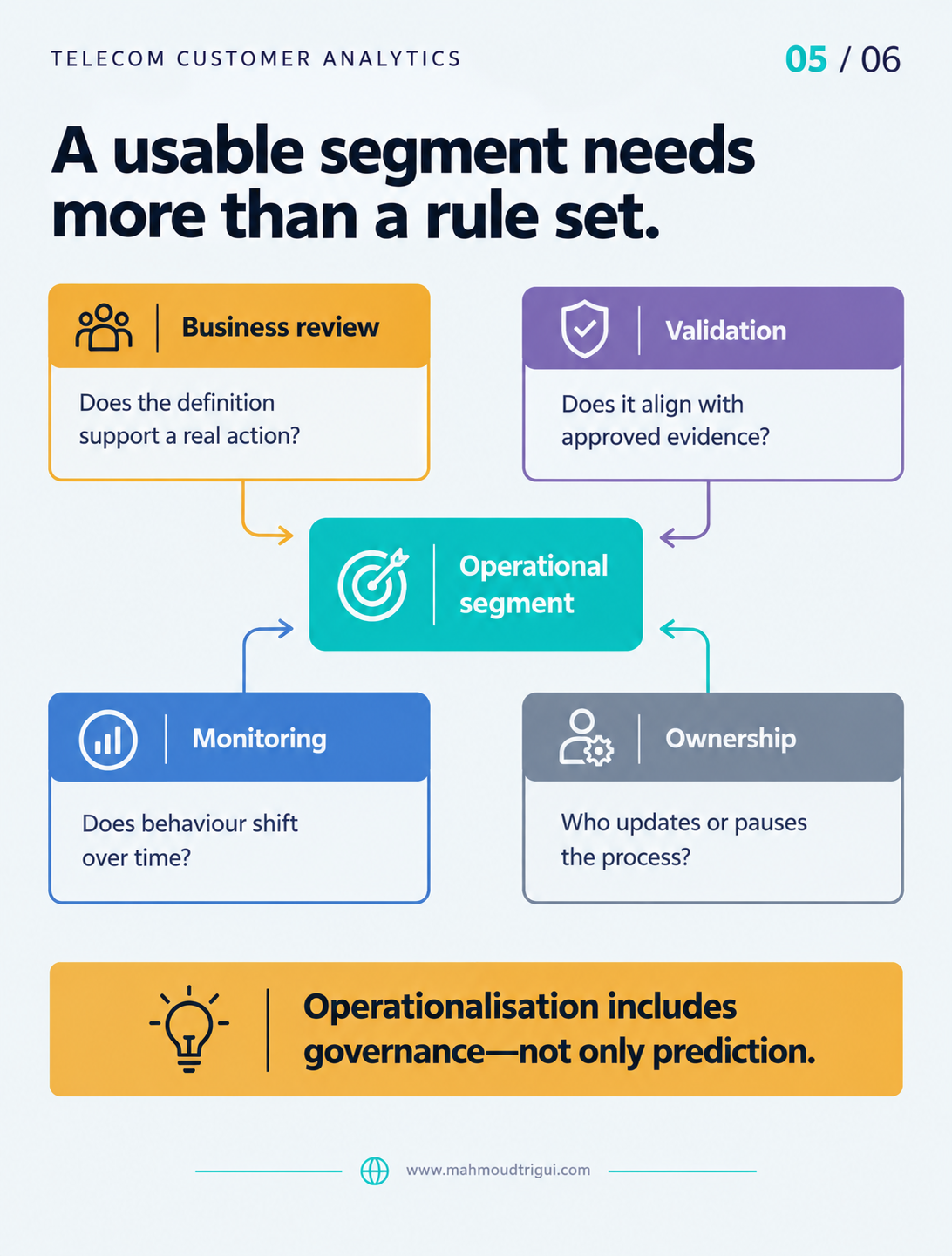
The resulting definition could be reviewed by business teams, applied to future customers, monitored over time, challenged when behaviour changed, and updated when evidence improved.
Outcome
This is an important distinction in segmentation. A discovered cluster can be analytically interesting, but an operational segment needs an assignment process — and that process needs more than model performance.
It needs explainability, governance, monitoring, and an agreed business use. Discovery identifies a pattern; operationalisation makes it usable.
Key Takeaway
Design insight: A discovered cluster is an analytical result, not yet an operating model. To use it, translate the pattern into an explainable assignment process — interpretable conditions derived from feature profiling, then governance, monitoring, and an agreed business use. Discovery identifies a pattern; operationalisation makes it usable — never confuse a historical cluster with permanent truth.
Related
When the Label Does Not Exist: Define the Behaviour First →One Row Is a Modelling Decision: Customer or State? →Feature Engineering Is Assembling Evidence Across Systems →K-Means as Compression Before Hierarchical Clustering →Households vs Communities: Different Detection Tasks →Cell Tower Dominance Is More Than a Demographic Feature →Not Every Analytics Question Is About What Drives Outcome →Adversarial Validation: Detect Data Shift Before It Hurts →
FAQ
What is the key takeaway from "From Cluster to Operational Segment: Assignment First"?
A discovered cluster is an analytical result, not yet an operating model. To use it, translate the pattern into an explainable assignment process — interpretable conditions derived from feature profiling, then governance, monitoring, and an agreed business use. Discovery identifies a pattern; operationalisation makes it usable — never confuse a historical cluster with permanent truth.
Who wrote this and what is it about?
This was written by Mahmoud Trigui, Senior Data Scientist. A discovered cluster is not operational until future customers can be assigned to it — translate it into explainable, monitored assignment rules.