When the Label Does Not Exist: Define the Behaviour First
Some ML projects begin before a target exists. Start with a behavioural hypothesis, discover patterns with clustering, then validate and assign.
TL;DR: When no reliable label exists, the ML workflow changes: start from a behavioural hypothesis, design features across multiple data domains, use unsupervised clustering as a discovery tool, profile and validate the candidate against approved business evidence, then translate it into an explainable, operationally assignable segment under governance. A cluster can reveal a useful behavioural shape without proving the underlying reality — the target is sometimes a discovery process, not a column.
Visual Summary
The Problem
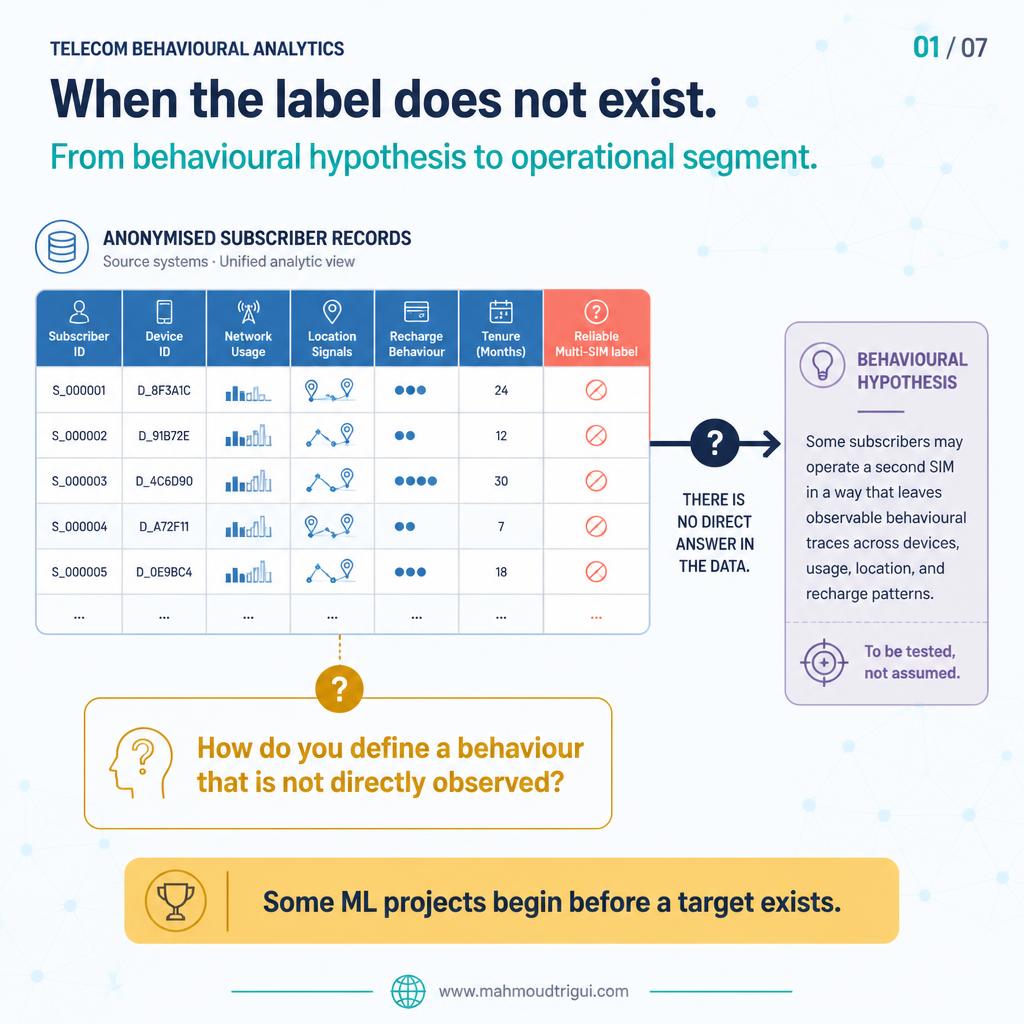
In a telecom Multi-SIM project, there was no clean column saying "This subscriber uses more than one SIM." The behaviour was not directly observed. So the project could not begin with a standard supervised-learning workflow — it started with a behavioural hypothesis.
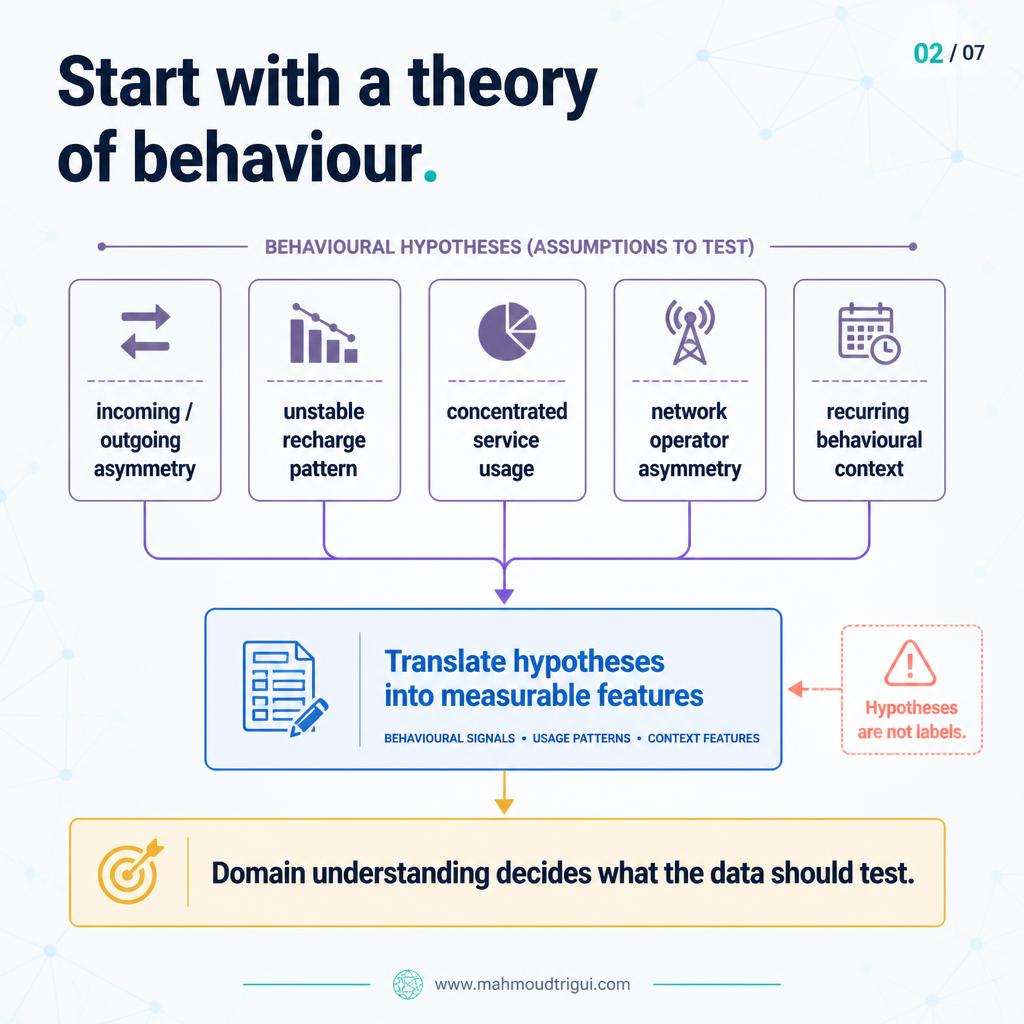
What might secondary-SIM behaviour look like in approved telecom usage data? Potential signals included asymmetry between incoming and outgoing activity, recharge and usage instability, concentration on specific services, operator mix inside a communication community, network patterns suggesting activity spread across different operators, and device and location context, interpreted carefully.
Those were not labels. They were hypotheses to test.
The Approach
Build a multi-source behavioural table and use unsupervised segmentation to identify clusters that most resemble the expected pattern. But clustering was not the final answer — a cluster can reveal a useful behavioural shape without proving the underlying customer reality.
Start with a theory of behaviour
Before any modelling, decide what the data should test: domain understanding drives the hypotheses that become measurable features.
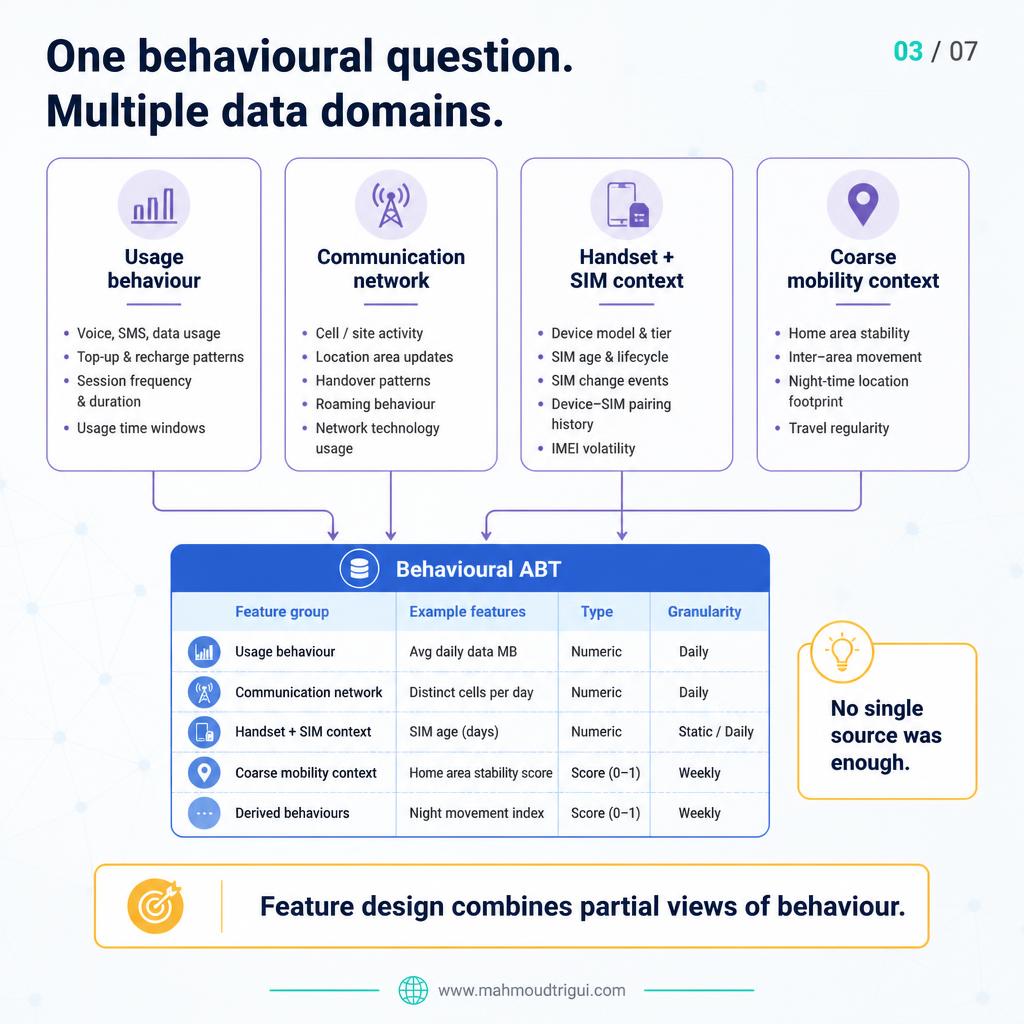
Combine partial views of behaviour
One source is rarely enough. Usage behaviour, communication network, handset and SIM context, and coarse mobility context feed a single behavioural table.
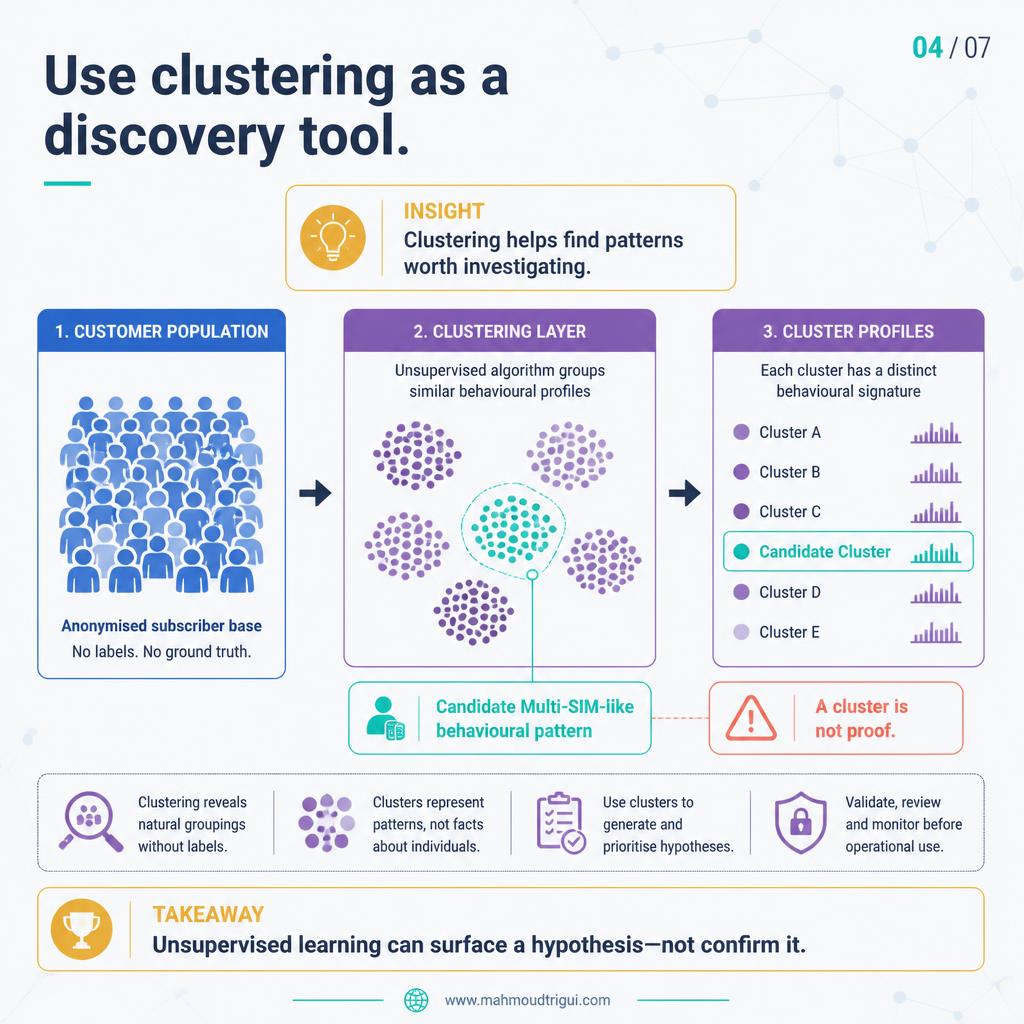
Use clustering as a discovery tool
Unsupervised segmentation surfaces a pattern worth investigating — not confirmed truth. A cluster is evidence of shape, never proof of reality.
Profile and validate the candidate
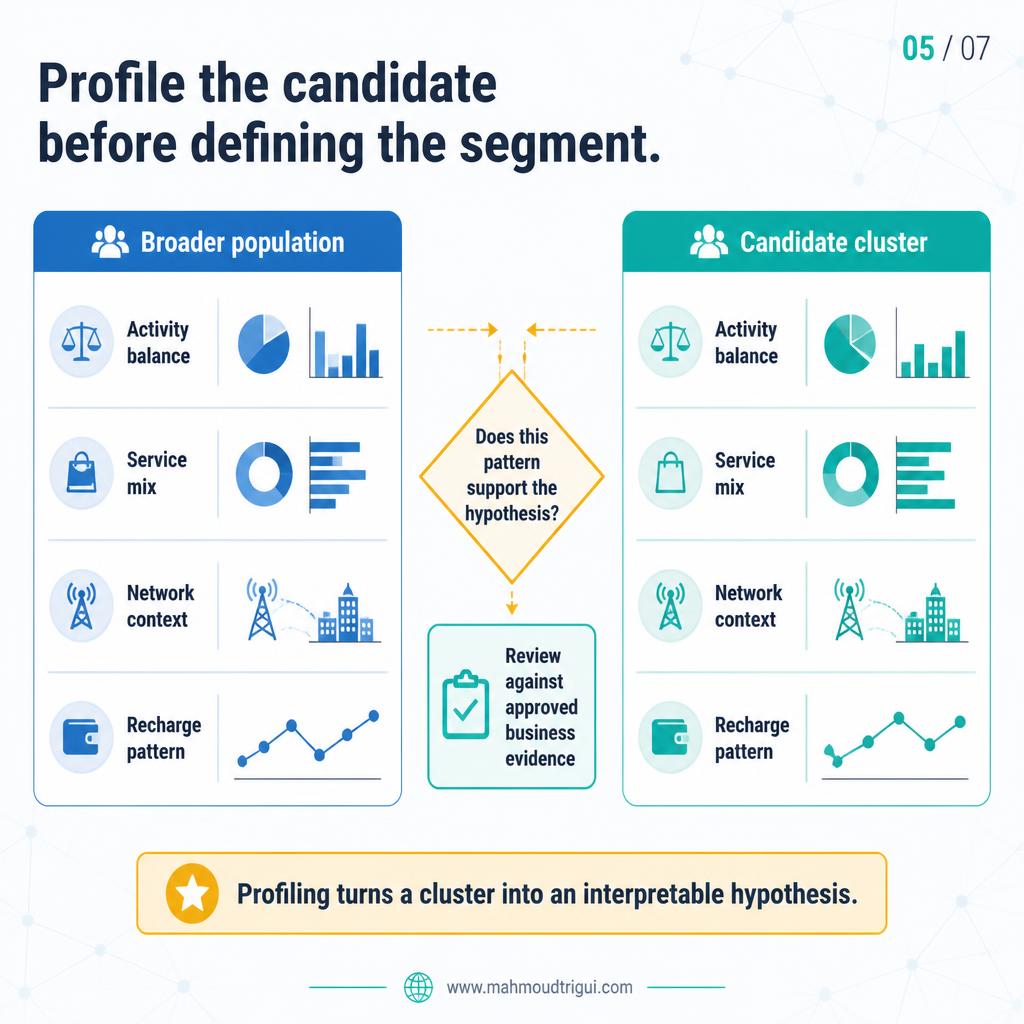
Compare the candidate cluster with the broader population, find the discriminative variables, check the pattern against approved business evidence, and confirm it makes business sense.
Assign with explainable rules
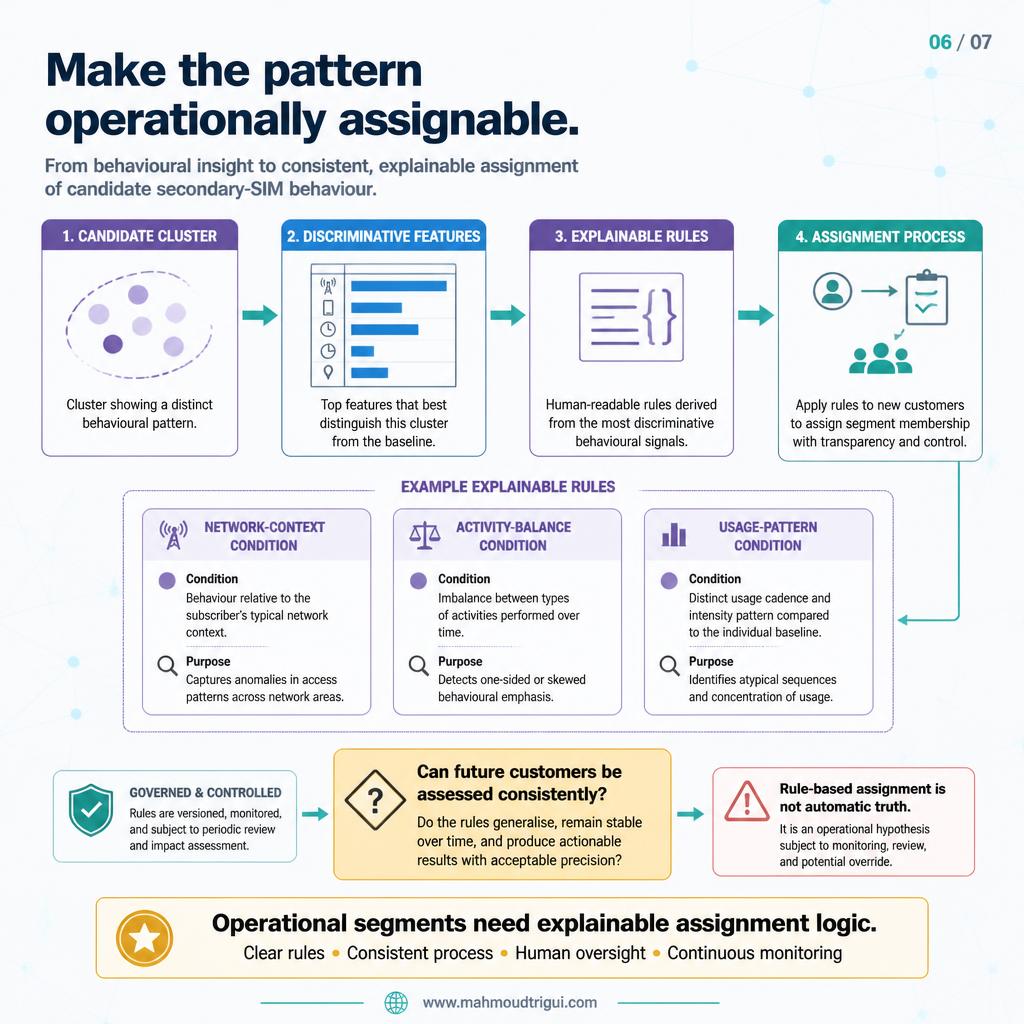
Translate discriminative features into a stable assignment process that can assess future customers consistently. Rule-based assignment is not automatic truth.
The output was not "ground truth created by an algorithm." It was a more operational definition of a Multi-SIM-like behavioural segment — one that could be assessed, challenged, and applied to future customers under appropriate governance.
Outcome
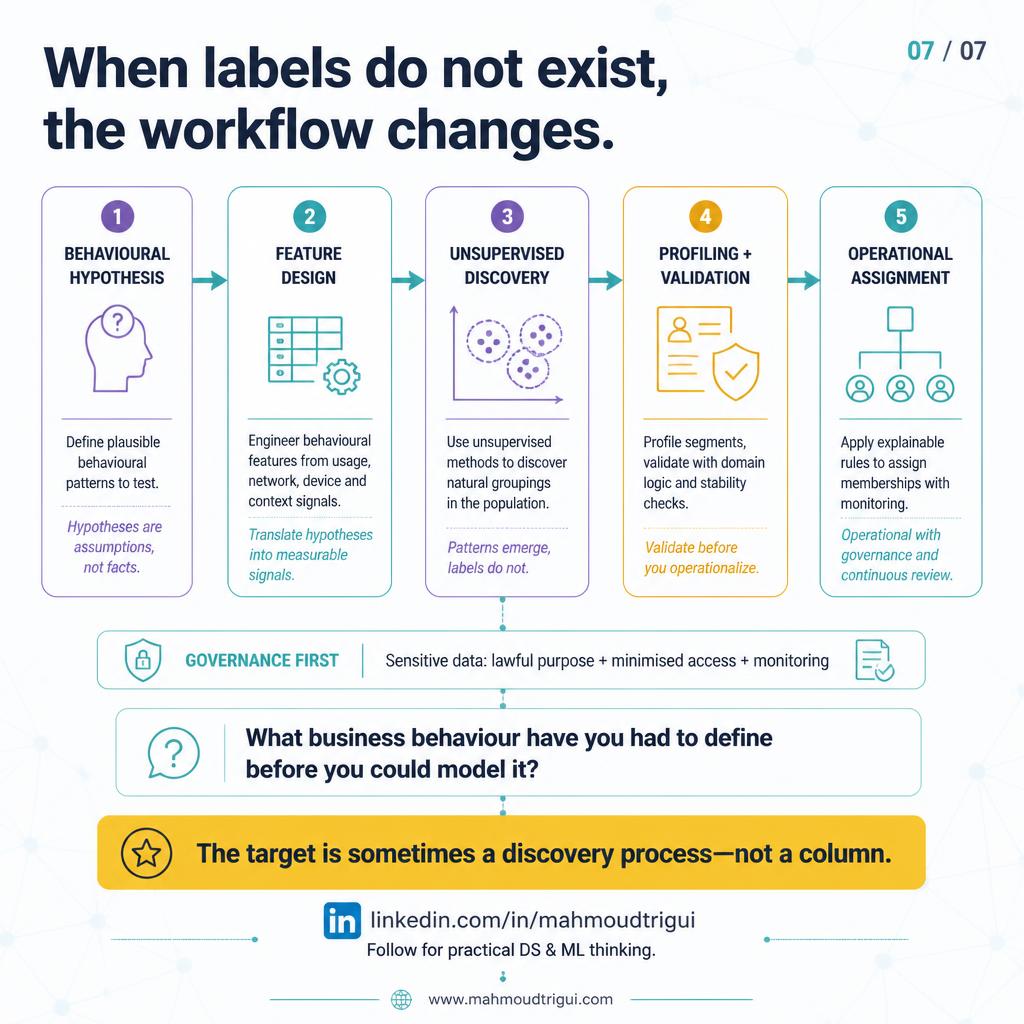
In applied ML, the target is not always a column you receive. Sometimes the real workflow is: behavioural hypothesis, feature design, unsupervised discovery, profiling and validation, and operational assignment.
The difficult part is not only training a model. It is defining a useful business object when the world does not provide a clean label.
Key Takeaway
Design insight: When no reliable label exists, the ML workflow changes: start from a behavioural hypothesis, design features across multiple data domains, use unsupervised clustering as a discovery tool, profile and validate the candidate against approved business evidence, then translate it into an explainable, operationally assignable segment under governance. A cluster can reveal a useful behavioural shape without proving the underlying reality — the target is sometimes a discovery process, not a column.
Related
Households vs Communities: Different Detection Tasks →Cell Tower Dominance Is More Than a Demographic Feature →Turning a Categorical Variable Into Behavioral Signal →K-Means as Compression Before Hierarchical Clustering →Don't Ask Your Model to Learn What a Formula Knows →Adversarial Validation: Detect Data Shift Before It Hurts →isnull() Is a Feature — Missingness as a Signal →Categorical Encoding Cheat Sheet for Tabular ML →
FAQ
What is the key takeaway from "When the Label Does Not Exist: Define the Behaviour First"?
When no reliable label exists, the ML workflow changes: start from a behavioural hypothesis, design features across multiple data domains, use unsupervised clustering as a discovery tool, profile and validate the candidate against approved business evidence, then translate it into an explainable, operationally assignable segment under governance. A cluster can reveal a useful behavioural shape without proving the underlying reality — the target is sometimes a discovery process, not a column.
Who wrote this and what is it about?
This was written by Mahmoud Trigui, Senior Data Scientist. No reliable label? Start from a behavioural hypothesis, discover patterns with clustering, validate by profiling, then assign with explainable rules.