Route Structurally Inactive Series Before Forecasting
Some time series should be routed before forecasting - not learned by the forecasting model: a long zero tail can mean several different things.
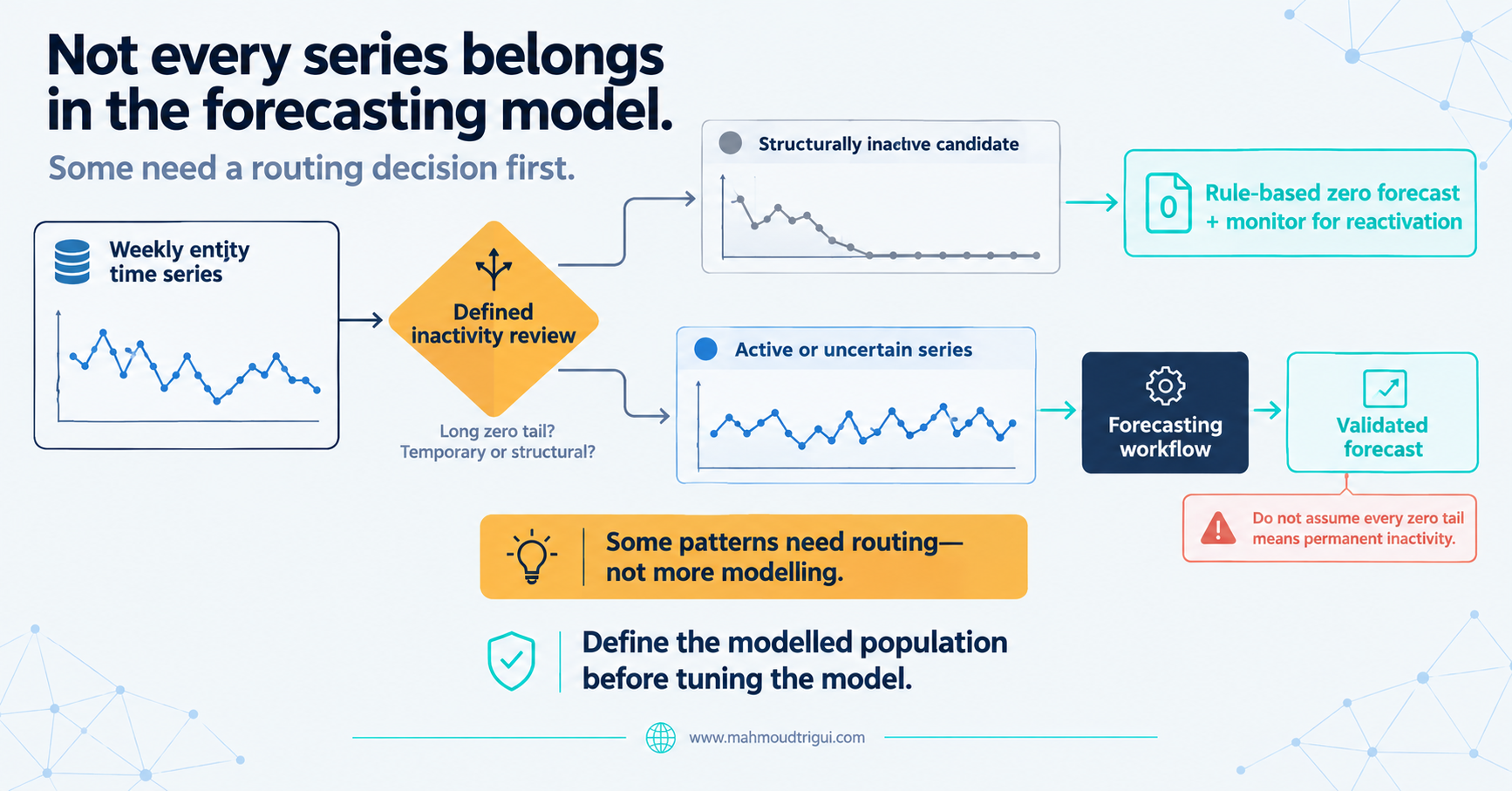
TL;DR: Some time series should be routed before forecasting, not learned by the forecasting model. When an entity meets a carefully defined inactivity rule, route it outside the active forecasting path to a deterministic zero forecast that stays under monitoring — a zero tail may still be temporary, so the routing definition needs domain review, backtesting, and monitoring for reactivation.
The Problem
In a weekly forecasting pipeline, some entities had long runs of zero activity. The important question was not "Can the model learn this pattern?" but "Is this still an active forecasting problem?"
A long zero tail can mean different things: temporary inactivity, delayed reporting, a seasonal pause, product discontinuation, customer churn, or a structurally inactive entity. Those situations should not automatically be treated the same.
The Approach
When an entity met a carefully defined inactivity rule, I routed it outside the active forecasting path. The pipeline split into two clear routes:
Structurally inactive entities
Deterministic zero forecast, subject to monitoring.
Active or uncertain entities
Normal forecasting workflow.
The routing definition matters: a zero tail can still be temporary, so the rule needs domain review, backtesting, and monitoring for reactivation. If one model has to learn both active demand patterns and structurally inactive series, it is solving two different problems at once — and that makes the active-series forecasting task less clear.
Outcome
The active-series forecasting task became clearer. Before adding another feature, ask whether the case still belongs in the modelled population.
Some cases do not need a more sophisticated prediction — they need a different route.
Key Takeaway
Design insight: Some time series should be routed before forecasting — not learned by the forecasting model. Before adding another feature, ask whether the case still belongs in the modelled population: a long zero tail can mean temporary inactivity, delayed reporting, a seasonal pause, product discontinuation, or churn. When a defined inactivity rule is met, a monitored deterministic zero forecast beats forcing one model to solve active demand and structural inactivity at once.
Related
Hard Constraints Belong in the Architecture, Not Preferences →The Hardest Forecasting Decision Is Not Which Model to Use →Zero-Shot Forecasting Changes the Baseline →Foundation Models Raise the Baseline →Conformal Prediction: When the Model Is Uncertain →Adversarial Validation: Detect Data Shift Before Your Model Fails →The Most Dangerous Label in ML Is the One That Looks Correct →isnull() Is a Feature →MLforecast Made Me Rewrite My Forecasting Pipeline →
FAQ
Why route inactive series before forecasting?
A long zero tail can mean temporary inactivity, delayed reporting, a seasonal pause, product discontinuation, or churn. If one model has to learn both active demand patterns and structurally inactive series, it is solving two different problems at once - which makes the active-series forecasting task less clear.
How do you handle structurally inactive series?
When an entity meets a carefully defined inactivity rule, route it outside the active forecasting path to a deterministic zero forecast subject to monitoring. Active or uncertain entities keep the normal forecasting workflow.