Late Fusion for Multimodal Data: Represent Every Modality Well
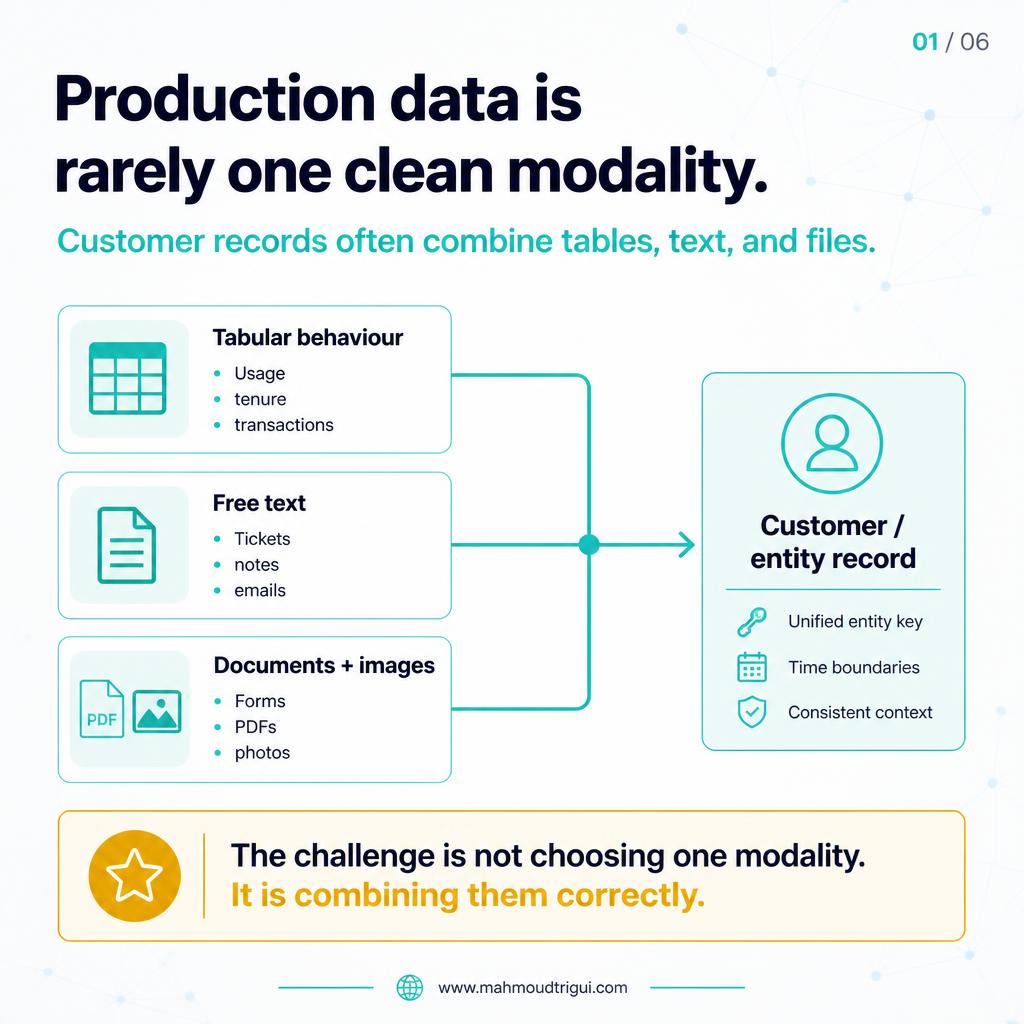
Production data is rarely one clean modality. A customer or business record can combine tabular behaviour, free text, documents, and images — all linked to the same entity over time. The practical challenge is not which modality is best, but how to represent each one well enough to combine it safely.
TL;DR: Add multimodal data without breaking your model. Keep structured data structured, turn text into measurable signals, turn documents and images into structured outputs, then align every signal to the correct entity and prediction timestamp. Fuse only the branches that improve the real production baseline.
Visual Summary
The Problem
Tutorials often isolate one clean modality. Production data rarely does. A real customer or business record may contain tabular behaviour (usage, tenure, transactions), free-text tickets, notes or emails, and documents, images, or uploaded files — all linked to the same entity over time.
The practical challenge is not “which modality is best?” It is “how do we represent each modality well enough to combine it safely?” Forcing everything into one end-to-end fusion model too early is hard to debug, validate, monitor, and improve — especially when data is limited and some records are missing modalities.
The Approach
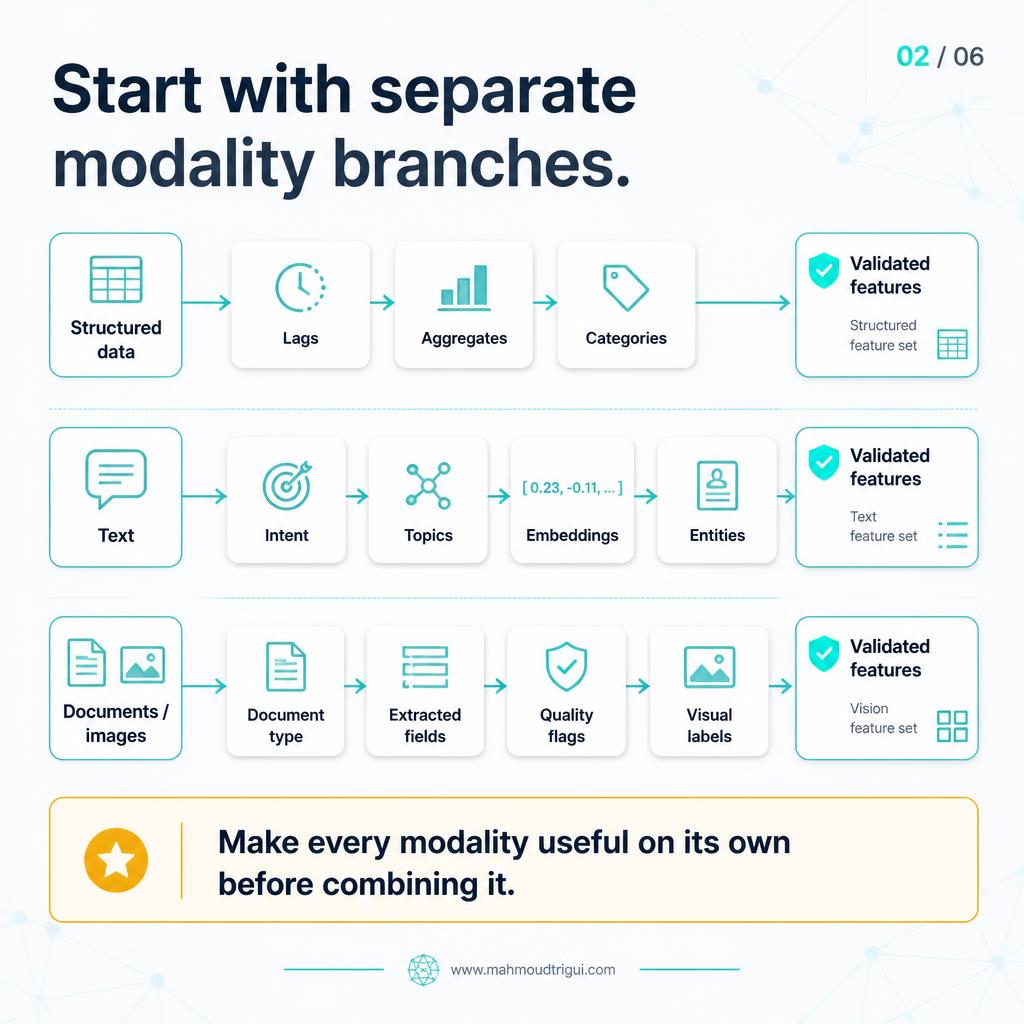
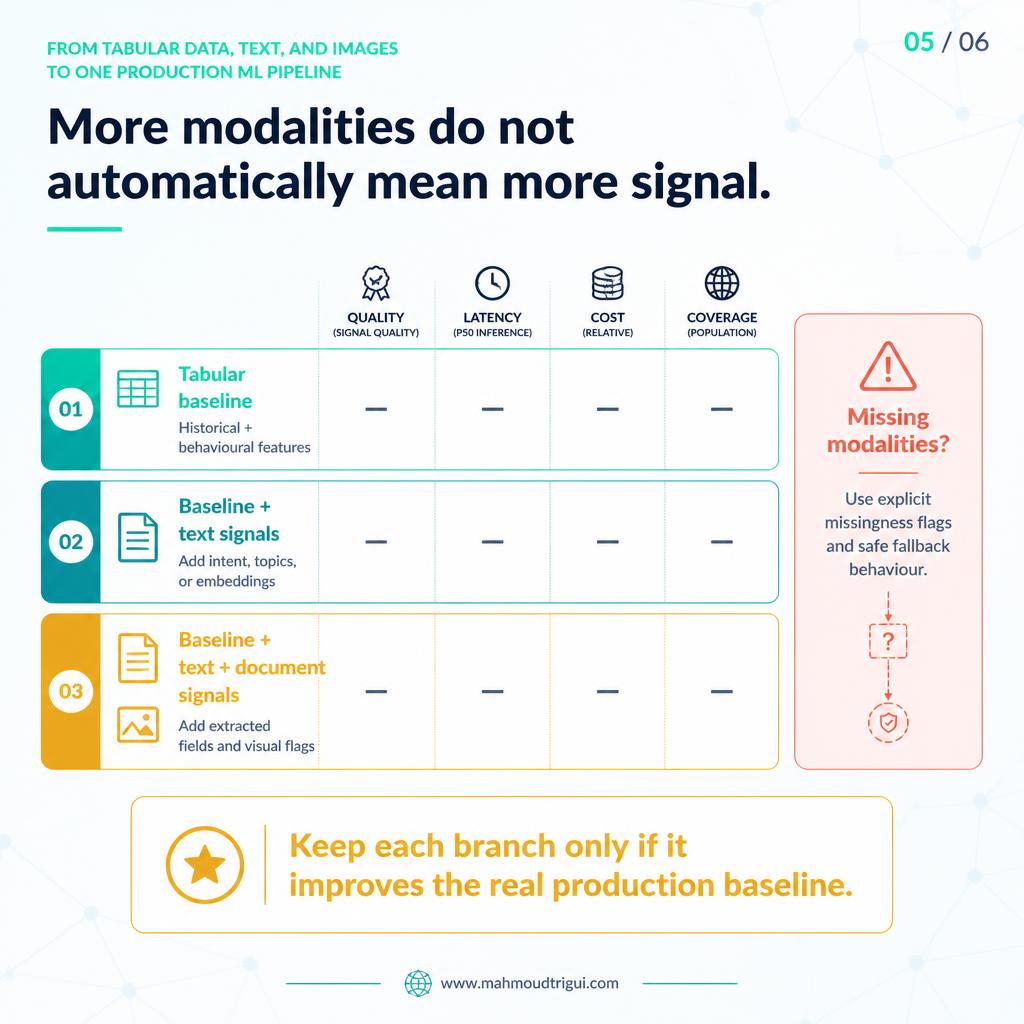
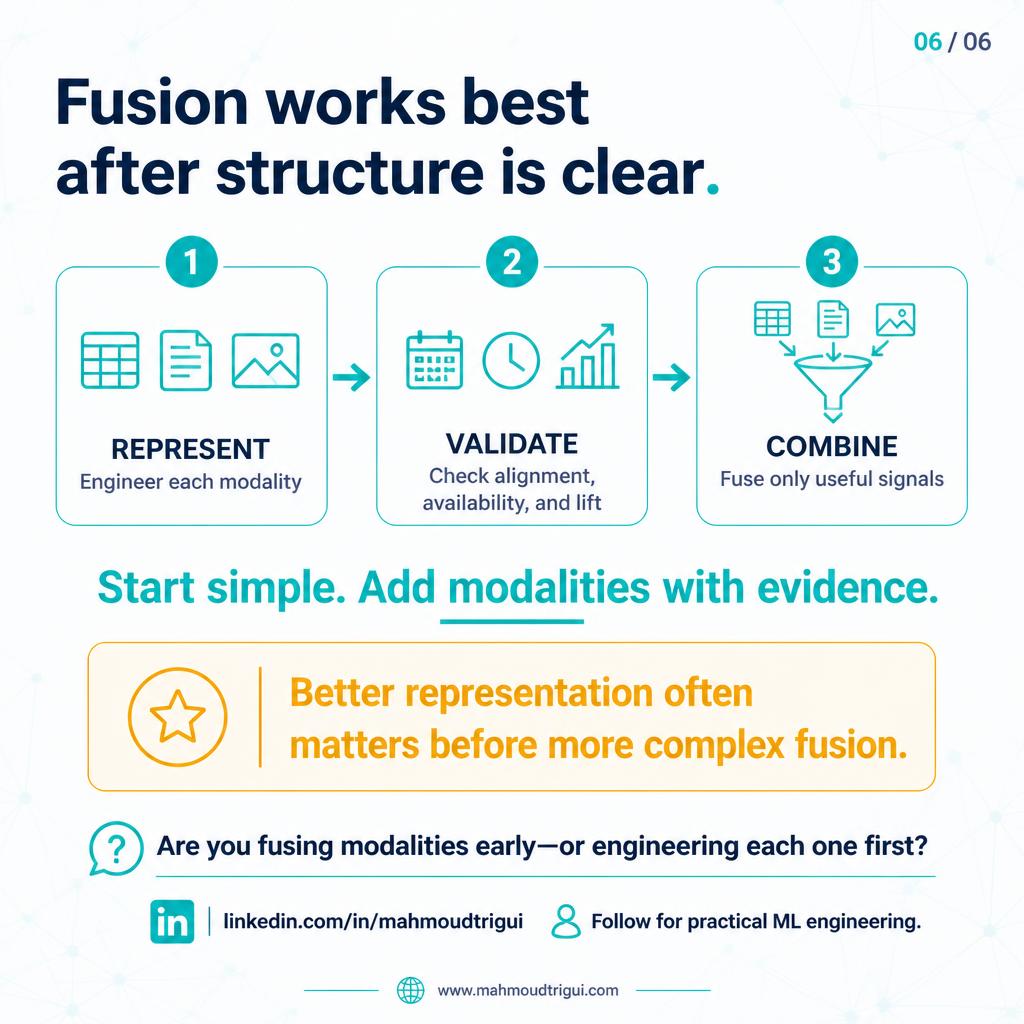
The pattern I prefer is to start with separate branches — one per modality — and only combine them once each branch is a validated, structured signal.
Keep structured data structured
Numerical, categorical, lag, and aggregate features stay in the proven tabular pipeline. No need to force them through a text or image model first.
Turn text into measurable signals
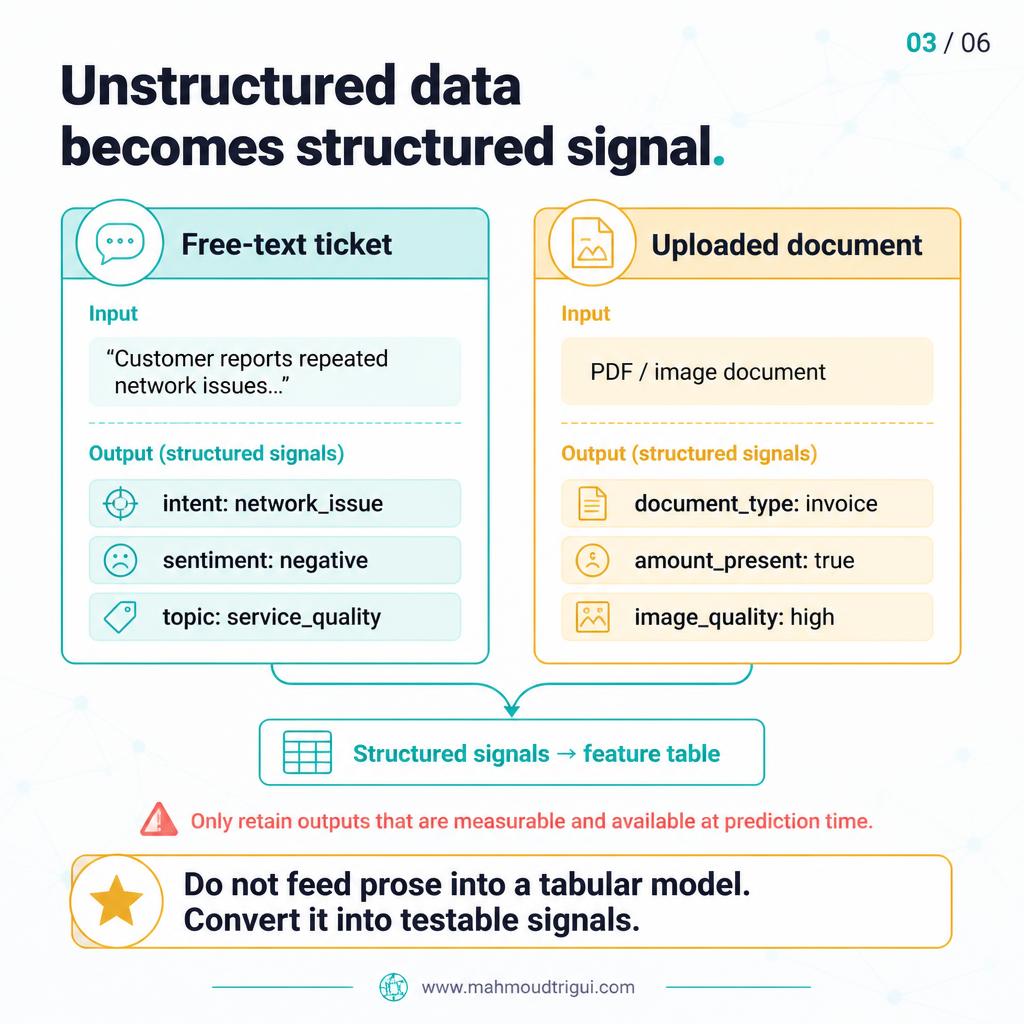
Start simple: keyword or topic indicators, sentiment or intent labels, embeddings, extracted entities, or semantic categories. Feed feature models only what is measurable and available at prediction time.
Turn documents and images into structured outputs
For files and photos, extract document type, fields, quality flags, visual classification, and detected events or entities. Do not feed prose or raw pixels into a tabular model.
Align and combine
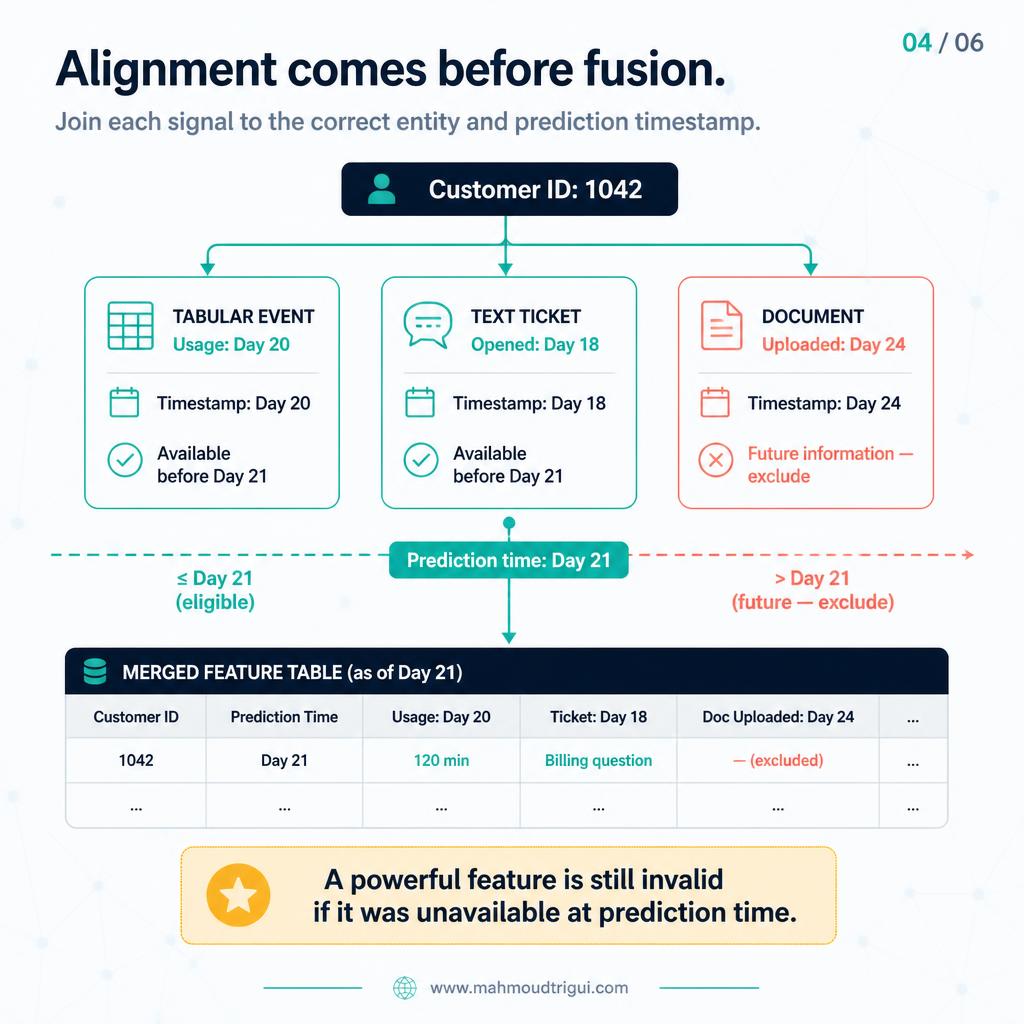
Join every signal to the correct entity and prediction timestamp, then test whether the combined feature table improves the real baseline.
Alignment Comes Before Fusion
A powerful feature is still invalid if it was unavailable at prediction time. A document uploaded or an event recorded after the prediction boundary must be excluded — this is the temporal-leakage trap that silently inflates offline metrics. Align every signal to the correct entity and the exact prediction timestamp, and flag missing modalities explicitly with safe fallback behaviour.
Outcome
Late fusion is not always the best architecture. But it is often the best starting point when data is limited, modalities are missing for some records, and production interpretability matters. Because each branch is a column you can inspect, it is easier to debug, validate, monitor, and later swap for a richer encoder. The result is a system where every fusion is an evidence-backed decision, not an act of faith.
Key Takeaway
Design insight: Represent each modality well, validate each branch, then combine only what earns its place. Better representation usually matters more than more complex fusion — start simple and add modalities with evidence.
FAQ
What is late fusion for multimodal data?
Late fusion means engineering each modality separately into structured signals, aligning them, and only then combining them into one feature table before the model. It is often a better starting point than forcing every modality into one end-to-end fusion model, especially when data is limited, modalities are missing for some records, and interpretability matters.
How do you combine tabular, text, and document data without breaking the model?
Keep structured data in the tabular pipeline, turn free text into measurable signals such as intent, topics, embeddings or sentiment, convert documents and images into structured outputs such as document type or extracted fields, then join every signal to the correct entity and prediction timestamp. Only retain branches that improve the real production baseline.