RevIN: When a Neural Forecast Learns Only One Scale
A neural forecaster can learn the shape of a series around 100 and still fail once the same series operates around 500. RevIN normalizes every input window with its own statistics, then restores the original scale — so the model reads local temporal patterns instead of absolute magnitude.
TL;DR: RevIN is a normalization control, not a modelling shortcut. Reversible instance normalization makes a neural forecaster see every input window relative to its own mean and scale, so a local level or variance shift is not read as an unfamiliar magnitude. It does not repair structural breaks, missing drivers, leakage, or a broken backtest. Test it like any other modelling choice: same rolling-origin windows, same horizons, same point-in-time inputs, with and without the layer.
Visual Summary
The Problem
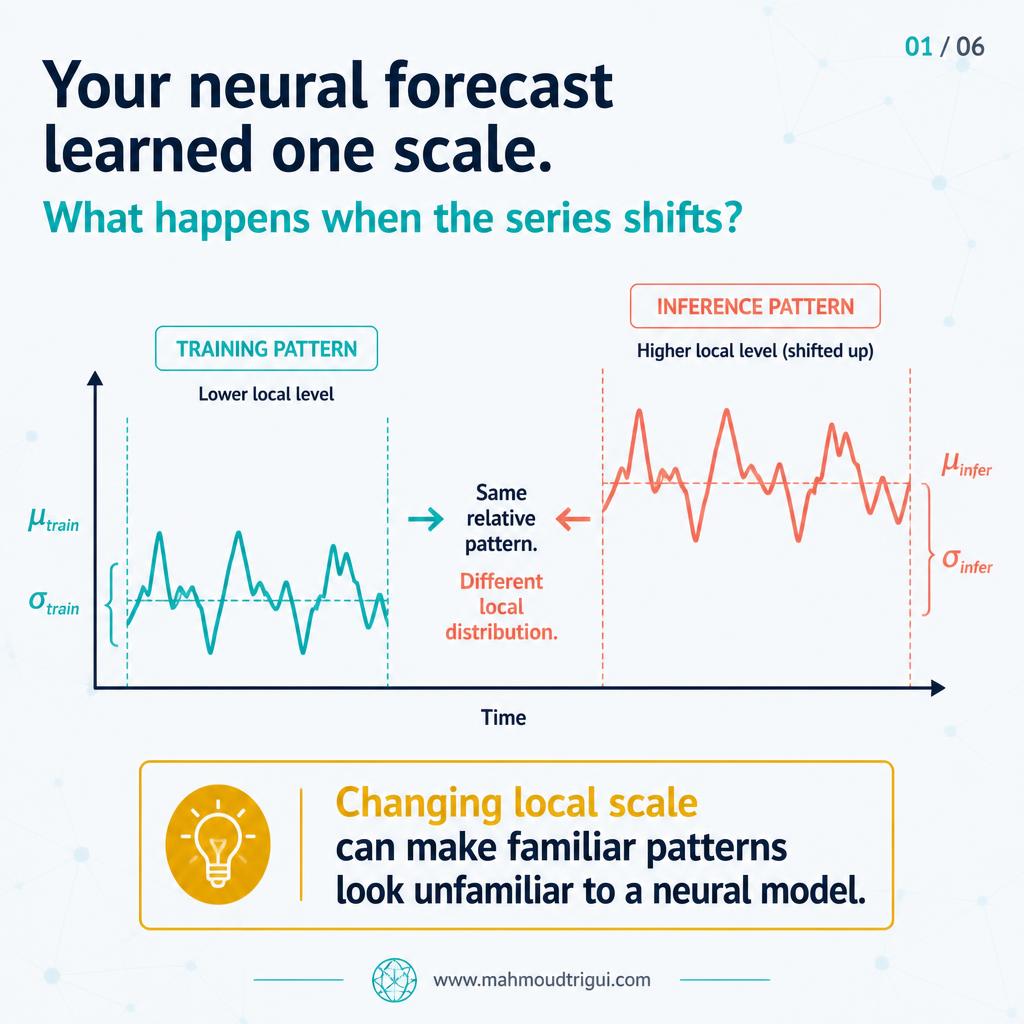
I kept meeting the same failure with neural forecasting models. The model learned its patterns while a series sat around one level, and then the same series started operating somewhere else entirely. Training around 100, inference around 500. The relative shape still looked familiar, but the absolute distribution had changed, and the model was reading that as unfamiliar magnitude rather than as a pattern it already knew.
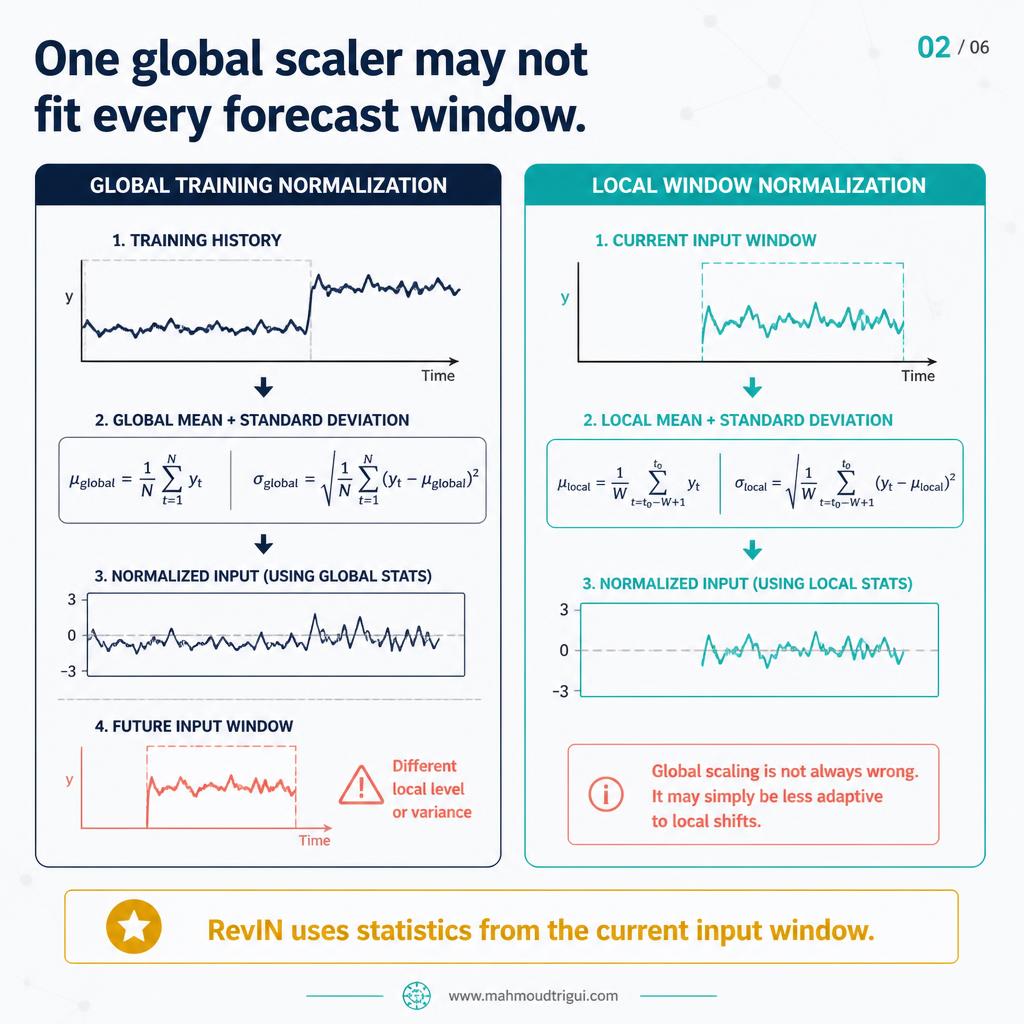
The root cause is usually one global scaler. Statistics computed across the whole training set are a reasonable average of a past that no longer describes the current forecast window. When local mean or local variance drifts, that single global normalization quietly becomes a train/inference mismatch — and the model spends its capacity relearning scale instead of learning time.
The Approach
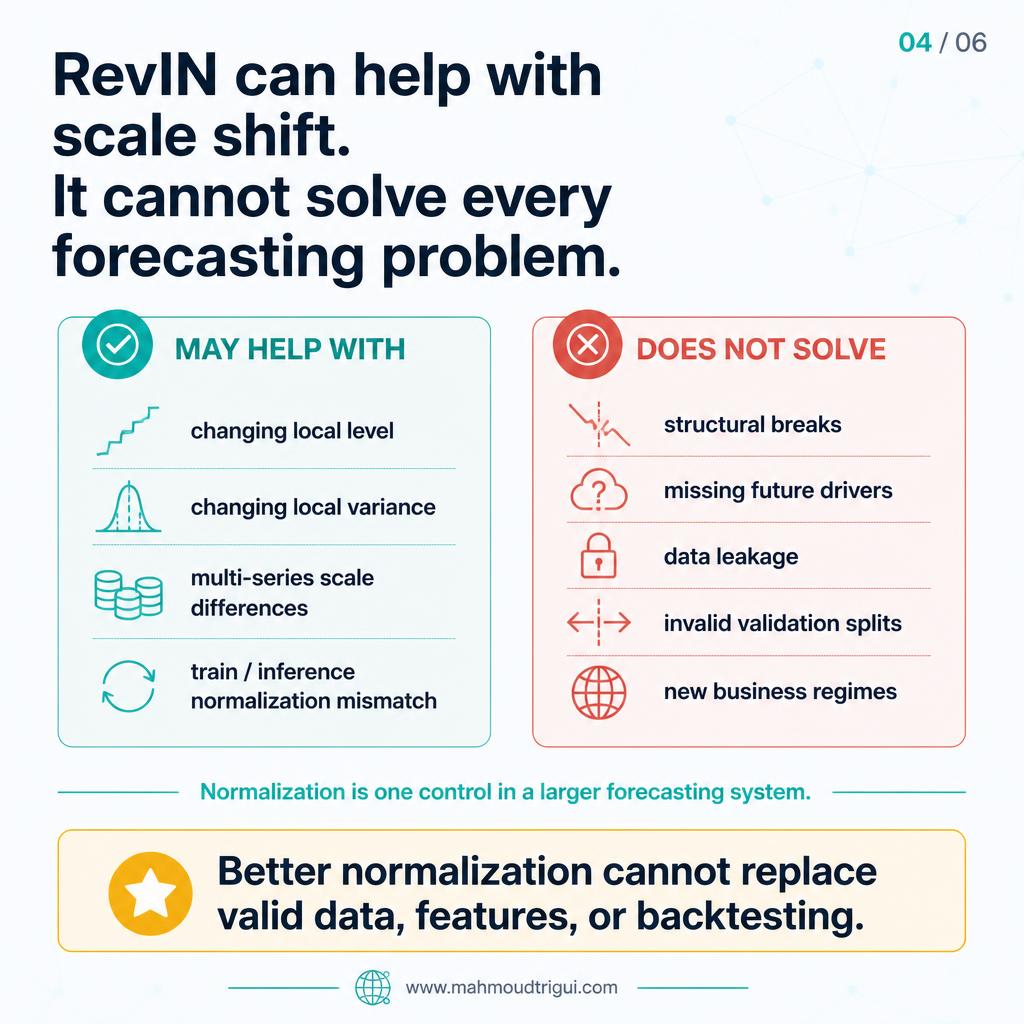
RevIN — Reversible Instance Normalization — is a small layer that moves the normalization decision from the whole dataset to the individual input window, and then undoes it before the forecast leaves the model. The pattern is three steps, and the third one is what makes it safe to use in production.
Normalize each input window with its own statistics
Instead of only the global training statistics, compute the mean and standard deviation of the current input window, and normalize against those: x_norm = (x − μ_window) / (σ_window + ε). The epsilon keeps the division numerically stable on flat windows.
Forecast on the normalized series
The model receives an input expressed relative to its local mean and scale. Local temporal patterns survive; the raw magnitude that has drifted no longer dominates what the network learns to represent.
Denormalize the forecast with the same stored statistics
The forecast is mapped back to the original scale using the very statistics that were stored for that instance: ŷ = ŷ_norm × (σ_window + ε) + μ_window. This is the reversible part, and it is why the layer can be dropped into an existing pipeline without changing its output contract.
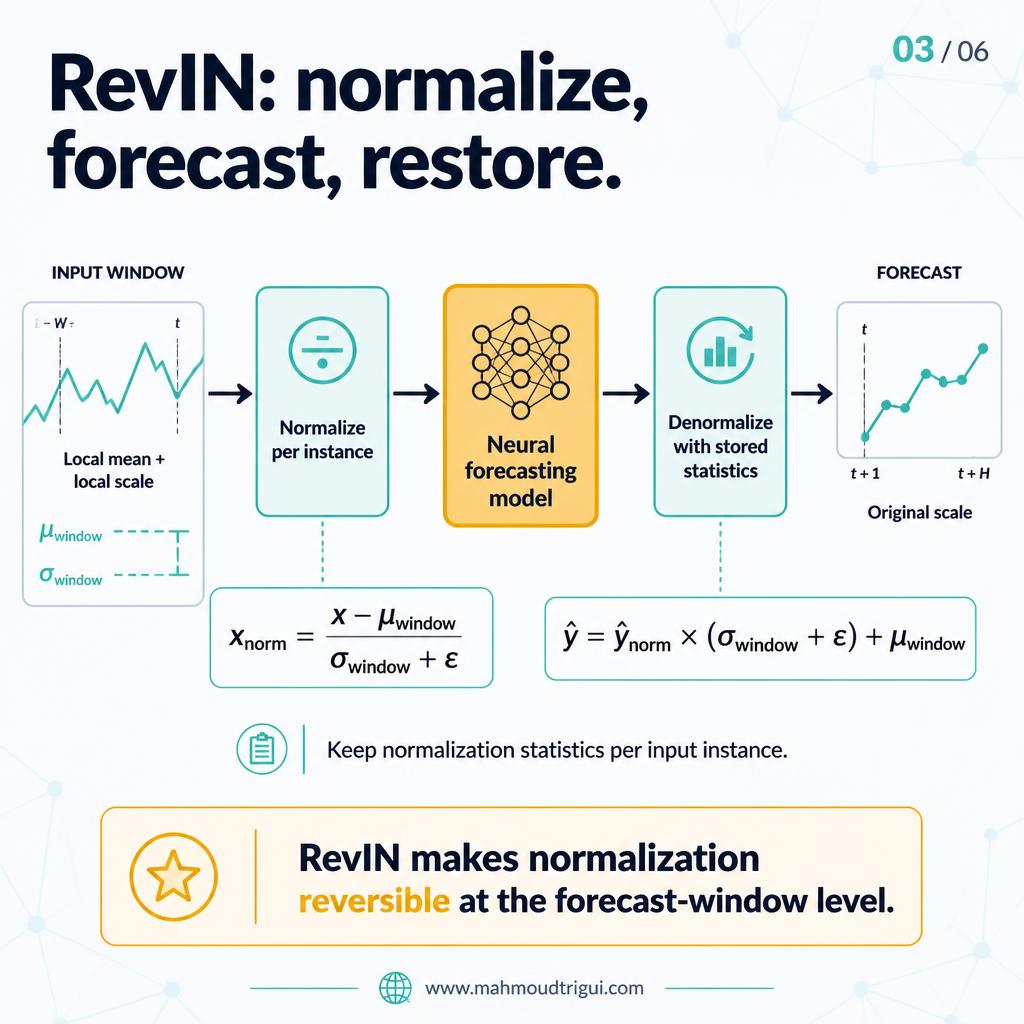
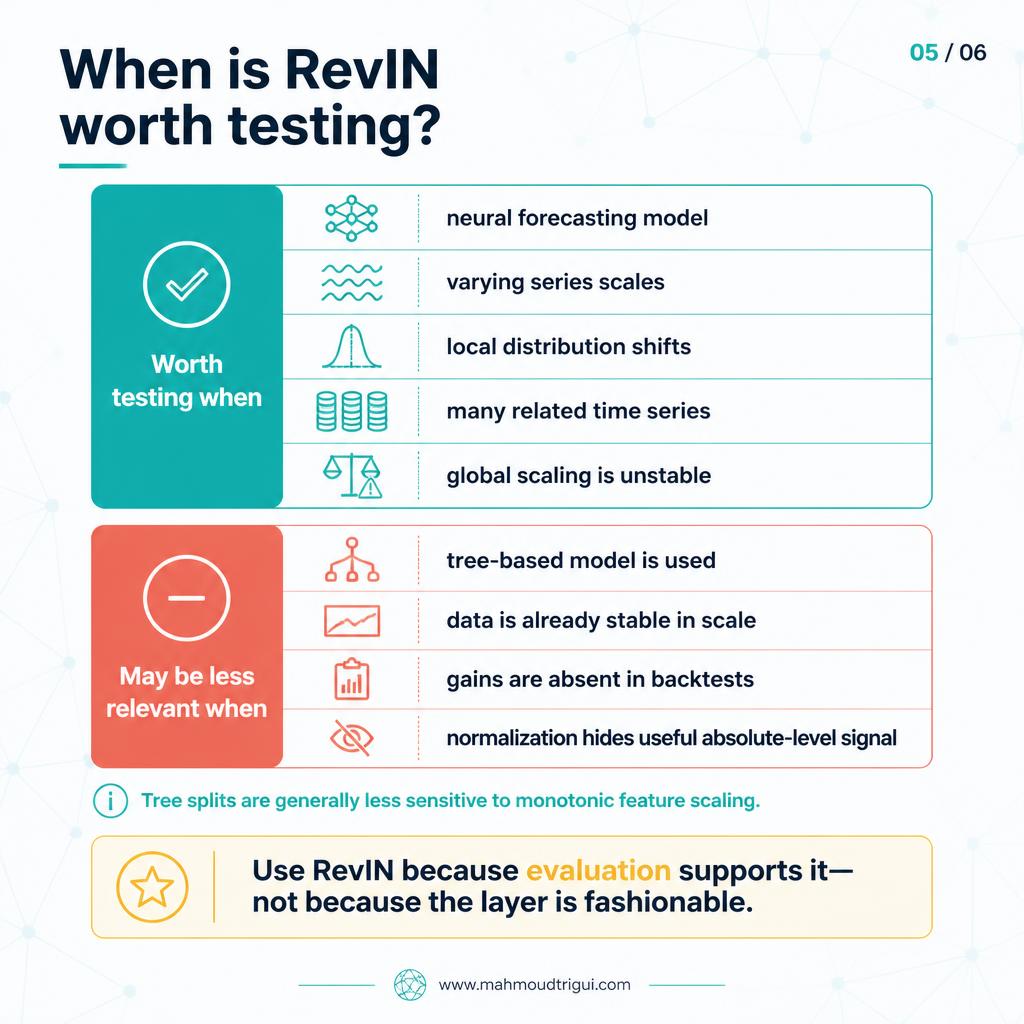
What I like about it is the honesty of the scope. RevIN is a targeted technique, and it is worth testing when you use a neural forecasting model, when series carry different scales, when local mean or variance shifts over time, or when one global scaler is visibly unstable. It is less relevant for tree-based models, because split-based trees are generally insensitive to monotonic feature scaling.
Outcome
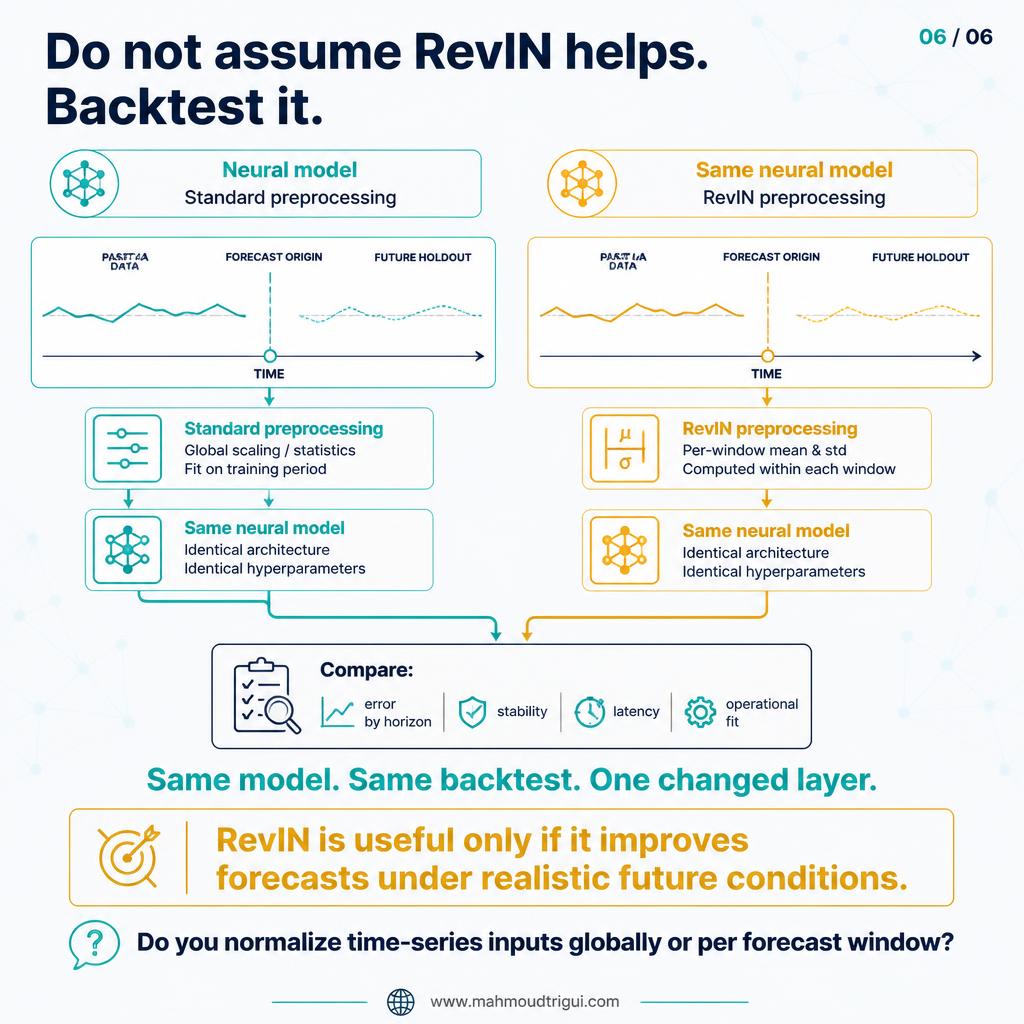
The discipline that matters is not adding the layer. It is evaluating it like any other modelling choice, under exactly the conditions the model will face in production:
Same rolling-origin backtests, same horizons, same point-in-time inputs
If the evaluation window changes between the two runs, the comparison measures the backtest rather than the normalization layer.
Compare with and without the normalization layer
One model, one changed layer. Look at error by horizon, stability across folds, latency, and operational fit — not only on an aggregate metric.
RevIN will not rescue a model from structural breaks, missing future drivers, an incorrect forecast horizon, leakage in feature generation, a poorly designed validation split, or a business regime with no historical analogue. Better normalization cannot replace valid data, valid features, or valid backtesting. And because I saw the improvement disappear on some series and hold on others, I treat the layer as a hypothesis to be tested per problem, not a fashionable default to be switched on globally.
Key Takeaway
Design insight: RevIN is a normalization control, not a modelling shortcut. Reversible instance normalization makes a neural forecaster see every input window relative to its own mean and scale, so a local level or variance shift is not read as an unfamiliar magnitude. It does not repair structural breaks, missing drivers, leakage, or a broken backtest. Test it like any other modelling choice: same rolling-origin windows, same horizons, same point-in-time inputs, with and without the layer.
Related
StatsForecast, MLforecast & NeuralForecast: Three Forecasting Jobs in One Ecosystem → An LLM-Derived Feature Is Still a Feature → A Strong AutoML Baseline Can Beat Hand-Tuned Models → Should this be a rule, a model, or an LLM? → DLinear: Make a Simple Forecasting Baseline Fail First → Zero-Shot Forecasting Changes the Baseline → Turning Decomposition into a Forecasting Strategy → The hardest forecasting decision is not which model to use! → MLforecast Made Me Rewrite My Forecasting Pipeline → Encoding is a modeling decision, not a preprocessing checkbox → Seed Sensitivity Is Part of Model Selection → Semi-Automatic Forecasting Framework →
FAQ
What is the key takeaway from "RevIN: Reversible Instance Normalization for Forecasting"?
RevIN is a normalization control, not a modelling shortcut. Reversible instance normalization makes a neural forecaster see every input window relative to its own mean and scale, so a local level or variance shift is not read as an unfamiliar magnitude. It does not repair structural breaks, missing drivers, leakage, or a broken backtest. Test it like any other modelling choice: same rolling-origin windows, same horizons, same point-in-time inputs, with and without the layer.
Who wrote this and what is it about?
This was written by Mahmoud Trigui, Senior Data Scientist. RevIN normalizes every forecast window with its own statistics, so a neural model handles local scale shift instead of failing on magnitude.
What is RevIN and how does it work?
RevIN (Reversible Instance Normalization) is a layer for neural forecasting models that normalizes each input window with that window's own mean and standard deviation, passes the normalized values to the model, then denormalizes the forecast with the same stored statistics. The normalization is therefore per input instance and reversible, so the model reads local temporal patterns instead of absolute magnitude, and the forecast still leaves the pipeline in the original scale.
When should I not use RevIN?
RevIN is a targeted technique, not a general fix. It will not resolve structural breaks, missing future drivers, an incorrect forecast horizon, leakage in feature generation, an invalid validation split, or a business regime with no historical analogue. It is also rarely necessary for tree-based models, because split-based trees are generally insensitive to monotonic feature scaling. The right test is the same rolling-origin backtest, horizons, and point-in-time inputs, run with and without the layer.