Tools That Last in Data Science

After 10 years in data science, the tools that stayed were rarely the flashiest ones. They are the ones that keep solving the same boring, recurring work well.
SQL LightGBM / XGBoost Pydantic Low Friction
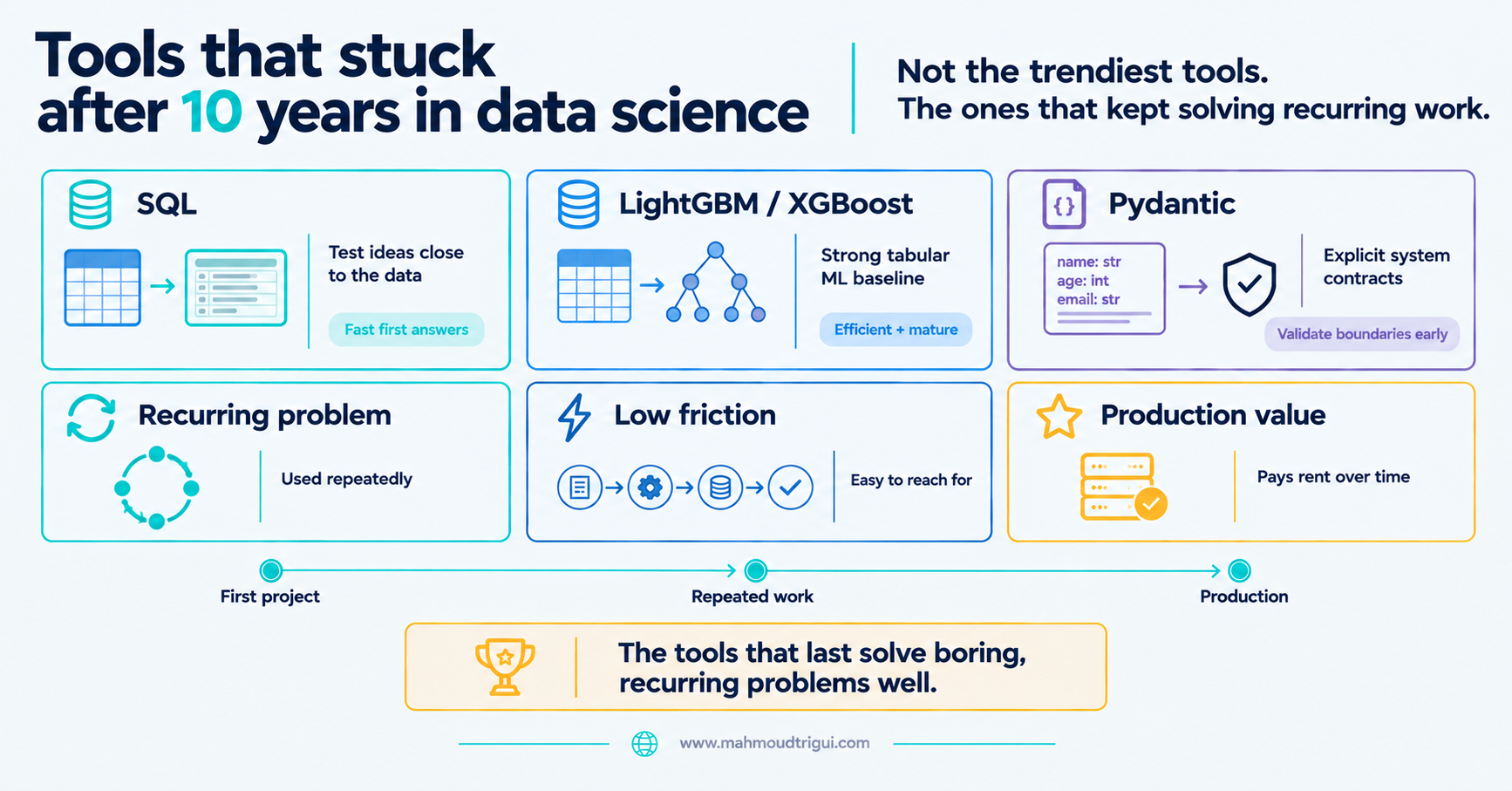
Six-card grid in three columns by two rows. Top row, the tools that stuck: SQL, a structured data table flowing into a query-result card, described as testing ideas close to the data, proof line fast first answers; LightGBM / XGBoost, a blue tabular data card flowing into an abstract tree-ensemble structure, described as a strong tabular ML baseline, proof line efficient and mature; Pydantic, a typed schema card flowing through a validation gate, described as explicit system contracts, proof line validate boundaries early. Bottom row, why tools stick: recurring problem, used repeatedly; low friction, easy to reach for; production value, pays rent over time. A thin teal timeline beneath the grid reads first project, repeated work, production. Headline tools that stuck after years in data science, subtitle not the trendiest tools, the ones that kept solving recurring work.

TL;DR: The tools that survive solve recurring problems with low friction. After 10 years in data science, the tools that stayed were rarely the flashiest ones — they were the ones that keep paying rent. SQL still gives the first useful answer because it tests an idea close to the data, before a notebook, feature pipeline, dashboard, or model exists. LightGBM and XGBoost remain serious baselines for structured tabular problems because they are efficient, mature, and hard to beat without a clear reason for more complexity. Pydantic holds its place by making assumptions explicit at system boundaries, so API inputs, configuration, pipeline handoffs, and structured outputs are easier to validate, review, and maintain. What did not stick were tools that required significant setup without enough repeated value, or that solved a problem rarely encountered. The longer you work, the less you optimise for novelty and the more you optimise for tools you still reach for when there is real work to do. The most durable tools are rarely the loudest — they are the ones that keep paying rent.

The Problem

Every year brings a new “must-have” tool. Some are genuinely useful. Some solve a short-term problem. And a few quietly earn a permanent place because they keep solving the same boring, recurring work well.

The tools that did not stick were usually the ones that required significant setup without enough repeated value — or the ones that solved a problem I did not actually have often enough. Choosing tools by novelty is a reliable way to spend a year on setup instead of on the work.

The Approach

Over 10 years, three tools have stayed in my stack. Each one earns its place the same way: it solves a recurring problem with low friction.

SQL

Still the fastest way to test an idea close to the data. Before building a notebook, feature pipeline, dashboard, or model, a query often gives the first useful answer.

LightGBM / XGBoost

For many structured tabular problems, gradient-boosted trees remain serious baselines. Not because they are trendy, but because they are efficient, mature, and often difficult to beat without a clear reason for more complexity.

Pydantic

Earned its place by making assumptions explicit at system boundaries. API inputs, configuration, pipeline handoffs, and structured outputs become easier to validate, review, and maintain.

The pattern is simple: these tools help you inspect data, establish a reliable baseline, define a clear contract, or ship something maintainable. Each one covers a repeated, boring task that otherwise costs real time.

Outcome

The longer I work, the less I optimise for novelty. I optimise for tools I still reach for when there is real work to do. That shift is what turns a pile of libraries into a working stack.

The most durable tools are rarely the loudest. They are the ones that keep paying rent.

Key Takeaway

Design insight: The tools that survive solve recurring problems with low friction. After 10 years in data science, the tools that stayed were rarely the flashiest ones — they were the ones that keep paying rent. SQL still gives the first useful answer because it tests an idea close to the data, before a notebook, feature pipeline, dashboard, or model exists. LightGBM and XGBoost remain serious baselines for structured tabular problems because they are efficient, mature, and hard to beat without a clear reason for more complexity. Pydantic holds its place by making assumptions explicit at system boundaries, so API inputs, configuration, pipeline handoffs, and structured outputs are easier to validate, review, and maintain. What did not stick were tools that required significant setup without enough repeated value, or that solved a problem rarely encountered. The longer you work, the less you optimise for novelty and the more you optimise for tools you still reach for when there is real work to do. The most durable tools are rarely the loudest — they are the ones that keep paying rent.

FAQ

What is the key takeaway from "Tools That Last in Data Science: SQL, GBDTs, Pydantic"?

The tools that survive solve recurring problems with low friction. After 10 years in data science, the tools that stayed were rarely the flashiest ones — they were the ones that keep paying rent. SQL still gives the first useful answer because it tests an idea close to the data, before a notebook, feature pipeline, dashboard, or model exists. LightGBM and XGBoost remain serious baselines for structured tabular problems because they are efficient, mature, and hard to beat without a clear reason for more complexity. Pydantic holds its place by making assumptions explicit at system boundaries, so API inputs, configuration, pipeline handoffs, and structured outputs are easier to validate, review, and maintain. What did not stick were tools that required significant setup without enough repeated value, or that solved a problem rarely encountered. The longer you work, the less you optimise for novelty and the more you optimise for tools you still reach for when there is real work to do. The most durable tools are rarely the loudest — they are the ones that keep paying rent.

Who wrote this and what is it about?

This was written by Mahmoud Trigui, Senior Data Scientist. After 10 years in data science, the tools that stayed were rarely the flashiest ones. SQL, gradient-boosted trees, and Pydantic survived because they solve recurring problems with low friction.

Comments

Machine LearningFeature EngineeringMLForecastTime Series DecompositionForecastingLightGBMXGBoostCatboostClusteringSegmentationNLPLLMsWeb AppR MarkdownSQLOracle DBSAS-GuideSAS E-MinerDataikuBigQueryGCPPythonRCRISP-DMHypothesis TestingANOVAData AnalyticsDimensionality ReductionRecommendation SystemNetwork AnalysisGeospace AnalysisSpatial DataEmbeddingSampling TechniquesDecision RulesData StorytellingCVMChurnFraud DetectionSentiment AnalysisTopic ModelingIBM WatsonPowerBILooker StudioVBAStatistical LearningEnsemble ModelingStackingCross-ValidationProfilingABT ConstructionPlumberTidyverseShinyProphetDeep LearningScikit-LearnJSONSAS ProgrammingGitVS CodeCSS StylingAutomated ReportingOutlier DetectionTemporal ClusteringStartup SurvivalPre-Valuation ModelingK-MeansDecision TreesData SciencePredictive ModelingSVMLDAText ClassificationWeight PredictionPattern RecognitionReal-Time DetectionCommunity DetectionPipeline AutomationData Quality ChecksData ReliabilitySpecification MappingBusiness StrategyMarketing CampaignsTry & Buy FrameworksKPI DashboardsNetwork QualitySales AnalyticsMentoringStatistics LecturerRemote WorkHybrid WorkConsultingContractFull-TimeFreelanceSofrecomOrange GroupTunisia TelecomKiota IntelligenceVC AnalyticsSeries A PredictionProduction MLApplied AIPrompt EngineeringBusiness ForecastingDecision SystemsGraph AnalyticsHousehold DetectionMulti-SIM DetectionFTTH ForecastingPydanticGPT-4OpenAI APIZindiCell Tower AnalysisBehavioral SignalsObservation Unit DesignWard ClusteringTarget Encoding Machine LearningFeature EngineeringMLForecastTime Series DecompositionForecastingLightGBMXGBoostCatboostClusteringSegmentationNLPLLMsWeb AppR MarkdownSQLOracle DBSAS-GuideSAS E-MinerDataikuBigQueryGCPPythonRCRISP-DMHypothesis TestingANOVAData AnalyticsDimensionality ReductionRecommendation SystemNetwork AnalysisGeospace AnalysisSpatial DataEmbeddingSampling TechniquesDecision RulesData StorytellingCVMChurnFraud DetectionSentiment AnalysisTopic ModelingIBM WatsonPowerBILooker StudioVBAStatistical LearningEnsemble ModelingStackingCross-ValidationProfilingABT ConstructionPlumberTidyverseShinyProphetDeep LearningScikit-LearnJSONSAS ProgrammingGitVS CodeCSS StylingAutomated ReportingOutlier DetectionTemporal ClusteringStartup SurvivalPre-Valuation ModelingK-MeansDecision TreesData SciencePredictive ModelingSVMLDAText ClassificationWeight PredictionPattern RecognitionReal-Time DetectionCommunity DetectionPipeline AutomationData Quality ChecksData ReliabilitySpecification MappingBusiness StrategyMarketing CampaignsTry & Buy FrameworksKPI DashboardsNetwork QualitySales AnalyticsMentoringStatistics LecturerRemote WorkHybrid WorkConsultingContractFull-TimeFreelanceSofrecomOrange GroupTunisia TelecomKiota IntelligenceVC AnalyticsSeries A PredictionProduction MLApplied AIPrompt EngineeringBusiness ForecastingDecision SystemsGraph AnalyticsHousehold DetectionMulti-SIM DetectionFTTH ForecastingPydanticGPT-4OpenAI APIZindiCell Tower AnalysisBehavioral SignalsObservation Unit DesignWard ClusteringTarget Encoding