Same Practitioner, Better Tools: ML Workflow Then vs Now

My competition workflow looks very different from a few years ago. The fundamentals do not. Better tools increase leverage — but fundamentals decide whether that leverage is useful.
MLOps Reusable Pipelines Automated Search Validation First
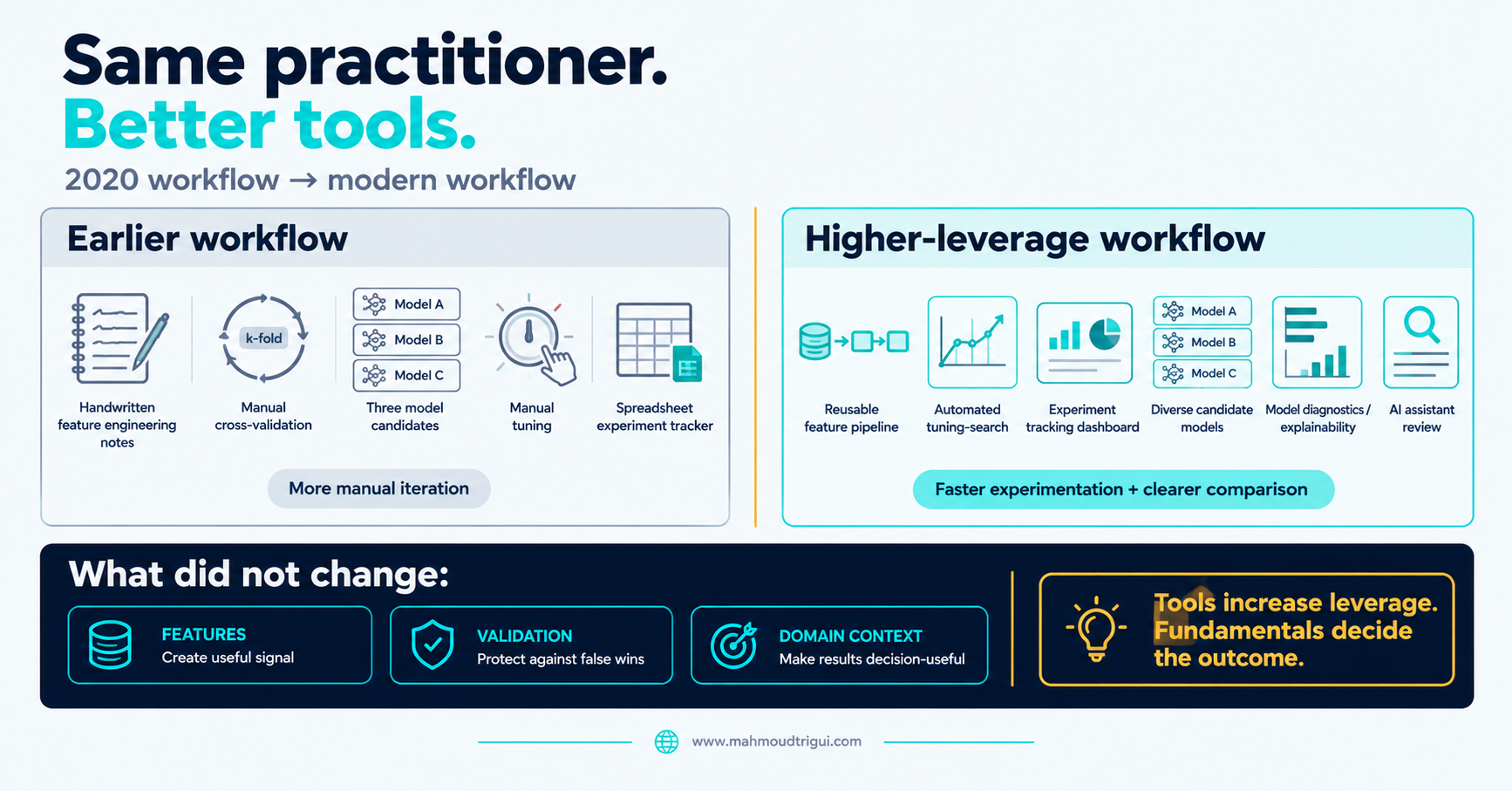
Split-screen then versus now comparison of an ML competition workflow. Left, a muted sepia and slate-grey cluttered workstation labelled Then, with handwritten feature-engineering notes around a table icon, a looping arrow labelled manual CV, three unevenly stacked basic model cards, one tuning dial with many tiny trial marks, an old spreadsheet-style experiment tracker with inconsistent highlighted rows, subtle coffee-cup-ring marks and a small loading bar labelled run again, captioned More manual iteration. Right, a calm teal and deep navy workstation labelled Now, with one reusable feature-pipeline flow, an automated search chart with several trial dots, a clean experiment-tracking dashboard, a compact group of candidate model cards, a model-diagnostics chart and a small AI assistant review card with a magnifying glass labelled Review questions and boilerplate, captioned More leverage, better visibility. A deep navy band underneath reads What did NOT change and holds three foundation cards: FEATURES create useful signal, VALIDATION prevent false wins, DOMAIN CONTEXT make results useful. Final gold takeaway: better tools increase leverage, fundamentals still decide the outcome

TL;DR: Better tools increase leverage; fundamentals decide whether that leverage is useful. A modern ML workflow — reusable feature pipelines, automated hyperparameter search, experiment tracking, better diagnostics, and AI assistance for boilerplate and review questions — makes it possible to run many more experiments than before. But it does not remove the judgement that actually determines the result. You can run more bad experiments faster, poor validation can still select the wrong model, and generated code still cannot tell you whether a feature exists at prediction time or whether a business rule makes sense. The fundamentals have not changed: understand the problem before modelling it, build a reliable validation design, check for leakage, improve features with domain context, and add model complexity only when it earns its place. Leverage without fundamentals just produces more bad experiments at a larger scale; fundamentals are what turn that leverage into a decision you can defend.

The Problem

Earlier on, my workflow was more manual: feature engineering written from scratch, cross-validation loops built by hand, a small number of model families, parameter changes tested one by one, experiment tracking in spreadsheets, and simple averaging for ensembles.

That does not mean the tools suddenly do the thinking for you. If anything, better tools make weak reasoning easier to expose. You can run more experiments, but you can also run more bad experiments faster. You can test more models, but poor validation can still select the wrong one. You can use AI to generate code, but it still cannot decide whether a feature exists at prediction time or whether a business rule makes sense.

The Approach

Today the workflow has more leverage, but the way I work through it has not changed much. The stack evolved; the sequence of decisions stayed the same.

Then: manual feature engineering and hand-built CV loops

Features written from scratch, cross-validation loops assembled by hand, a small number of model families, parameter changes tested one at a time, and experiment tracking kept in spreadsheets.

Now: reusable pipelines and automated search

Reusable feature pipelines, stronger baseline tools, automated hyperparameter search, real experiment tracking, easier model comparison, better diagnostics, and AI assistance for boilerplate, review questions, and documentation.

Understand the problem before modelling it

The prediction target, the decision it drives, and the data that will genuinely exist at prediction time all come first.

Build a reliable validation design

Split the data the way the real deployment splits it, and make sure the validation setup answers the business question instead of a convenient proxy.

Check for leakage

Automated pipelines make it easier to leak a target by accident. Leakage checks are not optional, and they are harder to eyeball once the feature code is abstracted away.

Improve features with domain context

Domain knowledge still decides whether a feature carries signal, and no amount of automated search substitutes for a feature that means something.

Add model complexity only when it earns its place

More search does not mean more value. The extra complexity has to beat a strong baseline on held-out evidence before it stays.

Outcome

The stack evolved. My workflow became faster, more reproducible, and easier to inspect. But the core job is still the same: turn imperfect data into a decision you can defend.

The measurable change is not a better leaderboard score on its own. It is that experiments are cheaper to run, cheaper to reproduce, and cheaper to audit — so the questions I spend my attention on move back to the parts that actually matter.

Key Takeaway

Design insight: Better tools increase leverage; fundamentals decide whether that leverage is useful. A modern ML workflow — reusable feature pipelines, automated hyperparameter search, experiment tracking, better diagnostics, and AI assistance for boilerplate and review questions — makes it possible to run many more experiments than before. But it does not remove the judgement that actually determines the result. You can run more bad experiments faster, poor validation can still select the wrong model, and generated code still cannot tell you whether a feature exists at prediction time or whether a business rule makes sense. The fundamentals have not changed: understand the problem before modelling it, build a reliable validation design, check for leakage, improve features with domain context, and add model complexity only when it earns its place. Leverage without fundamentals just produces more bad experiments at a larger scale; fundamentals are what turn that leverage into a decision you can defend.

FAQ

What is the key takeaway from "Same Practitioner, Better Tools: ML Workflow Then vs Now"?

Better tools increase leverage; fundamentals decide whether that leverage is useful. A modern ML workflow — reusable feature pipelines, automated hyperparameter search, experiment tracking, better diagnostics, and AI assistance for boilerplate and review questions — makes it possible to run many more experiments than before. But it does not remove the judgement that actually determines the result. You can run more bad experiments faster, poor validation can still select the wrong model, and generated code still cannot tell you whether a feature exists at prediction time or whether a business rule makes sense. The fundamentals have not changed: understand the problem before modelling it, build a reliable validation design, check for leakage, improve features with domain context, and add model complexity only when it earns its place. Leverage without fundamentals just produces more bad experiments at a larger scale; fundamentals are what turn that leverage into a decision you can defend.

Who wrote this and what is it about?

This was written by Mahmoud Trigui, Senior Data Scientist. Better tools increase leverage; fundamentals decide the outcome. How my ML competition workflow moved from hand-built CV loops to automated search.

Comments

Machine LearningFeature EngineeringMLForecastTime Series DecompositionForecastingLightGBMXGBoostCatboostClusteringSegmentationNLPLLMsWeb AppR MarkdownSQLOracle DBSAS-GuideSAS E-MinerDataikuBigQueryGCPPythonRCRISP-DMHypothesis TestingANOVAData AnalyticsDimensionality ReductionRecommendation SystemNetwork AnalysisGeospace AnalysisSpatial DataEmbeddingSampling TechniquesDecision RulesData StorytellingCVMChurnFraud DetectionSentiment AnalysisTopic ModelingIBM WatsonPowerBILooker StudioVBAStatistical LearningEnsemble ModelingStackingCross-ValidationProfilingABT ConstructionPlumberTidyverseShinyProphetDeep LearningScikit-LearnJSONSAS ProgrammingGitVS CodeCSS StylingAutomated ReportingOutlier DetectionTemporal ClusteringStartup SurvivalPre-Valuation ModelingK-MeansDecision TreesData SciencePredictive ModelingSVMLDAText ClassificationWeight PredictionPattern RecognitionReal-Time DetectionCommunity DetectionPipeline AutomationData Quality ChecksData ReliabilitySpecification MappingBusiness StrategyMarketing CampaignsTry & Buy FrameworksKPI DashboardsNetwork QualitySales AnalyticsMentoringStatistics LecturerRemote WorkHybrid WorkConsultingContractFull-TimeFreelanceSofrecomOrange GroupTunisia TelecomKiota IntelligenceVC AnalyticsSeries A PredictionProduction MLApplied AIPrompt EngineeringBusiness ForecastingDecision SystemsGraph AnalyticsHousehold DetectionMulti-SIM DetectionFTTH ForecastingPydanticGPT-4OpenAI APIZindiCell Tower AnalysisBehavioral SignalsObservation Unit DesignWard ClusteringTarget Encoding Machine LearningFeature EngineeringMLForecastTime Series DecompositionForecastingLightGBMXGBoostCatboostClusteringSegmentationNLPLLMsWeb AppR MarkdownSQLOracle DBSAS-GuideSAS E-MinerDataikuBigQueryGCPPythonRCRISP-DMHypothesis TestingANOVAData AnalyticsDimensionality ReductionRecommendation SystemNetwork AnalysisGeospace AnalysisSpatial DataEmbeddingSampling TechniquesDecision RulesData StorytellingCVMChurnFraud DetectionSentiment AnalysisTopic ModelingIBM WatsonPowerBILooker StudioVBAStatistical LearningEnsemble ModelingStackingCross-ValidationProfilingABT ConstructionPlumberTidyverseShinyProphetDeep LearningScikit-LearnJSONSAS ProgrammingGitVS CodeCSS StylingAutomated ReportingOutlier DetectionTemporal ClusteringStartup SurvivalPre-Valuation ModelingK-MeansDecision TreesData SciencePredictive ModelingSVMLDAText ClassificationWeight PredictionPattern RecognitionReal-Time DetectionCommunity DetectionPipeline AutomationData Quality ChecksData ReliabilitySpecification MappingBusiness StrategyMarketing CampaignsTry & Buy FrameworksKPI DashboardsNetwork QualitySales AnalyticsMentoringStatistics LecturerRemote WorkHybrid WorkConsultingContractFull-TimeFreelanceSofrecomOrange GroupTunisia TelecomKiota IntelligenceVC AnalyticsSeries A PredictionProduction MLApplied AIPrompt EngineeringBusiness ForecastingDecision SystemsGraph AnalyticsHousehold DetectionMulti-SIM DetectionFTTH ForecastingPydanticGPT-4OpenAI APIZindiCell Tower AnalysisBehavioral SignalsObservation Unit DesignWard ClusteringTarget Encoding