Speed Buys Iterations: Faster Training, More Validated Ideas
Training speed is modelling leverage. A faster training loop lets you run more time-aware cross-validation, test more feature ideas, and inspect more failures before shipping.
TL;DR: Training speed is modelling leverage. Faster loops make time-aware cross-validation, feature tests, baselines, tuning, and failure inspection more practical, creating more chances to build a better model. Speed doesn't guarantee quality, but when two approaches deliver similar validated performance, the faster one lets you explore more hypotheses, evaluate more reliably, and reach a better decision sooner.
Hero
The Problem
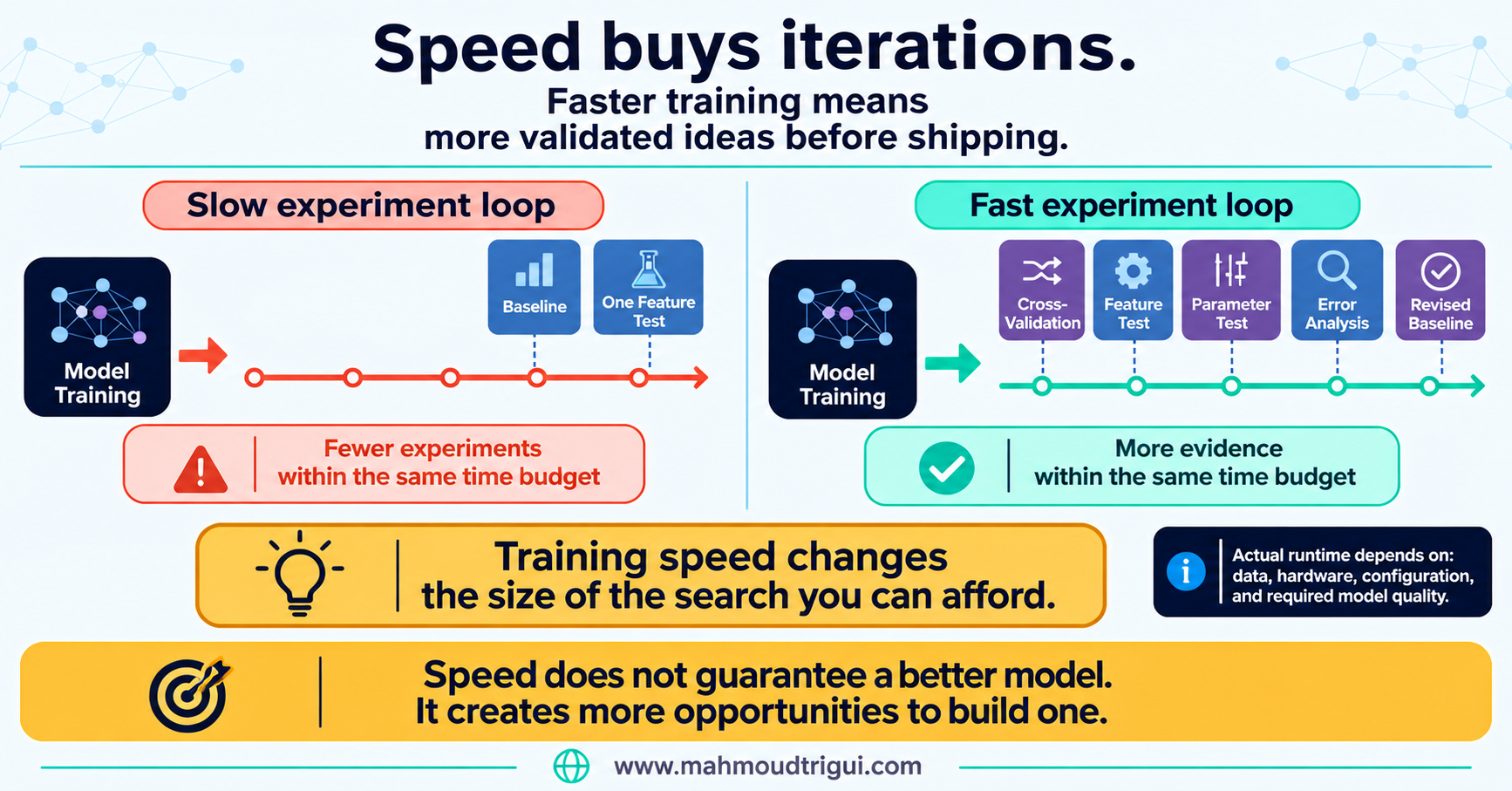
Model-training speed is not only an infrastructure concern. It changes how many good modelling decisions you can make before shipping. With a slow loop, you may only be able to test a baseline and one feature idea in the time you have. With a faster loop, you can run time-aware cross-validation, test multiple ideas, compare strong baselines, tune parameters, inspect failures, and repeat after finding a data issue.
That leverage explains why histogram-based gradient-boosting libraries became such useful tools for tabular ML—they can often train far faster than older exact or slower boosting implementations, especially on larger datasets.
The Approach
Speed creates iteration capacity
Each extra experiment costs less time, so you can afford to be more thorough: robust validation, failure analysis, and sanity checks that would be skipped under tight time pressure.
Benchmark claims need context
Training time depends on dataset size and feature count, sparsity and categorical handling, CPU/GPU hardware, thread settings, library version, tree depth and iterations, early stopping, preprocessing, target metric, and required model quality.
Ask the right question
Not "Which library is fastest in one chart?" but "Which setup gives us the best quality-to-iteration-speed trade-off for this problem?"
Don't sacrifice quality for speed
A slower model may still be the right choice when it delivers meaningful held-out value, handles a required constraint, or fits the deployment environment better. When two approaches deliver similar validated performance, the faster one creates leverage.
Outcome
Faster training means more validated ideas before shipping. More evidence leads to better decisions sooner, without cutting corners on validation. Speed gives you more chances to build a better model—it doesn't replace the discipline of testing on realistic held-out data.
Key Takeaway
Design insight: Training speed is modelling leverage. A faster training loop lets you run more time-aware cross-validation, test more feature ideas, tune parameters, and inspect failures before shipping. Speed doesn't guarantee a better model—it gives you more chances to build one. When two approaches deliver similar validated performance, the faster one creates leverage. Always optimise for the quality-to-iteration-speed trade-off, not raw speed alone.