A Rough First Run Is Not a Failure: Iterative Learning Loops

A rough first run is not a failure signal. A useful first run does not need to solve everything — it needs to reveal where the real problems are.
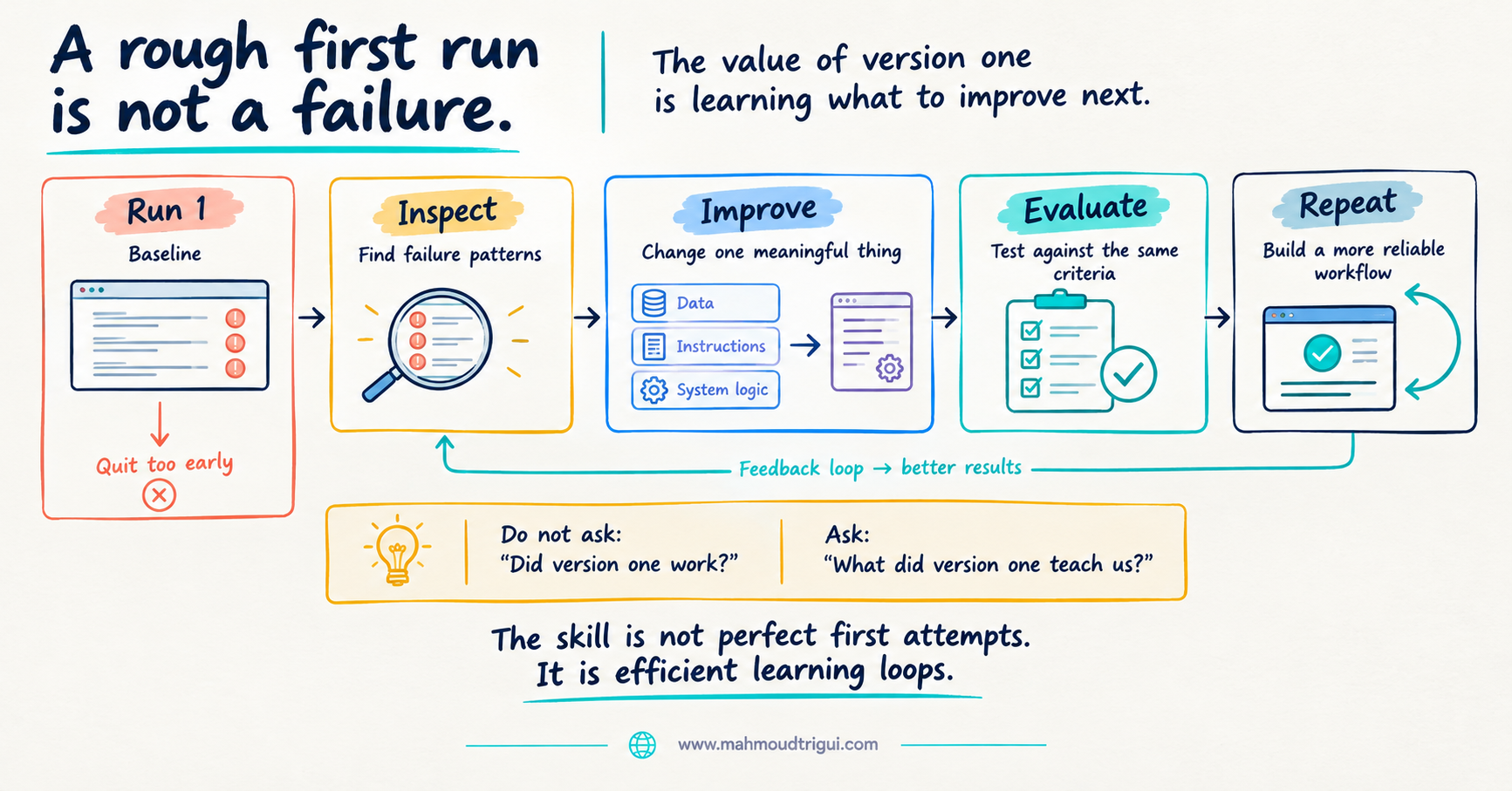
Baseline First Failure Patterns One Change at a Time Same Criteria
Five-stage iterative improvement path from left to right. Stage 1, muted coral Run 1, baseline, a simple first-version system card with three small visible issue markers and a downward exit arrow labelled Quit too early ending in a crossed-out symbol. Stage 2, amber-gold Inspect, find failure patterns, a magnifying glass reviewing the three issue markers. Stage 3, blue Improve, change one meaningful thing, a source-data, instruction and system-logic card being refined. Stage 4, teal Evaluate, test against the same criteria, a clear validation gate with a checklist. Stage 5, deep navy and teal Repeat, build a more reliable workflow, a stable system-output card connected back to the inspection stage by a thin teal feedback arrow. Central gold insight: do not ask did version one work, ask what did version one teach us. Bottom takeaway: the skill is not perfect first attempts, it is efficient learning loops. Headline: a rough first run is not a failure, and the value of version one is learning what to improve next

TL;DR: A rough first run is not a failure signal. Whether you are building a prompt, an AI workflow, an extraction pipeline, a feature-engineering approach, or a forecasting system, the first serious version is often incomplete, and that is normal. The mistake is not getting an imperfect first result; the mistake is treating an imperfect first result as final evidence that the approach cannot work. Good iteration is not random repetition — it is a disciplined loop: build a baseline, inspect failure patterns, identify the highest-value fix, change one meaningful thing, and evaluate again using the same criteria. That loop applies to prompts, agents, models, and data pipelines alike. The first attempt does not need to be impressive; it needs to be observable enough to teach you what to do next. The skill is not getting everything right on run one. It is turning failures into the next useful iteration.

The Problem

Whether you are building a prompt, an AI workflow, an extraction pipeline, a feature-engineering approach, or a forecasting system, the first serious version is often incomplete. That is normal.

The mistake is not getting an imperfect first result. The mistake is treating an imperfect first result as final evidence that the approach cannot work. An unfinished run gets read as a verdict, the loop stops early, and a viable idea is thrown away because nobody read the failures properly.

The Approach

Good iteration is not random repetition. It is a disciplined loop, and the first run is used to answer specific questions rather than to produce a final answer.

Build a baseline

Get the simplest credible version running end to end, so every later change has something measured to be compared against.

Inspect failure patterns

Which inputs are ambiguous, which edge cases were never specified, and where does the system actually fail — and is the failure caused by data, logic, evaluation, or the workflow itself?

Identify the highest-value fix

Rank the observed failures by how much they matter and how much they cost, then pick the single change most likely to improve the next version.

Change one meaningful thing

One change at a time. Several simultaneous edits destroy the signal, because you can no longer tell which one produced the improvement.

Evaluate again using the same criteria

Reuse the same evaluation set and the same pass criteria, otherwise the comparison between versions is meaningless.

Apply the loop to the artefact in front of you

A prompt may need clearer constraints. An agent may need better tool instructions and fallback paths. A model may need a better target, a more realistic split, or stronger features.

Outcome

The first attempt does not need to be impressive. It needs to be observable enough to teach you what to do next. A disciplined loop turns a rough first run into a map of the real problems instead of a dead end.

The same discipline applies to prompts, agents, models, and data pipelines. What changes across those four is the object being iterated, not the method: baseline, inspect, fix one thing, evaluate again, repeat.

Key Takeaway

Design insight: A rough first run is not a failure signal. Whether you are building a prompt, an AI workflow, an extraction pipeline, a feature-engineering approach, or a forecasting system, the first serious version is often incomplete, and that is normal. The mistake is not getting an imperfect first result; the mistake is treating an imperfect first result as final evidence that the approach cannot work. Good iteration is not random repetition — it is a disciplined loop: build a baseline, inspect failure patterns, identify the highest-value fix, change one meaningful thing, and evaluate again using the same criteria. That loop applies to prompts, agents, models, and data pipelines alike. The first attempt does not need to be impressive; it needs to be observable enough to teach you what to do next. The skill is not getting everything right on run one. It is turning failures into the next useful iteration.

FAQ

What is the key takeaway from "A Rough First Run Is Not a Failure: Iterative Learning Loops"?

A rough first run is not a failure signal. Whether you are building a prompt, an AI workflow, an extraction pipeline, a feature-engineering approach, or a forecasting system, the first serious version is often incomplete, and that is normal. The mistake is not getting an imperfect first result; the mistake is treating an imperfect first result as final evidence that the approach cannot work. Good iteration is not random repetition — it is a disciplined loop: build a baseline, inspect failure patterns, identify the highest-value fix, change one meaningful thing, and evaluate again using the same criteria. That loop applies to prompts, agents, models, and data pipelines alike. The first attempt does not need to be impressive; it needs to be observable enough to teach you what to do next. The skill is not getting everything right on run one. It is turning failures into the next useful iteration.

Who wrote this and what is it about?

This was written by Mahmoud Trigui, Senior Data Scientist. A rough first run is not a failure signal. A disciplined loop - baseline, inspect failures, fix one thing, re-evaluate - turns imperfect results into learning.

Comments

Machine LearningFeature EngineeringMLForecastTime Series DecompositionForecastingLightGBMXGBoostCatboostClusteringSegmentationNLPLLMsWeb AppR MarkdownSQLOracle DBSAS-GuideSAS E-MinerDataikuBigQueryGCPPythonRCRISP-DMHypothesis TestingANOVAData AnalyticsDimensionality ReductionRecommendation SystemNetwork AnalysisGeospace AnalysisSpatial DataEmbeddingSampling TechniquesDecision RulesData StorytellingCVMChurnFraud DetectionSentiment AnalysisTopic ModelingIBM WatsonPowerBILooker StudioVBAStatistical LearningEnsemble ModelingStackingCross-ValidationProfilingABT ConstructionPlumberTidyverseShinyProphetDeep LearningScikit-LearnJSONSAS ProgrammingGitVS CodeCSS StylingAutomated ReportingOutlier DetectionTemporal ClusteringStartup SurvivalPre-Valuation ModelingK-MeansDecision TreesData SciencePredictive ModelingSVMLDAText ClassificationWeight PredictionPattern RecognitionReal-Time DetectionCommunity DetectionPipeline AutomationData Quality ChecksData ReliabilitySpecification MappingBusiness StrategyMarketing CampaignsTry & Buy FrameworksKPI DashboardsNetwork QualitySales AnalyticsMentoringStatistics LecturerRemote WorkHybrid WorkConsultingContractFull-TimeFreelanceSofrecomOrange GroupTunisia TelecomKiota IntelligenceVC AnalyticsSeries A PredictionProduction MLApplied AIPrompt EngineeringBusiness ForecastingDecision SystemsGraph AnalyticsHousehold DetectionMulti-SIM DetectionFTTH ForecastingPydanticGPT-4OpenAI APIZindiCell Tower AnalysisBehavioral SignalsObservation Unit DesignWard ClusteringTarget Encoding Machine LearningFeature EngineeringMLForecastTime Series DecompositionForecastingLightGBMXGBoostCatboostClusteringSegmentationNLPLLMsWeb AppR MarkdownSQLOracle DBSAS-GuideSAS E-MinerDataikuBigQueryGCPPythonRCRISP-DMHypothesis TestingANOVAData AnalyticsDimensionality ReductionRecommendation SystemNetwork AnalysisGeospace AnalysisSpatial DataEmbeddingSampling TechniquesDecision RulesData StorytellingCVMChurnFraud DetectionSentiment AnalysisTopic ModelingIBM WatsonPowerBILooker StudioVBAStatistical LearningEnsemble ModelingStackingCross-ValidationProfilingABT ConstructionPlumberTidyverseShinyProphetDeep LearningScikit-LearnJSONSAS ProgrammingGitVS CodeCSS StylingAutomated ReportingOutlier DetectionTemporal ClusteringStartup SurvivalPre-Valuation ModelingK-MeansDecision TreesData SciencePredictive ModelingSVMLDAText ClassificationWeight PredictionPattern RecognitionReal-Time DetectionCommunity DetectionPipeline AutomationData Quality ChecksData ReliabilitySpecification MappingBusiness StrategyMarketing CampaignsTry & Buy FrameworksKPI DashboardsNetwork QualitySales AnalyticsMentoringStatistics LecturerRemote WorkHybrid WorkConsultingContractFull-TimeFreelanceSofrecomOrange GroupTunisia TelecomKiota IntelligenceVC AnalyticsSeries A PredictionProduction MLApplied AIPrompt EngineeringBusiness ForecastingDecision SystemsGraph AnalyticsHousehold DetectionMulti-SIM DetectionFTTH ForecastingPydanticGPT-4OpenAI APIZindiCell Tower AnalysisBehavioral SignalsObservation Unit DesignWard ClusteringTarget Encoding