Agent ≠ Chatbot: The Operating Loop Difference
A chatbot follows question → answer. An agent follows goal → action → observation → next action → result — operating in a controlled loop with tools, state, and verification.
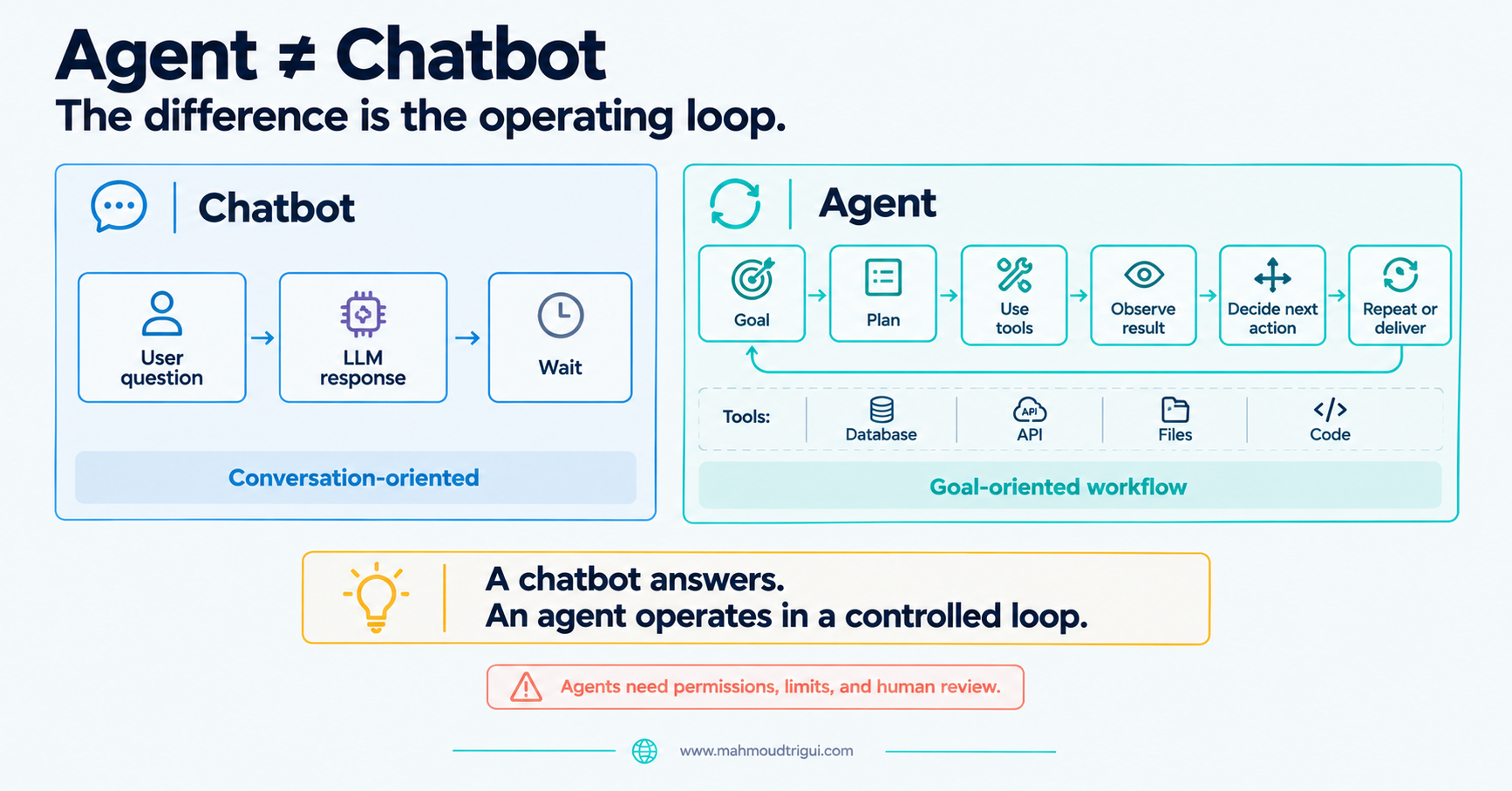
TL;DR: A chatbot answers. An agent operates within a controlled loop. The difference is actionability: agents take actions, evaluate what happened, and continue toward a goal — but only within verified permissions, clear constraints, and human oversight.
The Problem
The distinction isn't the model — it's the operating loop. A chatbot answers in a single turn; an agent can inspect data, run checks/scripts, evaluate intermediate results, decide next steps, and continue toward a goal with proper constraints.
The Approach
For agents, four building blocks matter: goal (outcome), tools (systems it can use), state (what's happened), and loop (observe + next action). Planning helps but isn't the definition. The key question is always: what can it do, what can it access, and how do we verify its actions? Agents need permissions, limits, and human review.
Outcome
Understanding the loop prevents conflating "chatbot with tools" with a true agent. Constrain actions, verify results, and treat unknown/unsafe outcomes as requiring review. An agent with weak constraints can repeat wrong actions faster.
Key Takeaway
Design insight: A chatbot answers. An agent operates within a controlled loop. The difference is actionability: agents take actions, evaluate what happened, and continue toward a goal — but only within verified permissions, clear constraints, and human oversight.