Target Leakage: Three Hidden Pitfalls

The obvious version is easy to catch. The dangerous version hides in timestamps, transformations, and the way training examples are constructed — and makes the model look smarter than it is.

Target Leakage Point-in-Time Fold-Safe Validation

TL;DR: Target leakage is not always obvious. Temporal, transformation, and observation-window leakage all create the same illusion: offline validation looks stronger than it will in production. When a result looks unusually strong, do not ask which algorithm to try next — ask what the model saw that would not exist at prediction time.

Visual Summary
The Problem

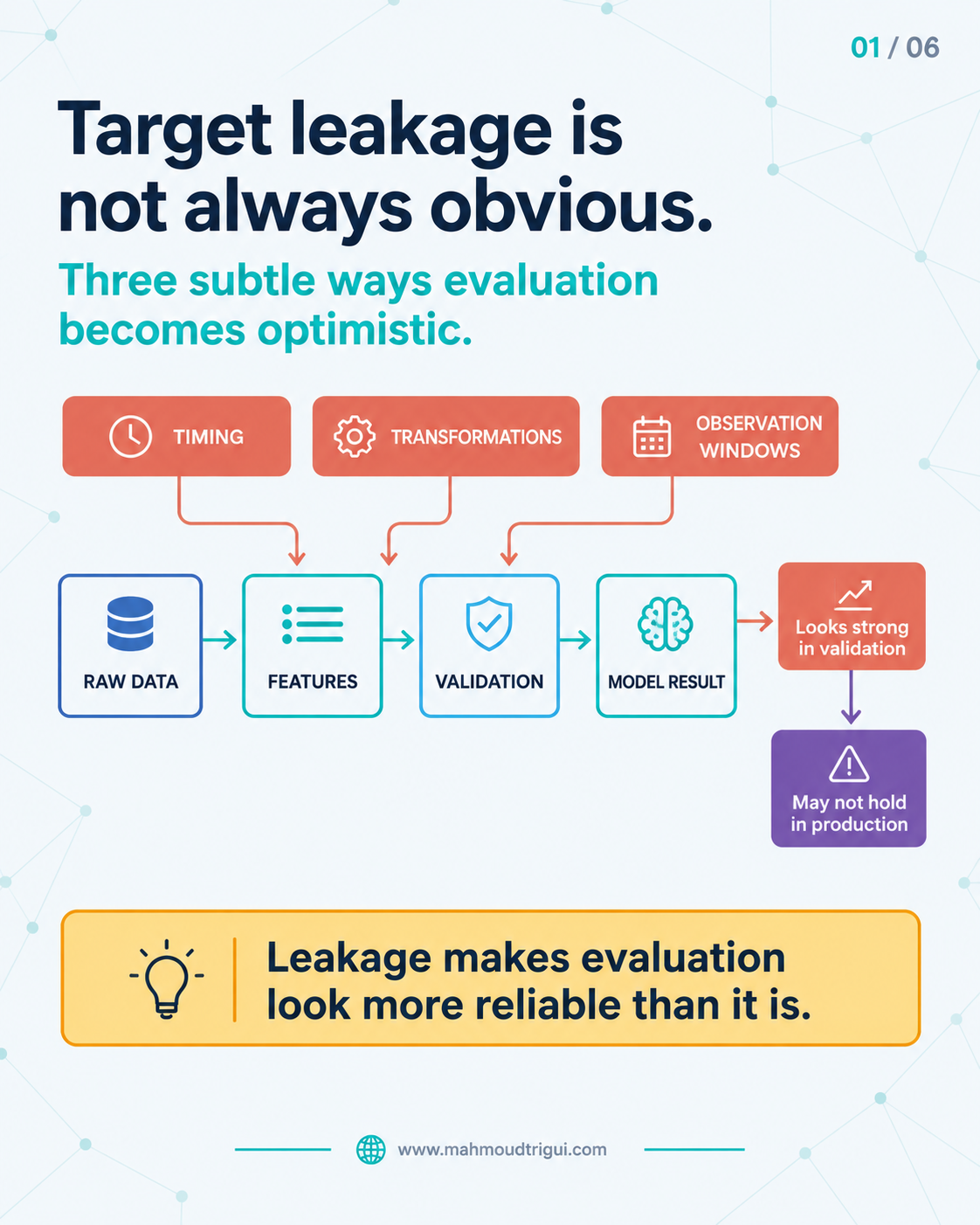
Target leakage is not always obvious. The obvious version is easy to catch: the target — or a direct proxy for it — accidentally appears in the features. The more dangerous version is subtle. It hides in timestamps, transformations, and the way training examples are constructed, and all three create the same illusion: the model looks smarter than it is.

Once evaluation becomes optimistic, downstream decisions become less reliable — model selection, hyperparameter tuning, feature importance, deployment confidence, and stakeholder trust.

The Approach

The discipline is to define the information flow before trusting a result. Three hidden pitfalls are worth checking explicitly:

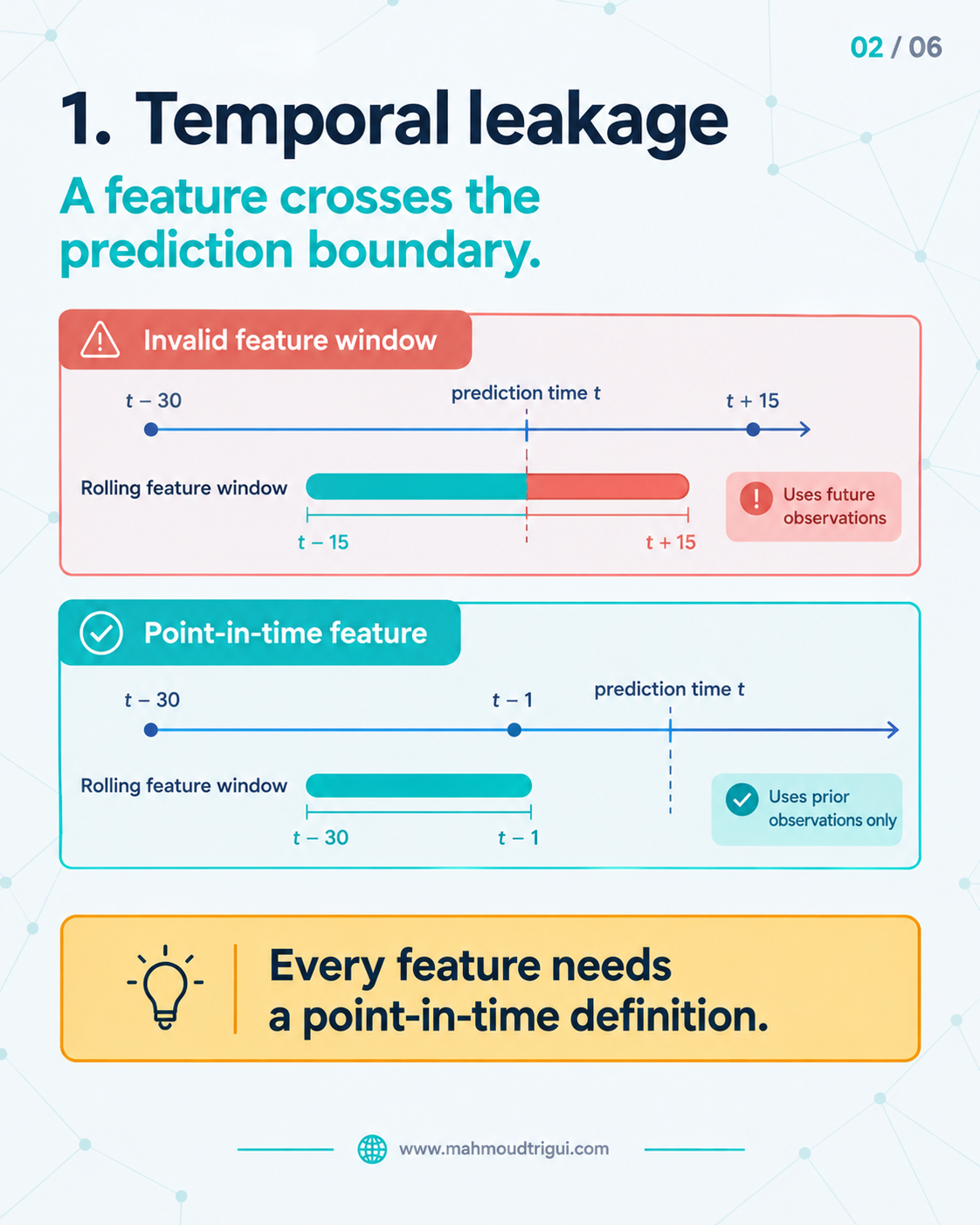
1. Temporal leakage

A feature uses information that was not available when the prediction should have been made. For example, a rolling feature crosses the prediction timestamp instead of using only prior observations.

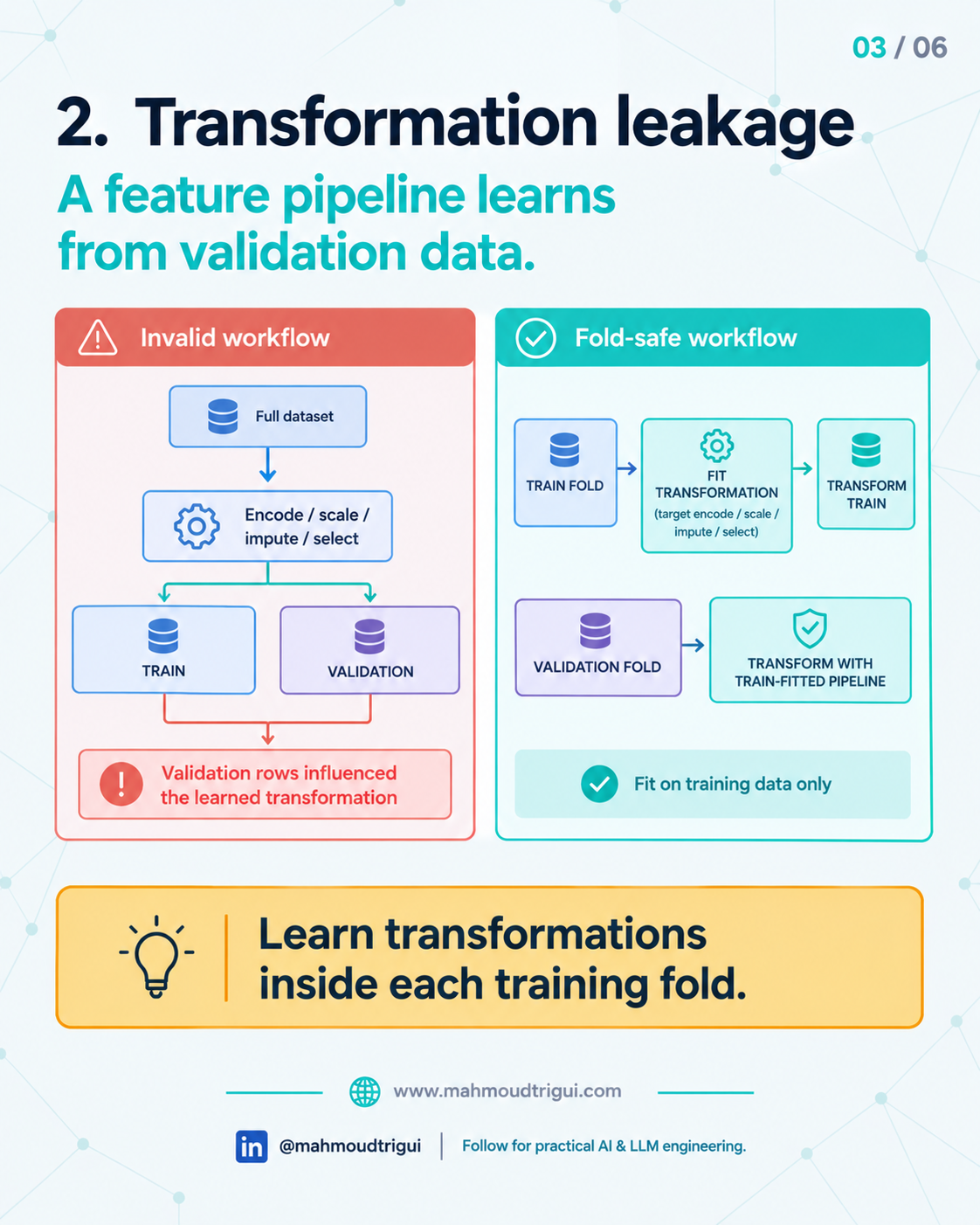
2. Transformation leakage

A transformation learns from rows it should not see. Target encoding, imputation, scaling, PCA, or feature selection fitted before the validation split means validation data influences the feature pipeline used to evaluate validation performance.

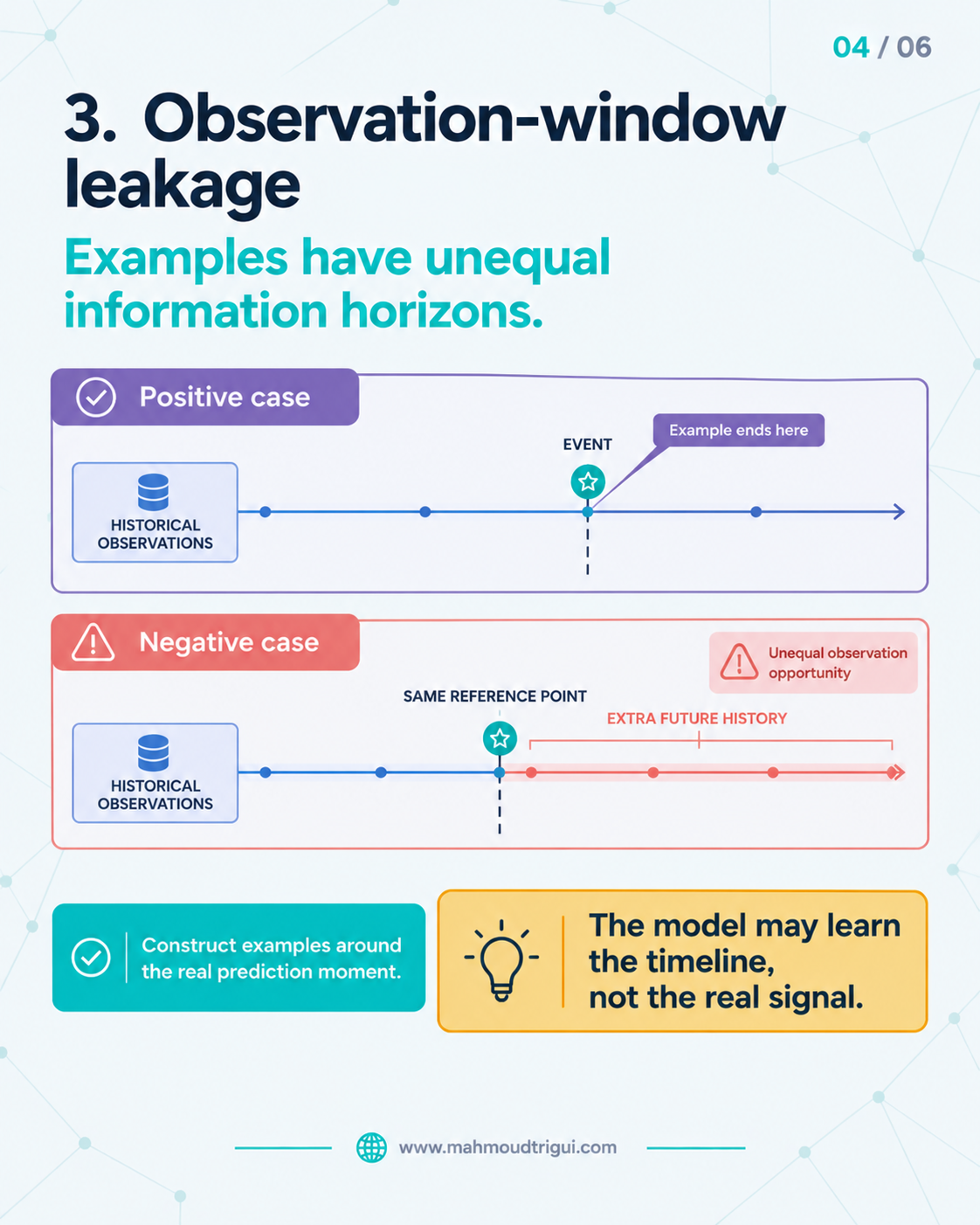
3. Observation-window leakage

Positive and negative examples are observed over different time horizons. If positive cases are cut at an event date while negative cases retain substantially more future history, the model may learn differences in observation opportunity rather than real predictive signal.

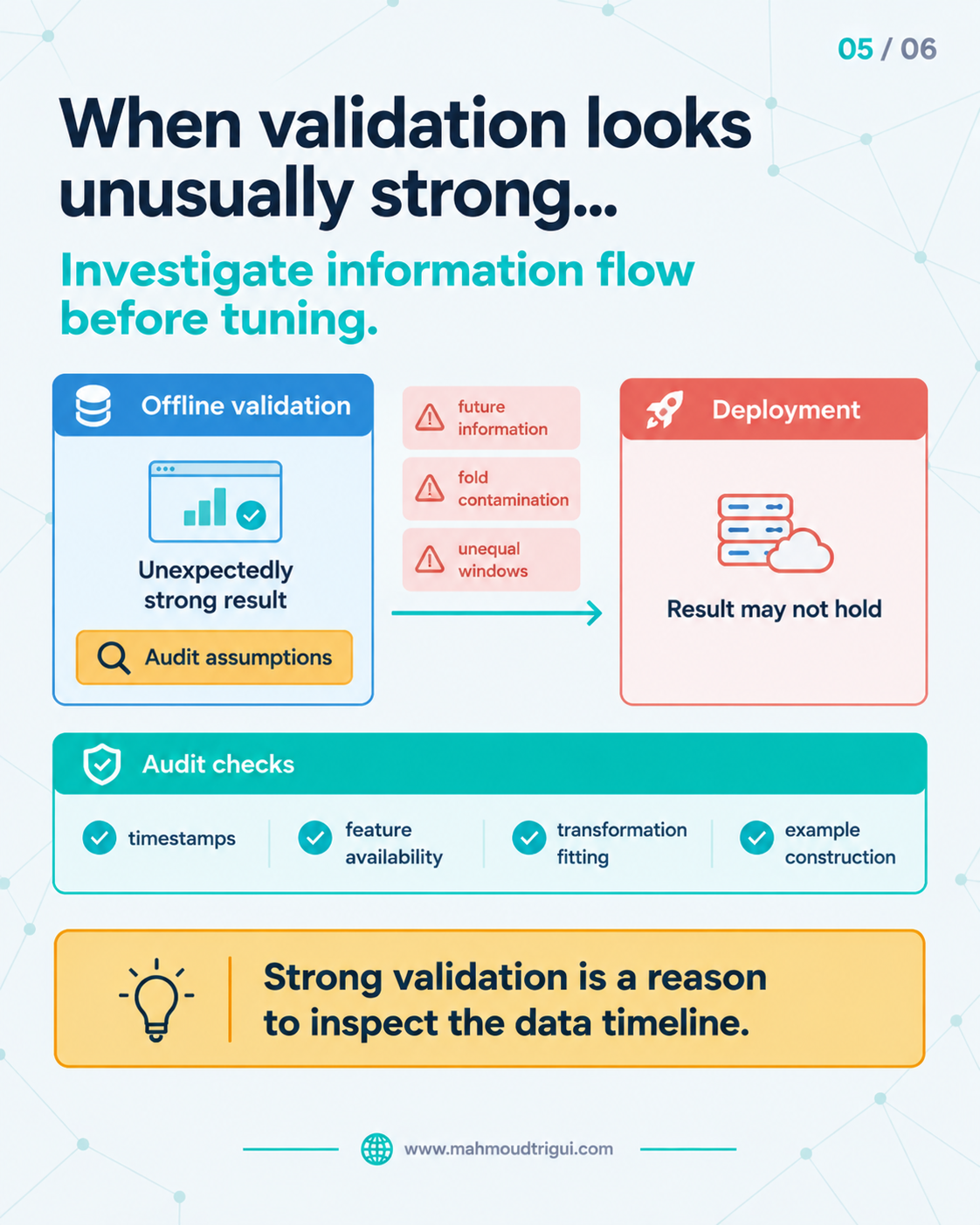
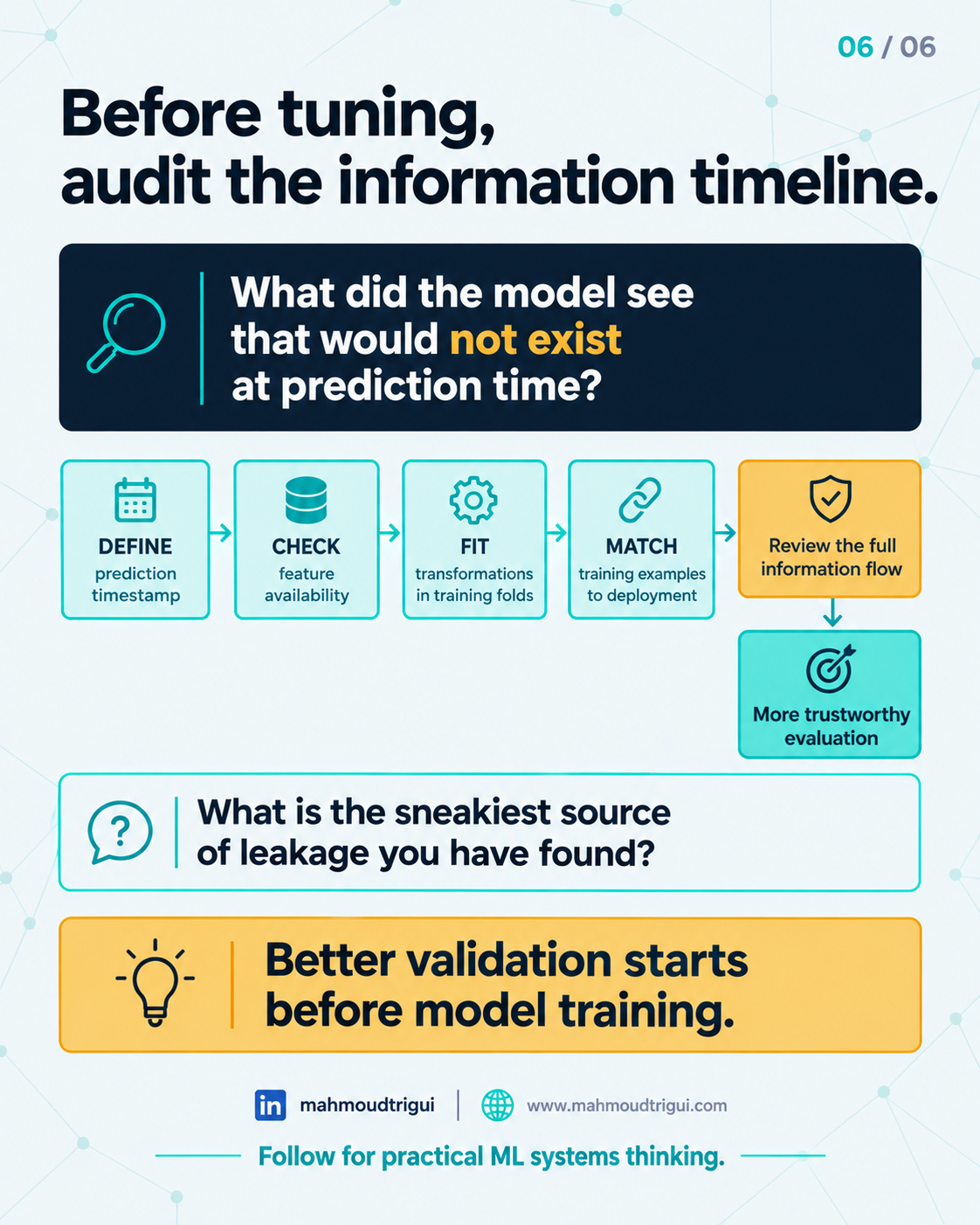
The fix is a short, repeatable set of checks: define the prediction timestamp, use only data available at that time, fit learned transformations within training folds, and construct examples that reflect the real deployment decision.

Outcome

If a validation result looks unusually strong, the first question is not “which algorithm should I try next?” It is: what did this model see that would not exist at prediction time? Auditing the information timeline often saves more projects than another round of tuning.

A leak-free evaluation is not a luxury — it is what makes every later decision, from model choice to deployment, trustworthy.

Key Takeaway

Design insight: Target leakage is not always obvious, and the subtle forms are the dangerous ones. Temporal leakage uses information that was not available at prediction time. Transformation leakage lets a learned step — target encoding, imputation, scaling, PCA, feature selection — fit on rows it should not see. Observation-window leakage gives positive and negative examples unequal information horizons, so the model can learn the timeline rather than the signal. All three make validation optimistic, which quietly undermines model selection, tuning, feature importance, deployment confidence, and stakeholder trust. The discipline is simple: define the prediction timestamp, use only data available at that time, fit learned transformations inside training folds, and construct examples that mirror the real deployment decision. When a result looks unusually strong, ask what the model saw that would not exist at prediction time — that question saves more projects than another round of tuning. Better validation starts before model training.

FAQ

What is the key takeaway from "Target Leakage: Three Hidden Pitfalls"?

Target leakage is not always obvious, and the subtle forms are the dangerous ones. Temporal leakage uses information that was not available at prediction time. Transformation leakage lets a learned step — target encoding, imputation, scaling, PCA, feature selection — fit on rows it should not see. Observation-window leakage gives positive and negative examples unequal information horizons, so the model can learn the timeline rather than the signal. All three make validation optimistic, which quietly undermines model selection, tuning, feature importance, deployment confidence, and stakeholder trust. The discipline is simple: define the prediction timestamp, use only data available at that time, fit learned transformations inside training folds, and construct examples that mirror the real deployment decision. When a result looks unusually strong, ask what the model saw that would not exist at prediction time — that question saves more projects than another round of tuning. Better validation starts before model training.

Who wrote this and what is it about?

This was written by Mahmoud Trigui, Senior Data Scientist. Target leakage is not always obvious. Temporal, transformation, and observation-window leakage make offline validation look stronger than it is. Audit the information timeline before tuning.

Comments

Machine LearningFeature EngineeringMLForecastTime Series DecompositionForecastingLightGBMXGBoostCatboostClusteringSegmentationNLPLLMsWeb AppR MarkdownSQLOracle DBSAS-GuideSAS E-MinerDataikuBigQueryGCPPythonRCRISP-DMHypothesis TestingANOVAData AnalyticsDimensionality ReductionRecommendation SystemNetwork AnalysisGeospace AnalysisSpatial DataEmbeddingSampling TechniquesDecision RulesData StorytellingCVMChurnFraud DetectionSentiment AnalysisTopic ModelingIBM WatsonPowerBILooker StudioVBAStatistical LearningEnsemble ModelingStackingCross-ValidationProfilingABT ConstructionPlumberTidyverseShinyProphetDeep LearningScikit-LearnJSONSAS ProgrammingGitVS CodeCSS StylingAutomated ReportingOutlier DetectionTemporal ClusteringStartup SurvivalPre-Valuation ModelingK-MeansDecision TreesData SciencePredictive ModelingSVMLDAText ClassificationWeight PredictionPattern RecognitionReal-Time DetectionCommunity DetectionPipeline AutomationData Quality ChecksData ReliabilitySpecification MappingBusiness StrategyMarketing CampaignsTry & Buy FrameworksKPI DashboardsNetwork QualitySales AnalyticsMentoringStatistics LecturerRemote WorkHybrid WorkConsultingContractFull-TimeFreelanceSofrecomOrange GroupTunisia TelecomKiota IntelligenceVC AnalyticsSeries A PredictionProduction MLApplied AIPrompt EngineeringBusiness ForecastingDecision SystemsGraph AnalyticsHousehold DetectionMulti-SIM DetectionFTTH ForecastingPydanticGPT-4OpenAI APIZindiCell Tower AnalysisBehavioral SignalsObservation Unit DesignWard ClusteringTarget Encoding Machine LearningFeature EngineeringMLForecastTime Series DecompositionForecastingLightGBMXGBoostCatboostClusteringSegmentationNLPLLMsWeb AppR MarkdownSQLOracle DBSAS-GuideSAS E-MinerDataikuBigQueryGCPPythonRCRISP-DMHypothesis TestingANOVAData AnalyticsDimensionality ReductionRecommendation SystemNetwork AnalysisGeospace AnalysisSpatial DataEmbeddingSampling TechniquesDecision RulesData StorytellingCVMChurnFraud DetectionSentiment AnalysisTopic ModelingIBM WatsonPowerBILooker StudioVBAStatistical LearningEnsemble ModelingStackingCross-ValidationProfilingABT ConstructionPlumberTidyverseShinyProphetDeep LearningScikit-LearnJSONSAS ProgrammingGitVS CodeCSS StylingAutomated ReportingOutlier DetectionTemporal ClusteringStartup SurvivalPre-Valuation ModelingK-MeansDecision TreesData SciencePredictive ModelingSVMLDAText ClassificationWeight PredictionPattern RecognitionReal-Time DetectionCommunity DetectionPipeline AutomationData Quality ChecksData ReliabilitySpecification MappingBusiness StrategyMarketing CampaignsTry & Buy FrameworksKPI DashboardsNetwork QualitySales AnalyticsMentoringStatistics LecturerRemote WorkHybrid WorkConsultingContractFull-TimeFreelanceSofrecomOrange GroupTunisia TelecomKiota IntelligenceVC AnalyticsSeries A PredictionProduction MLApplied AIPrompt EngineeringBusiness ForecastingDecision SystemsGraph AnalyticsHousehold DetectionMulti-SIM DetectionFTTH ForecastingPydanticGPT-4OpenAI APIZindiCell Tower AnalysisBehavioral SignalsObservation Unit DesignWard ClusteringTarget Encoding