SPARC: A Practical Checklist for AI Code Requests
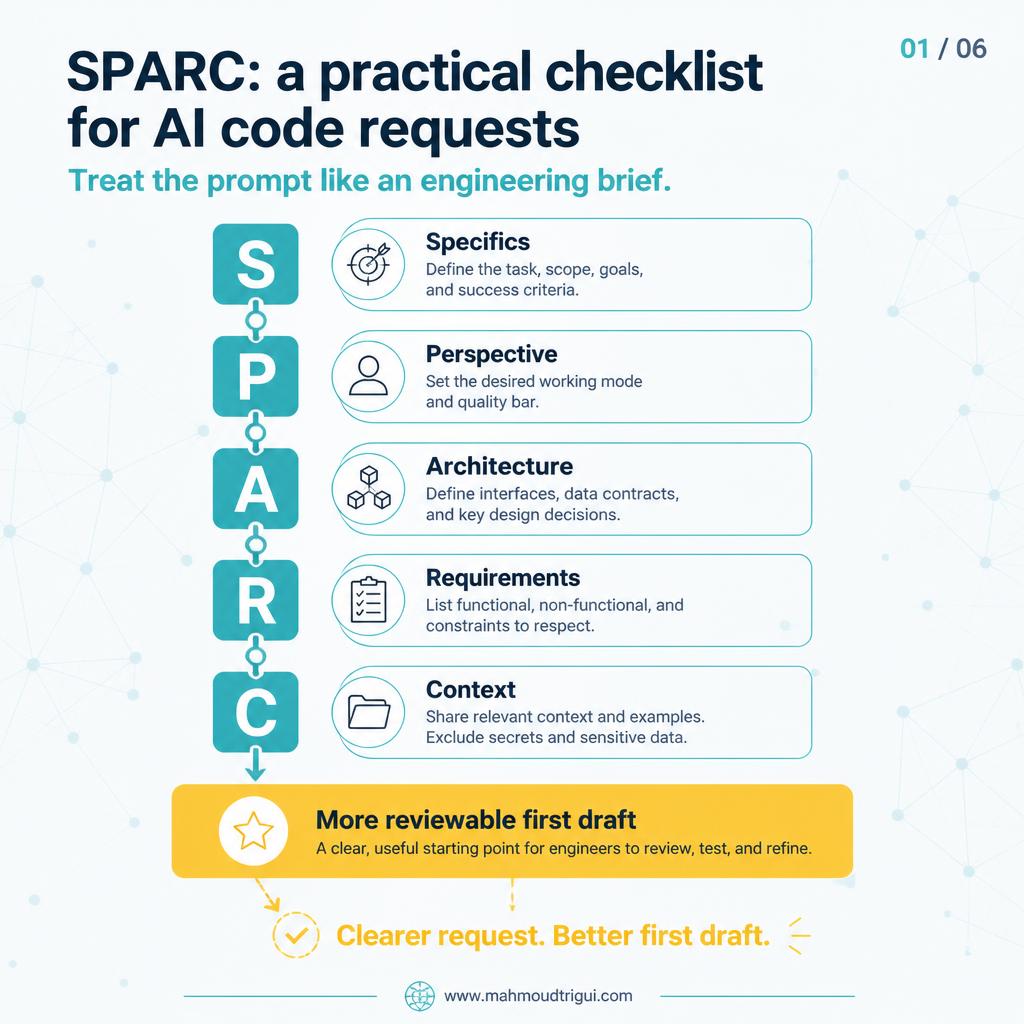
AI code generation improves when the request looks more like an engineering brief. SPARC is the five-part checklist I use — Specifics, Perspective, Architecture, Requirements, Context.
TL;DR: Writing the prompt like an engineering brief is what makes AI code generation useful. SPARC — Specifics, Perspective, Architecture, Requirements, Context — removes the ambiguity a vague request leaves open. Specifics define the input, output, behaviour and acceptance criteria; Perspective sets the quality bar; Architecture says where the code fits; Requirements say what it must survive; Context makes the draft fit the real project. The result is a more useful first draft. Clearer request, better first draft, same responsibility: engineers still own validation, security and the final decision.
Visual Summary
The Problem
I ask an AI coding assistant to build something most weeks: an API endpoint, a data transformation, a test scaffold. The first drafts arrive fast but uneven, and the reason is rarely the model. It is the request.
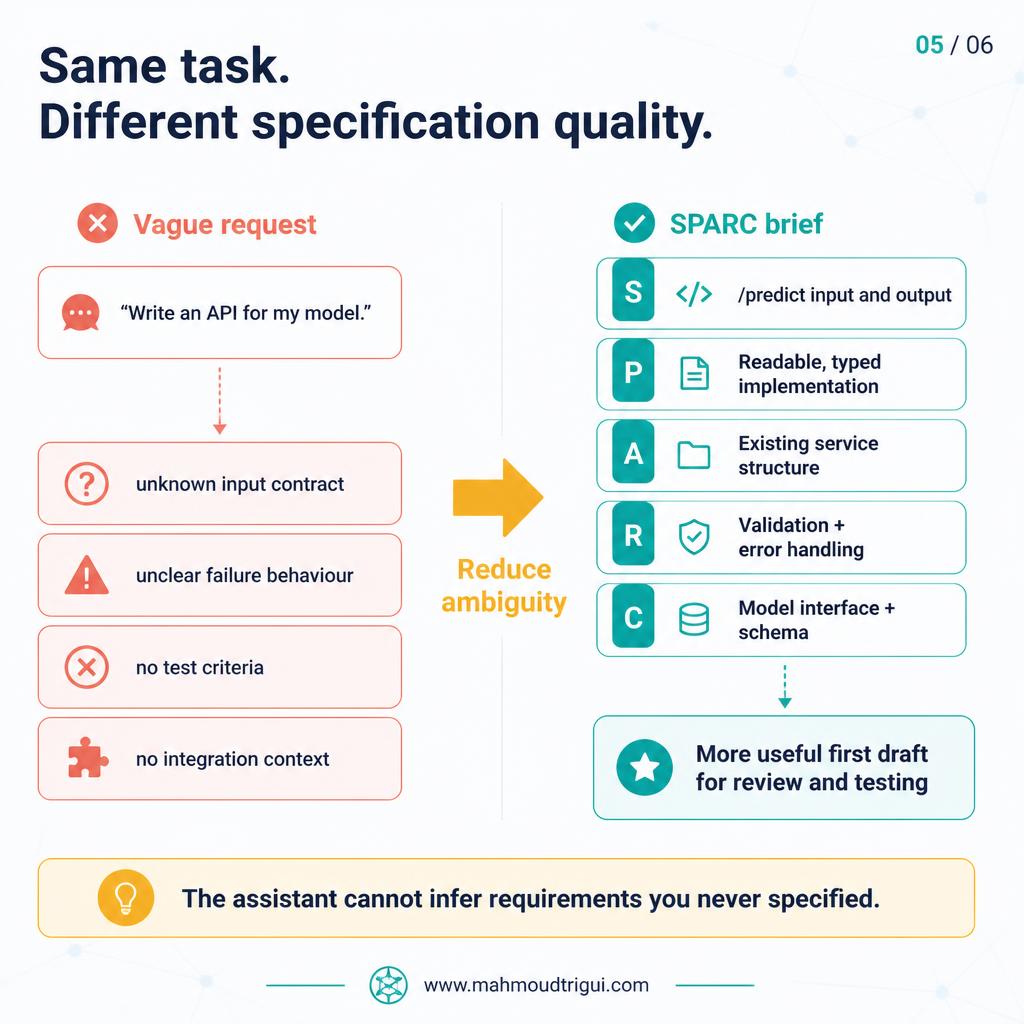
"Build me an API for my model" leaves the important decisions open to interpretation: what goes in, what comes out, how failures should behave, and what the code has to fit into. When those decisions are missing, review time gets spent re-deciding things I should have specified in the first place.
The Approach
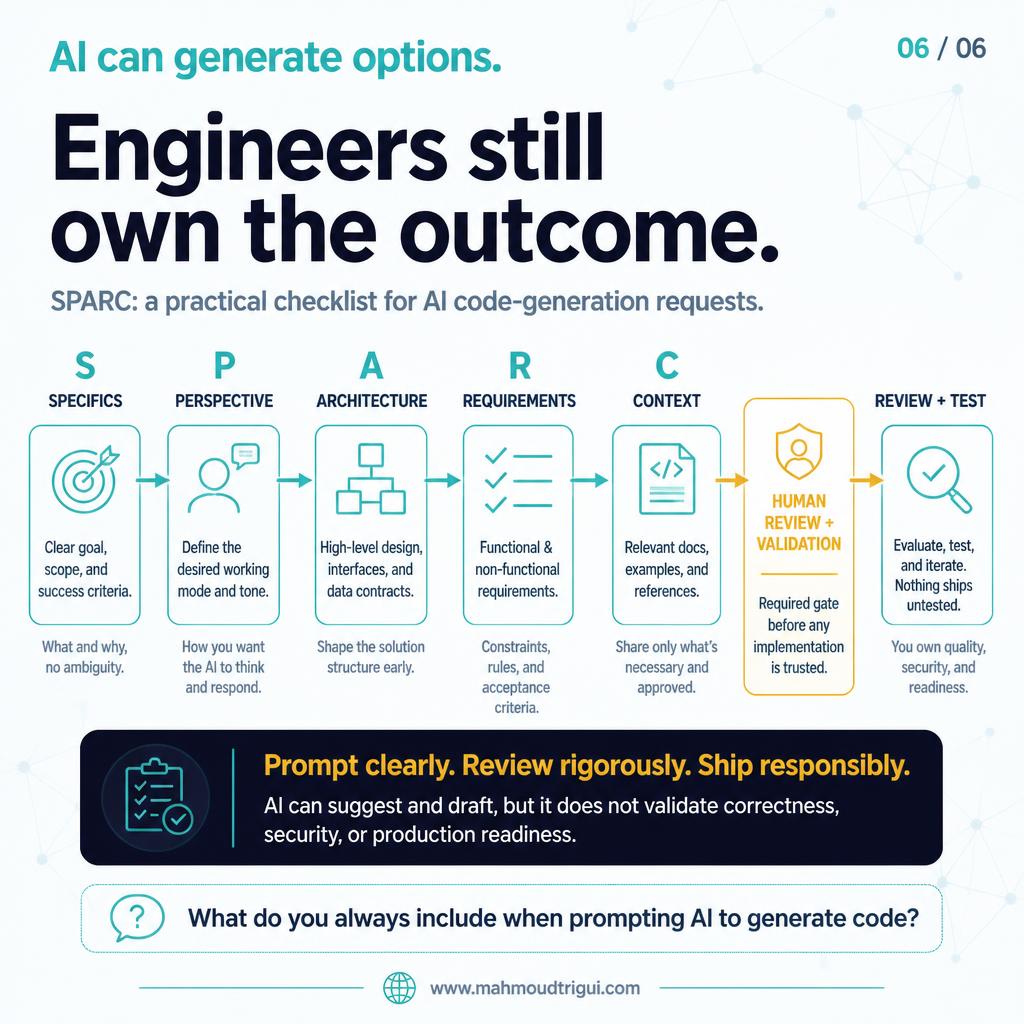
I write the request the way I would write a short engineering brief. SPARC is the checklist I use — five parts, each one closing a gap a vague prompt leaves open.
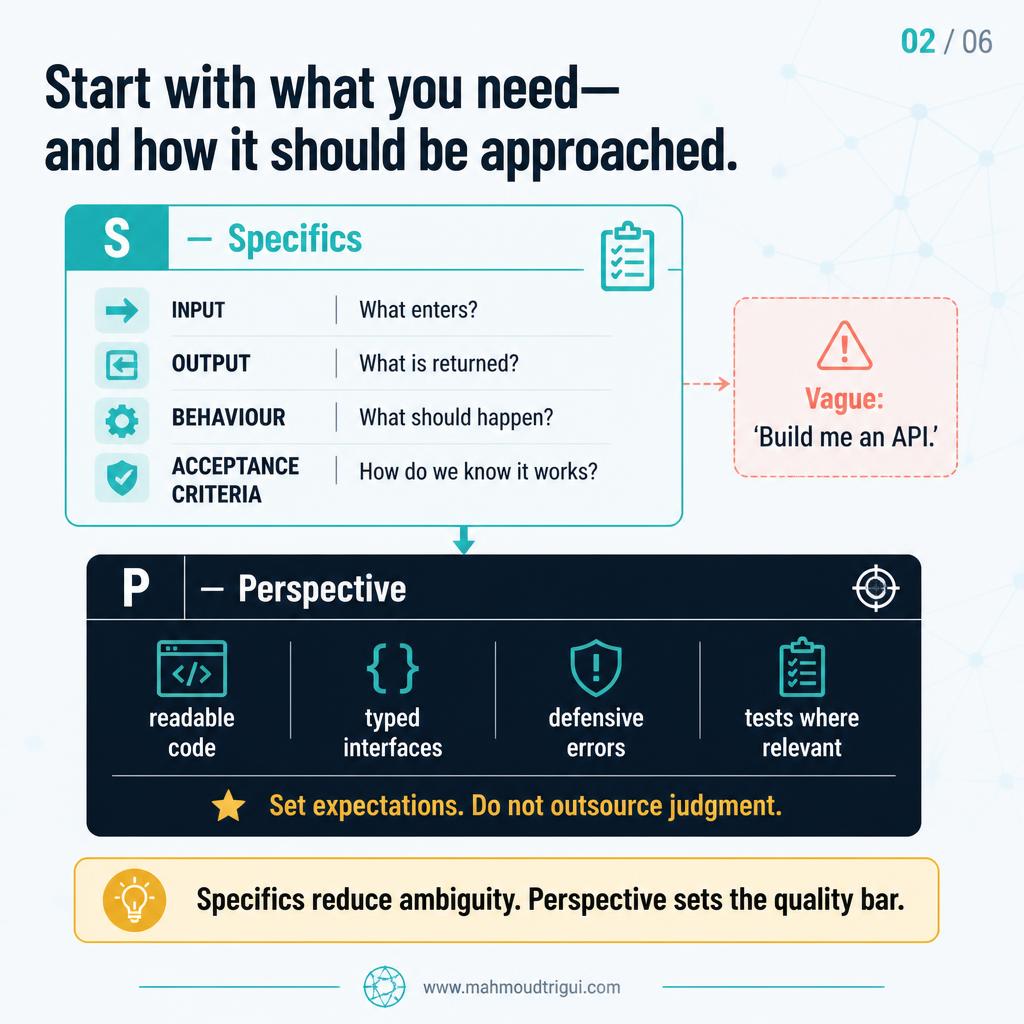
S — Specifics
Say what should be built: the input, the output, the user behaviour, and the acceptance criteria. "Build me an API" is not a specification; "/predict takes a JSON payload and returns a typed prediction with documented errors" is.
P — Perspective
Set the working mode and the quality bar: readability, type hints, tests, defensive error handling, or an explanation before implementation. This sets expectations. It does not replace review.
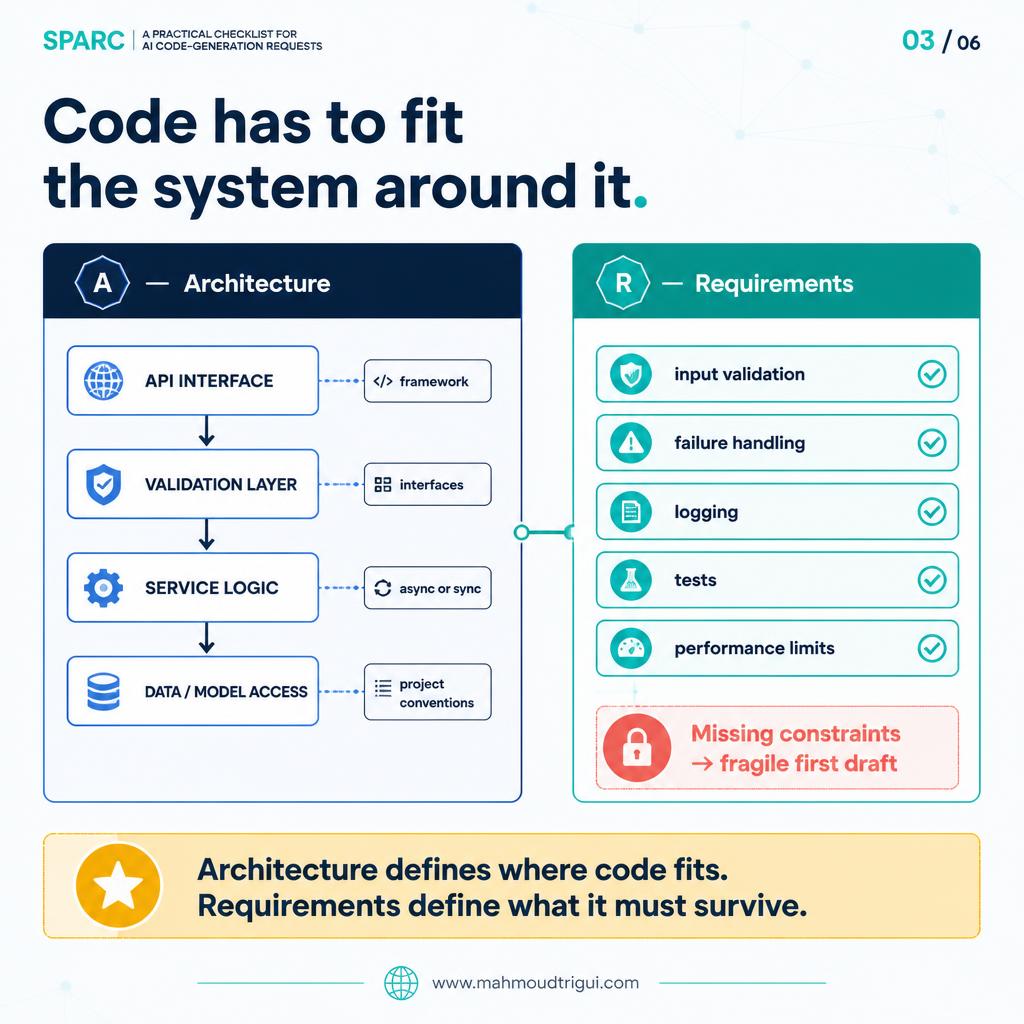
A — Architecture
Describe the stack, interfaces and constraints the code must respect — FastAPI, Pydantic, asynchronous I/O, an existing repository structure, or a specific data contract. Generated code is only useful if it fits the system around it.
R — Requirements
List what the solution must handle: validation, failure modes, tests, logging, performance limits, security boundaries, and operational constraints. Missing constraints produce a fragile first draft.
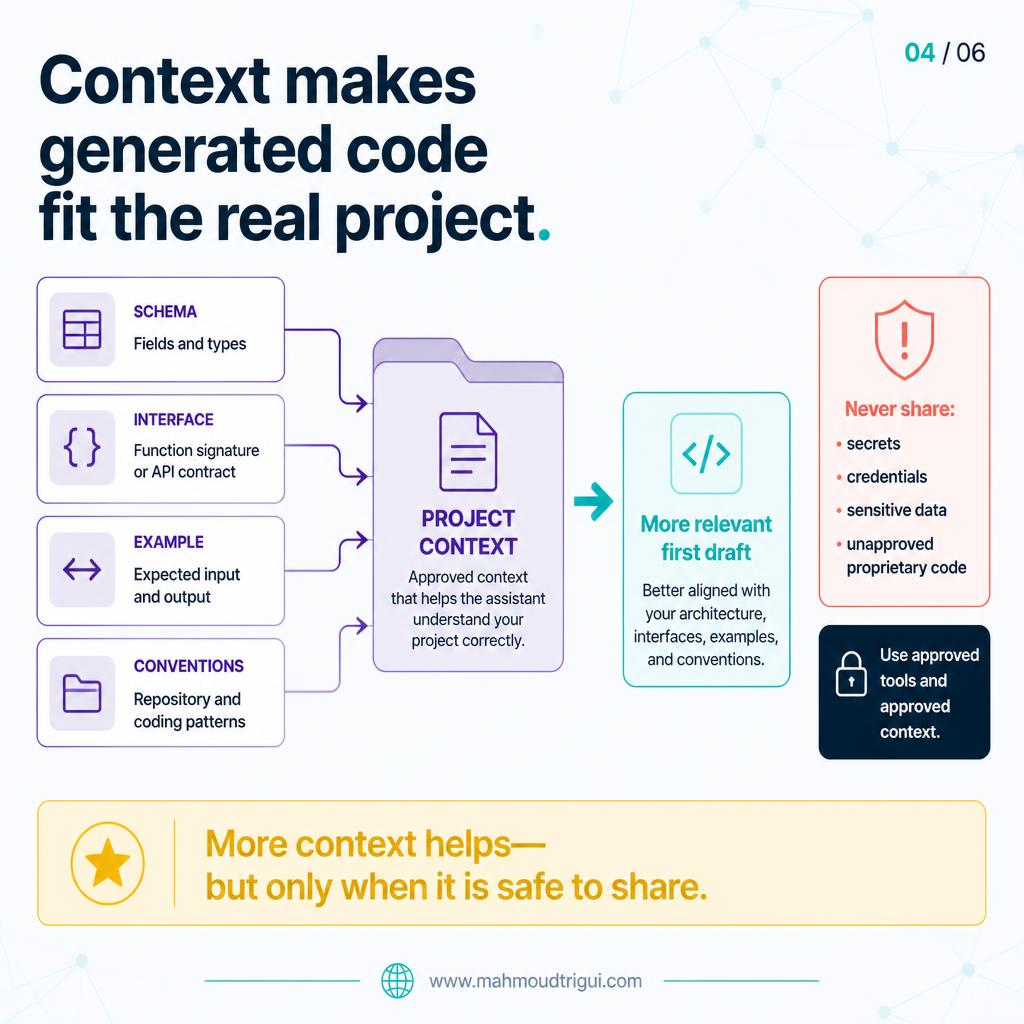
C — Context
Share the schemas, function signatures, examples and conventions that matter — only what is approved for the tool. Never paste secrets, sensitive data, or proprietary code into an unapproved environment.
The goal is not to ask for "production-ready code." It is to get a more useful first draft — one that is easier to review, test, and integrate.
Outcome
Same task, different specification quality. Compare "Write an API for my model" with the SPARC brief: the vague version leaves the input contract, failure behaviour, test criteria and integration context undefined; the SPARC version removes that ambiguity in five lines.
The drafts come back closer to the project, so review time goes into logic and edge cases instead of re-explaining the basics. AI generates implementation options. Engineers still own the specification, validation, security, and the final decision.
Key Takeaway
Design insight: Writing the prompt like an engineering brief is what makes AI code generation useful. SPARC — Specifics, Perspective, Architecture, Requirements, Context — removes the ambiguity a vague request leaves open. Specifics define the input, output, behaviour and acceptance criteria; Perspective sets the quality bar; Architecture says where the code fits; Requirements say what it must survive; Context makes the draft fit the real project. The result is a more useful first draft. Clearer request, better first draft, same responsibility: engineers still own validation, security and the final decision.
Related
AI-Assisted Coding Moved the Hard Part of Data Science to Specification → If Your AI Coding Assistant Keeps Missing Your Standards → Open-Source AI Coding Agents: Which One Fits Your Workflow? → An AI Endpoint Is a Workflow Contract, Not Just a Response → Not All AI Assistance Deserves Equal Trust → Delegate the Optuna Scaffold. Not the Tuning Strategy. → Pydantic as Software Contracts, Not Just Validation → Better Tools, Same Principles →
FAQ
What is the key takeaway from "SPARC: A Practical Checklist for AI Code Requests"?
Writing the prompt like an engineering brief is what makes AI code generation useful. SPARC — Specifics, Perspective, Architecture, Requirements, Context — removes the ambiguity a vague request leaves open. Specifics define the input, output, behaviour and acceptance criteria; Perspective sets the quality bar; Architecture says where the code fits; Requirements say what it must survive; Context makes the draft fit the real project. The result is a more useful first draft. Clearer request, better first draft, same responsibility: engineers still own validation, security and the final decision.
Who wrote this and what is it about?
This was written by Mahmoud Trigui, Senior Data Scientist. SPARC checklist for AI code requests: Specifics, Perspective, Architecture, Requirements, Context. Clearer request, better first draft.
What are the five parts of SPARC?
SPARC stands for Specifics, Perspective, Architecture, Requirements and Context: what should be built, which working mode and quality bar to follow, which stack and interfaces the code must respect, what the solution must handle, and which approved existing schemas and conventions to reuse.
Does a clearer prompt mean the generated code ships without review?
No. A clearer request only improves the first draft. Engineers still own the specification, validation, security and the final decision, and the generated code still has to be reviewed, tested and validated before it reaches a repository.