Document AI: 4 Production Patterns From PDF to Decision
Most organisations do not really want "document AI" — they want document in, reliable business action out. The model matters, but the architecture around it decides whether the output can be trusted.
TL;DR: Document AI is an architecture decision, not a model choice. Start with the simplest pattern that can support a trustworthy business action — direct extraction when documents and fields are predictable — then add classify-and-route, context-augmented extraction, or human review only when document variability and business risk earn the extra complexity. More components do not automatically mean more reliability; they mean more to evaluate and maintain. Automation should know when not to decide alone.
Visual Summary
The Problem
Most organisations that ask for "document AI" are not really asking for a model. They want a reliable path from a document to a business action: a supplier invoice becomes a payment, a claim becomes a case, a contract becomes a tracked obligation. The model matters, but the architecture around it matters more than most demos suggest.
I have watched a simple extraction flow break on layout variation, and I have watched teams add retrieval and a review queue before the workflow needed either. The hard part is rarely choosing a model. It is choosing the smallest architecture that still produces a decision you can stand behind.
The Approach
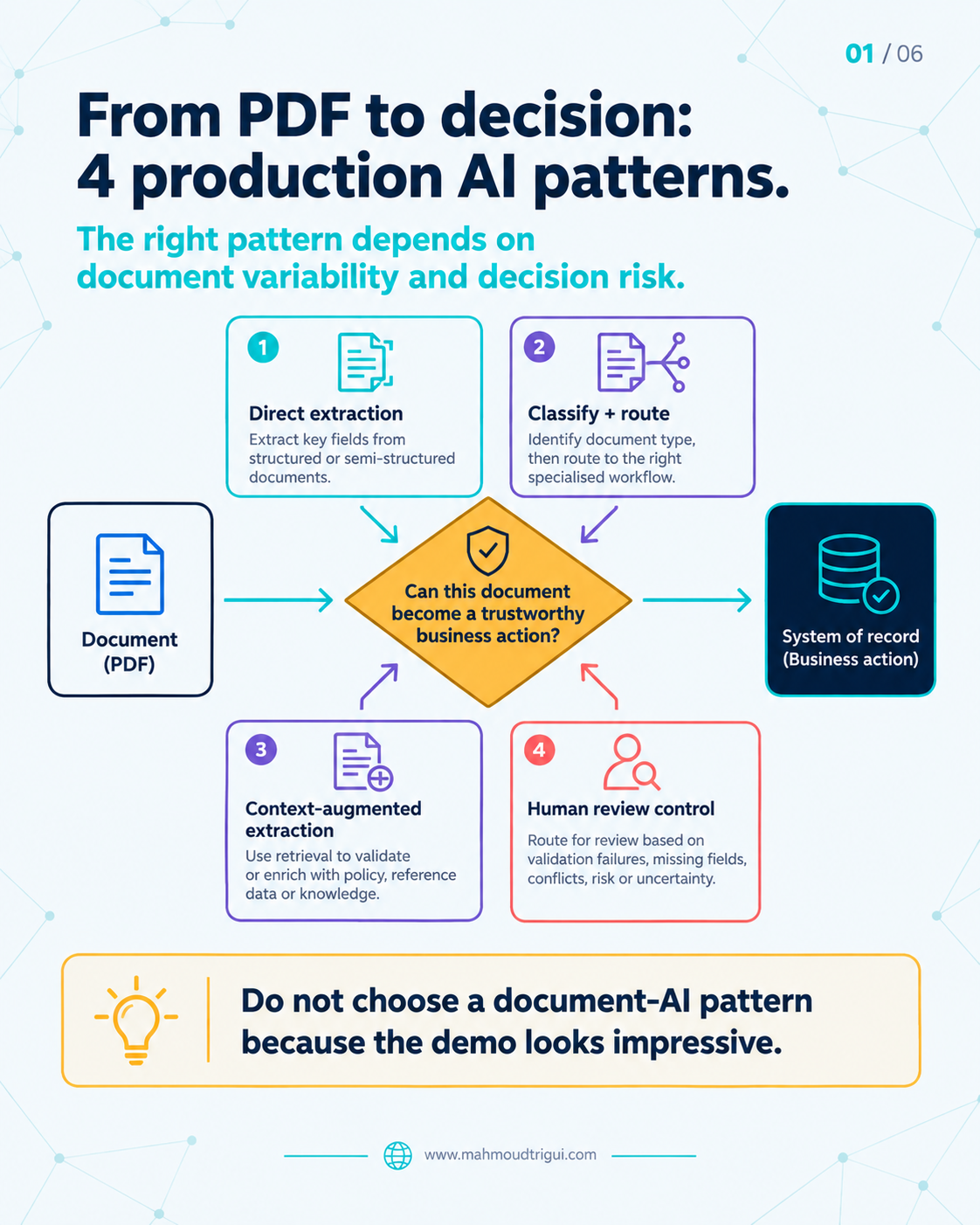
Instead of reaching for the most capable model first, I work through four patterns and pick the simplest one that can support a trustworthy decision. Each adds a specific capability, and each should be earned by the document variability and the business risk in front of it.
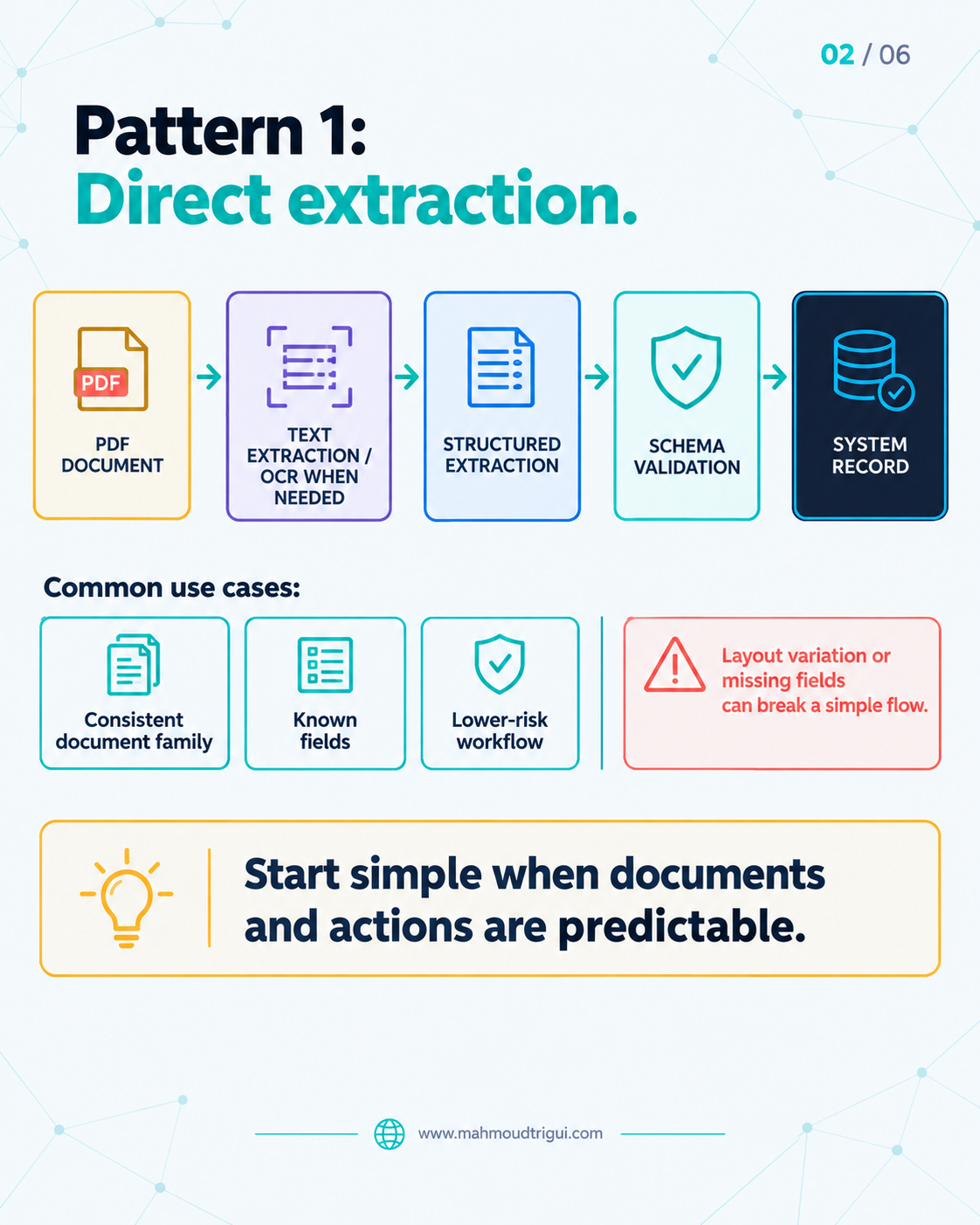
Direct extraction
PDF → text extraction or OCR when needed → structured extraction → schema validation → system record. This is where to start when documents are consistent, fields are well-defined, and the action is low risk. Start simple when documents and actions are predictable.
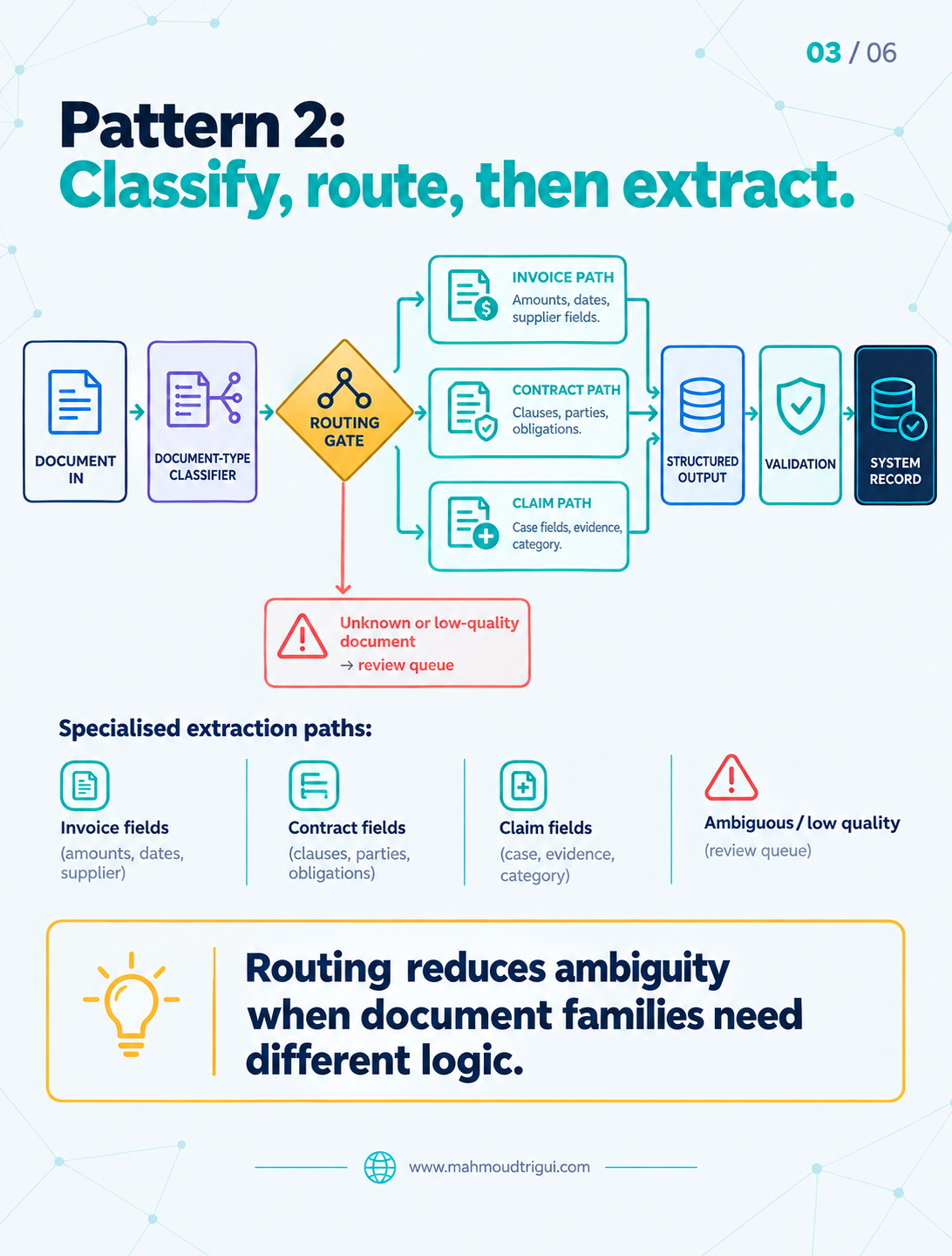
Classify, route, then extract
Document → classify type → route → specialised extraction workflow. Use it when several document families have different layouts, fields, rules, or downstream actions. Routing reduces ambiguity and makes the pipeline easier to evaluate and maintain.
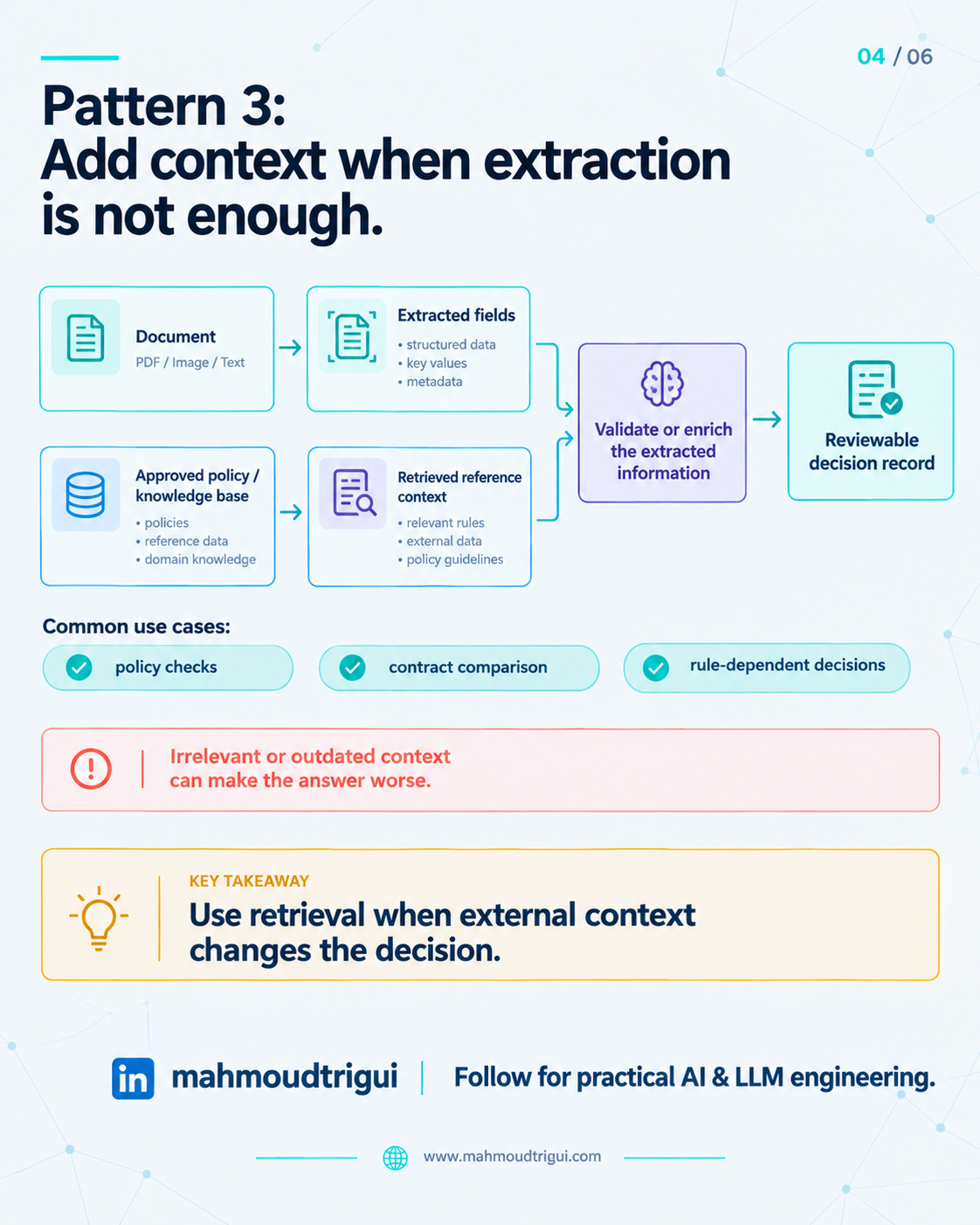
Context-augmented extraction
Document → extract fields → retrieve relevant policy or reference data → validate or enrich the decision. Use it when extracted information only becomes meaningful against policies, contracts, product rules, or other approved knowledge sources. Retrieval has to be evaluated carefully: more context is not automatically better context.
Human review as a control layer
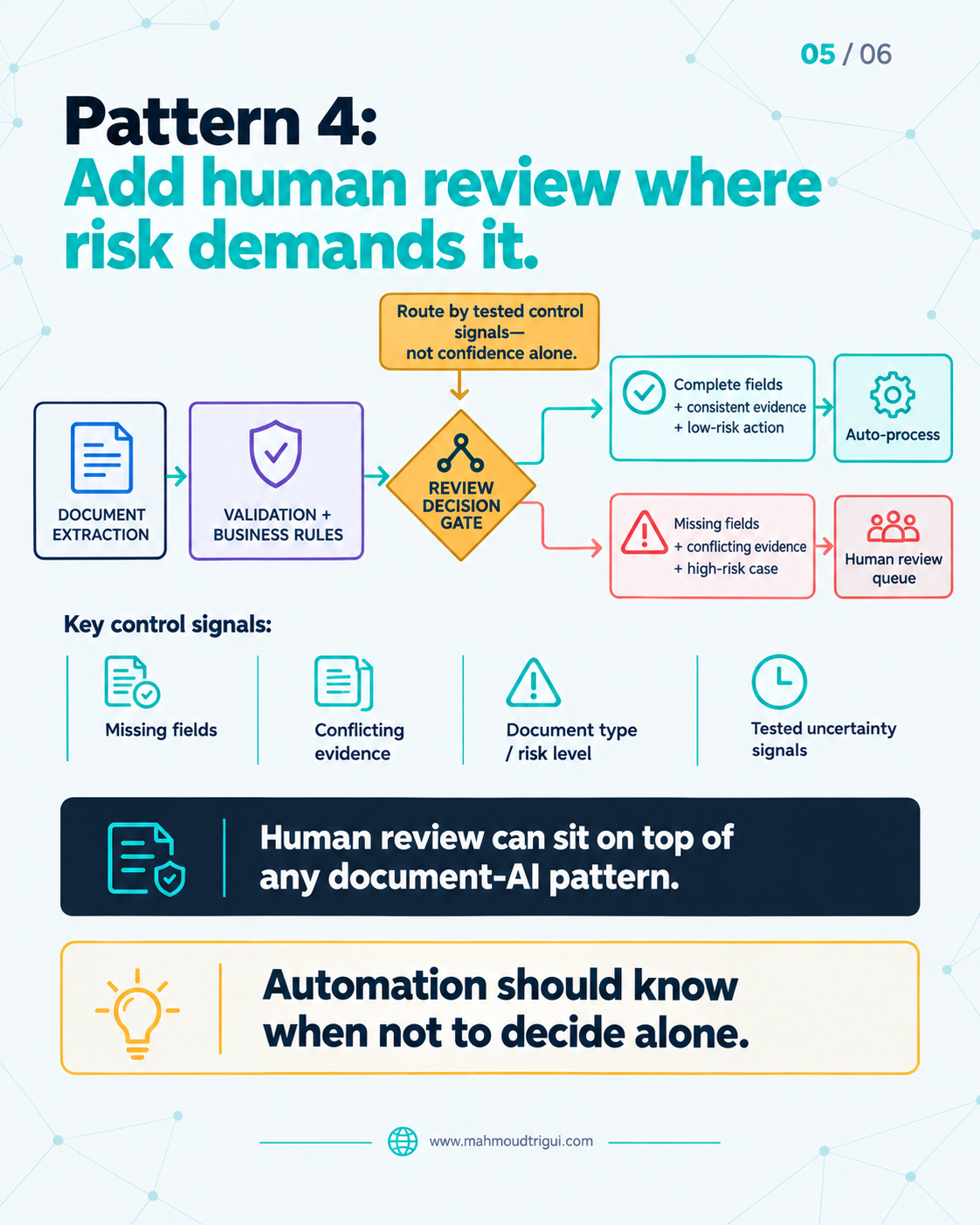
Extraction → validation checks and business rules → auto-process or a review queue. This is essential when the cost of a wrong decision is high. Do not route cases to review on an untested model-confidence score alone; use multiple signals — missing fields, conflicting evidence, document type, validation failures, risk level, and uncertainty.
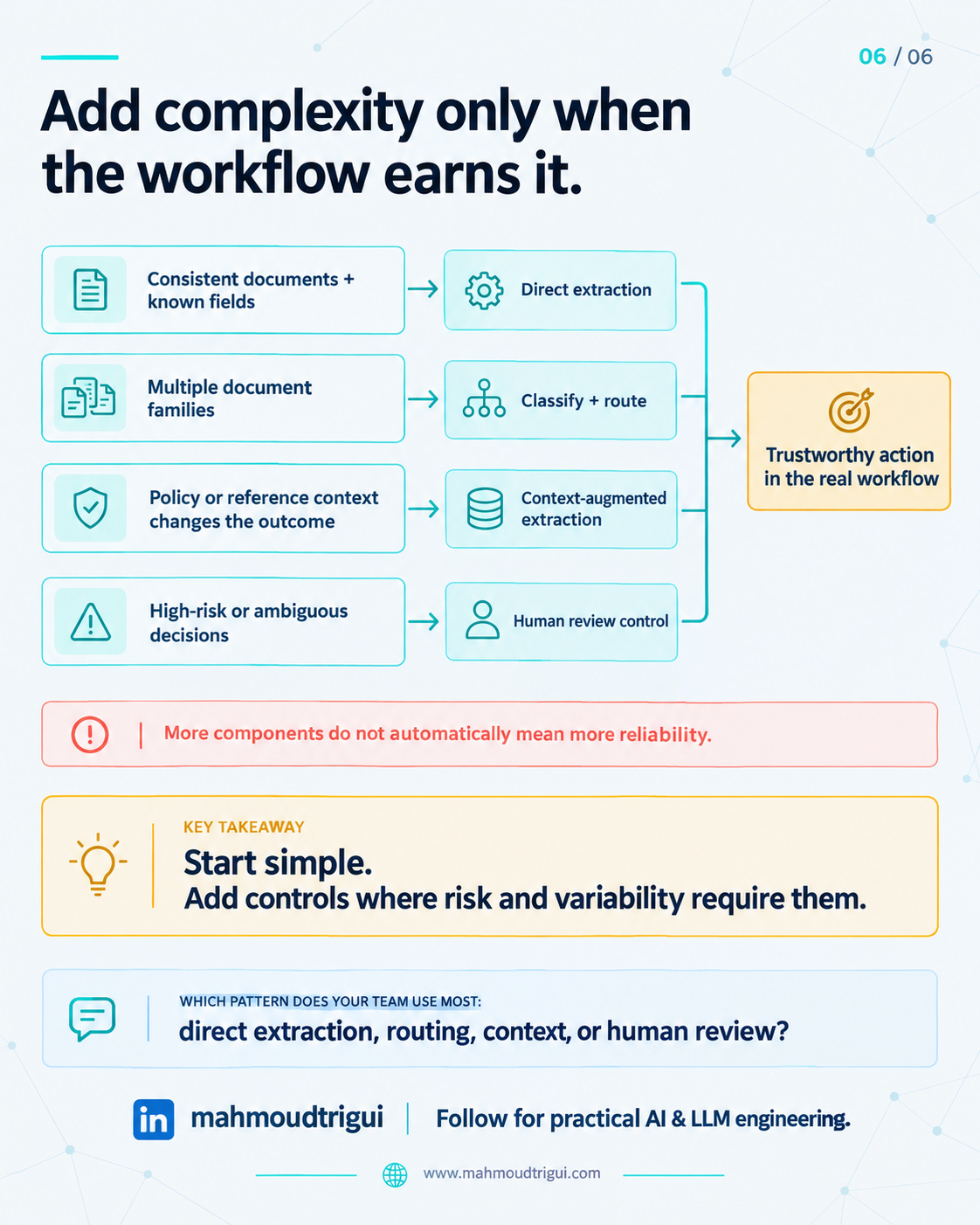
The principle is the same across all four: start with the simplest architecture that can support a trustworthy decision, then add routing, external context, or human review only when document variability and business risk justify them.
Outcome
I use these patterns as a decision guide, not a maturity ladder. Consistent documents with known fields usually go straight to direct extraction. Multiple document families earn a classify-and-route layer. When policy or reference context changes the outcome, context-augmented extraction earns its retrieval step. And when the document is ambiguous or a wrong decision is expensive, human review sits on top of whichever pattern is underneath.
The result is a pipeline that is easier to evaluate, easier to maintain, and honest about where automation should stop and a person should decide.
Key Takeaway
Design insight: Document AI is an architecture decision, not a model choice. Start with the simplest pattern that can support a trustworthy business action — direct extraction when documents and fields are predictable — then add classify-and-route, context-augmented extraction, or human review only when document variability and business risk earn the extra complexity. More components do not automatically mean more reliability; they mean more to evaluate and maintain. Automation should know when not to decide alone.
Related
Document AI Starts Before Extraction: Route First → Document AI Is a Pipeline, Not One LLM Call → Structured Outputs for Reliable LLM Pipelines → Pydantic Is More Than Input Validation → A Predictive Model Is Not a Decision System → AI Architecture Production Readiness: 5 Red Flags → LLM Fallback Strategy: What Happens When the Model Fails? → AI-Generated Validation Can Pass While Data Is Still Wrong →
FAQ
What is the key takeaway from "Document AI: 4 Production Patterns From PDF to Decision"?
Document AI is an architecture decision, not a model choice. Start with the simplest pattern that can support a trustworthy business action — direct extraction when documents and fields are predictable — then add classify-and-route, context-augmented extraction, or human review only when document variability and business risk earn the extra complexity. More components do not automatically mean more reliability; they mean more to evaluate and maintain. Automation should know when not to decide alone.
Who wrote this and what is it about?
This was written by Mahmoud Trigui, Senior Data Scientist. Document AI patterns for turning PDFs into reliable decisions: direct extraction, classify and route, context-augmented extraction, and human review.
When should I use direct extraction instead of a router or RAG?
Use direct extraction when documents are a consistent family, fields are well defined, and the business action is low risk. Add a classify-and-route layer only when several document families have different layouts, fields, or rules. Add retrieval only when extracted fields become meaningful against policies, contracts, or other approved reference data.
How should document AI route cases to human review?
Do not route on an untested model-confidence score alone. Use multiple signals together: missing fields, conflicting evidence, document type, validation failures, risk level, and uncertainty. Human review is a control layer that can sit on top of any of the other document AI patterns when the cost of a wrong decision is high.